• Home
  • Latest
  • Fortune 500
  • Finance
  • Tech
  • Leadership
  • Lifestyle
  • Rankings
  • Multimedia

Trendingnow

1

As Big Tech showers employees with perks to win the talent war, Nvidia built a nearly $5 trillion company by making people pay for their own lunch

2

Mark Zuckerberg feeds his cows macadamia nuts and beer to create the 'highest-quality beef in the world' on his $300 million estate in Hawaii

3

MacKenzie Scott alone accounted for one-third of America's $19.2 billion in megagifts last year

1

As Big Tech showers employees with perks to win the talent war, Nvidia built a nearly $5 trillion company by making people pay for their own lunch

2

Mark Zuckerberg feeds his cows macadamia nuts and beer to create the 'highest-quality beef in the world' on his $300 million estate in Hawaii

3

MacKenzie Scott alone accounted for one-third of America's $19.2 billion in megagifts last year
Healthprocessed meat

Bacon, sausage and other processed meats cause cancer, World Health Organization warns

By
Tamar Haspel
Tamar Haspel
Down Arrow Button Icon
By
Tamar Haspel
Tamar Haspel
Down Arrow Button Icon
October 26, 2015, 8:54 AM ET
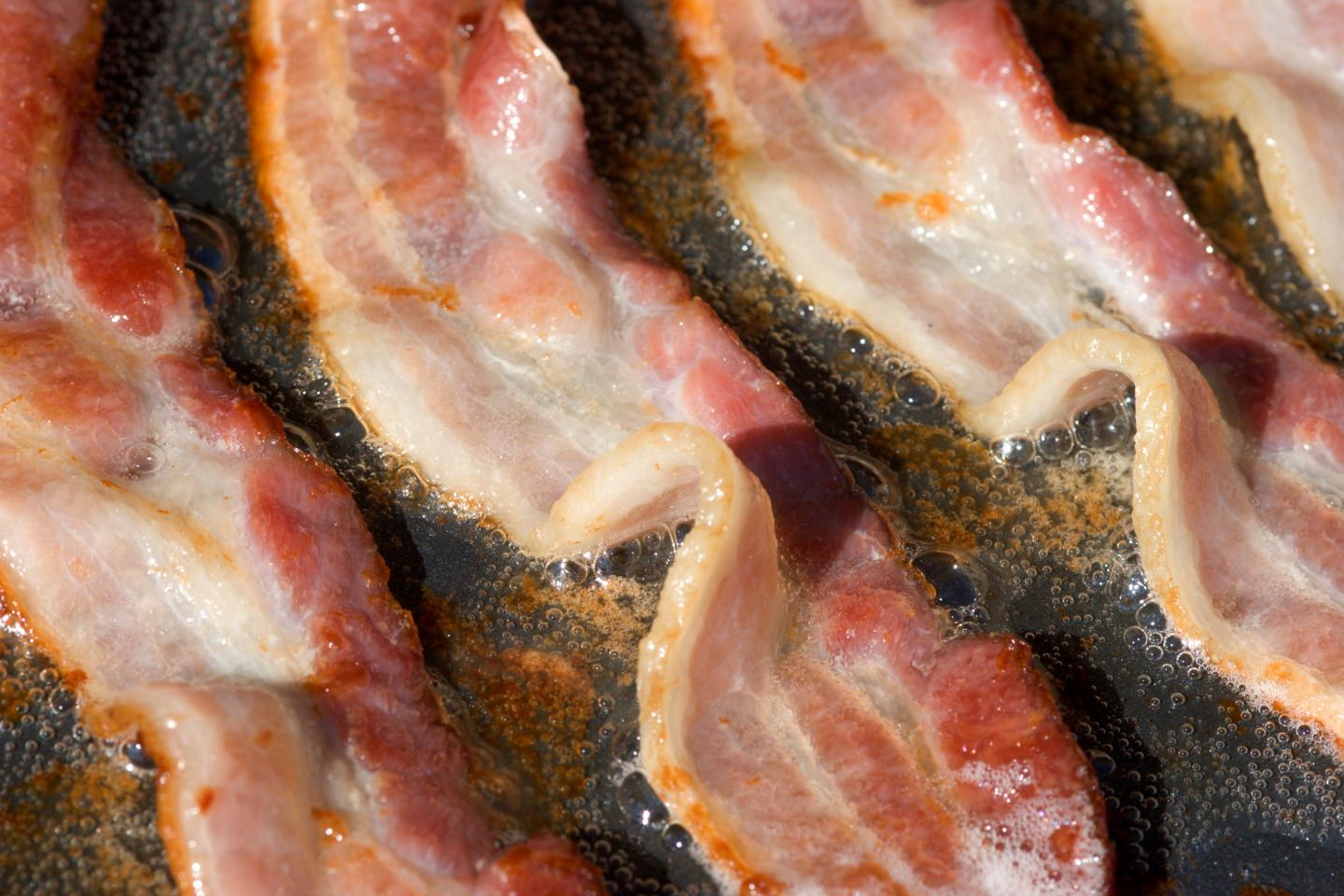
Bacon Frying on a Griddle
Bacon Frying On An Electric Griddle. (Photo By: MyLoupe/UIG Via Getty Images)Photograph by Getty Images
Add Fortune on Google for similar content.

The World Health Organization (WHO) announced on Monday that it has classified processed meat as a human carcinogen.

Red meat also was classified as a probable human carcinogen, according to the release by WHO’s International Agency for Research on Cancer (IARC).

The group cited “sufficient evidence” linking processed meat—such as bacon and sausage—to colorectal cancer, and noted associations with stomach, prostate, and pancreatic cancers. Processed meat is preserved by smoking, salting, fermenting, or by the addition of chemicals, and the category includes bacon, sausage, deli meats, and hot dogs. The red meat category includes beef, veal, pork, and lamb.

The IARC evaluates substances suspected of causing cancer in humans, and arrives at its classifications by convening a working group of international experts to review and assess the strength and quality of the evidence—in this case, more than 800 studies. Although the meat classifications have no regulatory impact in the United States, they are likely to further intensify the already heated debate about meat-eating, which has made headlines since February, when the committee charged with updating the US Dietary Guidelines recommended that Americans should eat less meat.

It’s also possible that the classification could fuel lawsuits. Another recent IARC report, which classified the herbicide glyphosate as a probable human carcinogen, has prompted some law firms to seek out cancer sufferers who were exposed to the chemical, to file suit on their behalf.

The American meat industry, understandably, takes strong issue with any suggestion that meat is something consumers should eat less of. The North American Meat Institute (NAMI) immediately issued a statement declaring the classification as defying “both common sense and dozens of studies showing no correlation between meat and cancer and other studies showing the many health benefits of balanced diets that include meat.” In fact, many of the studies NAMI references do show correlations, but describe them as “inconsistent” or “weak.”

Like much of the research on how diet affects health, the research on the link between meat and cancer has enough ambiguity that it’s possible to cherry-pick a research list that supports either position, but many reviews of research on the best-established link between meat and cancer—colorectal cancer—find, as this 2014 review published in the American Journal of Clinical Nutrition does, that there is a convincing association between meat eating and colorectal cancer. The question, though, is whether the meat eating causes the cancer, or whether meat eaters, who are different from non-meat eaters in many ways, are eating or doing other things that put them at risk.

The National Cancer Institute’s position is that the preponderance of the evidence does find a correlation between meat consumption and cancer risk, but it cites inconsistent results and confounding factors as barriers to a definitive conclusion. “The evidence is inadequate” to determine whether eating less meat would cut colorectal cancer incidence, the group says.

In an interview with Fortune, Shalene McNeill, executive director of human nutrition research for the National Cattlemen’s Beef Association, acknowledged the association between cancer and meat, but pointed to those confounding factors as the culprit: “Red meat is being consumed in the context of an unhealthy diet,” she said, and pointed out that meat-eaters are more likely to smoke and be overweight. David Klurfeld, National Program Leader for human nutrition at the USDA and a participant in the IARC process, wrote in a recent paper that meat-eaters also exercise less, drink more, and eat fewer fruits and vegetables. Controlling for these things is a tricky business, and there are undoubtedly other behaviors, not included in the data, that can’t be controlled for at all.
[fortune-brightcove videoid=4575611199001]

The IARC acknowledges the difficulty of determining causality, but their report concludes that, “the consistent associations of colorectal cancer with consumption of processed meat across studies in different populations, which make chance, bias, and confounding unlikely as explanations.” On red meat, though, “Chance, bias, and confounding could not be ruled out with the same degree of confidence.”

In light of all this, it’s not surprising that scientists do not speak with one voice on this issue. Leaning toward the IARC position is Andrew Chan, an associate professor of medicine at Harvard Medical School whose research focuses on colorectal cancer prevention. “I think the evidence is reasonably supportive of that position,” he told Fortune of the IARC classification. He acknowledged that “many studies are flawed,” but nevertheless said that if you look at the preponderance of the evidence, the IARC conclusion is “a reasonable one.” He notes that the evidence for processed meat is stronger than that for red meat.

Tamar Haspel is a journalist on the food and science beat. She writes the James Beard Award-winning Washington Post column, Unearthed, and farms oysters off Cape Cod.

About the Author
By Tamar Haspel
See full bioRight Arrow Button Icon
Add Fortune on Google for similar content.

Latest in Health

Finance
Lorem ipsum dolor sit amet, consectetur adipiscing elit, sed do eiusmod tempor incididunt ut labore et dolore magna aliqua. Ut enim ad minim veniam
By Fortune Editors
October 20, 2025
Finance
Lorem ipsum dolor sit amet, consectetur adipiscing elit, sed do eiusmod tempor incididunt ut labore et dolore magna aliqua. Ut enim ad minim veniam
By Fortune Editors
October 20, 2025
Finance
Lorem ipsum dolor sit amet, consectetur adipiscing elit, sed do eiusmod tempor incididunt ut labore et dolore magna aliqua. Ut enim ad minim veniam
By Fortune Editors
October 20, 2025
Finance
Lorem ipsum dolor sit amet, consectetur adipiscing elit, sed do eiusmod tempor incididunt ut labore et dolore magna aliqua. Ut enim ad minim veniam
By Fortune Editors
October 20, 2025
Finance
Lorem ipsum dolor sit amet, consectetur adipiscing elit, sed do eiusmod tempor incididunt ut labore et dolore magna aliqua. Ut enim ad minim veniam
By Fortune Editors
October 20, 2025
Finance
Lorem ipsum dolor sit amet, consectetur adipiscing elit, sed do eiusmod tempor incididunt ut labore et dolore magna aliqua. Ut enim ad minim veniam
By Fortune Editors
October 20, 2025

Most Popular

Finance
Lorem ipsum dolor sit amet, consectetur adipiscing elit, sed do eiusmod tempor incididunt ut labore et dolore magna aliqua. Ut enim ad minim veniam
By Fortune Editors
October 20, 2025
Finance
Lorem ipsum dolor sit amet, consectetur adipiscing elit, sed do eiusmod tempor incididunt ut labore et dolore magna aliqua. Ut enim ad minim veniam
By Fortune Editors
October 20, 2025
Finance
Lorem ipsum dolor sit amet, consectetur adipiscing elit, sed do eiusmod tempor incididunt ut labore et dolore magna aliqua. Ut enim ad minim veniam
By Fortune Editors
October 20, 2025
Finance
Lorem ipsum dolor sit amet, consectetur adipiscing elit, sed do eiusmod tempor incididunt ut labore et dolore magna aliqua. Ut enim ad minim veniam
By Fortune Editors
October 20, 2025
Finance
Lorem ipsum dolor sit amet, consectetur adipiscing elit, sed do eiusmod tempor incididunt ut labore et dolore magna aliqua. Ut enim ad minim veniam
By Fortune Editors
October 20, 2025
Finance
Lorem ipsum dolor sit amet, consectetur adipiscing elit, sed do eiusmod tempor incididunt ut labore et dolore magna aliqua. Ut enim ad minim veniam
By Fortune Editors
October 20, 2025
Fortune Secondary Logo
Rankings
  • 100 Best Companies
  • Fortune 500
  • Global 500
  • Fortune 500 Europe
  • Most Powerful Women
  • World's Most Admired Companies
  • See All Rankings
  • Lists Calendar
Sections
  • Finance
  • Fortune Crypto
  • Features
  • Leadership
  • Health
  • Commentary
  • Success
  • Retail
  • Mpw
  • Tech
  • Lifestyle
  • CEO Initiative
  • Asia
  • Politics
  • Conferences
  • Europe
  • Newsletters
  • Personal Finance
  • Environment
  • Magazine
  • Education
Customer Support
  • Frequently Asked Questions
  • Customer Service Portal
  • Privacy Policy
  • Terms Of Use
  • Single Issues For Purchase
  • International Print
Commercial Services
  • Advertising
  • Fortune Brand Studio
  • Fortune Analytics
  • Fortune Conferences
  • Business Development
  • Group Subscriptions
About Us
  • About Us
  • Press Center
  • Work At Fortune
  • Terms And Conditions
  • Site Map
  • About Us
  • Press Center
  • Work At Fortune
  • Terms And Conditions
  • Site Map
  • Facebook icon
  • Twitter icon
  • LinkedIn icon
  • Instagram icon
  • Pinterest icon

Latest in Health

Opti-Greens 50 Review (2026): Insights from Hands-On Testing
HealthDietary Supplements
Opti-Greens 50 Review (2026): Insights from Hands-On Testing
By Christina SnyderJuly 2, 2026
9 hours ago
A man shaves wood pieces from a block.
EconomyRetirement
Economists have found an answer to slowing cognitive decline: Avoid retiring early, study finds
By Sasha RogelbergJuly 2, 2026
13 hours ago
The Best Compact Ellipticals of 2026: Tested by Fitness Fanatics
HealthDietary Supplements
The Best Compact Ellipticals of 2026: Tested by Fitness Fanatics
By Emily PharesJuly 2, 2026
13 hours ago
The 6 Best Exercise Bikes of 2026: Fitness Expert Reviewed
HealthDietary Supplements
The 6 Best Exercise Bikes of 2026: Fitness Expert Reviewed
By Christina SnyderJuly 1, 2026
1 day ago
kean
PoliticsCongress
Tom Kean discloses depression diagnosis behind 4-month absence from Congress: ‘until you experience it yourself, it is difficult to fully understand’
By Mike Catalini, Joey Cappelletti and The Associated PressJune 30, 2026
3 days ago
‘Cop on your wrist’: Wearables offer tons of data, but people are still going to sleep to Netflix and TikTok
HealthBrainstorm Tech
‘Cop on your wrist’: Wearables offer tons of data, but people are still going to sleep to Netflix and TikTok
By Amanda GerutJune 29, 2026
3 days ago

Most Popular

As Big Tech showers employees with perks to win the talent war, Nvidia built a nearly $5 trillion company by making people pay for their own lunch
Big Tech
As Big Tech showers employees with perks to win the talent war, Nvidia built a nearly $5 trillion company by making people pay for their own lunch
By Marco Quiroz-GutierrezJuly 1, 2026
2 days ago
Mark Zuckerberg feeds his cows macadamia nuts and beer to create the 'highest-quality beef in the world' on his $300 million estate in Hawaii
Success
Mark Zuckerberg feeds his cows macadamia nuts and beer to create the 'highest-quality beef in the world' on his $300 million estate in Hawaii
By Sasha RogelbergJuly 2, 2026
12 hours ago
MacKenzie Scott alone accounted for one-third of America's $19.2 billion in megagifts last year
Success
MacKenzie Scott alone accounted for one-third of America's $19.2 billion in megagifts last year
By Sydney LakeJune 25, 2026
8 days ago
Today, Emily Blunt is worth $80 million thanks to her Hollywood career—but she actually wanted to be a UN Spanish translator on $80K
Success
Today, Emily Blunt is worth $80 million thanks to her Hollywood career—but she actually wanted to be a UN Spanish translator on $80K
By Orianna Rosa RoyleJuly 2, 2026
22 hours ago
Americans are escaping the U.S. for New Zealand where house prices have hit a new low—but only wealthy Americans with $3 million spare can invest
Success
Americans are escaping the U.S. for New Zealand where house prices have hit a new low—but only wealthy Americans with $3 million spare can invest
By Emma BurleighJuly 2, 2026
14 hours ago
Current price of oil as of July 2, 2026
Personal Finance
Current price of oil as of July 2, 2026
By Joseph HostetlerJuly 2, 2026
15 hours ago

© 2026 Fortune Media IP Limited. All Rights Reserved. Use of this site constitutes acceptance of our Terms of Use and Privacy Policy | CA Notice at Collection and Privacy Notice | Do Not Sell/Share My Personal Information
FORTUNE is a trademark of Fortune Media IP Limited, registered in the U.S. and other countries. FORTUNE may receive compensation for some links to products and services on this website. Offers may be subject to change without notice.