
• Home
  • Latest
  • Fortune 500
  • Finance
  • Tech
  • Leadership
  • Lifestyle
  • Rankings
  • Multimedia

Trendingnow

1

As Big Tech showers employees with perks to win the talent war, Nvidia built a nearly $5 trillion company by making people pay for their own lunch

2

MacKenzie Scott alone accounted for one-third of America's $19.2 billion in megagifts last year

3

The Supreme Court's birthright citizenship ruling hands the U.S. economy a $7.7 trillion win

1

As Big Tech showers employees with perks to win the talent war, Nvidia built a nearly $5 trillion company by making people pay for their own lunch

2

MacKenzie Scott alone accounted for one-third of America's $19.2 billion in megagifts last year

3

The Supreme Court's birthright citizenship ruling hands the U.S. economy a $7.7 trillion win
EconomyApple iPhone

You can blame America’s plummeting fertility rate on the iPhone, study finds: ‘People are all depressed and alone and doomscrolling’

Sasha Rogelberg
By
Sasha Rogelberg
Sasha Rogelberg
Reporter
Down Arrow Button Icon
Sasha Rogelberg
By
Sasha Rogelberg
Sasha Rogelberg
Reporter
Down Arrow Button Icon
June 12, 2026, 3:21 AM ET
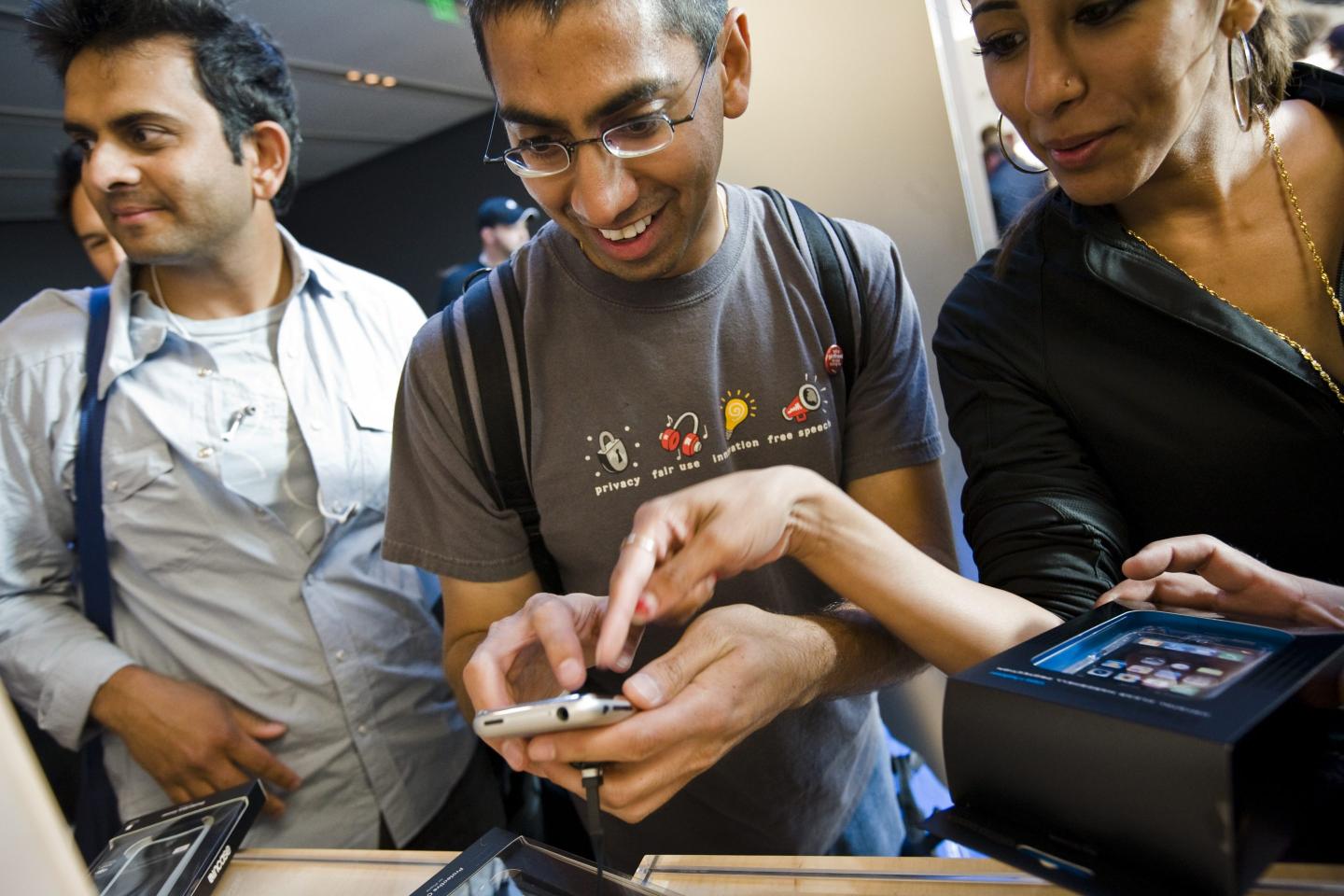
A person holds an iPhone as someone next to them points at the screen.
America’s dropping fertility rates coincided with the 2007 release of the iPhone, and economists believe there is a connection.James Leynse—Corbis/Getty Images
Add Fortune on Google for similar content.

Your iPhone may now be a form of birth control, economists warn.

Recommended Video

New research is linking America’s plummeting birth rate to the rise of the iPhone, providing evidence that smartphone use is causing people to have fewer children. A working paper published this month by the National Bureau of Economic Research (NBER) found that in the first four years of the iPhone’s release, geographies with access to the device saw reduced births from 4.5% to 8% for ages 15 to 19, and a 3.2% to 6.6% reduction in births for ages 20 to 24. These birth rates decreased the most among teenagers, but were reduced in every age group.

From June 2007 to February 2011, AT&T was the only provider distributing the iPhone, which pioneered smartphone technology, meaning the researchers were able to create a natural experiment by looking at areas of the country in which AT&T was selling the device and then compare them to parts of the country where the phone was not yet being sold. The study looked only at the period of time when AT&T had a monopoly over iPhone sales. 

Even after controlling variables relating to home prices across the country or regions that were more or less urban, researchers still found a relationship showing greater iPhone sales meant less fertility.

“What we show is that births are declining way faster in the places where you could get the iPhone than the places where you couldn’t,” Caitlin Myers, the study coauthor and professor of economics at Middlebury College, told Fortune. She authored the paper alongside her son.

The U.S. has seen dropping fertility rates for nearly two decades, with rates hitting an all-time low in 2024. At first, fewer births were not surprising to scientists. Lower fertility rates usually correlate to challenging economic times, and the Great Recession, when birth rates began dropping, was no exception. But even after the economy improved, Americans were still having fewer children.

“We had a baby-less recovery,” Myers said of the years following the 2008 financial crisis, the start of which almost perfectly coincided with AT&T’s release of the iPhone. “The economy recovered, and births didn’t.”

Low fertility can mean real economic headaches down the line. It can shrink the total population that’s able to participate in the labor force just as it can reduce total spend in the economy. Lower birth rates also mean an aging population with fewer economic stimulants, placing a strain on social benefits like Social Security and Medicare.

While rising housing and childcare costs, as well as economic anxiety, have all contributed to why Americans are having fewer children, it doesn’t tell the full story, Myers argued. 

“I’m not saying those don’t play a role,” she said. “But I think one of the really important things to keep in mind is that this effect is huge.”

Instead, Myers noted, it may have more to do with how people are—or aren’t—choosing to connect with one another.

Check your screen time

For years, psychologists like The Anxious Generation author Jonathan Haidt and San Diego State University’s Jean Twenge have warned of the “great rewiring.” As young generations like Gen Z grow up with easy access to these technologies, they are also growing more attached. These psychologists have argued that increased screen usage is associated with mental health struggles like anxiety and depression, as well as lower cognitive capability.

Myers said their theories can extend to birth rates. Using data from the National Survey of Family Growth, the study found not only a decline in the number of activities people participate in with peers outside of work and school, but also a decrease in frequency of sex. About two decades later, this trend looks to be continuing: Gen Z is not only having less sex than older generations, but they are dating less, citing the high costs of going out and the emotional disruptions of dating.

“Many younger adults are no longer treating relationships as proof of stability,” Sarah Meyer, managing director at cognitive assessment platform MyIQ, previously told Fortune. “They are asking whether a relationship adds to their sense of safety, focus, and self-understanding, or whether it introduces instability they have worked hard to avoid.”

For Myers, the data is troubling, as it’s not just indicative of economic obstacles down the line, but also a society grappling with the relationship between technology and its own emotional well-being.

“I see these declines in births, and I’m wondering, like, ‘Are we okay?’” Myers said. “People in their twenties, and more broadly—if the reason we’re seeing this decline is because people are all depressed and alone and doomscrolling—I’m worried about us.”

But data elucidating the reasons behind the declining birth rate could be crucial in designing policy interventions to address the crisis. Myers noted that the data shows declining rates of teen pregnancy, which is in many cases a good thing. Specific solutions informed by more research can help ensure these positive trends continue, while also addressing factors affecting the country’s mental and economic health. 

“My answer, as an economist, is just here to measure the phenomenon,” she said. “My answer, as a human, is this could be cause for concern if it’s another signal that our phones are making us less happy.”

Subscribe to Fortune Gulf Brief. Every Tuesday, this new newsletter delivers clear-eyed, authoritative intelligence on the deals, decisions, policies, and power shifts shaping one of the world’s most consequential regions, written for the people who need to act on it. Sign up here.
About the Author
Sasha Rogelberg
By Sasha RogelbergReporter
LinkedIn iconTwitter icon

Sasha Rogelberg is a reporter and former editorial fellow on the news desk at Fortune, covering retail and the intersection of business and popular culture.

See full bioRight Arrow Button Icon
Add Fortune on Google for similar content.

Latest in Economy

Finance
Lorem ipsum dolor sit amet, consectetur adipiscing elit, sed do eiusmod tempor incididunt ut labore et dolore magna aliqua. Ut enim ad minim veniam
By Fortune Editors
October 20, 2025
Finance
Lorem ipsum dolor sit amet, consectetur adipiscing elit, sed do eiusmod tempor incididunt ut labore et dolore magna aliqua. Ut enim ad minim veniam
By Fortune Editors
October 20, 2025
Finance
Lorem ipsum dolor sit amet, consectetur adipiscing elit, sed do eiusmod tempor incididunt ut labore et dolore magna aliqua. Ut enim ad minim veniam
By Fortune Editors
October 20, 2025
Finance
Lorem ipsum dolor sit amet, consectetur adipiscing elit, sed do eiusmod tempor incididunt ut labore et dolore magna aliqua. Ut enim ad minim veniam
By Fortune Editors
October 20, 2025
Finance
Lorem ipsum dolor sit amet, consectetur adipiscing elit, sed do eiusmod tempor incididunt ut labore et dolore magna aliqua. Ut enim ad minim veniam
By Fortune Editors
October 20, 2025
Finance
Lorem ipsum dolor sit amet, consectetur adipiscing elit, sed do eiusmod tempor incididunt ut labore et dolore magna aliqua. Ut enim ad minim veniam
By Fortune Editors
October 20, 2025

Most Popular

Finance
Lorem ipsum dolor sit amet, consectetur adipiscing elit, sed do eiusmod tempor incididunt ut labore et dolore magna aliqua. Ut enim ad minim veniam
By Fortune Editors
October 20, 2025
Finance
Lorem ipsum dolor sit amet, consectetur adipiscing elit, sed do eiusmod tempor incididunt ut labore et dolore magna aliqua. Ut enim ad minim veniam
By Fortune Editors
October 20, 2025
Finance
Lorem ipsum dolor sit amet, consectetur adipiscing elit, sed do eiusmod tempor incididunt ut labore et dolore magna aliqua. Ut enim ad minim veniam
By Fortune Editors
October 20, 2025
Finance
Lorem ipsum dolor sit amet, consectetur adipiscing elit, sed do eiusmod tempor incididunt ut labore et dolore magna aliqua. Ut enim ad minim veniam
By Fortune Editors
October 20, 2025
Finance
Lorem ipsum dolor sit amet, consectetur adipiscing elit, sed do eiusmod tempor incididunt ut labore et dolore magna aliqua. Ut enim ad minim veniam
By Fortune Editors
October 20, 2025
Finance
Lorem ipsum dolor sit amet, consectetur adipiscing elit, sed do eiusmod tempor incididunt ut labore et dolore magna aliqua. Ut enim ad minim veniam
By Fortune Editors
October 20, 2025
Fortune Secondary Logo
Rankings
  • 100 Best Companies
  • Fortune 500
  • Global 500
  • Fortune 500 Europe
  • Most Powerful Women
  • World's Most Admired Companies
  • See All Rankings
  • Lists Calendar
Sections
  • Finance
  • Fortune Crypto
  • Features
  • Leadership
  • Health
  • Commentary
  • Success
  • Retail
  • Mpw
  • Tech
  • Lifestyle
  • CEO Initiative
  • Asia
  • Politics
  • Conferences
  • Europe
  • Newsletters
  • Personal Finance
  • Environment
  • Magazine
  • Education
Customer Support
  • Frequently Asked Questions
  • Customer Service Portal
  • Privacy Policy
  • Terms Of Use
  • Single Issues For Purchase
  • International Print
Commercial Services
  • Advertising
  • Fortune Brand Studio
  • Fortune Analytics
  • Fortune Conferences
  • Business Development
  • Group Subscriptions
About Us
  • About Us
  • Press Center
  • Work At Fortune
  • Terms And Conditions
  • Site Map
  • About Us
  • Press Center
  • Work At Fortune
  • Terms And Conditions
  • Site Map
  • Facebook icon
  • Twitter icon
  • LinkedIn icon
  • Instagram icon
  • Pinterest icon

Latest in Economy

Mark Zandi, Moody's chief economist.
EconomyU.S. economy
‘It’s fair to ask whether it was worth it’: The Iran war has cost Americans $1,000 per household—and that’s a conservative estimate, Mark Zandi says
By Tristan BoveJuly 1, 2026
12 hours ago
mr
Commentary250 Years of Innovation
America needs 3.8 million manufacturing workers. This CEO has a blueprint to find them
By Mark RayfieldJuly 1, 2026
20 hours ago
Photo: Rocks balancing on driftwood, sea in background.
AIMarkets
Leveraged stock bets are ‘very concentrated in the AI ecosystem,’ Goldman Sachs warns
By Jim EdwardsJuly 1, 2026
21 hours ago
Young couple looking sad in front of a home with a for sale sign
Real EstateHousing
Gen Z and millennials aren’t convinced the American Dream exists anymore: Only 40% of them can afford to buy a home
By Tristan BoveJune 30, 2026
1 day ago
Russian President Vladimir Putin
EconomyRussia
It started with one viral influencer complaining about Russia’s economy. Now a record 60% of Russians are pessimistic about their country’s outlook
By Tristan BoveJune 30, 2026
2 days ago
A woman types into a kiosk at an airport.
Travel & LeisureAviation
‘You can expect prices to be high and stay high’: Domestic airfare is skyrocketing faster than international flight costs, despite using less jet fuel
By Sasha RogelbergJune 30, 2026
2 days ago

Most Popular

As Big Tech showers employees with perks to win the talent war, Nvidia built a nearly $5 trillion company by making people pay for their own lunch
Big Tech
As Big Tech showers employees with perks to win the talent war, Nvidia built a nearly $5 trillion company by making people pay for their own lunch
By Marco Quiroz-GutierrezJuly 1, 2026
23 hours ago
MacKenzie Scott alone accounted for one-third of America's $19.2 billion in megagifts last year
Success
MacKenzie Scott alone accounted for one-third of America's $19.2 billion in megagifts last year
By Sydney LakeJune 25, 2026
7 days ago
The Supreme Court's birthright citizenship ruling hands the U.S. economy a $7.7 trillion win
Newsletters
The Supreme Court's birthright citizenship ruling hands the U.S. economy a $7.7 trillion win
By Diane BradyJuly 1, 2026
21 hours ago
Current price of oil as of July 1, 2026
Personal Finance
Current price of oil as of July 1, 2026
By Joseph HostetlerJuly 1, 2026
18 hours ago
Philanthropy leader at Warren Buffett and Bill Gates’ Giving Pledge says children of billionaires are pushing them to give their wealth away faster
Success
Philanthropy leader at Warren Buffett and Bill Gates’ Giving Pledge says children of billionaires are pushing them to give their wealth away faster
By Preston ForeJune 27, 2026
5 days ago
Elon Musk on MacKenzie Scott giving away $26 billion of her fortune: 'Sadly,' it makes the world a worse place
Success
Elon Musk on MacKenzie Scott giving away $26 billion of her fortune: 'Sadly,' it makes the world a worse place
By Sydney LakeJune 29, 2026
3 days ago

© 2026 Fortune Media IP Limited. All Rights Reserved. Use of this site constitutes acceptance of our Terms of Use and Privacy Policy | CA Notice at Collection and Privacy Notice | Do Not Sell/Share My Personal Information
FORTUNE is a trademark of Fortune Media IP Limited, registered in the U.S. and other countries. FORTUNE may receive compensation for some links to products and services on this website. Offers may be subject to change without notice.