• Home
  • Latest
  • Fortune 500
  • Finance
  • Tech
  • Leadership
  • Lifestyle
  • Rankings
  • Multimedia
Tech

The Washington Post and Facebook: Smart strategy or deal with the devil?

By
Mathew Ingram
Mathew Ingram
Down Arrow Button Icon
By
Mathew Ingram
Mathew Ingram
Down Arrow Button Icon
September 22, 2015, 6:08 PM ET
Courtesy of Facebook

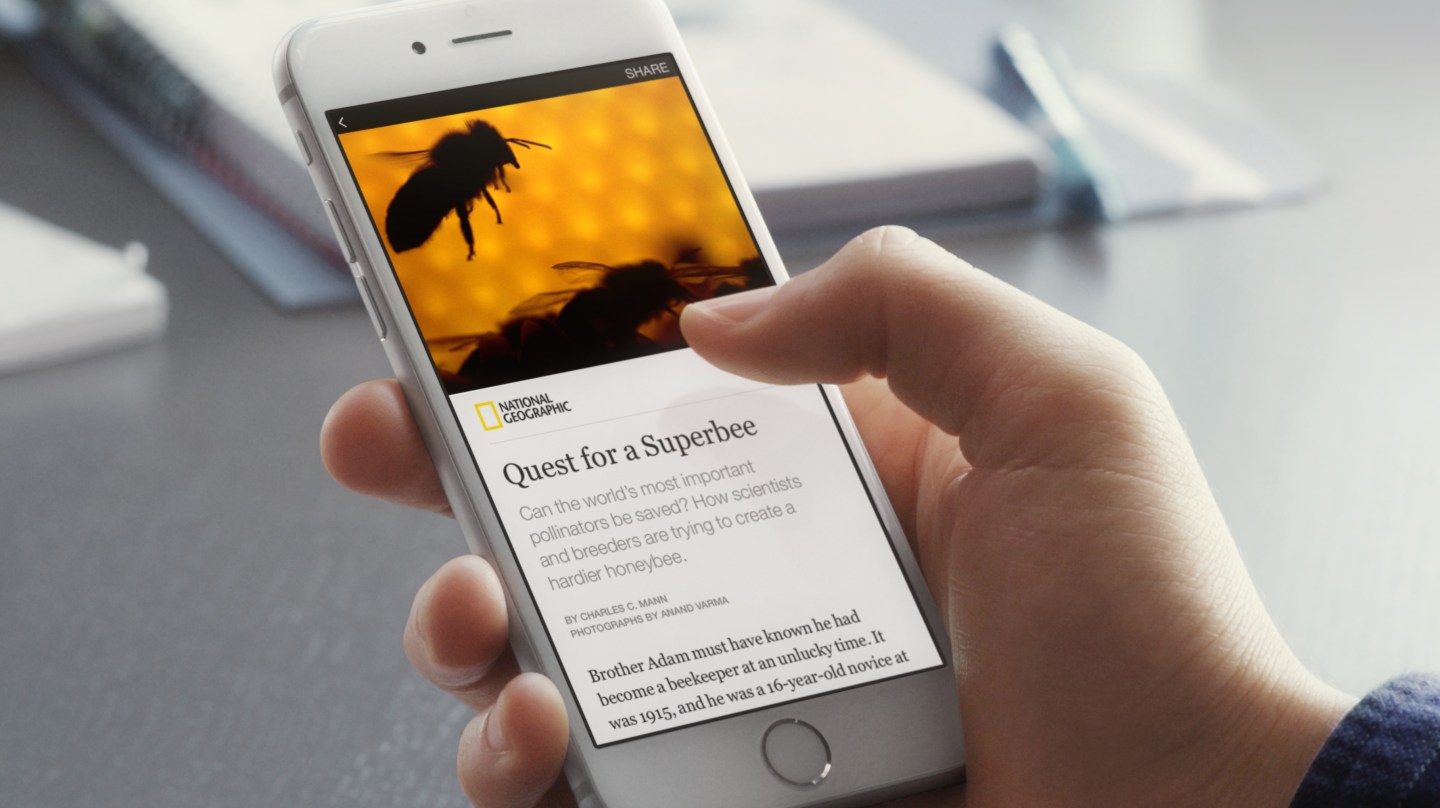
Facebook rolled out an expansion of its Instant Articles project on Tuesday — that’s the mobile-focused offering it launched earlier this year, which offers faster-loading pages to media companies who agree to publish directly to the social network. At first, Facebook had only partnered with a few media outlets like the New York Times, The Guardian and the BBC, but now it has expanded the list to include other publishers such as Mashable and Vox (and Time Inc., which owns Fortune).

Under the terms of the deal, media outlets can sell their own ads and keep all of the proceeds, or they can have Facebook sell the ads and keep 70% of the revenue. The giant social network takes the content and makes it load faster and look better on mobile devices, something that has been an issue for many media outlets — and has in turn helped drive the adoption of ad-blocking software.

According to Facebook (FB), publishers are free to send as few or as many of their stories to the network as they wish, and so far most have experimented with only a few per day. But one newspaper has decided to go all in: The Washington Post announced Tuesday that it will be sending all of its published content to Facebook — 100%. That amounts to more than a thousand news stories and other articles every day.

Whatever you may think of this news, the Post certainly can’t be accused of half measures. But is it making a wise decision for the long-term health of its business, or a Faustian bargain that it will ultimately regret? Here’s a breakdown of those two positions, so you can come to your own conclusions:

Strategic decision: The bullish case for partnering with Facebook can probably best be summed up by BuzzFeed founder Jonah Peretti, whose company is the epitome of the distributed model for news and content. In other words, it creates and publishes video and photos and text and news stories on a variety of platforms, including Facebook, Instagram, Snapchat and more — and none of that content is designed to push readers to the company’s website. It lives or dies on its own.

The argument for this strategy is simple: That’s how content works now. Young users in particular don’t go to websites any more — they find the news and other content on social networks, or are referred by their friends. So in order to reach them, publishers have to go where they are. Other publishers are also taking this approach, including Vox Media, Mashable and Business Insider.

“We want to reach current and future readers on all platforms, and we aren’t holding anything back,” Washington Post publisher Fred Ryan said in a statement. “The Post has seen explosive growth in readership over the past year [and] working with partners like Facebook allows us to further attract and engage those readers.” And if there’s anyone who knows the value of a platform, it is Washington Post owner and Amazon CEO Jeff Bezos.

Faustian bargain: The counter-argument to the Washington Post‘s approach has a number of facets to it. For one thing, many open-Web advocates argue that these kinds of deals cement control of the internet with a few large platforms such as Facebook, which may not always have the best interests of news and journalism at heart. The giant social network has a habit of removing things for its own reasons — in some cases content that has an important social and journalistic purpose.

Handing over all your content to Facebook, the theory goes, may get you a larger readership and brand awareness, and it may even get you a bunch of advertising revenue. But it also increases the power of the social network, and it uses your own content to do so. Many younger users already don’t know where the content they read originally comes from — all they know is that they get it from Facebook. Instant Articles will increase that effect.

Then there’s the risk that Facebook will change its mind about what it sees as important, or whose content it wants to highlight using its all-powerful algorithm. We don’t even have to speculate about what this might look like, since the Washington Post was part of an earlier experiment called “Social Readers.” Under that deal, newspapers created social-reading apps that lived on Facebook and allowed users to consume the paper’s content without having to leave the network.

This worked great for awhile — publishers like the Post signed up millions of readers and their apps were promoted heavily by Facebook. And then, they weren’t. Facebook changed its algorithm, for reasons only it knows, and suddenly social-reading apps weren’t being promoted any more, and readership evaporated.

As I’ve argued before, it’s not as though Facebook is somehow evil (despite my Faustian bargain metaphor). I think it genuinely wants to help newspaper companies and news publishers. But what it also wants to do is increase engagement on Facebook and boost its bottom line and all the other things that profit-seeking corporations do. And if news doesn’t accomplish that, then it will turn its attention elsewhere.

The problem is that by then, news publishers like the Post will be so wedded to the social network that they may find it difficult to cope with the aftermath. And Facebook may wind up damaging the business model of media partners completely by accident. Is seeking out new readers a good idea? Yes. But there are some significant risks to that strategy, and the real cost won’t become obvious for awhile.

You can follow Mathew Ingram on Twitter at @mathewi, and read all of his posts here. And please subscribe to Data Sheet, Fortune’s daily newsletter on the business of technology.

Join us at the Fortune Workplace Innovation Summit May 19–20, 2026, in Atlanta. The next era of workplace innovation is here—and the old playbook is being rewritten. At this exclusive, high-energy event, the world’s most innovative leaders will convene to explore how AI, humanity, and strategy converge to redefine, again, the future of work. Register now.
About the Author
By Mathew Ingram
See full bioRight Arrow Button Icon

Latest in Tech

Finance
Lorem ipsum dolor sit amet, consectetur adipiscing elit, sed do eiusmod tempor incididunt ut labore et dolore magna aliqua. Ut enim ad minim veniam
By Fortune Editors
October 20, 2025
Finance
Lorem ipsum dolor sit amet, consectetur adipiscing elit, sed do eiusmod tempor incididunt ut labore et dolore magna aliqua. Ut enim ad minim veniam
By Fortune Editors
October 20, 2025
Finance
Lorem ipsum dolor sit amet, consectetur adipiscing elit, sed do eiusmod tempor incididunt ut labore et dolore magna aliqua. Ut enim ad minim veniam
By Fortune Editors
October 20, 2025
Finance
Lorem ipsum dolor sit amet, consectetur adipiscing elit, sed do eiusmod tempor incididunt ut labore et dolore magna aliqua. Ut enim ad minim veniam
By Fortune Editors
October 20, 2025
Finance
Lorem ipsum dolor sit amet, consectetur adipiscing elit, sed do eiusmod tempor incididunt ut labore et dolore magna aliqua. Ut enim ad minim veniam
By Fortune Editors
October 20, 2025
Finance
Lorem ipsum dolor sit amet, consectetur adipiscing elit, sed do eiusmod tempor incididunt ut labore et dolore magna aliqua. Ut enim ad minim veniam
By Fortune Editors
October 20, 2025

Most Popular

Finance
Lorem ipsum dolor sit amet, consectetur adipiscing elit, sed do eiusmod tempor incididunt ut labore et dolore magna aliqua. Ut enim ad minim veniam
By Fortune Editors
October 20, 2025
Finance
Lorem ipsum dolor sit amet, consectetur adipiscing elit, sed do eiusmod tempor incididunt ut labore et dolore magna aliqua. Ut enim ad minim veniam
By Fortune Editors
October 20, 2025
Finance
Lorem ipsum dolor sit amet, consectetur adipiscing elit, sed do eiusmod tempor incididunt ut labore et dolore magna aliqua. Ut enim ad minim veniam
By Fortune Editors
October 20, 2025
Finance
Lorem ipsum dolor sit amet, consectetur adipiscing elit, sed do eiusmod tempor incididunt ut labore et dolore magna aliqua. Ut enim ad minim veniam
By Fortune Editors
October 20, 2025
Finance
Lorem ipsum dolor sit amet, consectetur adipiscing elit, sed do eiusmod tempor incididunt ut labore et dolore magna aliqua. Ut enim ad minim veniam
By Fortune Editors
October 20, 2025
Finance
Lorem ipsum dolor sit amet, consectetur adipiscing elit, sed do eiusmod tempor incididunt ut labore et dolore magna aliqua. Ut enim ad minim veniam
By Fortune Editors
October 20, 2025
Fortune Secondary Logo
Rankings
  • 100 Best Companies
  • Fortune 500
  • Global 500
  • Fortune 500 Europe
  • Most Powerful Women
  • Future 50
  • World’s Most Admired Companies
  • See All Rankings
Sections
  • Finance
  • Fortune Crypto
  • Features
  • Leadership
  • Health
  • Commentary
  • Success
  • Retail
  • Mpw
  • Tech
  • Lifestyle
  • CEO Initiative
  • Asia
  • Politics
  • Conferences
  • Europe
  • Newsletters
  • Personal Finance
  • Environment
  • Magazine
  • Education
Customer Support
  • Frequently Asked Questions
  • Customer Service Portal
  • Privacy Policy
  • Terms Of Use
  • Single Issues For Purchase
  • International Print
Commercial Services
  • Advertising
  • Fortune Brand Studio
  • Fortune Analytics
  • Fortune Conferences
  • Business Development
About Us
  • About Us
  • Editorial Calendar
  • Press Center
  • Work At Fortune
  • Diversity And Inclusion
  • Terms And Conditions
  • Site Map
Fortune Secondary Logo
  • About Us
  • Editorial Calendar
  • Press Center
  • Work At Fortune
  • Diversity And Inclusion
  • Terms And Conditions
  • Site Map
  • Facebook icon
  • Twitter icon
  • LinkedIn icon
  • Instagram icon
  • Pinterest icon

Latest in Tech

Bankinginvestment banking
DBS, Southeast Asia’s largest bank, partners with VC giant Granite Asia to counter the region’s lack of capital
By Angelica Ang and Andrew StaplesFebruary 22, 2026
3 hours ago
daron acemoglu
AILayoffs
The Nobel laureate who co-wrote ‘Why Nations Fail’ warns U.S. democracy won’t survive unless these two things change
By Jake AngeloFebruary 22, 2026
18 hours ago
jesse
CommentaryDEI
A decade ago, I had a front row seat as Jesse Jackson held big tech firms accountable for being overwhelmingly white and male
By Brennan Nevada JohnsonFebruary 22, 2026
18 hours ago
Man wearing a suit awkwardly takes a video call on a laptop
Future of WorkInterview
Recruiter reveals broken Zoom interview etiquette: bathrobes, yoga, and outsourcing thinking to AI
By Nick LichtenbergFebruary 22, 2026
18 hours ago
werfel
CommentaryTaxes
Former IRS Commissioner: Here’s how we used AI to create immediate value when taxpayers scrutinized every dollar
By Danny WerfelFebruary 22, 2026
19 hours ago
LawMedia
DOJ probes Netflix’s power over filmmakers in Warner deal review
By Josh Sisco and BloombergFebruary 21, 2026
1 day ago

Most Popular

placeholder alt text
Innovation
The U.S. spent $30 billion to ditch textbooks for laptops and tablets: The result is the first generation less cognitively capable than their parents
By Sasha RogelbergFebruary 21, 2026
2 days ago
placeholder alt text
Economy
New Fed report proves Milton Friedman and Joe Biden understood something vital about immigration—and explains why growth may sputter under Trump
By Shawn TullyFebruary 22, 2026
19 hours ago
placeholder alt text
Startups & Venture
'I have a chip on my shoulder.' Phoebe Gates wants her $185 million AI startup Phia to succeed with 'no ties to my privilege or my last name'
By Sydney LakeFebruary 21, 2026
2 days ago
placeholder alt text
Big Tech
Peter Thiel and other tech billionaires are publicly shielding their children from the products that made them rich
By Marco Quiroz-GutierrezFebruary 21, 2026
2 days ago
placeholder alt text
Success
40% of Stanford undergrads receive disability accommodations—but it's become a college-wide phenomenon as Gen Z try to succeed in the current climate
By Preston ForeFebruary 21, 2026
2 days ago
placeholder alt text
Economy
The Russian economy is eating its own muscle to survive as Putin's war on Ukraine destroys future capacity, former central bank adviser says
By Jason MaFebruary 22, 2026
7 hours ago

© 2026 Fortune Media IP Limited. All Rights Reserved. Use of this site constitutes acceptance of our Terms of Use and Privacy Policy | CA Notice at Collection and Privacy Notice | Do Not Sell/Share My Personal Information
FORTUNE is a trademark of Fortune Media IP Limited, registered in the U.S. and other countries. FORTUNE may receive compensation for some links to products and services on this website. Offers may be subject to change without notice.