• Home
  • Latest
  • Fortune 500
  • Finance
  • Tech
  • Leadership
  • Lifestyle
  • Rankings
  • Multimedia
TechT-Mobile

Here’s why cell carriers freak out when you use your unlimited data

By
Stacey Higginbotham
Stacey Higginbotham
Down Arrow Button Icon
September 17, 2015, 11:41 AM ET
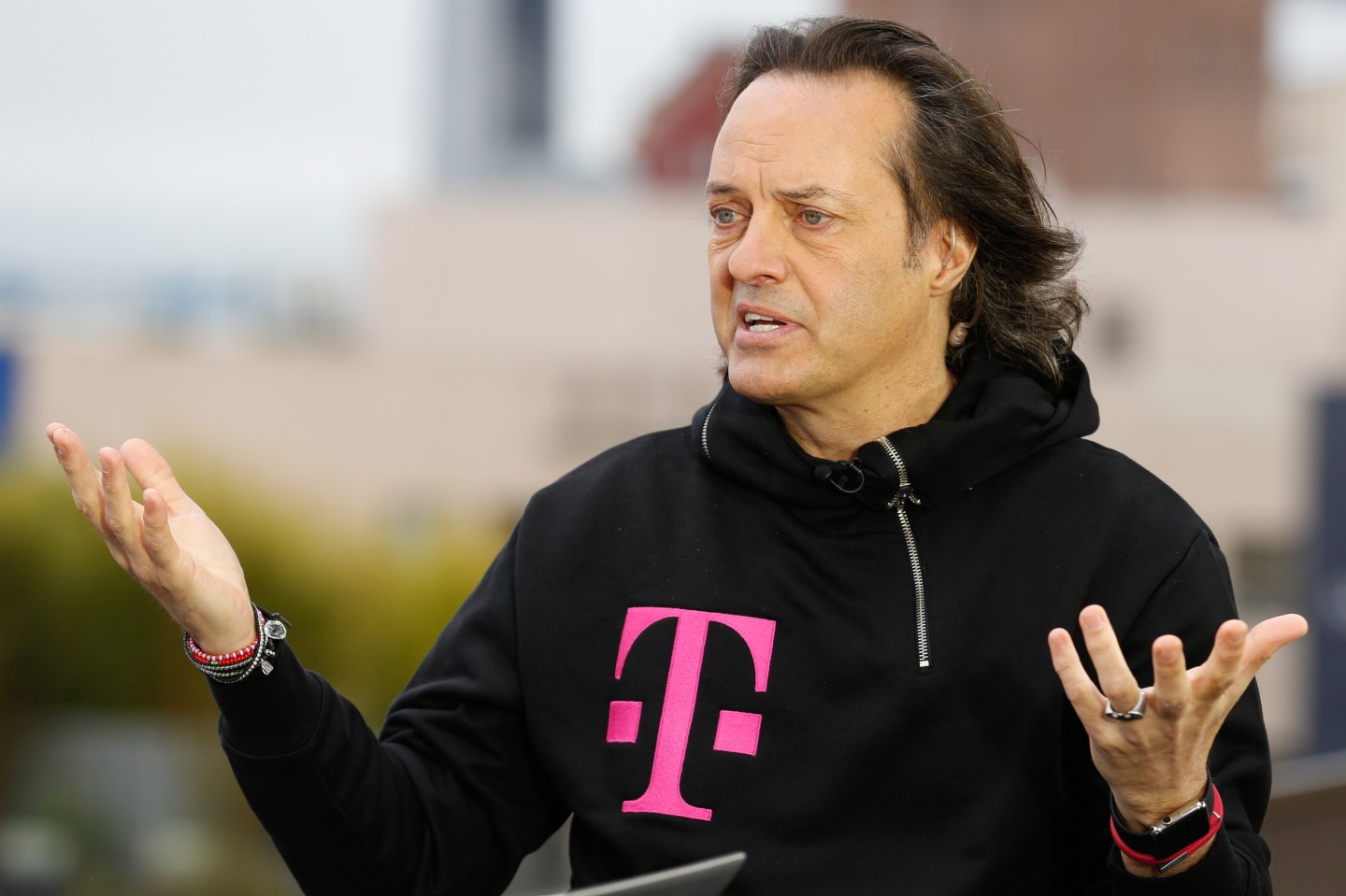
John Legere, CEO and President of T-Mobile US.
John Legere, CEO and President of T-Mobile US.Photograph by CNBC via Getty Images

In a story almost as old as unlimited mobile data plans, there has been a fight over those who provide the plans and those who actually test the boundaries on what unlimited use actually means. This week AT&T said it would only start throttling users on its unlimited plans when they reached about 22 GB per month, as opposed to 5 GB per month, in response to a Federal Communication Commission fine.

Last month T-Mobile CEO John Legere accused customers of “stealing data” by using their data plans on their smartphones as a Wi-Fi hot spot (also known as tethering). Users of T-Mobile’s network can do this up until they hit 7 GB gigabytes of data on their $80 a month plan, but after that point, they need to buy more. What Legere was accusing these users of doing was basically going around T-Mobile’s software barriers and using their phones as a Wi-Fi hot spot beyond those limits, and using T-Mobile’s data network to provide connectivity to devices outside of the smartphone.

This is such a problem for carriers because with larger screens and faster processors a laptop can consume three times more bandwidth as a smartphone (or more). If someone on T-Mobile’s network tethers he will gobble far more data than even a heavy smartphone user. That’s why carriers have those limits in place, and why carriers like Verizon didn’t even allow tethering early in the flush of unlimited data plans.

ciscotypedevice
Data courtesy of Cisco’s VNI

The T-Mobile story brought attention back to tethering, a practice that has been around for at least a decade if not longer. Late last week the Wall Street Journal wrote a story discussing some of the apps that people on T-Mobile’s network used to tether their phones, such as TetherMe or CarrierCrack. The story included a sympathetic figure who tethered because he lived in a rural area lacking access to high-quality wireline broadband.

That dearth of quality internet access is why the FCC is pushing for mobile broadband to be added to its broadband competition report. It’s also why consumers groups are up in arms about the fact that, as Verizon and AT&T pull out of serving rural areas with copper telephone lines, they are also pulling out of serving rural areas with copper-based DSL broadband. Entire swathes of the country will be left behind when it comes to decent broadband speeds.

But wireless providers can’t actually pick up the slack in many cases because costs and physics won’t let them. Legere can let people use unlimited data on their smartphones because he understands the limits of those devices and how much data they can actually funnel. Once people turn that phone into a hot spot, however, all bets are off, and using 300 GB or a terabyte of data really can play havoc with a carrier’s network and costs.

This is a battle that breaks out every few years between savvy mobile users who want access to data wherever they are, and mobile operators who are providing faster and faster mobile broadband networks while also charging relatively high prices for that connectivity, or blocking services that they perceive to compete with their own. Caught in between are consumers and developers who don’t necessarily understand the economics of carrier networks and who don’t trust the carriers to avoid meddling with the ecosystem to their own advantage.

When it comes to cellular networks, every carrier is limited by the licensed airwaves over which it can send data. When the FCC conducts auctions for spectrum carriers spend billions buying airwaves. They will spend billions more placing base stations and equipment tuned to that frequency to send data around the country. Building a wireless network isn’t cheap. But that’s not the main problem. The real challenge is physics.

Carriers are bound by Shannon’s Law, which dictates how many bits of information can be crammed into a single hertz of spectrum. The goal with every wireless technology evolution from 3G to 4G is to get more and more bits per hertz, and so far, LTE, the current generation wireless technology, is as economical as it gets. However, LTE has achieved about all the efficiency is can, which means that all carriers can do is allocate more spectrum to the network if their users require more bits. In short, carriers are running the most efficient car they have, so now all they can do is buy more gas.

There are some short-term solutions to this problem, such as allocating more base stations and using different antenna arrays on those base stations to optimize network capacity, but in the end cellular networks are limited by the capacity of the airwaves. That’s why carriers pay so much money for their spectrum.

The demand for data rises and falls depending on the time of day and place. Those rural folks sucking down massive gigabytes of data in the middle of the night may not be causing significant problems for AT&T and Verizon, but for a smaller carrier like T-Mobile it actually can add up. Even if those customers don’t cause problems on the wireless side, they can cause expenses where the bits transition from T-Mobile’s cellular network and go back onto a wireline network to get to the Internet. T-mobile doesn’t own a large wireline network, and in rural areas especially it has to pay a network operator (in some cases Verizon or AT&T) for access to the Internet. If a bunch of users are using a few hundred or a thousand gigabytes of data, those costs can add up quickly.

That means that when John Legere freaks out over customers using terabytes of data on the network, he’s freaking out because it’s costing him a lot more to run those bits over cellular. Not only that, when those bits do eventually hit the wireline network that’s also costing him a lot. As for AT&T and Verizon, they too have to deal with the laws of physics and the cost of spectrum. That’s why offloading to Wi-Fi has become so popular in recent years.

Subscribe to Data Sheet, Fortune’s daily newsletter on the business of technology.

About the Author
By Stacey Higginbotham
See full bioRight Arrow Button Icon

Latest in Tech

Finance
Lorem ipsum dolor sit amet, consectetur adipiscing elit, sed do eiusmod tempor incididunt ut labore et dolore magna aliqua. Ut enim ad minim veniam
By Fortune Editors
October 20, 2025
Finance
Lorem ipsum dolor sit amet, consectetur adipiscing elit, sed do eiusmod tempor incididunt ut labore et dolore magna aliqua. Ut enim ad minim veniam
By Fortune Editors
October 20, 2025
Finance
Lorem ipsum dolor sit amet, consectetur adipiscing elit, sed do eiusmod tempor incididunt ut labore et dolore magna aliqua. Ut enim ad minim veniam
By Fortune Editors
October 20, 2025
Finance
Lorem ipsum dolor sit amet, consectetur adipiscing elit, sed do eiusmod tempor incididunt ut labore et dolore magna aliqua. Ut enim ad minim veniam
By Fortune Editors
October 20, 2025
Finance
Lorem ipsum dolor sit amet, consectetur adipiscing elit, sed do eiusmod tempor incididunt ut labore et dolore magna aliqua. Ut enim ad minim veniam
By Fortune Editors
October 20, 2025
Finance
Lorem ipsum dolor sit amet, consectetur adipiscing elit, sed do eiusmod tempor incididunt ut labore et dolore magna aliqua. Ut enim ad minim veniam
By Fortune Editors
October 20, 2025

Most Popular

Finance
Lorem ipsum dolor sit amet, consectetur adipiscing elit, sed do eiusmod tempor incididunt ut labore et dolore magna aliqua. Ut enim ad minim veniam
By Fortune Editors
October 20, 2025
Finance
Lorem ipsum dolor sit amet, consectetur adipiscing elit, sed do eiusmod tempor incididunt ut labore et dolore magna aliqua. Ut enim ad minim veniam
By Fortune Editors
October 20, 2025
Finance
Lorem ipsum dolor sit amet, consectetur adipiscing elit, sed do eiusmod tempor incididunt ut labore et dolore magna aliqua. Ut enim ad minim veniam
By Fortune Editors
October 20, 2025
Finance
Lorem ipsum dolor sit amet, consectetur adipiscing elit, sed do eiusmod tempor incididunt ut labore et dolore magna aliqua. Ut enim ad minim veniam
By Fortune Editors
October 20, 2025
Finance
Lorem ipsum dolor sit amet, consectetur adipiscing elit, sed do eiusmod tempor incididunt ut labore et dolore magna aliqua. Ut enim ad minim veniam
By Fortune Editors
October 20, 2025
Finance
Lorem ipsum dolor sit amet, consectetur adipiscing elit, sed do eiusmod tempor incididunt ut labore et dolore magna aliqua. Ut enim ad minim veniam
By Fortune Editors
October 20, 2025
Rankings
  • 100 Best Companies
  • Fortune 500
  • Global 500
  • Fortune 500 Europe
  • Most Powerful Women
  • Future 50
  • World’s Most Admired Companies
  • See All Rankings
Sections
  • Finance
  • Leadership
  • Success
  • Tech
  • Asia
  • Europe
  • Environment
  • Fortune Crypto
  • Health
  • Retail
  • Lifestyle
  • Politics
  • Newsletters
  • Magazine
  • Features
  • Commentary
  • Mpw
  • CEO Initiative
  • Conferences
  • Personal Finance
  • Education
Customer Support
  • Frequently Asked Questions
  • Customer Service Portal
  • Privacy Policy
  • Terms Of Use
  • Single Issues For Purchase
  • International Print
Commercial Services
  • Advertising
  • Fortune Brand Studio
  • Fortune Analytics
  • Fortune Conferences
  • Business Development
About Us
  • About Us
  • Editorial Calendar
  • Press Center
  • Work At Fortune
  • Diversity And Inclusion
  • Terms And Conditions
  • Site Map

© 2025 Fortune Media IP Limited. All Rights Reserved. Use of this site constitutes acceptance of our Terms of Use and Privacy Policy | CA Notice at Collection and Privacy Notice | Do Not Sell/Share My Personal Information
FORTUNE is a trademark of Fortune Media IP Limited, registered in the U.S. and other countries. FORTUNE may receive compensation for some links to products and services on this website. Offers may be subject to change without notice.


Latest in Tech

AIthe future of work
‘Godfather of AI’ Geoffrey Hinton predicts 2026 will see the technology get even better and gain the ability to ‘replace many other jobs’
By Jason MaDecember 28, 2025
11 hours ago
Startups & VentureTaxes
California tech founders unload on a proposed state wealth tax that already has some billionaires preparing an escape. ‘I am screwed for life’
By Jason MaDecember 28, 2025
12 hours ago
Innovationspace
NASA’s upcoming moonshot may let astronauts be the first to lay eyes on parts of the lunar far side that were missed by the Apollo program
By Marcia Dunn and The Associated PressDecember 28, 2025
15 hours ago
Arts & EntertainmentGen Z
Gen Zers and millennials flock to so-called analog islands ‘because so little of their life feels tangible’
By Michael Liedtke and The Associated PressDecember 28, 2025
15 hours ago
Sridhar Ramaswamy is CEO of Snowflake, the AI Data Cloud company.
CommentarySoftware
Snowflake CEO: Big Tech’s grip on AI will loosen in 2026 — plus 6 more predictions that will define the year
By Sridhar RamaswamyDecember 28, 2025
17 hours ago
Sam Altman, chief executive officer of OpenAI Inc., during a media tour of the Stargate AI data center in Abilene, Texas, US, on Tuesday, Sept. 23, 2025.
AISam Altman
OpenAI CEO Sam Altman says he is ‘envious’ of Gen Z college dropouts who have the ‘mental space’ and time to build new startups
By Nino PaoliDecember 28, 2025
17 hours ago

Most Popular

placeholder alt text
Future of Work
Malcolm Gladwell tells young people if they want a STEM degree, 'don’t go to Harvard.' You may end up at the bottom of your class and drop out
By Sasha RogelbergDecember 27, 2025
2 days ago
placeholder alt text
Success
MacKenzie Scott's close relationship with Toni Morrison long before Amazon put her on the path give more than $1 billion to HBCUs
By Sasha RogelbergDecember 28, 2025
17 hours ago
placeholder alt text
Banking
Russian official warns a banking crisis is possible amid nonpayments. 'I don’t want to think about a continuation of the war or an escalation'
By Jason MaDecember 27, 2025
1 day ago
placeholder alt text
Arts & Entertainment
Gen Zers and millennials flock to so-called analog islands 'because so little of their life feels tangible'
By Michael Liedtke and The Associated PressDecember 28, 2025
15 hours ago
placeholder alt text
Politics
Peter Thiel and Larry Page are preparing to flee California in case the state passes a billionaire wealth tax, report says
By Jason MaDecember 27, 2025
1 day ago
placeholder alt text
Real Estate
Paris Hilton took out a mortgage on the $63 million mansion she bought from Mark Wahlberg. Here’s why that’s actually a smart financial decision
By Sydney LakeDecember 28, 2025
17 hours ago