• Home
  • Latest
  • Fortune 500
  • Finance
  • Tech
  • Leadership
  • Lifestyle
  • Rankings
  • Multimedia
Leadershipnarcissism

Should leaders be modest?

Alan Murray
By
Alan Murray
Alan Murray
Down Arrow Button Icon
Alan Murray
By
Alan Murray
Alan Murray
Down Arrow Button Icon
September 15, 2015, 10:00 AM ET
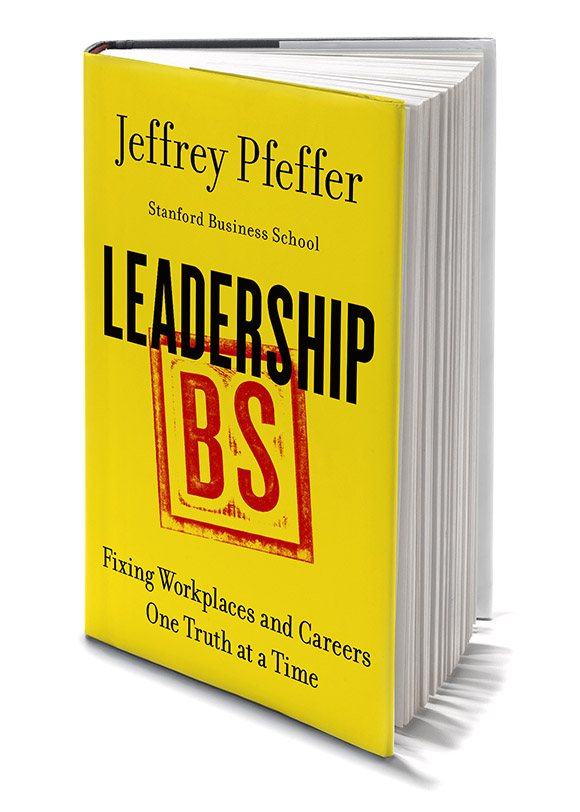
Jeffrey Pfeffer's "Leadership BS"
handout

In his new book, ‘Leadership BS,’ Stanford professor and Fortune columnist Jeffrey Pfeffer takes aim at the rapidly growing leadership industrial complex, a multibillion-dollar business of books, blogs, business school courses, and training sessions that, he argues, is based more “on hope than reality, on wishes rather than data, on beliefs instead of science.” He urges a new approach, based not on anecdotes but on actual measurement of results. The book is published by Harper-Business. What follows is excerpted.

Bill Bradley, the retired National Basketball Association star and former New Jersey senator, summarized the sentiments of many leadership “experts” when he said, “Leaders should be collaborative, modest, and generous.” Jim Collins, in his bestselling management book Good to Great, also argued that “personal humility” is a trait that distinguished “good to great” leaders.

But few leaders, particularly leaders of large organizations, actually seem to be very modest.

Consider Donald Trump, now running for President, with a net worth approaching $4 billion. Trump tweets constantly, is all over the media, had his own television show, and, most famously, names all his buildings after, of course, himself.

Trump is an extreme case, but he is not alone. Many of the most well-known and well-regarded CEOs—including Bill Gates of Microsoft (MSFT), Steve Jobs of Apple (AAPL), and Jack Welch of General Electric (GE)—exhibited narcissistic traits and behaviors. Immodesty in all its manifestations—narcissism, self-promotion, self-aggrandizement, unwarranted self-confidence—helps people attain leadership positions in the first place and then, once they’re in them, positively affects their ability to hold on to those positions, extract more resources (salary), and even helps in some, although not all, aspects of their performance on the job.

“Many of the most well-known and well-regarded CEOs—Bill Gates, Steve Jobs, Jack Welch—exhibited narcissistic traits and behaviors.”

We know a lot about narcissism. A study of 392 CEOs during the financial crisis found that because narcissists tend to be self-absorbed and overconfident, firms led by more narcissistic CEOs did worse at the beginning of the crisis. However, because narcissists have a stronger bias for action and risk-taking—again a result of their higher levels of self-confidence—the study also found that more-narcissistic CEOs led firms to bounce back more successfully during the post-crisis recovery.

If organizations really wanted to select modest leaders, it would be fairly easy to do so. The Narcissistic Personality Inventory is a validated scale, and it can be used as part of a personality assessment. The fact that most companies not only don’t use such selection techniques but their selection decisions also seemingly reflect precisely the opposite preference—a preference for immodest, grandiose, and narcissistic leaders—stands as an important barrier to having leaders who might create workplaces quite different from most contemporary work environments.

A version of this article appears in the September 15, 2015 issue of Fortune magazine.
About the Author
Alan Murray
By Alan Murray
LinkedIn iconTwitter icon
See full bioRight Arrow Button Icon

Latest in Leadership

Donald Trump
HealthHealth Insurance
‘Tragedy in the making’: Top healthcare exec on why insurance will spike to subsidize a tax cut to millionaires and billionaires
By Nick LichtenbergDecember 12, 2025
2 hours ago
three men in suits, one gesturing
AIBrainstorm AI
The fastest athletes in the world can botch a baton pass if trust isn’t there—and the same is true of AI, Blackbaud exec says
By Amanda GerutDecember 12, 2025
2 hours ago
Brainstorm AI panel
AIBrainstorm AI
Creative workers won’t be replaced by AI—but their roles will change to become ‘directors’ managing AI agents, executives say
By Beatrice NolanDecember 12, 2025
3 hours ago
Ryan Serhant lifts his arms at the premiere of Owning Manhattan, his Netflix show
Successrelationships
Ryan Serhant, a real-estate mogul who’s met over 100 billionaires, reveals his best networking advice: ‘Every room I go into, I use the two C’s’
By Dave SmithDecember 12, 2025
4 hours ago
Fei-Fei Li, the "Godmother of AI," says she values AI skills more than college degrees when hiring software engineers for her tech startup.
AITech
‘Godmother of AI’ says degrees are less important in hiring than ‘how quickly can you superpower yourself’ with new tools
By Nino PaoliDecember 12, 2025
5 hours ago
C-SuiteFortune 500 Power Moves
Fortune 500 Power Moves: Which executives gained and lost power this week
By Fortune EditorsDecember 12, 2025
5 hours ago

Most Popular

placeholder alt text
Economy
Tariffs are taxes and they were used to finance the federal government until the 1913 income tax. A top economist breaks it down
By Kent JonesDecember 12, 2025
11 hours ago
placeholder alt text
Success
At 18, doctors gave him three hours to live. He played video games from his hospital bed—and now, he’s built a $10 million-a-year video game studio
By Preston ForeDecember 10, 2025
3 days ago
placeholder alt text
Success
Palantir cofounder calls elite college undergrads a ‘loser generation’ as data reveals rise in students seeking support for disabilities, like ADHD
By Preston ForeDecember 11, 2025
1 day ago
placeholder alt text
Investing
Baby boomers have now 'gobbled up' nearly one-third of America's wealth share, and they're leaving Gen Z and millennials behind
By Sasha RogelbergDecember 8, 2025
4 days ago
placeholder alt text
Arts & Entertainment
'We're not just going to want to be fed AI slop for 16 hours a day': Analyst sees Disney/OpenAI deal as a dividing line in entertainment history
By Nick LichtenbergDecember 11, 2025
23 hours ago
placeholder alt text
Economy
‘We have not seen this rosy picture’: ADP’s chief economist warns the real economy is pretty different from Wall Street’s bullish outlook
By Eleanor PringleDecember 11, 2025
1 day ago
Rankings
  • 100 Best Companies
  • Fortune 500
  • Global 500
  • Fortune 500 Europe
  • Most Powerful Women
  • Future 50
  • World’s Most Admired Companies
  • See All Rankings
Sections
  • Finance
  • Leadership
  • Success
  • Tech
  • Asia
  • Europe
  • Environment
  • Fortune Crypto
  • Health
  • Retail
  • Lifestyle
  • Politics
  • Newsletters
  • Magazine
  • Features
  • Commentary
  • Mpw
  • CEO Initiative
  • Conferences
  • Personal Finance
  • Education
Customer Support
  • Frequently Asked Questions
  • Customer Service Portal
  • Privacy Policy
  • Terms Of Use
  • Single Issues For Purchase
  • International Print
Commercial Services
  • Advertising
  • Fortune Brand Studio
  • Fortune Analytics
  • Fortune Conferences
  • Business Development
About Us
  • About Us
  • Editorial Calendar
  • Press Center
  • Work At Fortune
  • Diversity And Inclusion
  • Terms And Conditions
  • Site Map

© 2025 Fortune Media IP Limited. All Rights Reserved. Use of this site constitutes acceptance of our Terms of Use and Privacy Policy | CA Notice at Collection and Privacy Notice | Do Not Sell/Share My Personal Information
FORTUNE is a trademark of Fortune Media IP Limited, registered in the U.S. and other countries. FORTUNE may receive compensation for some links to products and services on this website. Offers may be subject to change without notice.