
• Home
  • News
  • Fortune 500
  • Tech
  • Finance
  • Leadership
  • Lifestyle
  • Rankings
  • Multimedia
TechSpotify

Spotify updates privacy policy to clarify how it collects your data

Robert Hackett
By
Robert Hackett
Robert Hackett
Down Arrow Button Icon
Robert Hackett
By
Robert Hackett
Robert Hackett
Down Arrow Button Icon
September 4, 2015, 9:49 AM ET
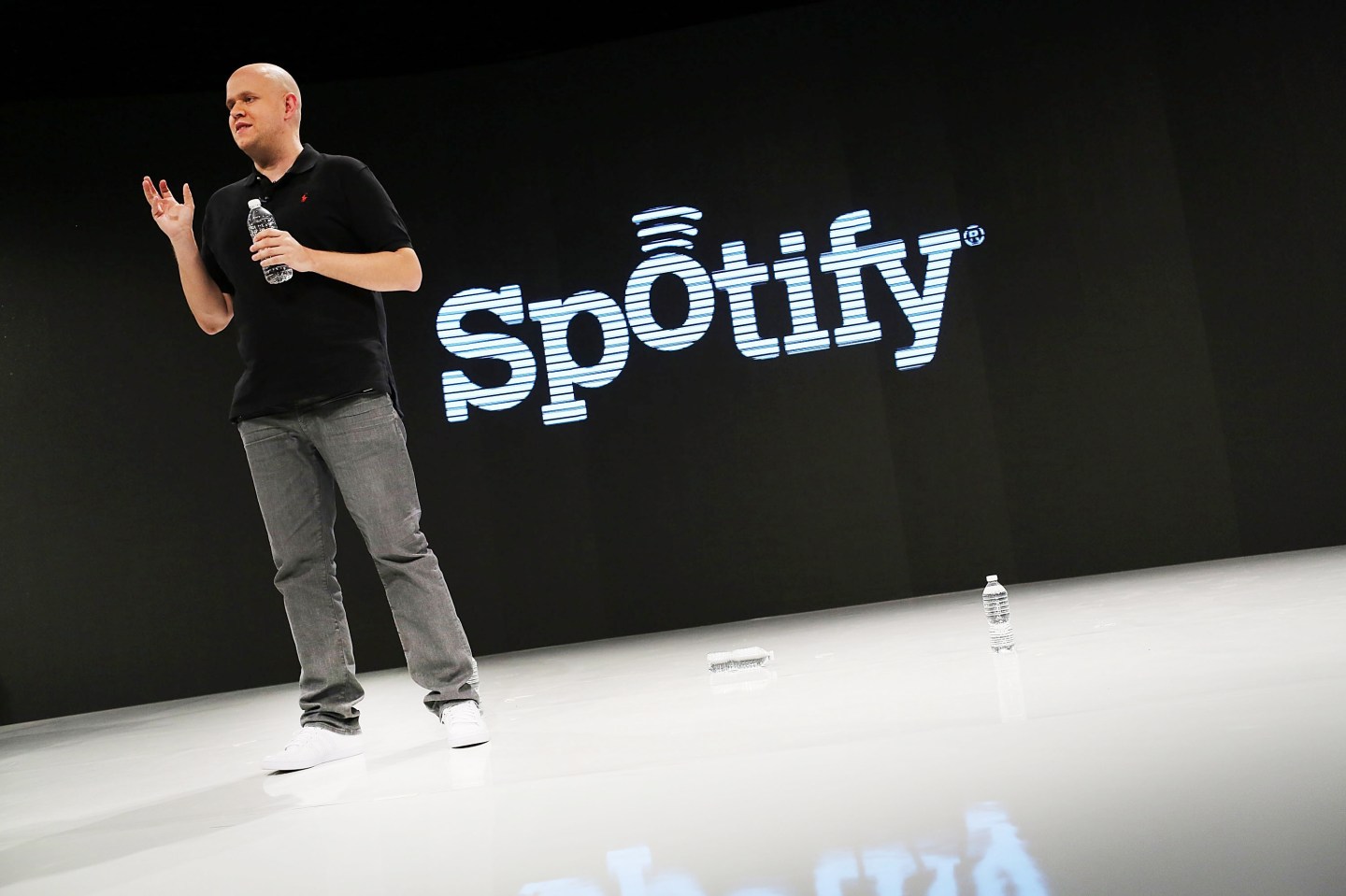
Spotify Holds Press Event In New York
NEW YORK, NY - DECEMBER 06: Spotify's founder and CEO Daniel Elk speaks at a Spotify event on December 6, 2012 in New York City. Elk, who started the Swedish music streaming business in 2006, introduced a variety of new additions to the popular music sight. Elk also announced that Spotify now has 5 million paid subscribers, 20 million active users and has paid out a half billion dollars to artist's record labels. (Photo by Spencer Platt/Getty Images)Photograph by Spencer Platt — Getty Images

After Spotify worked the Internet into a tizzy over seemingly invasive changes to its privacy policy last month, the company has issued another update that better explains why it wants so much more of your data.

The new version isn’t much different from its predecessor. While the language is simpler, clearer, and less alarming, the revision doesn’t change what data the music streaming service will collect. Instead, it clarifies how it will collect that data.

Basically, there are two sets of data the company is interested in. The first set, as the new policy clarifies, includes data the company “must have” in order to deliver its service: usernames and passwords, subscription type (free versus paid), IP addresses, and music preferences. The second set includes information Spotify “can use…if you choose to share,” which allows for additional personalized features.

Read more on data science at Spotify.

That second category is where the company initially met with backlash. In August, people panicked when the company announced that it would begin requesting access to users’ photos, contact lists, microphones, location, and Facebook data. Spotify said that it would do so only “with your permission,” and that it needed the access in order to enable the new and improved features, such as friend-finding, profile picture-swapping, voice activation, and local recommendations.

That explanation didn’t satisfy everyone, however. Many people, such as billionaire video-game creator Markus Persson, felt the company had overstepped the line. And they said so.

Daniel Ek, Spotify co-founder and CEO, personally apologized for the gaffe. “SORRY,” he posted on Twitter. “Privacy super impt. We should have done better explaining new terms.”

He vowed on the corporate blog to deliver a new privacy agreement “in the coming days and weeks.” This latest version is that update.

As mentioned, aside from a far more explicit (and lengthy) introduction, there’s not much new here. Considering how much flak the company took for the original update, it is clear that something about the former legalese-filled policy was amiss. The plainer language is a welcome change.

“We never receive any of the following information unless you expressly choose to share it with us,” the new policy states, regarding the second category of data the company collects. “It’s as simple as that.”

Anyone who recently quit the service over privacy concerns should have a look at the revised policy. (Those who accepted the last update are already automatically opted in.) The new version is at least more understandable.

But if Spotify’s reassurances are still not enough, then there is certainly no dearth of music streaming alternatives on the market right now: Apple Music, Google Play Music, Pandora, Tidal, Rdio. No doubt the others would love to have you, too.

For more on Spotify, watch this video below.

Subscribe to Data Sheet, Fortune’s daily newsletter on the business of technology.
About the Author
Robert Hackett
By Robert Hackett
Instagram iconLinkedIn iconTwitter icon
See full bioRight Arrow Button Icon

Latest in Tech

Co-founder and chief executive officer of Nvidia Corp., Jensen Huang attends the 9th edition of the VivaTech trade show at the Parc des Expositions de la Porte de Versailles on June 11, 2025, in Paris.
C-SuiteNvidia
Before running the world’s most valuable company, Jensen Huang was a 9-year-old janitor in Kentucky
By Eva RoytburgDecember 5, 2025
2 minutes ago
Future of WorkBrainstorm Design
The workplace needs to be designed like an ‘experience,’ says Gensler’s Ray Yuen, as employees resist the return to office
By Angelica AngDecember 5, 2025
2 hours ago
Four years ago, BKV started buying up the two Temple power plants in Texas—located between Austin and Dallas—which now total 1.5 gigawatts of electricity generation capacity—enough to power more than 1.1 million homes, or a major data center campus. There is room to expand.
Energypower
How a Texas gas producer plans to exploit the ‘mega trend’ of power plants for AI hyperscalers
By Jordan BlumDecember 5, 2025
2 hours ago
Big TechSpotify
Spotify users lamented Wrapped in 2024. This year, the company brought back an old favorite and made it less about AI
By Dave Lozo and Morning BrewDecember 4, 2025
12 hours ago
InnovationVenture Capital
This Khosla Ventures–backed startup is using AI to personalize cancer care
By Allie GarfinkleDecember 4, 2025
16 hours ago
AIEye on AI
Companies are increasingly falling victim to AI impersonation scams. This startup just raised $28M to stop deepfakes in real time
By Sharon GoldmanDecember 4, 2025
17 hours ago

Most Popular

placeholder alt text
Economy
Two months into the new fiscal year and the U.S. government is already spending more than $10 billion a week servicing national debt
By Eleanor PringleDecember 4, 2025
22 hours ago
placeholder alt text
Success
‘Godfather of AI’ says Bill Gates and Elon Musk are right about the future of work—but he predicts mass unemployment is on its way
By Preston ForeDecember 4, 2025
18 hours ago
placeholder alt text
Success
Nvidia CEO Jensen Huang admits he works 7 days a week, including holidays, in a constant 'state of anxiety' out of fear of going bankrupt
By Jessica CoacciDecember 4, 2025
17 hours ago
placeholder alt text
Success
Nearly 4 million new manufacturing jobs are coming to America as boomers retire—but it's the one trade job Gen Z doesn't want
By Emma BurleighDecember 4, 2025
18 hours ago
placeholder alt text
North America
Jeff Bezos and Lauren Sánchez Bezos commit $102.5 million to organizations combating homelessness across the U.S.: ‘This is just the beginning’
By Sydney LakeDecember 2, 2025
3 days ago
placeholder alt text
Health
Bill Gates decries ‘significant reversal in child deaths’ as nearly 5 million kids will die before they turn 5 this year
By Nick LichtenbergDecember 4, 2025
1 day ago
Rankings
  • 100 Best Companies
  • Fortune 500
  • Global 500
  • Fortune 500 Europe
  • Most Powerful Women
  • Future 50
  • World’s Most Admired Companies
  • See All Rankings
Sections
  • Finance
  • Leadership
  • Success
  • Tech
  • Asia
  • Europe
  • Environment
  • Fortune Crypto
  • Health
  • Retail
  • Lifestyle
  • Politics
  • Newsletters
  • Magazine
  • Features
  • Commentary
  • Mpw
  • CEO Initiative
  • Conferences
  • Personal Finance
  • Education
Customer Support
  • Frequently Asked Questions
  • Customer Service Portal
  • Privacy Policy
  • Terms Of Use
  • Single Issues For Purchase
  • International Print
Commercial Services
  • Advertising
  • Fortune Brand Studio
  • Fortune Analytics
  • Fortune Conferences
  • Business Development
About Us
  • About Us
  • Editorial Calendar
  • Press Center
  • Work At Fortune
  • Diversity And Inclusion
  • Terms And Conditions
  • Site Map

© 2025 Fortune Media IP Limited. All Rights Reserved. Use of this site constitutes acceptance of our Terms of Use and Privacy Policy | CA Notice at Collection and Privacy Notice | Do Not Sell/Share My Personal Information
FORTUNE is a trademark of Fortune Media IP Limited, registered in the U.S. and other countries. FORTUNE may receive compensation for some links to products and services on this website. Offers may be subject to change without notice.