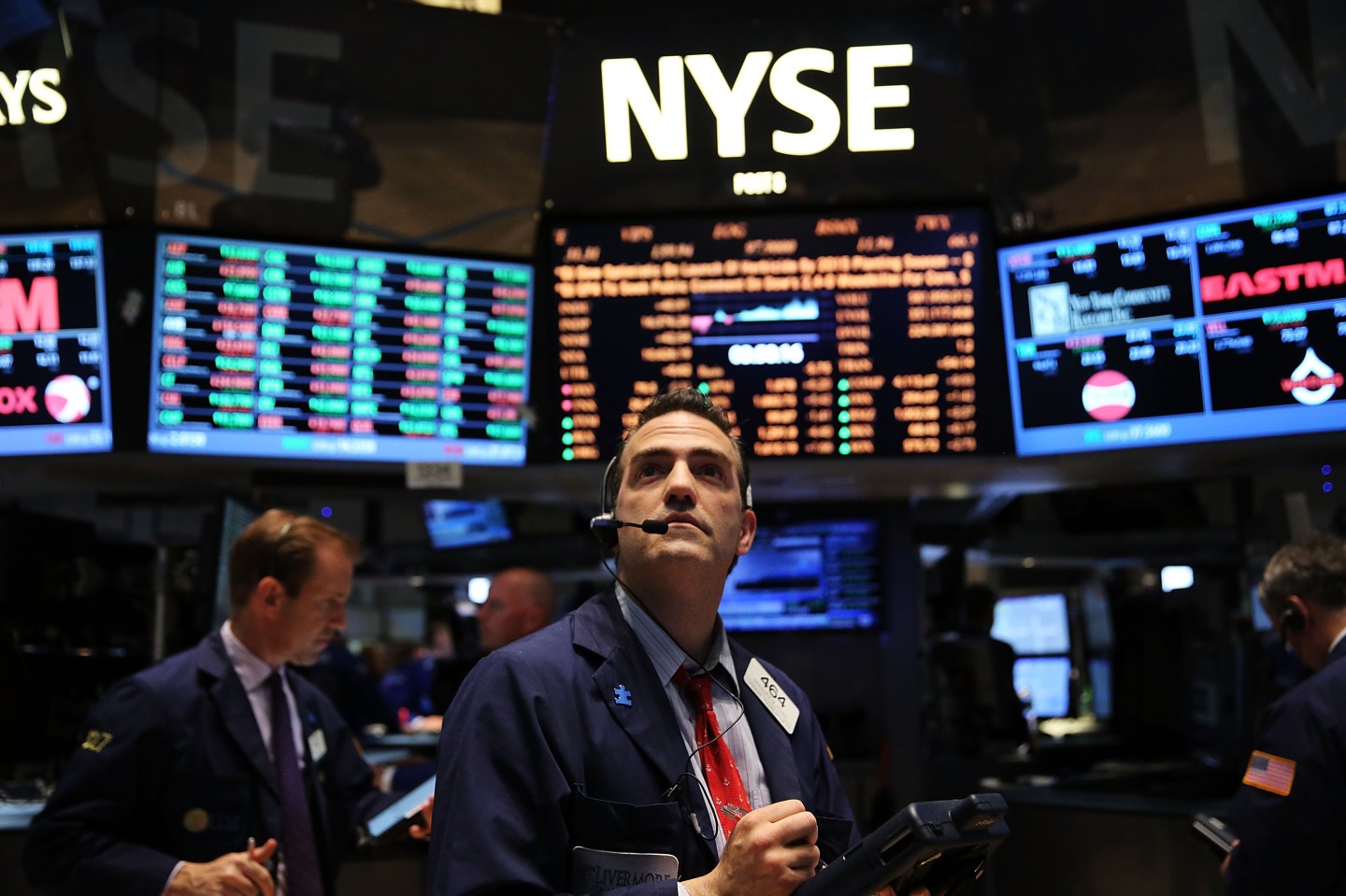
Until now, Wall Street lobby groups have been able to largely ignore any calls for taxing the financial services industry.
Eleven European governments say they’re going to implement a coordinated tax on stock market transactions, but progress has been slow and U.S. policymakers have been much more cautious.
Now, with Bernie Sanders, a major proponent of such taxes, surging in the polls and market volatility rattling investors, the momentum behind this idea is likely to build—as will the backlash.
What we’re talking about here is a small tax, at a fraction of 1%, on each trade of stocks, bonds and derivatives. Opponents argue this would reduce “market liquidity.” Our ability to buy or sell securities at their so-called “equilibrium value” would be limited. And this, in turn, would translate into poorer resource allocation in the economy, and weaker economic growth.
These fears are misplaced.
In a “bull market” there is plenty of liquidity – it is easy to buy and sell a lot of stock when folks are optimistic and prices are rising. But in a “crisis,” it becomes very difficult to trade. The observed changes in “liquidity conditions” in these two types of market environments have nothing to do with transactions costs and everything to do with the fear of losing money when prices are falling.
The sad reality is markets misprice assets all the time. Just take a look at the market this past week. What was the “equilibrium level” of the S&P 500? Was it the low on Tuesday of 1867, or was it the high on Friday of 1990? Was it somewhere in between?
The truth is we don’t know. Stock prices are simply far more volatile than the earnings and cash flows of the companies they represent. And this mispricing of securities often persists for long periods of time, and results in “sub-optimal” resource allocation for our economy.
A tax on stock trades isn’t a magic elixir. It won’t prevent stock prices from moving far away from their “equilibrium values” any more than high transactions costs prevented house prices from moving far away from their equilibrium values. But nor will a transactions tax make our financial markets any less “liquid” of any less “efficient” than they already are.
So why then would a tax on stock transactions be a perfect tax? There are three reasons why.
First, billions of dollars of stock market transactions are already being “taxed.” For more than a decade, so-called high-frequency traders have used so-called “latency arbitrage” to take a little bite from hundreds of millions of transactions in U.S. equity markets. While a purchase order is slowly making its way to an exchange (the “latency” part), a trader with higher-speed access to that exchange intercepts the order and pre-emptively buys and marks up the price of the shares, and then sells them back at a higher price to the slower-moving buyer (the “arbitrage”).
This activity plays out in milliseconds over and over again, and the victim is unaware of the bite. This transactions “tax” does not do the public a whit of good, but it definitely enriches a handful of traders whose low-percentage, high-volume skimming went, until recently, unnoticed.
An explicit transaction tax could transparently and legitimately capture revenue for public purposes and put the high-volume skimmers out of business.
For believers in efficient markets, low-priced, easy-access trading — so-called “frictionless markets” — has been the great dream. But the reality uncovered by psychologists and behavioral economists is that low-priced trading actually harms the vast majority of Americans that embrace it.
Humans overreact to new stimuli, as do the machines they construct, to trade on their behalf. In financial markets, people and their machines move in herds, watching others and emulating them, buying as prices rise and selling as they fall.
At the supermarket, we respond to higher prices by cutting back purchases and we respond to lower prices by loading up the shopping cart. But in the stock market, buyers flock to stocks that have rallied and shy away from stocks that have slumped.
Low-priced easy-access trading makes stock flipping as easy as Tweeting. It enables our primal urges to follow the crowd and to chase the market. Turning the most straightforward market dictum on its head, low-priced trading – by both humans and by machines — leads us to “buy high and sell low.” We hurt ourselves by frequently flipping stocks and we hurt others by amplifying the volatility of stock price movements.
To quote Jack Bogle, founder of the fund management company Vanguard: “When it comes to trading, the greater the activity, the worse the returns.”
Taxing stock market transactions – intentionally adding meaningful friction to the market – can reduce wasteful trading and improve our financial well-being.
Finally, the proceeds from a tax on financial transactions could do a lot of social good. It could support cash-starved financial regulators desperately seeking funds to fulfill their policy mandates. It could help to fund more generous social security benefits to the millions of Americans with nowhere near enough 401K or IRA savings to support a decent standard of living in their retirement years. It could do many positive things.
The social costs of a financial transactions tax appear to be close to zero, and the potential benefits to society loom large. The perfect tax.
Douglas Cliggott is lecturer in economics at the University of Massachusetts Amherst and former managing director and U.S. equity strategist at JP Morgan Chase.