• Home
  • Latest
  • Fortune 500
  • Finance
  • Tech
  • Leadership
  • Lifestyle
  • Rankings
  • Multimedia
Commentary

What Tesla is doing in America’s newest smokestacks-free manufacturing city

By
Bruce Katz
Bruce Katz
and
Kelly Kline
Kelly Kline
Down Arrow Button Icon
By
Bruce Katz
Bruce Katz
and
Kelly Kline
Kelly Kline
Down Arrow Button Icon
July 21, 2015, 10:51 AM ET
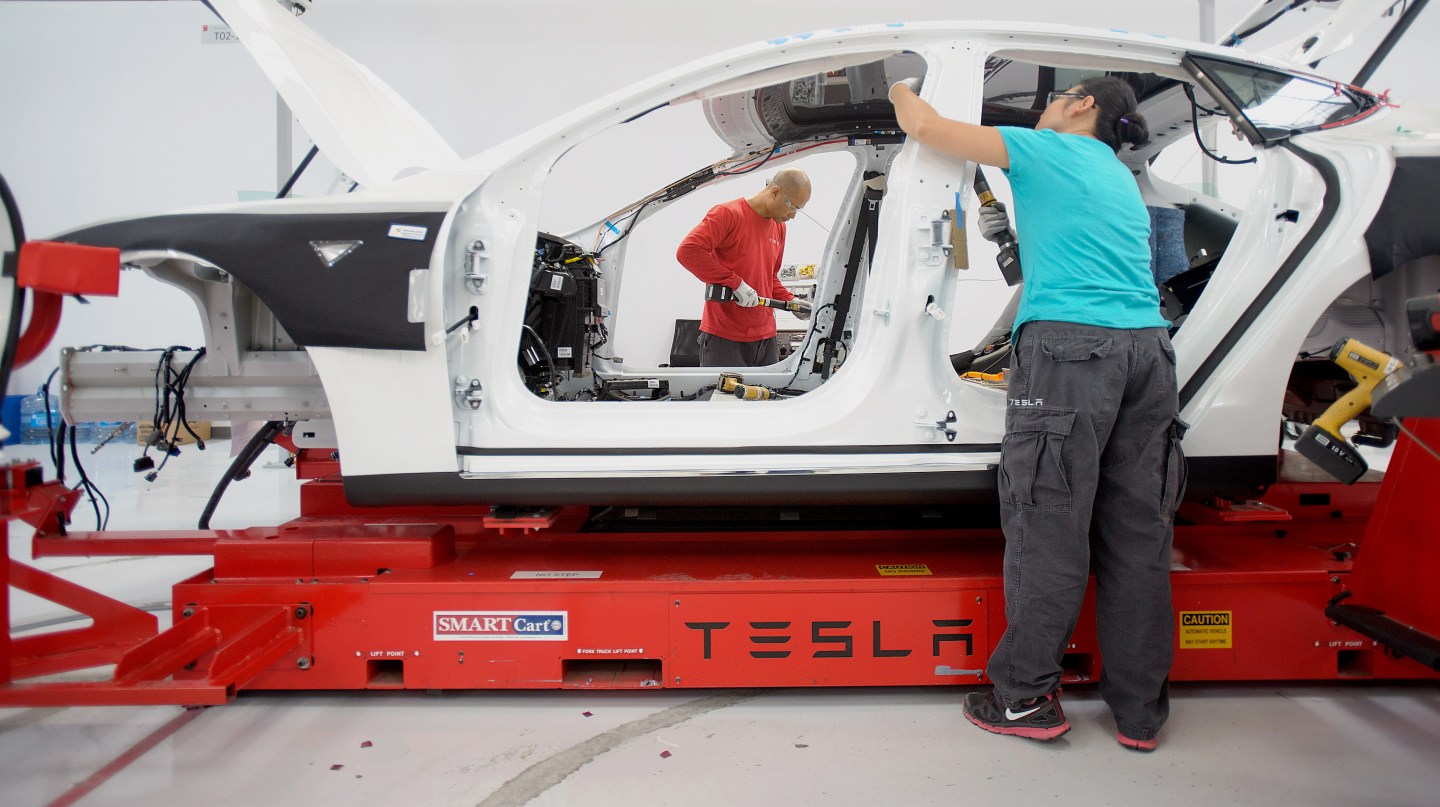
Tesla Motor Co's Plant As Production Of The Model S Speeds Up
Workers add seat belts to a Telsa Motor Inc. Model S sedan at the company's assembly plant in Fremont, California, U.S., on Wednesday, July 10, 2013. Tesla is building Model S electric sedans faster than its initial 400-a-week goal as demand and the companys production skills increase, Chief Executive Officer Elon Musk said. Photographer: Noah Berger/Bloomberg via Getty ImagesPhotograph by Noah Berger — Bloomberg via Getty Images

Manufacturing may conjure up images of smokestacks and smelters, but two former industrial towns are seeking to change what it means—and what it looks like—to make things. By locating large companies near small entrepreneurs, research scientists, and young apprentices, Fremont, Calif. and the Sheffield urban area in the U.K. are embracing the innovation district—new industrial neighborhoods that harness the latest ideas in technology and place-making. The result is smarter products for the global market and the ability to keep and grow manufacturing close to home.

Innovation districts mix corporations, start-up ventures, and advanced research institutions in dense urban areas rich with housing, public transit, and amenities. Think Kendall Square in Cambridge, Mass., University City in Philadelphia, or the new urban vision for Research Triangle Park outside Raleigh-Durham, N.C. Innovation districts cater to high-value research as well as creative endeavors such as industrial design and architecture. Companies benefit from their close proximity to universities and the talented workers and research ideas these anchor institutions generate.

But can these dynamics exist when overlaid on former industrial centers? Two mid-sized cities Fremont and Sheffield are in different parts of the world but share long legacies in manufacturing. In Fremont, a former General Motors (GM) plant is now home to electric car manufacturer Tesla (TSLA), a company that embodies the shift to advanced manufacturing processes and connections between hardware and software. The factory is steps away from a new Bay Area Rapid Transit station and hundreds of acres of land on which there are plans to develop a more urban, amenity-rich environment.


In Sheffield’s neighboring town of Rotherham, a former coal mine now houses the Advanced Manufacturing Research Park, where the University of Sheffield collaborates with over 100 leading research and development (R&D) and production companies including Boeing (BA), Rolls-Royce, BAE Systems, Hitachi, and Tata. Sheffield and Rotherham show how R&D benefits from concentrated districts that take advantage of open, networked innovation.

Fremont and Sheffield are two cities to watch as they transform their historic production hubs into integrated innovation districts. These cities are challenging the idea that industry should be isolated from other uses and are working to end the bifurcation between idea development and product delivery. In response to the demands of a corporate mix of companies like Seagate, Western Digital, and Lam Research, Fremont is adding a high-density residential neighborhood to its innovation district. Sheffield is bringing production and technological problem-solving closer together with early research efforts that will ultimately influence the factory floor. Because their urbanization is nascent, these cities are perfectly positioned to capitalize on this convergence. It is easier for industrial cities to embrace software companies than for white-collar cities to incorporate new industrial uses.

A lot is riding on the success of hardware-software hubs like Fremont and the Sheffield urban area because advanced manufacturing and services are vitally important to modern economies. A recent Brookings report shows that the sector produced 17% ($2.7 trillion) of U.S. GDP and indirectly supported 27 million jobs even though it directly employed just 9% (12.3 million) of U.S. workers. Advanced industry jobs are also high paying—an average salary of $90,000, nearly twice as much as the average in other industries)—and broadly accessible—the average worker has less than a bachelor’s degree.

[fortune-brightcove videoid=4124740502001]


The common thread for Fremont and Sheffield is the opportunity to leverage new growth opportunities fueled by the “Internet of things” (IOT)—the integration of hardware and software. The efficiencies that come from the mingling of industries is perhaps most pronounced in manufacturing, where closely aligned design and production processes are improving cost, quality, and overall competitiveness. In Fremont, Tesla’s electric vehicle supply chain orbits its factory, allowing changes to be made on a dime. And a related but much smaller company called Gridscape Solutions is demonstrating the value of microgrids for critical infrastructure through partnerships with local companies, including Delta Electronics.

Already, best practices are emerging from Sheffield and Fremont that can guide other cities with an advanced manufacturing focus. As with all innovation districts, there are several critical characteristics: local government support, education and research anchors, corporate investment, and skills development. Both cities note the need for high-profile champions, a solid development plan, and a commitment to foster a real mix of uses and a lively atmosphere.

Sheffield and Fremont are changing perceptions about what a factory town looks like and what it can be. Ironically, it may not mean fully shedding their outdated blue-collar, “Full Monty” image but rather, embracing the new maker movement. Advanced manufacturing, it turns out, is the vanguard of the innovative economy.

Bruce Katz is vice president at the Brookings Institution and director of its Metropolitan Policy Program. Katz is author of The Metropolitan Revolution: How Cities and Metros Are Fixing Our Broken Politics and Fragile Economy. Kelly Kline is the economic development director for the City of Fremont and a frequent contributor to the blog, “Takes From Silicon Valley East.”

About the Authors
By Bruce Katz
See full bioRight Arrow Button Icon
By Kelly Kline
See full bioRight Arrow Button Icon

Latest in Commentary

Finance
Lorem ipsum dolor sit amet, consectetur adipiscing elit, sed do eiusmod tempor incididunt ut labore et dolore magna aliqua. Ut enim ad minim veniam
By Fortune Editors
October 20, 2025
Finance
Lorem ipsum dolor sit amet, consectetur adipiscing elit, sed do eiusmod tempor incididunt ut labore et dolore magna aliqua. Ut enim ad minim veniam
By Fortune Editors
October 20, 2025
Finance
Lorem ipsum dolor sit amet, consectetur adipiscing elit, sed do eiusmod tempor incididunt ut labore et dolore magna aliqua. Ut enim ad minim veniam
By Fortune Editors
October 20, 2025
Finance
Lorem ipsum dolor sit amet, consectetur adipiscing elit, sed do eiusmod tempor incididunt ut labore et dolore magna aliqua. Ut enim ad minim veniam
By Fortune Editors
October 20, 2025
Finance
Lorem ipsum dolor sit amet, consectetur adipiscing elit, sed do eiusmod tempor incididunt ut labore et dolore magna aliqua. Ut enim ad minim veniam
By Fortune Editors
October 20, 2025
Finance
Lorem ipsum dolor sit amet, consectetur adipiscing elit, sed do eiusmod tempor incididunt ut labore et dolore magna aliqua. Ut enim ad minim veniam
By Fortune Editors
October 20, 2025

Most Popular

Finance
Lorem ipsum dolor sit amet, consectetur adipiscing elit, sed do eiusmod tempor incididunt ut labore et dolore magna aliqua. Ut enim ad minim veniam
By Fortune Editors
October 20, 2025
Finance
Lorem ipsum dolor sit amet, consectetur adipiscing elit, sed do eiusmod tempor incididunt ut labore et dolore magna aliqua. Ut enim ad minim veniam
By Fortune Editors
October 20, 2025
Finance
Lorem ipsum dolor sit amet, consectetur adipiscing elit, sed do eiusmod tempor incididunt ut labore et dolore magna aliqua. Ut enim ad minim veniam
By Fortune Editors
October 20, 2025
Finance
Lorem ipsum dolor sit amet, consectetur adipiscing elit, sed do eiusmod tempor incididunt ut labore et dolore magna aliqua. Ut enim ad minim veniam
By Fortune Editors
October 20, 2025
Finance
Lorem ipsum dolor sit amet, consectetur adipiscing elit, sed do eiusmod tempor incididunt ut labore et dolore magna aliqua. Ut enim ad minim veniam
By Fortune Editors
October 20, 2025
Finance
Lorem ipsum dolor sit amet, consectetur adipiscing elit, sed do eiusmod tempor incididunt ut labore et dolore magna aliqua. Ut enim ad minim veniam
By Fortune Editors
October 20, 2025
Fortune Secondary Logo
Rankings
  • 100 Best Companies
  • Fortune 500
  • Global 500
  • Fortune 500 Europe
  • Most Powerful Women
  • Future 50
  • World’s Most Admired Companies
  • See All Rankings
Sections
  • Finance
  • Fortune Crypto
  • Features
  • Leadership
  • Health
  • Commentary
  • Success
  • Retail
  • Mpw
  • Tech
  • Lifestyle
  • CEO Initiative
  • Asia
  • Politics
  • Conferences
  • Europe
  • Newsletters
  • Personal Finance
  • Environment
  • Magazine
  • Education
Customer Support
  • Frequently Asked Questions
  • Customer Service Portal
  • Privacy Policy
  • Terms Of Use
  • Single Issues For Purchase
  • International Print
Commercial Services
  • Advertising
  • Fortune Brand Studio
  • Fortune Analytics
  • Fortune Conferences
  • Business Development
About Us
  • About Us
  • Editorial Calendar
  • Press Center
  • Work At Fortune
  • Diversity And Inclusion
  • Terms And Conditions
  • Site Map
Fortune Secondary Logo
  • About Us
  • Editorial Calendar
  • Press Center
  • Work At Fortune
  • Diversity And Inclusion
  • Terms And Conditions
  • Site Map
  • Facebook icon
  • Twitter icon
  • LinkedIn icon
  • Instagram icon
  • Pinterest icon

Latest in Commentary

taylor
CommentaryMarketing
How fandom became culture’s power center — and a blueprint for Gen Z’s economic influence
By Reid LitmanFebruary 21, 2026
6 hours ago
igor
CommentaryMarkets
If the recent AI and crypto shocks upset you, you’re tracking the wrong cycle
By Igor PejicFebruary 21, 2026
8 hours ago
ceos
CommentaryTariffs and trade
We heard CEOs rip into Trump’s tariffs behind the scenes and the Supreme Court just vindicated them
By Jeffrey Sonnenfeld, Steven Tian and Stephen HenriquesFebruary 20, 2026
20 hours ago
AI
CommentaryCareers
Something big is happening in AI, but that’s the only thing Matt Shumer got right
By Neil Chilson and Kevin FrazierFebruary 20, 2026
1 day ago
wealth
CommentaryMillionaires
Are you a ‘hidden millionaire?’
By Joanna RotenbergFebruary 20, 2026
1 day ago
laid off
CommentaryJobs
The billion-dollar justification: why AI giants need you to fear for your job
By David StoutFebruary 19, 2026
2 days ago

Most Popular

placeholder alt text
Economy
Fed confirms it obeyed U.S. Treasury request for an unusual ‘rate check,’ weakening the dollar against foreign currencies
By Jim EdwardsFebruary 19, 2026
2 days ago
placeholder alt text
Innovation
The U.S. spent $30 billion to ditch textbooks for laptops and tablets: The result is the first generation less cognitively capable than their parents
By Sasha RogelbergFebruary 21, 2026
8 hours ago
placeholder alt text
Big Tech
Peter Thiel and other tech billionaires are publicly shielding their children from the products that made them rich
By Marco Quiroz-GutierrezFebruary 21, 2026
7 hours ago
placeholder alt text
AI
‘I’m deeply uncomfortable’: Anthropic CEO warns that a cadre of AI leaders, including himself, should not be in charge of the technology’s future
By Sasha RogelbergFebruary 19, 2026
2 days ago
placeholder alt text
Arts & Entertainment
Gen Zers and millennials flock to so-called analog islands 'because so little of their life feels tangible'
By Michael Liedtke and The Associated PressFebruary 20, 2026
1 day ago
placeholder alt text
Success
'I had to take 60 meetings': Jeff Bezos says 'the hardest thing I've ever done' was raising the first million dollars of seed capital for Amazon
By Dave Smith and Fortune EditorsFebruary 19, 2026
2 days ago

© 2026 Fortune Media IP Limited. All Rights Reserved. Use of this site constitutes acceptance of our Terms of Use and Privacy Policy | CA Notice at Collection and Privacy Notice | Do Not Sell/Share My Personal Information
FORTUNE is a trademark of Fortune Media IP Limited, registered in the U.S. and other countries. FORTUNE may receive compensation for some links to products and services on this website. Offers may be subject to change without notice.