• Home
  • Latest
  • Fortune 500
  • Finance
  • Tech
  • Leadership
  • Lifestyle
  • Rankings
  • Multimedia
TechMoore's Law

Intel’s tweaking Moore’s Law, like Moore’s Law still matters

By
Stacey Higginbotham
Stacey Higginbotham
Down Arrow Button Icon
By
Stacey Higginbotham
Stacey Higginbotham
Down Arrow Button Icon
July 17, 2015, 12:26 PM ET
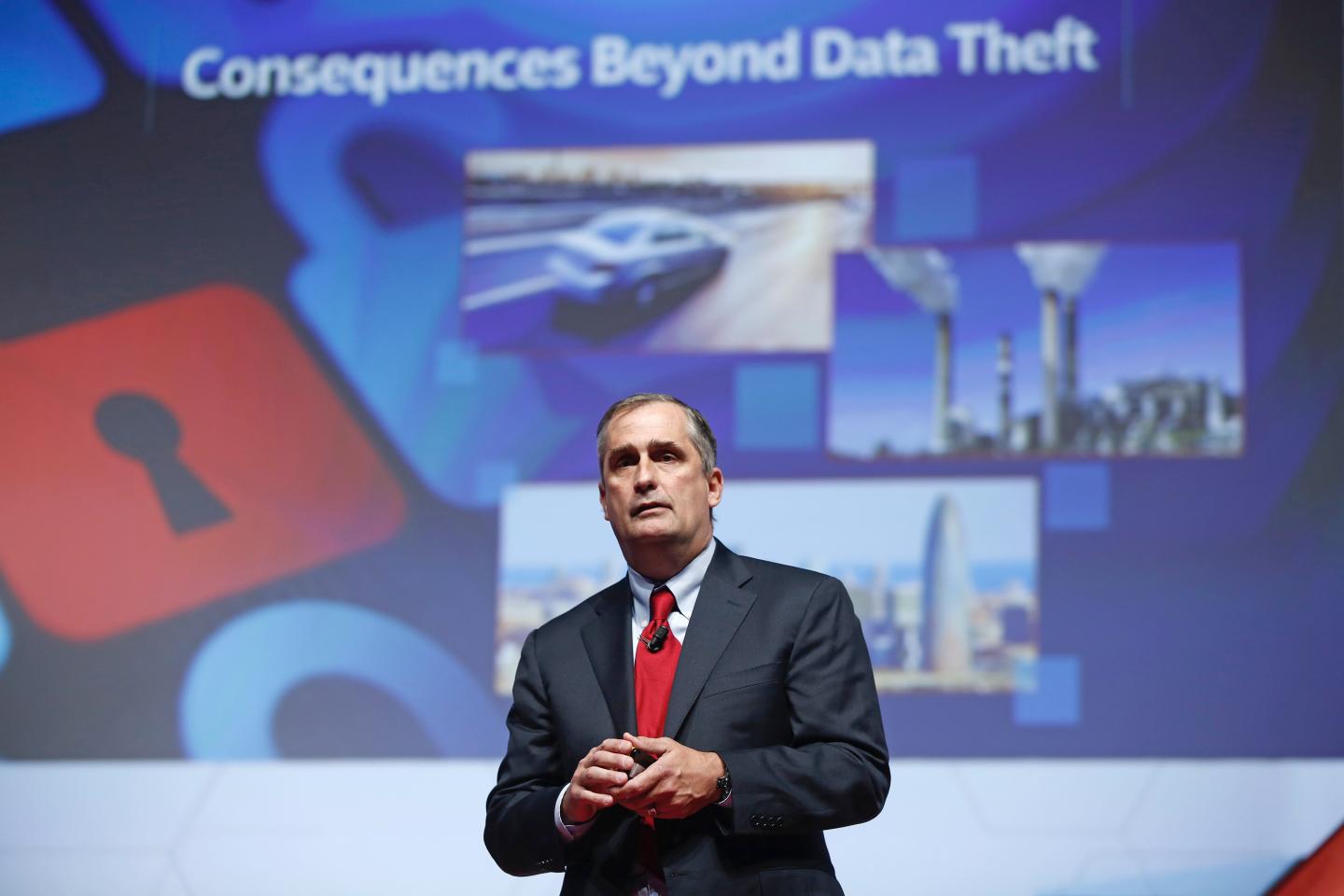
Brian Krzanich, chief executive officer of Intel Corp., speaks during a keynote session at the Mobile World Congress in Barcelona, Spain, on Wednesday, March 4, 2015. The event, which generates several hundred million euros in revenue for the city of Barcelona each year, also means the world for a week turns its attention back to Europe for the latest in technology, despite a lagging ecosystem. Photographer: Simon Dawson/Bloomberg *** Local Caption *** Brian Krzanich
Brian Krzanich, chief executive officer of Intel Corp., speaks during a keynote session at the Mobile World Congress in Barcelona, Spain, on Wednesday, March 4, 2015. The event, which generates several hundred million euros in revenue for the city of Barcelona each year, also means the world for a week turns its attention back to Europe for the latest in technology, despite a lagging ecosystem. Photographer: Simon Dawson/Bloomberg *** Local Caption *** Brian KrzanichPhotograph by Simon Dawson — Bloomberg via Getty Images

Intel CEO Brian Krzanich said Wednesday that the exponential advances in semiconductor manufacturing that enable faster and cheaper computing and storage every two years are now going to come closer to a rate of every two and half years. If Intel’s CEO had said it couldn’t keep cramming more transistors on a chip a decade and a half ago or even a decade ago, it would have shocked the tech world.

But today, adjusting the formula for what is known as Moore’s Law—named after Intel co-founder Gordon Moore—Krzanich was making a significant announcement for Intel shareholders and customers, but a less important one for the tech industry overall.

That’s because Moore’s Law is less relevant. The need to put more transistors on a chip is still important, which is why everyone was super excited about IBM’s announcement that it had made a super-dense 7-nanometer chip last week. However, density is no longer the most important aspect of a chip. Cramming more transistors mattered when all you wanted was faster chips that were good at one style of computing. But we don’t actually live in that world anymore.


Intel’s style of computing is really good at corporate jobs on desktops, servers and things that require linear progression, stuff like spreadsheets and word processors and everything associated with the phrase Wintel. And that remains a big part of computing today. But it’s not great for an increasing swath of computing jobs, such as transcoding graphics, networking, climate or seismic simulations, or Monte Carlo simulations required by trading desks. Those jobs require parallel computing that is much better handled by graphics processing units (or GPUs) offered by AMD or Nvidia.

This isn’t a new trend. The GPU folks were calling the end of Moore’s Law in 2010 and I was writing about it then too. Concerns about power consumption in the data center also helped drive the adoption of GPUs and research into other types of semiconductors from novel architectures that never quite caught on to Intel’s own research into chips such as its Larrabee design.

And as mobility became a top concern, Moore’s Law took another blow. Storage inside phones still relies heavily on Moore’s Law, so the cost of the memory cards and upgrades matters, although technologies such as stacking and new memory alternatives can help there as well. But when it comes to the brains for the handset, power consumption is the priority. This means the emphasis is on assigning the right task for the right chip, which is why graphics processors and specialized sensor processors such as the M7 inside the iPhone are being popped into handsets.

The emphasis isn’t on a massive, super-dense semiconductor that is marching down the process node following Moore’s Law. And as we progress into intensive real-time data processing and artificial intelligence, researchers are looking beyond Intel architectures as well. Google is trying out quantum computing and IBM, HP, the U.S. military and others are spending on processors that mirror the human brain. Others are trying to make computers that are right only some of the time (instead of all of the time) in an effort to cut down on power usage.

So when Krzanich said of Intel’s efforts to follow Moore’s Law, “The last two technology transitions have signaled that our cadence today is closer to 2½ years than two,” analysts paid attention because they want to understand when Intel gets to reap the benefits of its next-generation chip. But the rest of the computing world glanced back, nodded and kept their eyes on the real prize—taking us beyond the limits of Moore’s architecture.

Subscribe to Data Sheet, Fortune’s daily newsletter on the business of technology.

About the Author
By Stacey Higginbotham
See full bioRight Arrow Button Icon

Latest in Tech

Finance
Lorem ipsum dolor sit amet, consectetur adipiscing elit, sed do eiusmod tempor incididunt ut labore et dolore magna aliqua. Ut enim ad minim veniam
By Fortune Editors
October 20, 2025
Finance
Lorem ipsum dolor sit amet, consectetur adipiscing elit, sed do eiusmod tempor incididunt ut labore et dolore magna aliqua. Ut enim ad minim veniam
By Fortune Editors
October 20, 2025
Finance
Lorem ipsum dolor sit amet, consectetur adipiscing elit, sed do eiusmod tempor incididunt ut labore et dolore magna aliqua. Ut enim ad minim veniam
By Fortune Editors
October 20, 2025
Finance
Lorem ipsum dolor sit amet, consectetur adipiscing elit, sed do eiusmod tempor incididunt ut labore et dolore magna aliqua. Ut enim ad minim veniam
By Fortune Editors
October 20, 2025
Finance
Lorem ipsum dolor sit amet, consectetur adipiscing elit, sed do eiusmod tempor incididunt ut labore et dolore magna aliqua. Ut enim ad minim veniam
By Fortune Editors
October 20, 2025
Finance
Lorem ipsum dolor sit amet, consectetur adipiscing elit, sed do eiusmod tempor incididunt ut labore et dolore magna aliqua. Ut enim ad minim veniam
By Fortune Editors
October 20, 2025

Most Popular

Finance
Lorem ipsum dolor sit amet, consectetur adipiscing elit, sed do eiusmod tempor incididunt ut labore et dolore magna aliqua. Ut enim ad minim veniam
By Fortune Editors
October 20, 2025
Finance
Lorem ipsum dolor sit amet, consectetur adipiscing elit, sed do eiusmod tempor incididunt ut labore et dolore magna aliqua. Ut enim ad minim veniam
By Fortune Editors
October 20, 2025
Finance
Lorem ipsum dolor sit amet, consectetur adipiscing elit, sed do eiusmod tempor incididunt ut labore et dolore magna aliqua. Ut enim ad minim veniam
By Fortune Editors
October 20, 2025
Finance
Lorem ipsum dolor sit amet, consectetur adipiscing elit, sed do eiusmod tempor incididunt ut labore et dolore magna aliqua. Ut enim ad minim veniam
By Fortune Editors
October 20, 2025
Finance
Lorem ipsum dolor sit amet, consectetur adipiscing elit, sed do eiusmod tempor incididunt ut labore et dolore magna aliqua. Ut enim ad minim veniam
By Fortune Editors
October 20, 2025
Finance
Lorem ipsum dolor sit amet, consectetur adipiscing elit, sed do eiusmod tempor incididunt ut labore et dolore magna aliqua. Ut enim ad minim veniam
By Fortune Editors
October 20, 2025
Fortune Secondary Logo
Rankings
  • 100 Best Companies
  • Fortune 500
  • Global 500
  • Fortune 500 Europe
  • Most Powerful Women
  • World's Most Admired Companies
  • See All Rankings
  • Lists Calendar
Sections
  • Finance
  • Fortune Crypto
  • Features
  • Leadership
  • Health
  • Commentary
  • Success
  • Retail
  • Mpw
  • Tech
  • Lifestyle
  • CEO Initiative
  • Asia
  • Politics
  • Conferences
  • Europe
  • Newsletters
  • Personal Finance
  • Environment
  • Magazine
  • Education
Customer Support
  • Frequently Asked Questions
  • Customer Service Portal
  • Privacy Policy
  • Terms Of Use
  • Single Issues For Purchase
  • International Print
Commercial Services
  • Advertising
  • Fortune Brand Studio
  • Fortune Analytics
  • Fortune Conferences
  • Business Development
  • Group Subscriptions
About Us
  • About Us
  • Press Center
  • Work At Fortune
  • Terms And Conditions
  • Site Map
  • About Us
  • Press Center
  • Work At Fortune
  • Terms And Conditions
  • Site Map
  • Facebook icon
  • Twitter icon
  • LinkedIn icon
  • Instagram icon
  • Pinterest icon

Latest in Tech

Google Cloud revenue is now 18% of Alphabet’s business. Is this the beginning of the end of Google’s search identity?
Big TechGoogle
Google Cloud revenue is now 18% of Alphabet’s business. Is this the beginning of the end of Google’s search identity?
By Alexei OreskovicApril 29, 2026
1 hour ago
Man wearing a suit and tie and glasses
Big TechTech
Microsoft, Meta, and Google just announced billions more in AI spending. Only Google convinced investors it’s paying off
By Amanda GerutApril 29, 2026
2 hours ago
A man in a suit and tie
InvestingMeta
Meta just bumped its 2026 capex forecast up to as much as $145 billion for the AI boom—and investors flinched
By Amanda GerutApril 29, 2026
4 hours ago
How JPMorgan’s CIO is reshaping work at the bank with a $19.8 billion annual tech and AI budget
NewslettersCIO Intelligence
How JPMorgan’s CIO is reshaping work at the bank with a $19.8 billion annual tech and AI budget
By John KellApril 29, 2026
9 hours ago
hollywood
CommentaryMarketing
I spent 20 years learning to navigate an industry. Then I built a campaign for the man who’s dismantling it
By Matti YahavApril 29, 2026
13 hours ago
Current price of Ethereum for April 29, 2026
Personal FinanceEthereum
Current price of Ethereum for April 29, 2026
By Joseph HostetlerApril 29, 2026
13 hours ago

Most Popular

Apple cofounder Ronald Wayne—whose stake would be worth up to $400 billion had he not sold it in 1976—says that at 91, he has no regrets
Success
Apple cofounder Ronald Wayne—whose stake would be worth up to $400 billion had he not sold it in 1976—says that at 91, he has no regrets
By Preston ForeApril 27, 2026
2 days ago
‘Take the money and run’: Johns Hopkins economist Steve Hanke on why the UAE quit OPEC
Energy
‘Take the money and run’: Johns Hopkins economist Steve Hanke on why the UAE quit OPEC
By Shawn TullyApril 29, 2026
20 hours ago
‘The cost of compute is far beyond the costs of the employees’: Nvidia executive says right now AI is more expensive than paying human workers
AI
‘The cost of compute is far beyond the costs of the employees’: Nvidia executive says right now AI is more expensive than paying human workers
By Sasha RogelbergApril 28, 2026
2 days ago
Jamie Dimon gets candid about national debt: ‘There will be a bond crisis, and then we’ll have to deal with it’
Economy
Jamie Dimon gets candid about national debt: ‘There will be a bond crisis, and then we’ll have to deal with it’
By Eleanor PringleApril 29, 2026
16 hours ago
More than two-thirds of U.S. schools say they’re unable to afford the cost of student free lunch—and MAHA’s dietary guidelines may make it worse
Economy
More than two-thirds of U.S. schools say they’re unable to afford the cost of student free lunch—and MAHA’s dietary guidelines may make it worse
By Sasha RogelbergApril 29, 2026
18 hours ago
Current price of gold as of April 28, 2026
Personal Finance
Current price of gold as of April 28, 2026
By Danny BakstApril 28, 2026
2 days ago

© 2026 Fortune Media IP Limited. All Rights Reserved. Use of this site constitutes acceptance of our Terms of Use and Privacy Policy | CA Notice at Collection and Privacy Notice | Do Not Sell/Share My Personal Information
FORTUNE is a trademark of Fortune Media IP Limited, registered in the U.S. and other countries. FORTUNE may receive compensation for some links to products and services on this website. Offers may be subject to change without notice.