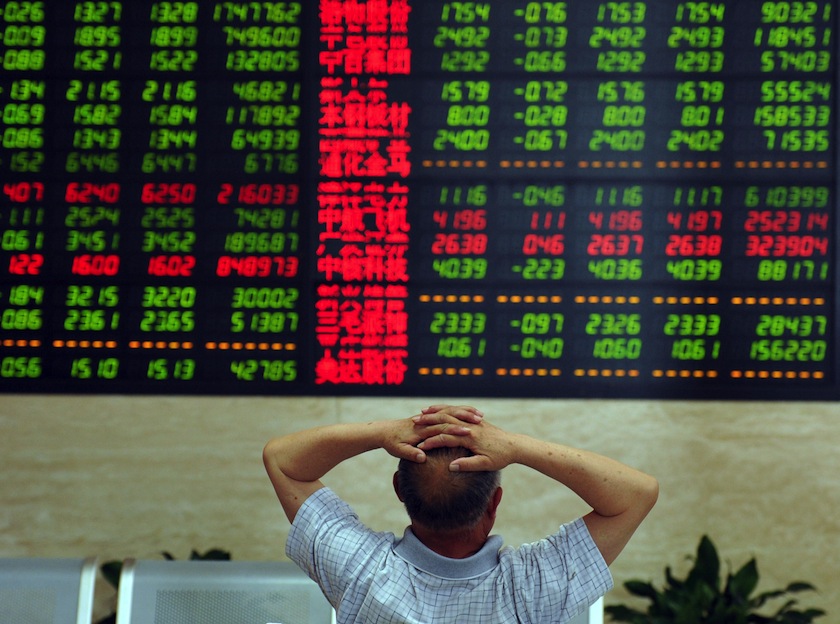
The rout in China’s frothy stock markets since mid-June has been painful, to say the least. Between its peak on June 12 and July 2, the Shanghai Composite Index, which includes China’s largest companies, dropped 28%, wiping out $2.4 trillion in paper wealth.
In real market economies, stock crashes of such magnitude may cause heartburn but unlikely precipitate frenzied government efforts to prop up equity prices. But China is, as we know, not exactly a market economy and has a government that acts differently. In response to the latest crash, instead of allowing market forces to self-correct, Beijing is rolling out aggressive measures to keep the bubble from popping completely.
Over the weekend, the People’s Bank of China announced a plan to inject funds into a state-owned entity that lends to brokerage firms. The country’s 21 brokerage firms also pledged 120 billion yuan to invest in stocks when the Shanghai Composite Index is below 4,500 (it closed at 3687 on July 2). Besides financing the bubble with new money, the Chinese government has suspended IPOs, cut trading fees, and relaxed requirements on margin loans (for example, Chinese retail investors can now use their apartments as collateral).
We can excuse Chinese leaders for fearing that a rapid collapse of the leverage-fueled bubble would set off secondary financial implosions in the country’s financial sector. Margin loans are estimated to total 4 trillion yuan, half of which is supplied by the shadow banking system, and they are the source of 18% of the country’s total credit, making them an integral part of the financial system. Beijing worries that a market crash could create, through the shadow banking system, financial contagion that, in turn, will accelerate the bursting of another much bigger bubble: Chinese real estate.
There are, however, two less charitable explanations for China’s latest moves. First, Chinese leaders tend to view economic issues from a purely political perspective. Unsurprisingly, the performance of the stock market has been made a barometer of the popularity of the current regime. The head of China Security Regulatory Commission not too long ago called the soaring market “a reform bull market,” suggesting that investors were giving a vote of confidence in the leadership’s promised reform programs. A plunging market would imply a loss of confidence and falling popularity of the current leadership—an intolerable prospect.
Second, those who have watched how China deals with bubbles know that its leaders have little faith in market forces but excessive confidence in their ability to sustain bubbles.
We can see this mindset at work in China’s management of two recent bubbles: the real estate market and local government debt. In addressing the real estate market bubble, Beijing has opted to keep insolvent developers alive by forcing their lenders to roll over the loans. Consequently, the glut of unsold inventory hangs over the real estate sector. Because there is such an excess in the supply of housing, it is unlikely that those zombie real estate developers will return to life and pay their creditors in full.
Beijing has used a similar recipe for shoring up its debt-laden local governments. After the bond market rejected Beijing’s plan to float the debt issued by local governments earlier this year, Chinese leaders simply ordered state-owned banks to buy such debt, adding assets of dubious quality to their balance sheet.
Fortunately for Chinese leaders, they have not paid a heavy penalty for supporting these bubbles. At least not yet. It is also likely that, in deciding to intervene in a crashing stock market, Beijing believes that it can again get away with market-defying policies.
We do not know whether Beijing’s big stock market gamble will pay off, but its odds are not encouraging. Even after its recent plunge, Chinese stock prices are overvalued. The price-earnings (P/E) ratio of the Shanghai Composite Index is 23, compared with 12 for the Hong Kong’s Hang Shen Index, on which many of the same Chinese firms are listed. The Shenzhen Composite Index, which has lost a third of its value, has an average P/E ratio of 50. (However, a hefty portion of the reported earnings of Chinese firms is “investment income,” paper gains from their overvalued stock portfolios.) Efforts to support the market at high valuations are expensive and unlikely sustainable.
Beijing is trying to save the stock market bubble while three other bubbles have yet to deflate: real estate, local government debt, and manufacturing overcapacity. It’s possible that these bubbles will feed into each other, amplifying distortions and raising the final bill to clean up the mess.
The opportunity costs for Beijing’s intervention are very high. Right now, Beijing should be building social safety nets and recapitalizing its banks, not betting the house on a stock market bubble.
Minxin Pei is the Tom and Margot Pritzker ’72 Professor of Government at Claremont McKenna College and a non-resident senior fellow of the German Marshall Fund of the United States