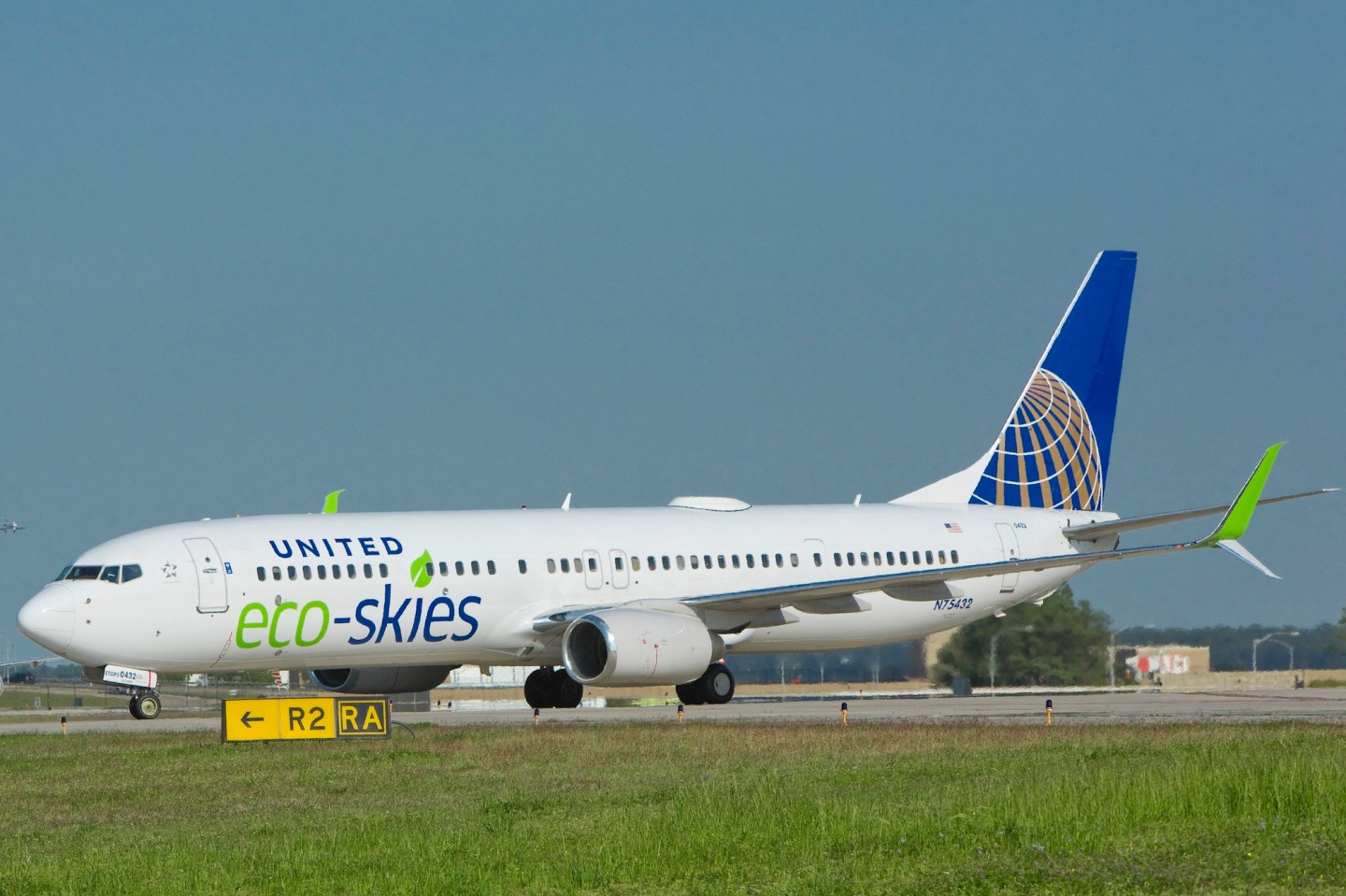
A first-of-its kind factory that will turn garbage into fuel for airplanes is inching closer to reality in the same Nevada industrial park as Tesla’s planned massive battery factory.
Fulcrum BioEnergy said Tuesday that it has raised $30 million from United Airlines partly to help work on the factory, which has been planned for nearly seven years. Higher than expected costs and longer development times, have hampered the project, which would create a unusual source of jet fuel.
The funding comes at a time when the biofuel industry has faced difficult times and startups come and go due to both the nascent stage of the market, and the wide availability of cheap fossil fuels. Because of the high risk, investors have been shying away from the niche sector.
Whatever the case, airlines are looking for any solution to volatile fuel prices, which have a huge impact on their costs. They are increasingly looking at securing new fuel options, even from biofuels. In addition, airlines are under increased pressure to reduce carbon emissions by new government mandates like the Environmental Protection Agency’s new draft rules announced earlier this month.
A loan guarantee
While many biofuel companies have tried and failed to sell jet fuel in large quantities, Fulcrum BioEnergy has some support that other haven’t had. In addition to United Airlines, the company has also had the U.S. federal government in its corner.
Near the end of last year, Fulcrum BioEnergy closed on a $105 million loan guarantee through Bank of America backed by the U.S. Agriculture Department. That amount represents less than half the factory’s total cost of $266 million, according to the USDA statement.
But that factory cost represents a major increase from estimates in 2011. At that time, Fulcrum predicted the factory could be built for closer to $120 million.
Through the loan guarantee, the USDA will take over the debt obligation if Fulcrum BioEnergy is unable to pay. The loan guarantee means Fulcrum BioEnergy’s loan comes with better interest rates than if Fulcrum tried to raise financing on its own.
Over the years, the USDA has backed a handful of these new, high risk biofuel factories. The idea behind the federal government’s support is to help promising tech companies working on lowering carbon emissions in the transportation industry.
But sometimes this support hasn’t turned out so well, making these federal loan programs quite controversial. For example, the USDA guaranteed an $80 million loan to biofuel startup Range Fuels, which later defaulted and was forced to sell off its factory. The now infamous Solyndra, which crashed and burned years ago, had a loan guaranteed by the U.S. Energy Department.
To play it a little safer, and avoid more failures, the USDA, (as well as the DOE) have more recently required companies that get their loan guarantees to meet more stringent milestones and conditions.
For its part, Fulcrum BioEnergy had to build a demonstration facility in North Carolina that is a smaller version of what it hopes to do at its Nevada facility. Fulcrum BioEnergy CEO James Macias told Fortune that the company spent a lot of time and effort making sure the North Carolina facility would use the exact same production process as the Nevada plant, showing the factory could run continuously and reliably.
Fulcrum BioEnergy also has to fund the rest of the factory. That’s partly why the new United Airlines investment is important.
But Fulcrum also has other investors as well. Trash giant Waste Management and airline Cathay Pacific have both put in money in recent years. Early investors in the startup were U.S. Renewables Group and Rustic Canyon Partners. U.S. Renewables Group Partner James McDermott founded the company.
In 2011 the company tried to raise money through the public markets for its factory by filing for an initial public offering. But a year later, citing adverse market conditions, the company withdrew from the process.
The factory
Fulcrum BioEnergy’s Nevada factory will use garbage that has been sorted to exclude waste like rocks, dirt, metal, and glass. What’s left — paper, plastic, fabric, and wood— will serve as the raw ingredients for its bio jet fuel.
The company plans to buy garbage from Waste Management Nevada, thereby diverting over 200,000 tons of refuse from the local land fills when the factory is fully operational. Power giant Abengoa has also agreed to serve as the construction company to build the factory, which will create 500 jobs.
To make the fuel, Fulcrum shreds trash and then bakes it at high temperatures to produce a gas. That gas is then purified and converted into ethanol.
Garbage-to-fuel technology faces a big hurdle in that the process can be complicated and takes many steps. Even the initial process of sourcing and sorting the trash can be time intensive. The more complicated the process, the more expensive it generally is.
Fulcrum’s Macias told the New York Times that the company will be able to produce its biofuel for “a lot less than” $1 a gallon. That’s probably when — and if — the company reaches a commercial mass scale.
For now, Fulcrum BioEnergy hasn’t yet commercialized its technology. The first plant outside of Reno won’t start producing biofuels until the end of 2017. And that’s depending on if everything goes as planned.
Beyond the first plant, the company says it wants to build another five plants to produce fuel for customers. As part of the partnerships with United and Cathay Pacific, Fulcrum is committed to selling them biofuel.
While the Nevada factory will only produce 10 million gallons per year, Fulcrum ambitiously talks about a deal with United to buy potentially 90 million gallons of fuel annually over many years. The deal discussed with Cathay Pacific is around selling the airline 375 million gallons of fuel over many years. Volumes like those — if they ever happen — would come in the far, far future.
These deals in general should be taken with a grain of salt. In its press release, United Airlines describe the deal as “an agreement that contemplates the joint development of up to five projects located near United’s hubs expected to have the potential to produce up to 180 million gallons of fuel per year.” Companies don’t really need strict agreements to “contemplate” projects.
Getting a first of this kind biofuel plant built is an unbelievably high risk project. Many things can go wrong and costs usually end up being much higher than expected. That Fulcrum BioEnergy has survived this long and is now getting that much closer to building its first commercial factory is a feat on its own.