

• Home
  • Latest
  • Fortune 500
  • Finance
  • Tech
  • Leadership
  • Lifestyle
  • Rankings
  • Multimedia
Retailbird flu

What the worst bird flu outbreak in U.S. history means for farms

Erika Fry
By
Erika Fry
Erika Fry
Down Arrow Button Icon
Erika Fry
By
Erika Fry
Erika Fry
Down Arrow Button Icon
June 25, 2015, 2:00 PM ET
Sunrise Farms in Osceola County, Iowa, taken on May 4, 2015. Photo by Ryan Donnell
Sunrise Farms in Osceola County, Iowa, taken on May 4, 2015. Photo by Ryan DonnellRyan Donnell

We have seen the future, and it’s northwest Iowa. This spring this corner of the Hawkeye State has been overwhelmed with dead birds—31.5 million of them. For weeks flu-stricken and euthanized chickens, turkeys, and other fowl piled up in dumpsters, attracting flies and emitting a stench. Only recently has the disposal crisis abated, with the help of round-the-clock incinerators and crews in hazmat suits.

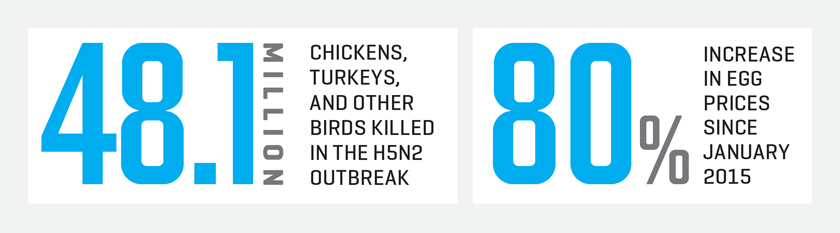
The carnage is the work of H5N2, the virus whose sweep through Midwestern poultry farms (Minnesota has been badly affected too) had killed 48.1 million birds as of late June. It’s the worst avian flu outbreak in U.S. history, and its impact is spreading: Egg prices have soared, and food companies, including Hormel and Post Holdings, have warned of likely declines in sales. The cost of dead poultry stands at $191 million; the total economic damage of the outbreak in Iowa alone is estimated at $957 million.
MAC.07.01.15. avian stats

Certainly, for farmers whose flocks were hit by H5N2—some of whom lost 5 million birds in one fell swoop—the financial and emotional toll has been devastating. “Our industry has been turned upside down,” says Randy Olson, executive director of the Iowa Poultry Association. At the same time, more than 40 countries have restricted or placed total bans on American poultry imports because of the virus—bans that have created a chicken glut in the U.S. and complicated economics for farmers who weren’t hit by the flu.

But perhaps the most troubling aspect of the crisis is its implications for the viability of industrial-scale farming. The egg industry’s huge “layer operations”—the sort that house millions of birds in one place—are designed to protect birds from contamination, says Michael Osterholm, director of the Center for Infectious Disease Research and Policy at the University of Minnesota at the University of Minnesota. The animals’ environment is tightly controlled, and workers who enter the henhouse follow special hygiene protocols; often, they must shower in and out, change clothes and wear special boots. But when a virus pierces such defenses, or when defenses lapse, having all of one’s eggs in one basket (so to speak) can make the impact more devastating.

That industry standards failed to keep H5N2 out of hen houses this year is puzzling and unsettling to observers, and a matter of active inquiry. Center Fresh, a leading egg producer in Sioux Center, Iowa, passed its USDA biosecurity audit just two months its birds came down with the flu. “With this highly infectious disease, there are just some points of entry that we hadn’t conceived of,” says Olson. “We’re not even sure what those points of entry are.”

The poultry apocalypse also exposes the food system’s vulnerability to such diseases. Like previous avian strains, H5N2 arrived in the U.S. in the droppings of migratory birds, says Jim Roth, director of the Center for Food Security and Public Health at Iowa State University. But it seems to have spread among farms in the Midwest in novel, unforeseen ways. The role of wind and even ventilation systems—transmission routes that current biosecurity strategies don’t address—are now the subject of intense study and anxiety.

The industry will know more as studies are completed in the coming weeks, but for now poultry farms in the South, wary of wild birds that may fly their way in the fall, are battening down the hatches. “Everything was working great for the diseases we knew,” says Roth, “but avian influenza is changing the rules.”

A version of this article appears in the July 1, 2015 issue of Fortune magazine with the headline “‘Big Ag’ is Laid Low by a Virus.”


About the Author
Erika Fry
By Erika Fry
LinkedIn iconTwitter icon
See full bioRight Arrow Button Icon

Latest in Retail

Finance
Lorem ipsum dolor sit amet, consectetur adipiscing elit, sed do eiusmod tempor incididunt ut labore et dolore magna aliqua. Ut enim ad minim veniam
By Fortune Editors
October 20, 2025
Finance
Lorem ipsum dolor sit amet, consectetur adipiscing elit, sed do eiusmod tempor incididunt ut labore et dolore magna aliqua. Ut enim ad minim veniam
By Fortune Editors
October 20, 2025
Finance
Lorem ipsum dolor sit amet, consectetur adipiscing elit, sed do eiusmod tempor incididunt ut labore et dolore magna aliqua. Ut enim ad minim veniam
By Fortune Editors
October 20, 2025
Finance
Lorem ipsum dolor sit amet, consectetur adipiscing elit, sed do eiusmod tempor incididunt ut labore et dolore magna aliqua. Ut enim ad minim veniam
By Fortune Editors
October 20, 2025
Finance
Lorem ipsum dolor sit amet, consectetur adipiscing elit, sed do eiusmod tempor incididunt ut labore et dolore magna aliqua. Ut enim ad minim veniam
By Fortune Editors
October 20, 2025
Finance
Lorem ipsum dolor sit amet, consectetur adipiscing elit, sed do eiusmod tempor incididunt ut labore et dolore magna aliqua. Ut enim ad minim veniam
By Fortune Editors
October 20, 2025

Most Popular

Finance
Lorem ipsum dolor sit amet, consectetur adipiscing elit, sed do eiusmod tempor incididunt ut labore et dolore magna aliqua. Ut enim ad minim veniam
By Fortune Editors
October 20, 2025
Finance
Lorem ipsum dolor sit amet, consectetur adipiscing elit, sed do eiusmod tempor incididunt ut labore et dolore magna aliqua. Ut enim ad minim veniam
By Fortune Editors
October 20, 2025
Finance
Lorem ipsum dolor sit amet, consectetur adipiscing elit, sed do eiusmod tempor incididunt ut labore et dolore magna aliqua. Ut enim ad minim veniam
By Fortune Editors
October 20, 2025
Finance
Lorem ipsum dolor sit amet, consectetur adipiscing elit, sed do eiusmod tempor incididunt ut labore et dolore magna aliqua. Ut enim ad minim veniam
By Fortune Editors
October 20, 2025
Finance
Lorem ipsum dolor sit amet, consectetur adipiscing elit, sed do eiusmod tempor incididunt ut labore et dolore magna aliqua. Ut enim ad minim veniam
By Fortune Editors
October 20, 2025
Finance
Lorem ipsum dolor sit amet, consectetur adipiscing elit, sed do eiusmod tempor incididunt ut labore et dolore magna aliqua. Ut enim ad minim veniam
By Fortune Editors
October 20, 2025
Fortune Secondary Logo
Rankings
  • 100 Best Companies
  • Fortune 500
  • Global 500
  • Fortune 500 Europe
  • Most Powerful Women
  • Future 50
  • World’s Most Admired Companies
  • See All Rankings
Sections
  • Finance
  • Fortune Crypto
  • Features
  • Leadership
  • Health
  • Commentary
  • Success
  • Retail
  • Mpw
  • Tech
  • Lifestyle
  • CEO Initiative
  • Asia
  • Politics
  • Conferences
  • Europe
  • Newsletters
  • Personal Finance
  • Environment
  • Magazine
  • Education
Customer Support
  • Frequently Asked Questions
  • Customer Service Portal
  • Privacy Policy
  • Terms Of Use
  • Single Issues For Purchase
  • International Print
Commercial Services
  • Advertising
  • Fortune Brand Studio
  • Fortune Analytics
  • Fortune Conferences
  • Business Development
About Us
  • About Us
  • Editorial Calendar
  • Press Center
  • Work At Fortune
  • Diversity And Inclusion
  • Terms And Conditions
  • Site Map
Fortune Secondary Logo
  • About Us
  • Editorial Calendar
  • Press Center
  • Work At Fortune
  • Diversity And Inclusion
  • Terms And Conditions
  • Site Map
  • Facebook icon
  • Twitter icon
  • LinkedIn icon
  • Instagram icon
  • Pinterest icon

Latest in Retail

HealthFood and drink
Chains like Sweetgreen and Chipotle are finally realizing they need to look beyond the ‘slop bowl’
By Phil WahbaFebruary 27, 2026
1 day ago
burger king
AIOpenAI
Burger King tests OpenAI-powered headsets that will track the friendliness of drive-through workers
By Dee-Ann Durbin and The Associated PressFebruary 27, 2026
1 day ago
Two restaurant workers wearing black stand in front of a silver "Flippy" fry station.
AIAutomation
Meet your new robot fry cooks: Inside the $28 billion race to disrupt White Castle and Jack in the Box
By Sasha RogelbergFebruary 26, 2026
2 days ago
Customers in the electronics section at Walmart on Black Friday in Columbus, Ohio, US, on Friday, Nov. 28, 2025. Americans are planning to spend more this holiday season than last year, according to credit reporting firm TransUnion. Photographer: Brian Kaiser/Bloomberg via Getty Images
C-SuiteLeadership
McKinsey studied 61 growth companies that outperformed their peers through COVID, inflation, and labor shocks. Here’s what they all had in common
By Geoff ColvinFebruary 26, 2026
3 days ago
The Home Depot storefront
InvestingHome Depot
Home Depot CEO says with the housing market stalemate, ‘our customers are telling us that they’re not investing’
By Jacqueline MunisFebruary 25, 2026
4 days ago
CommentaryCulture
Gen Z’s enthusiasm for all things touchable is resurrecting the analog economy—and costing parents
By Luba KassovaFebruary 24, 2026
4 days ago

Most Popular

placeholder alt text
Success
Japanese companies are paying older workers to sit by a window and do nothing—while Western CEOs demand super-AI productivity just to keep your job
By Orianna Rosa RoyleFebruary 27, 2026
1 day ago
placeholder alt text
Success
Walmart exec says U.S. workforces needs to take inspiration from China where ‘5 year-olds are learning DeepSeek’
By Preston ForeFebruary 27, 2026
2 days ago
placeholder alt text
AI
The week the AI scare turned real and America realized maybe it isn't ready for what's coming
By Nick LichtenbergFebruary 28, 2026
14 hours ago
placeholder alt text
Middle East
Iran is now on 'death ground' amid existential threat from U.S. attacks and could 'go big' in retaliation, former NATO commander warns
By Jason MaFebruary 28, 2026
7 hours ago
placeholder alt text
Personal Finance
Current price of gold as of February 27, 2026
By Danny BakstFebruary 27, 2026
1 day ago
placeholder alt text
Law
China's government intervenes to show Michigan scientists were carrying worms, not biological materials
By Ed White and The Associated PressFebruary 26, 2026
2 days ago

© 2026 Fortune Media IP Limited. All Rights Reserved. Use of this site constitutes acceptance of our Terms of Use and Privacy Policy | CA Notice at Collection and Privacy Notice | Do Not Sell/Share My Personal Information
FORTUNE is a trademark of Fortune Media IP Limited, registered in the U.S. and other countries. FORTUNE may receive compensation for some links to products and services on this website. Offers may be subject to change without notice.