• Home
  • Latest
  • Fortune 500
  • Finance
  • Tech
  • Leadership
  • Lifestyle
  • Rankings
  • Multimedia
LeadershipChina

How the U.S. can confront China’s Great Wall of Sand

By
Minxin Pei
Minxin Pei
Down Arrow Button Icon
By
Minxin Pei
Minxin Pei
Down Arrow Button Icon
May 15, 2015, 12:23 PM ET
South China Sea
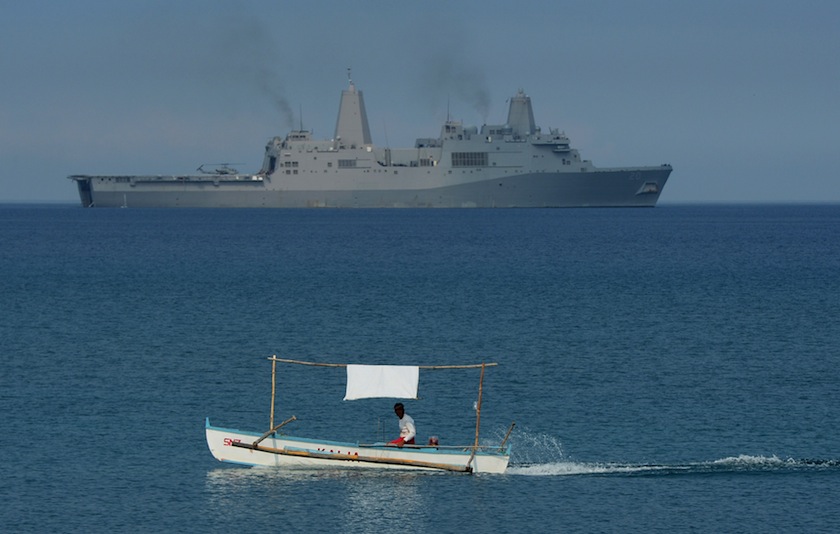
A Filipino fisherman is seen past the US Navy amphibious transport dock ship USS Green Bay (LPD-20) during an amphibious landing exercise on a beach at San Antonio in Zambales province on April 21, 2015, as part of annual Philippine-US joint maneuvers some 220 kilometres (137 miles) east of the Scarborough Shoal in the South China Sea. The Philippines voiced alarm April 20 about Chinese "aggressiveness" in disputed regional waters as it launched giant war games with the United States that were partly aimed as a warning shot to Beijing. AFP PHOTO/TED ALJIBE (Photo credit should read TED ALJIBE/AFP/Getty Images)Photo by Ted Aljibe—AFP/Getty Images

Not too long ago, if you had to guess where the U.S. and China could get into a direct military confrontation, the waters around the Senkaku-Diaoyu Islands—over which China and Japan, an American treaty ally, had been embroiled in bitter territorial disputes—would be as good a bet as any. Today, though, the South China Sea seems a much better candidate.

The Pentagon is seriously considering a robust response to recent Chinese activities in the disputed areas in the South China Sea. Since late 2012, China has been stepping up its efforts to turn the coral reefs it occupies into large artificial islands. Its progress is so rapid that recent satellite pictures show that Chinese construction crews have successfully reclaimed large areas surrounding the six reefs in the Spratly archipelago currently occupied by China. Prior to these activities, the reefs were submerged during high tides. Today, they have been built into sizable artificial islands, one of which has its own cement plant and airstrip.

The construction and operation of these artificial islands in disputed waters have serious long-term implications. Technically, existing international law neither prohibits nor permits Chinese reclamation activities. To be sure, China is not the only country that has taken advantage of this legal lacuna. Vietnam, another claimant in the South China Sea maritime disputes, has also engaged in similar, albeit more modest, activities in the two reefs it occupies.

Washington has a few reasons to challenge Beijing’s moves in the South China Sea. According to the United Nations Convention on the Law of the Sea (UNCLOS), parties that exercise effective administrative control over unclaimed or disputed territories enjoy considerable legal advantages in establishing and defending their claims. Based on this doctrine, Chinese leaders have developed a sophisticated strategy. While a satisfactory legal resolution of the disputes in the South China Sea is unlikely in the short term, constructing artificial islands in the contested areas is the surest way to strengthen China’s bargaining position and legal claims. Once these artificial islands become operational and inhabitable, China can assert its sovereignty over the 12-mile territorial airspace and waters. Should Beijing succeed in further expanding these artificial islands and turn them into self-sustaining economic entities with its own sources of energy and fresh water supplies, China could even conceivably claim the 200-mile exclusive economic zone around these islands, as allowed under the UNCLOS.

For the United States, China’s strategy raises troubling concerns. Left unchallenged, China will almost certainly succeed in executing its clever plan. This will allow China to reject or contest, on a more favorable legal basis, the maritime claims of its neighbors and the freedom of navigation in the area prized by the U.S. Navy.

Since the other claimants, particularly Vietnam and the Philippines, have no means to challenge China’s activities, only the U.S. can intervene to thwart this plan.

Defense Secretary Ashton Carter has instructed the Pentagon to examine several options, such as flying American military aircraft over the airspace of these artificial islands and sending U.S. naval vessels within 12 miles of the islands to contest Chinese claims. Technically, such acts by the U.S. military, if peacefully sustained, may weaken, or even void, China’s assertion of sovereignty. Ironically, Washington appears to have imitated Beijing’s tactics in contesting sovereignty claims made by Japan over the Senkaku-Diaoyu Islands. At the height of the Sino-Japanese confrontation over these islands in 2012-2013, Chinese military aircraft and paramilitary vessels repeatedly entered the territorial airspace and waters to demonstrate that Japan had no effective administrative control over the islands.

However, the U.S. plan to confront China in the South China Sea carries significant risks, especially if it decides to send in armed military aircraft and vessels. The Chinese are likely to respond by sending its own military jets and warships to intercept them. One can imagine dangerous scenarios of accidents and collisions.

Of course, Washington can minimize the risks of accidental military clashes with China by dispatching unarmed aircraft and vessels. In addition, it can also demonstrate its even-handedness by sending similar aircraft and vessels into the airspace and waters surrounding the two artificial islands being constructed by Vietnam.

Ultimately, a face-saving solution will only come through diplomacy. So far, Washington’s diplomatic pressure has not changed Beijing’s mind or behavior. Now, with the Pentagon floating its own ideas of a muscular response, the Obama Administration should make Chinese leaders rethink their assumptions and options. Secretary of State John Kerry is heading to Beijing this weekend in another attempt to de-escalate tensions with China. He may have better luck this time.

Minxin Pei is the Tom and Margot Pritzker ’72 Professor of Government at Claremont McKenna College and a non-resident senior fellow of the German Marshall Fund of the United States


About the Author
By Minxin Pei
See full bioRight Arrow Button Icon

Latest in Leadership

Finance
Lorem ipsum dolor sit amet, consectetur adipiscing elit, sed do eiusmod tempor incididunt ut labore et dolore magna aliqua. Ut enim ad minim veniam
By Fortune Editors
October 20, 2025
Finance
Lorem ipsum dolor sit amet, consectetur adipiscing elit, sed do eiusmod tempor incididunt ut labore et dolore magna aliqua. Ut enim ad minim veniam
By Fortune Editors
October 20, 2025
Finance
Lorem ipsum dolor sit amet, consectetur adipiscing elit, sed do eiusmod tempor incididunt ut labore et dolore magna aliqua. Ut enim ad minim veniam
By Fortune Editors
October 20, 2025
Finance
Lorem ipsum dolor sit amet, consectetur adipiscing elit, sed do eiusmod tempor incididunt ut labore et dolore magna aliqua. Ut enim ad minim veniam
By Fortune Editors
October 20, 2025
Finance
Lorem ipsum dolor sit amet, consectetur adipiscing elit, sed do eiusmod tempor incididunt ut labore et dolore magna aliqua. Ut enim ad minim veniam
By Fortune Editors
October 20, 2025
Finance
Lorem ipsum dolor sit amet, consectetur adipiscing elit, sed do eiusmod tempor incididunt ut labore et dolore magna aliqua. Ut enim ad minim veniam
By Fortune Editors
October 20, 2025

Most Popular

Finance
Lorem ipsum dolor sit amet, consectetur adipiscing elit, sed do eiusmod tempor incididunt ut labore et dolore magna aliqua. Ut enim ad minim veniam
By Fortune Editors
October 20, 2025
Finance
Lorem ipsum dolor sit amet, consectetur adipiscing elit, sed do eiusmod tempor incididunt ut labore et dolore magna aliqua. Ut enim ad minim veniam
By Fortune Editors
October 20, 2025
Finance
Lorem ipsum dolor sit amet, consectetur adipiscing elit, sed do eiusmod tempor incididunt ut labore et dolore magna aliqua. Ut enim ad minim veniam
By Fortune Editors
October 20, 2025
Finance
Lorem ipsum dolor sit amet, consectetur adipiscing elit, sed do eiusmod tempor incididunt ut labore et dolore magna aliqua. Ut enim ad minim veniam
By Fortune Editors
October 20, 2025
Finance
Lorem ipsum dolor sit amet, consectetur adipiscing elit, sed do eiusmod tempor incididunt ut labore et dolore magna aliqua. Ut enim ad minim veniam
By Fortune Editors
October 20, 2025
Finance
Lorem ipsum dolor sit amet, consectetur adipiscing elit, sed do eiusmod tempor incididunt ut labore et dolore magna aliqua. Ut enim ad minim veniam
By Fortune Editors
October 20, 2025
Fortune Secondary Logo
Rankings
  • 100 Best Companies
  • Fortune 500
  • Global 500
  • Fortune 500 Europe
  • Most Powerful Women
  • Future 50
  • World’s Most Admired Companies
  • See All Rankings
Sections
  • Finance
  • Fortune Crypto
  • Features
  • Leadership
  • Health
  • Commentary
  • Success
  • Retail
  • Mpw
  • Tech
  • Lifestyle
  • CEO Initiative
  • Asia
  • Politics
  • Conferences
  • Europe
  • Newsletters
  • Personal Finance
  • Environment
  • Magazine
  • Education
Customer Support
  • Frequently Asked Questions
  • Customer Service Portal
  • Privacy Policy
  • Terms Of Use
  • Single Issues For Purchase
  • International Print
Commercial Services
  • Advertising
  • Fortune Brand Studio
  • Fortune Analytics
  • Fortune Conferences
  • Business Development
  • Group Subscriptions
About Us
  • About Us
  • Editorial Calendar
  • Press Center
  • Work At Fortune
  • Diversity And Inclusion
  • Terms And Conditions
  • Site Map
  • About Us
  • Editorial Calendar
  • Press Center
  • Work At Fortune
  • Diversity And Inclusion
  • Terms And Conditions
  • Site Map
  • Facebook icon
  • Twitter icon
  • LinkedIn icon
  • Instagram icon
  • Pinterest icon

Latest in Leadership

erewhon
EconomyFood and drink
Americans hate the economy so much, they’re buying $22 smoothies
By Yuanyuan (Gina) Cui, Patrick Van Esch and The ConversationApril 9, 2026
12 hours ago
Mark Cuban admits he made a mistake letting go of the Mavericks: ‘I don’t regret selling. I regret who I sold to’
InvestingMark Cuban
Mark Cuban admits he made a mistake letting go of the Mavericks: ‘I don’t regret selling. I regret who I sold to’
By Sydney LakeApril 9, 2026
13 hours ago
You’re looking at the AI revolution all wrong, top economist says: 40% unemployment and a 3-day work week are the same thing
AIdisruption
You’re looking at the AI revolution all wrong, top economist says: 40% unemployment and a 3-day work week are the same thing
By Nick LichtenbergApril 9, 2026
13 hours ago
Jamie Dimon, the CEO of JPMorgan Chase
SuccessCareer Advice
JPMorgan CEO Jamie Dimon says he’s ‘learned and relearned’ to not make big decisions when he’s tired on Fridays
By Emma BurleighApril 9, 2026
14 hours ago
Zoom CEO Eric Yuan
Successthe future of work
‘I hate working 5 days’: Zoom CEO says traditional work schedules are becoming obsolete—and predicts a 3-day workweek by 2031
By Preston ForeApril 9, 2026
14 hours ago
trump
PoliticsIran
Trump’s journey from ‘annihilation’ to ‘PEACE’ in one day rested on realization of a long-term battle to control Strait of Hormuz
By Aamer Madhani, Will Weissert, Josh Boak, Farnoush Amiri and The Associated PressApril 9, 2026
17 hours ago

Most Popular

The U.S. government is spending $88 billion a month in interest on national debt—equal to spending on defense and education combined
Economy
The U.S. government is spending $88 billion a month in interest on national debt—equal to spending on defense and education combined
By Fortune EditorsApril 9, 2026
18 hours ago
Gen Z doesn't want your full-time job. They want several part-time roles, and it's reshaping the entire workforce
Success
Gen Z doesn't want your full-time job. They want several part-time roles, and it's reshaping the entire workforce
By Fortune EditorsApril 9, 2026
21 hours ago
A Meta employee created a dashboard so coworkers can compete to be the company's No. 1 AI token user—and Zuckerberg doesn't even rank in the top 250
AI
A Meta employee created a dashboard so coworkers can compete to be the company's No. 1 AI token user—and Zuckerberg doesn't even rank in the top 250
By Fortune EditorsApril 9, 2026
20 hours ago
2 years ago, Saudi Arabia quietly canceled the ‘petrodollar’ deal with America that wired the world economy for 50 years. Then war broke out in Iran
Energy
2 years ago, Saudi Arabia quietly canceled the ‘petrodollar’ deal with America that wired the world economy for 50 years. Then war broke out in Iran
By Fortune EditorsApril 7, 2026
2 days ago
White-collar workers are quietly rebelling against AI as 80% outright refuse adoption mandates
AI
White-collar workers are quietly rebelling against AI as 80% outright refuse adoption mandates
By Fortune EditorsApril 9, 2026
19 hours ago
Gen Z workers are so fearful AI will take their job they’re intentionally sabotaging their company’s AI rollout
AI
Gen Z workers are so fearful AI will take their job they’re intentionally sabotaging their company’s AI rollout
By Fortune EditorsApril 8, 2026
2 days ago

© 2026 Fortune Media IP Limited. All Rights Reserved. Use of this site constitutes acceptance of our Terms of Use and Privacy Policy | CA Notice at Collection and Privacy Notice | Do Not Sell/Share My Personal Information
FORTUNE is a trademark of Fortune Media IP Limited, registered in the U.S. and other countries. FORTUNE may receive compensation for some links to products and services on this website. Offers may be subject to change without notice.