• Home
  • Latest
  • Fortune 500
  • Finance
  • Tech
  • Leadership
  • Lifestyle
  • Rankings
  • Multimedia
CommentaryNepal earthquake

The sad economic lesson of the earthquakes in Nepal

By
Susana Ferreira
Susana Ferreira
Down Arrow Button Icon
By
Susana Ferreira
Susana Ferreira
Down Arrow Button Icon
May 13, 2015, 11:33 AM ET
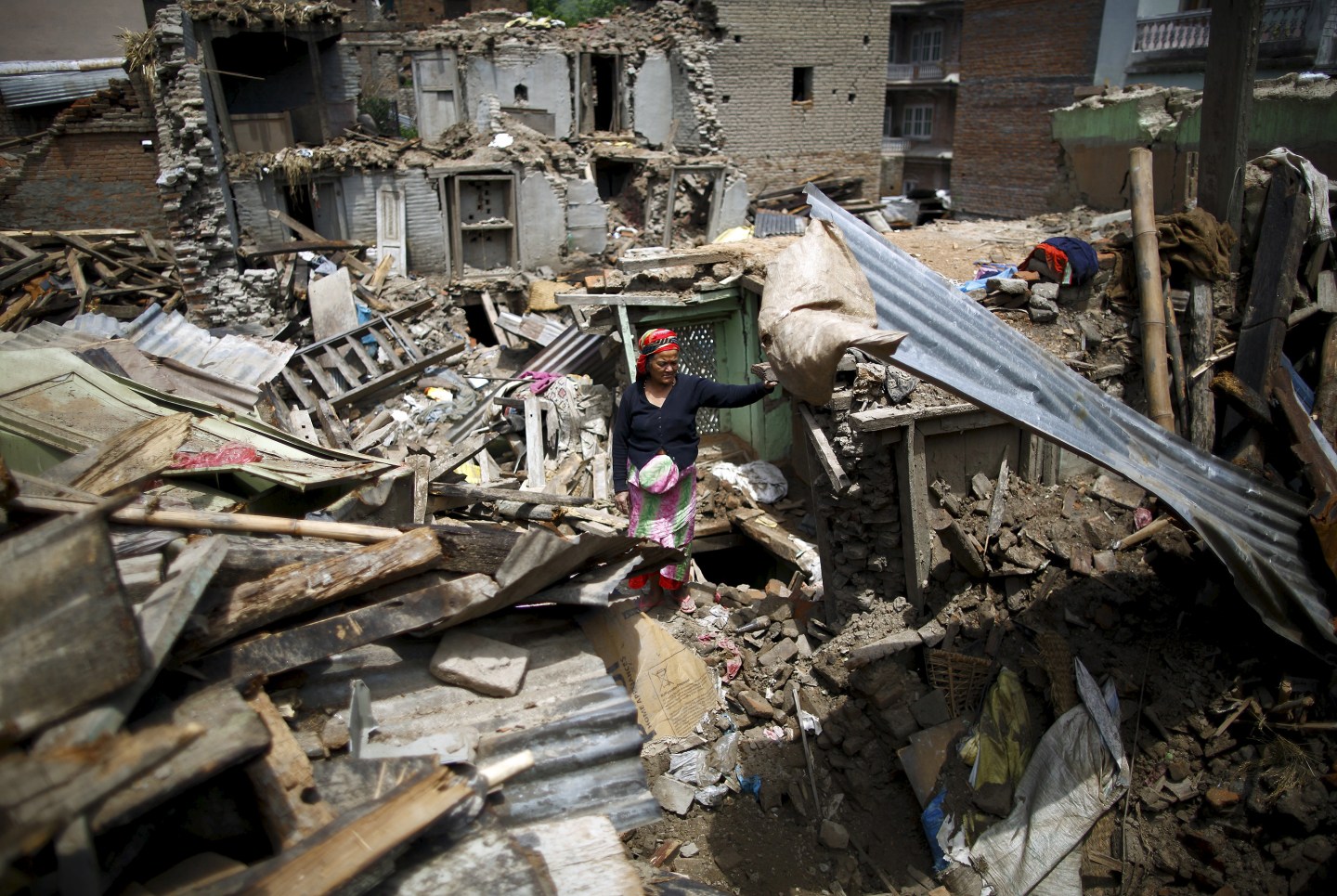
A woman stands on the debris of collapsed houses after a fresh 7.3-magnitude earthquake struck Nepal, in Sankhu
A woman stands on the debris of collapsed houses after a fresh 7.3-magnitude earthquake struck Nepal, in Sankhu May 12, 2015. REUTERS/Navesh Chitrakar - RTX1CL8DPhotograph by Navesh Chitrakar — Reuters

Two weeks after a 7.8-magnitude earthquake left thousands dead and destroyed much of the country’s infrastructure, another major, 7.3-magnitude earthquake struck Nepal on Tuesday, causing panic and adding to the damages. With the monsoon season beginning in six weeks, landsides and flooding could further complicate the recovery efforts and deteriorate the living conditions in an already impoverished nation. Nepal is one of the world’s poorest countries. Corruption is rife and it is politically unstable. After a decade of conflict that ended in 2006 with the creation of a Maoist government recently defeated in the 2013 elections, Nepal’s future seems uncertain. But will these tragic events resonate through global financial markets? Honestly, probably not.

The reason? Economics.

For all the destruction that natural disasters in recent history have caused, and for all the attention that they have gained in the public eye, they ultimately have had a negligible impact on the global economy over the past three centuries. While “domestic” disasters, earthquakes in particular, can have marked impacts on specific sectors such as insurance, construction and real estate, there are often economic winners as well as losers. On aggregate, earthquakes have had a small effect on GDP growth and long-term GDP for the countries affected (even if the immediate damages have been large). In a global and interconnected world, the ever-present concern is that disasters might impact countries other than those directly affected, for example neighbors or trading partners. But global financial markets have proven resilient to earthquake shocks and other natural disasters. More generally, noneconomic newsworthy events from president assassinations to election results to international conflicts— the type of major political and world events making headlines in major international newspapers and business magazines—have shown a surprisingly small effect on aggregate stock market returns.

There are exceptions to the rule, of course. The recent earthquakes in Nepal stand in contrast with the March 11, 2011 Tohoku-Oki earthquake and tsunami in Japan and the resulting Fukushima Daiichi nuclear accident that affected the third largest economy in the world. The earthquake and tsunami ravaged twenty prefectures in northeast Japan, killing thousands and causing an estimated $211-235 billion in damages. It hit the home of auto and semiconductor manufacturing, destroying factories, disrupting the supply of raw materials and causing power shortages across the country. In this age of global markets and just-in-time production processes, even a small disruption in the supply of a single component can cause turmoil in entire production lines. The 2011 earthquake had a negative impact across all the sectors in the Japanese stock market, with utilities experiencing the largest negative impact.

Were there ripple effects for the rest of the world? Did other economies feel the impacts of the disaster? Some economic sectors certainly did. Less than two months after the nuclear disaster, Chancellor Angela Merkel proclaimed an acceleration of the phase-out of nuclear power in Germany. Recent studies have shown that nuclear utilities across the world exhibited negative returns after Fukushima, an effect mainly driven by a heightened perception of nuclear risks. Even here, though, the impact on global financial markets was not uniformly negative. It varied across both countries and business sectors, arguably reflecting the nature of the trade linkages between Japan and the rest of the world. In general, for sectors whose supply chains rely on Japanese exports, there were negative abnormal returns, but substitution with domestic production or with imports from other trading partners reduced the magnitude of abnormal returns, and other sectors experienced abnormal positive returns.

If the global economic impact of the disaster in Japan was not large on aggregate, the global impact of the Nepali earthquakes will be negligible. Nepal’s main exports to the rest of the world are textiles. Its GDP is less than one percent of Japan’s, and it relies heavily on agriculture and on remittances from workers abroad. That an earthquake that has killed over 8,000 people, displaced hundred of thousands, and destroyed much of a country’s infrastructure will not register in global economic terms should not be a relief, however. It is a tragedy. It is a symptom that the assistance that the world is providing now should have arrived much earlier.

Susana Ferreira is an associate professor at the department of agricultural and applied economics at the University of Georgia.


About the Author
By Susana Ferreira
See full bioRight Arrow Button Icon

Latest in Commentary

Finance
Lorem ipsum dolor sit amet, consectetur adipiscing elit, sed do eiusmod tempor incididunt ut labore et dolore magna aliqua. Ut enim ad minim veniam
By Fortune Editors
October 20, 2025
Finance
Lorem ipsum dolor sit amet, consectetur adipiscing elit, sed do eiusmod tempor incididunt ut labore et dolore magna aliqua. Ut enim ad minim veniam
By Fortune Editors
October 20, 2025
Finance
Lorem ipsum dolor sit amet, consectetur adipiscing elit, sed do eiusmod tempor incididunt ut labore et dolore magna aliqua. Ut enim ad minim veniam
By Fortune Editors
October 20, 2025
Finance
Lorem ipsum dolor sit amet, consectetur adipiscing elit, sed do eiusmod tempor incididunt ut labore et dolore magna aliqua. Ut enim ad minim veniam
By Fortune Editors
October 20, 2025
Finance
Lorem ipsum dolor sit amet, consectetur adipiscing elit, sed do eiusmod tempor incididunt ut labore et dolore magna aliqua. Ut enim ad minim veniam
By Fortune Editors
October 20, 2025
Finance
Lorem ipsum dolor sit amet, consectetur adipiscing elit, sed do eiusmod tempor incididunt ut labore et dolore magna aliqua. Ut enim ad minim veniam
By Fortune Editors
October 20, 2025

Most Popular

Finance
Lorem ipsum dolor sit amet, consectetur adipiscing elit, sed do eiusmod tempor incididunt ut labore et dolore magna aliqua. Ut enim ad minim veniam
By Fortune Editors
October 20, 2025
Finance
Lorem ipsum dolor sit amet, consectetur adipiscing elit, sed do eiusmod tempor incididunt ut labore et dolore magna aliqua. Ut enim ad minim veniam
By Fortune Editors
October 20, 2025
Finance
Lorem ipsum dolor sit amet, consectetur adipiscing elit, sed do eiusmod tempor incididunt ut labore et dolore magna aliqua. Ut enim ad minim veniam
By Fortune Editors
October 20, 2025
Finance
Lorem ipsum dolor sit amet, consectetur adipiscing elit, sed do eiusmod tempor incididunt ut labore et dolore magna aliqua. Ut enim ad minim veniam
By Fortune Editors
October 20, 2025
Finance
Lorem ipsum dolor sit amet, consectetur adipiscing elit, sed do eiusmod tempor incididunt ut labore et dolore magna aliqua. Ut enim ad minim veniam
By Fortune Editors
October 20, 2025
Finance
Lorem ipsum dolor sit amet, consectetur adipiscing elit, sed do eiusmod tempor incididunt ut labore et dolore magna aliqua. Ut enim ad minim veniam
By Fortune Editors
October 20, 2025
Rankings
  • 100 Best Companies
  • Fortune 500
  • Global 500
  • Fortune 500 Europe
  • Most Powerful Women
  • Future 50
  • World’s Most Admired Companies
  • See All Rankings
Sections
  • Finance
  • Leadership
  • Success
  • Tech
  • Asia
  • Europe
  • Environment
  • Fortune Crypto
  • Health
  • Retail
  • Lifestyle
  • Politics
  • Newsletters
  • Magazine
  • Features
  • Commentary
  • Mpw
  • CEO Initiative
  • Conferences
  • Personal Finance
  • Education
Customer Support
  • Frequently Asked Questions
  • Customer Service Portal
  • Privacy Policy
  • Terms Of Use
  • Single Issues For Purchase
  • International Print
Commercial Services
  • Advertising
  • Fortune Brand Studio
  • Fortune Analytics
  • Fortune Conferences
  • Business Development
About Us
  • About Us
  • Editorial Calendar
  • Press Center
  • Work At Fortune
  • Diversity And Inclusion
  • Terms And Conditions
  • Site Map
  • Facebook icon
  • Twitter icon
  • LinkedIn icon
  • Instagram icon
  • Pinterest icon

Most Popular

placeholder alt text
Economy
Elon Musk warns the U.S. is '1,000% going to go bankrupt' unless AI and robotics save the economy from crushing debt
By Jason MaFebruary 7, 2026
2 days ago
placeholder alt text
Economy
Russian officials are warning Putin that a financial crisis could arrive this summer, report says, while his war on Ukraine becomes too big to fail
By Jason MaFebruary 8, 2026
17 hours ago
placeholder alt text
Commentary
America marks its 250th birthday with a fading dream—the first time that younger generations will make less than their parents
By Mark Robert Rank and The ConversationFebruary 8, 2026
1 day ago
placeholder alt text
Success
Gen Z Patriots quarterback Drake Maye still drives a 2015 pickup truck even after it broke down on the highway—despite his $37 million contract
By Sasha RogelbergFebruary 7, 2026
2 days ago
placeholder alt text
Commentary
We studied 70 countries' economic data for the last 60 years and something big about market crashes changed 25 years ago
By Josh Ederington, Jenny Minier and The ConversationFebruary 8, 2026
1 day ago
placeholder alt text
Success
NBA star Metta World Peace says Kobe Bryant taught him that no matter how hard you work, someone else is working harder
By Orianna Rosa RoyleFebruary 8, 2026
1 day ago

© 2026 Fortune Media IP Limited. All Rights Reserved. Use of this site constitutes acceptance of our Terms of Use and Privacy Policy | CA Notice at Collection and Privacy Notice | Do Not Sell/Share My Personal Information
FORTUNE is a trademark of Fortune Media IP Limited, registered in the U.S. and other countries. FORTUNE may receive compensation for some links to products and services on this website. Offers may be subject to change without notice.


Latest in Commentary

tara comonte
CommentaryAdvertising
Weight Watchers CEO: what the GLP-1 Super Bowl ads are missing
By Tara ComonteFebruary 9, 2026
30 minutes ago
ceo
CommentaryLeadership
The next 18 months of the agentic era will feel like a slow-motion stress test for CEOs. Most will make the same critical mistake
By Amy Eliza WongFebruary 9, 2026
2 hours ago
CommentaryHealth
Patient private capital is needed to help Asia plug its healthcare gaps
By Abrar MirFebruary 8, 2026
14 hours ago
nfl
CommentaryTV
The Super Bowl was made for TV and instant replay was made for visual AI. Here’s how it could be better and what it would look like
By Jason CorsoFebruary 8, 2026
24 hours ago
tipping
CommentaryTipping
I’m the chief growth officer at a payments app and I know how America really tips. Connecticut, I’m looking at you
By Ricardo CiciFebruary 8, 2026
1 day ago
heacock
CommentaryLeadership
I’m a CEO who grew a ‘boring’ air filter business into a $260 million company, and AI is going to help blue-collar, everyday people just like me
By David HeacockFebruary 8, 2026
1 day ago