• Home
  • Latest
  • Fortune 500
  • Finance
  • Tech
  • Leadership
  • Lifestyle
  • Rankings
  • Multimedia
TechCommentary

Big data is key to disrupting the U.S. patent industry

By
Robert Litan
Robert Litan
Down Arrow Button Icon
April 22, 2015, 2:35 PM ET
Leahy Delays Markup of Patent Bill Companies Oppose
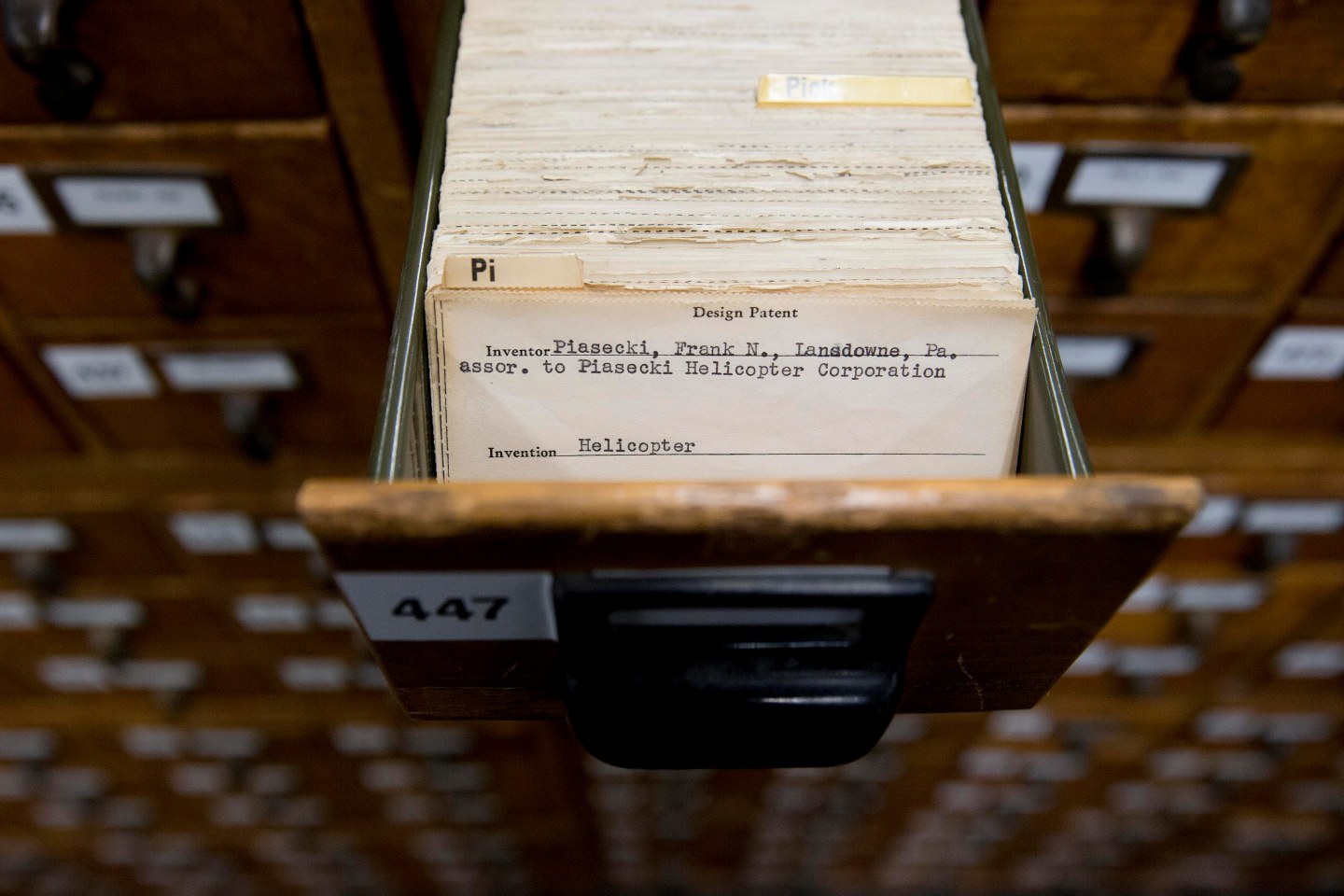
Patent records sit in the patent inventor index cabinet inside the public search facility at the U.S. Patent and Trademark Office (USPTO) headquarters in Alexandria, Virginia, U.S., on Friday, April 4, 2014. The Senate Judiciary Committee tomorrow plans to mark up a measure that would curb the activities of so-called patent trolls after pulling back the bill last week in the face of opposition from such companies as 3M Co., AstraZeneca Plc, Monsanto Co. and Procter & Gamble Co. Photographer: Andrew Harrer/Bloomberg via Getty ImagesAndrew Harrer/ Bloomberg—Getty Images

“Big data,” the industry buzzword that refers to massive data sets that can be analyzed for new insights into human behavior and trends, is often equated with Big Brother. In the popular imagination, it’s become synonymous with privacy concerns surrounding the endless streams of personal information collected by companies, governments, and social media networks.

Yet big data also refers to the vast bodies of information that can be mined for scientific and commercially useful insights, leading to improvements from healthcare to economics. A new startup is now poised to use big data for the greater good by changing the way companies find the latest innovations. It could have major implications for the patent system and any industry that relies on it.

The United States Patent Utility is a newly launched web-based licensing platform offered by Parent Properties. Led by Priceline (PCLN) founder Jay Walker, the Utility (as it’s sometimes called) is a public company that will bring together inventors and would-be users, kind of like a match-making service. The company’s analytics technology searches the two million-plus patents on file with the U.S. Patent Office, as well as its huge volume of pending patents, and matches companies with any concepts that will help them meet their business goals.

I have just signed on as the company’s chief economic adviser, and last fall co-authored a study estimating that the U.S. could reap up to $200 billion in annual economic benefits if there were even modest increases in the number of patented inventions that are successfully commercialized. Until now, that’s been easier said than done. For all but the most potentially valuable patents, it is next to impossible to secure a license for an invention.

Patent holders often must first file costly and time-consuming lawsuits before reaching license agreements with potential users. In instances where there is no litigation, it can be bewildering and costly for inventors to locate companies who might want to use their inventions. The current system’s shortcomings are the reason 95% of all patented inventions are never licensed, much less make it to the commercial marketplace. That’s a shame—the patent database is the world’s largest library of technical experts and technological innovation. It is the entryway to valuable and untapped improvements in a variety of sectors, from manufacturing to health care and beyond.

This is not to say that each and every patent has economic value. Many do, and many don’t. Blockbuster or “home run” patents, that is, those worth fighting over in court, help drive economic innovation. So do many patents of lower value—those that contribute to incremental changes in products, services, and manufacturing and business processes, the “singles” and “doubles” of the innovation world, to use a baseball metaphor. This failure to follow through on commercializing patents holds our nation and its individual companies back in a competitive international marketplace.

After all, wading through millions of granted and pending patents to find the right match is an expensive and time-consuming search for the proverbial needle in a haystack. Unless you are deep-pocketed member of the Fortune 500, it’s an effort that is out of reach for many companies. Not surprisingly, my own investigation of individual companies has revealed that the costs and uncertainties of using patents are driving some to forgo patenting. Instead they fiercely guard their products and inventions, counting on trade secret law to protect them. This may be a short-term solution for some firms, but is short sighted for those who could generate further innovations by disclosing patented concepts. This hoarding of industry advancements hurts the economy as a whole.

The Utility is designed to open up the world of innovation to companies of all sizes, particularly those with limited resources. Subscribers are provided with non-exclusive licenses to a package of patents which the Utility, using its search and statistical algorithms, determines to be highly relevant to the subscribers’ own products and processes. In essence, the Utility takes an unwieldy patent system and opens it up to opportunities wherever they exist, be that around the corner or across the globe. It’s part innovation search engine, part online dating service for enterprises seeking inventions.

The challenge for companies today, as Harvard Business School professor Karim R. Lakhanu points out, is to connect with the knowledge outside of the four walls of their own research and development operations. The Utility has the opportunity to disrupt the world of innovation itself by accelerating the use of new patented inventions, and the distribution of the knowledge these patents embody.

As Sun Microsystems co-founder Bill Joy once observed: “No matter who you are, most of the smartest people work for someone else.” The Utility is a way for companies to connect with those experts without costly hires, patent searches, or the legal fees of licensing. Given recent pessimism about the pace of long-term U.S. economic growth, there’s no better time to unlock and democratize the U.S. patent portfolio and reverse the trend. It’s all possible thanks to big data. When it comes to expanding U.S. business opportunities, this oft-misunderstood resource proves itself to be a gentle giant, not a Goliath.

Robert Litan is chief economic adviser to Patent Properties and a non-resident Senior Fellow at the Brookings Institution.


About the Author
By Robert Litan
See full bioRight Arrow Button Icon

Latest in Tech

Finance
Lorem ipsum dolor sit amet, consectetur adipiscing elit, sed do eiusmod tempor incididunt ut labore et dolore magna aliqua. Ut enim ad minim veniam
By Fortune Editors
October 20, 2025
Finance
Lorem ipsum dolor sit amet, consectetur adipiscing elit, sed do eiusmod tempor incididunt ut labore et dolore magna aliqua. Ut enim ad minim veniam
By Fortune Editors
October 20, 2025
Finance
Lorem ipsum dolor sit amet, consectetur adipiscing elit, sed do eiusmod tempor incididunt ut labore et dolore magna aliqua. Ut enim ad minim veniam
By Fortune Editors
October 20, 2025
Finance
Lorem ipsum dolor sit amet, consectetur adipiscing elit, sed do eiusmod tempor incididunt ut labore et dolore magna aliqua. Ut enim ad minim veniam
By Fortune Editors
October 20, 2025
Finance
Lorem ipsum dolor sit amet, consectetur adipiscing elit, sed do eiusmod tempor incididunt ut labore et dolore magna aliqua. Ut enim ad minim veniam
By Fortune Editors
October 20, 2025
Finance
Lorem ipsum dolor sit amet, consectetur adipiscing elit, sed do eiusmod tempor incididunt ut labore et dolore magna aliqua. Ut enim ad minim veniam
By Fortune Editors
October 20, 2025

Most Popular

Finance
Lorem ipsum dolor sit amet, consectetur adipiscing elit, sed do eiusmod tempor incididunt ut labore et dolore magna aliqua. Ut enim ad minim veniam
By Fortune Editors
October 20, 2025
Finance
Lorem ipsum dolor sit amet, consectetur adipiscing elit, sed do eiusmod tempor incididunt ut labore et dolore magna aliqua. Ut enim ad minim veniam
By Fortune Editors
October 20, 2025
Finance
Lorem ipsum dolor sit amet, consectetur adipiscing elit, sed do eiusmod tempor incididunt ut labore et dolore magna aliqua. Ut enim ad minim veniam
By Fortune Editors
October 20, 2025
Finance
Lorem ipsum dolor sit amet, consectetur adipiscing elit, sed do eiusmod tempor incididunt ut labore et dolore magna aliqua. Ut enim ad minim veniam
By Fortune Editors
October 20, 2025
Finance
Lorem ipsum dolor sit amet, consectetur adipiscing elit, sed do eiusmod tempor incididunt ut labore et dolore magna aliqua. Ut enim ad minim veniam
By Fortune Editors
October 20, 2025
Finance
Lorem ipsum dolor sit amet, consectetur adipiscing elit, sed do eiusmod tempor incididunt ut labore et dolore magna aliqua. Ut enim ad minim veniam
By Fortune Editors
October 20, 2025
Rankings
  • 100 Best Companies
  • Fortune 500
  • Global 500
  • Fortune 500 Europe
  • Most Powerful Women
  • Future 50
  • World’s Most Admired Companies
  • See All Rankings
Sections
  • Finance
  • Leadership
  • Success
  • Tech
  • Asia
  • Europe
  • Environment
  • Fortune Crypto
  • Health
  • Retail
  • Lifestyle
  • Politics
  • Newsletters
  • Magazine
  • Features
  • Commentary
  • Mpw
  • CEO Initiative
  • Conferences
  • Personal Finance
  • Education
Customer Support
  • Frequently Asked Questions
  • Customer Service Portal
  • Privacy Policy
  • Terms Of Use
  • Single Issues For Purchase
  • International Print
Commercial Services
  • Advertising
  • Fortune Brand Studio
  • Fortune Analytics
  • Fortune Conferences
  • Business Development
About Us
  • About Us
  • Editorial Calendar
  • Press Center
  • Work At Fortune
  • Diversity And Inclusion
  • Terms And Conditions
  • Site Map

Latest in Tech

AIRecruiting
To ease recruiters’ fears of being replaced by AI, Zillow experimented with ‘prompt-a-thons.’ Now the real estate giant has 6 new recruitment tools
By Paige McGlauflin and HR BrewJanuary 6, 2026
7 hours ago
zhan, deepak
AIRobotics
Robots are really advancing because they’re learning to think for themselves—and they’re close to figuring out door handles, execs say
By Nick LichtenbergJanuary 6, 2026
8 hours ago
LawAmazon
Amazon is cutting checks to millions of customers as part of a $2.5 billion FTC settlement. Here’s who qualifies and how to get paid
By Sydney LakeJanuary 6, 2026
10 hours ago
InvestingU.S. economy
Ray Dalio says AI is in ‘the early stages of a bubble,’ so watch out for 2026
By Tristan BoveJanuary 6, 2026
10 hours ago
musk
AISocial Media
Elon Musk’s Grok chatbot draws global backlash for generating sexualized images of women and children without consent
By Kelvin Chan and The Associated PressJanuary 6, 2026
10 hours ago
Databricks CEO Ali Ghodsi speaking on stage at a Fortune tech conference.
AIEye on AI
Want AI agents to work better? Improve the way they retrieve information, Databricks says
By Jeremy KahnJanuary 6, 2026
10 hours ago

Most Popular

placeholder alt text
Personal Finance
Janet Yellen warns the $38 trillion national debt is testing a red line economists have feared for decades
By Eva RoytburgJanuary 5, 2026
1 day ago
placeholder alt text
AI
Experienced software developers assumed AI would save them a chunk of time. But in one experiment, their tasks took 20% longer
By Sasha RogelbergJanuary 5, 2026
2 days ago
placeholder alt text
Success
Blackstone exec says elite Ivy League degrees aren’t good enough—new analysts need to 'work harder' and be nice 
By Ashley LutzJanuary 5, 2026
1 day ago
placeholder alt text
Personal Finance
Current price of silver as of Monday, January 5, 2026
By Joseph HostetlerJanuary 5, 2026
2 days ago
placeholder alt text
Personal Finance
Current price of gold as of January 5, 2025
By Danny BakstJanuary 5, 2026
2 days ago
placeholder alt text
Future of Work
Bank of America CEO says he hired 2,000 recent Gen Z grads from 200,000 applications, and many are scared about the future
By Ashley LutzJanuary 3, 2026
4 days ago

© 2025 Fortune Media IP Limited. All Rights Reserved. Use of this site constitutes acceptance of our Terms of Use and Privacy Policy | CA Notice at Collection and Privacy Notice | Do Not Sell/Share My Personal Information
FORTUNE is a trademark of Fortune Media IP Limited, registered in the U.S. and other countries. FORTUNE may receive compensation for some links to products and services on this website. Offers may be subject to change without notice.