• Home
  • News
  • Fortune 500
  • Tech
  • Finance
  • Leadership
  • Lifestyle
  • Rankings
  • Multimedia
TechTransportation

From hoverboards to flying cars, this startup has a maglev master plan

By
David Z. Morris
David Z. Morris
Down Arrow Button Icon
By
David Z. Morris
David Z. Morris
Down Arrow Button Icon
April 20, 2015, 12:34 PM ET
Courtesy of Arx Pax

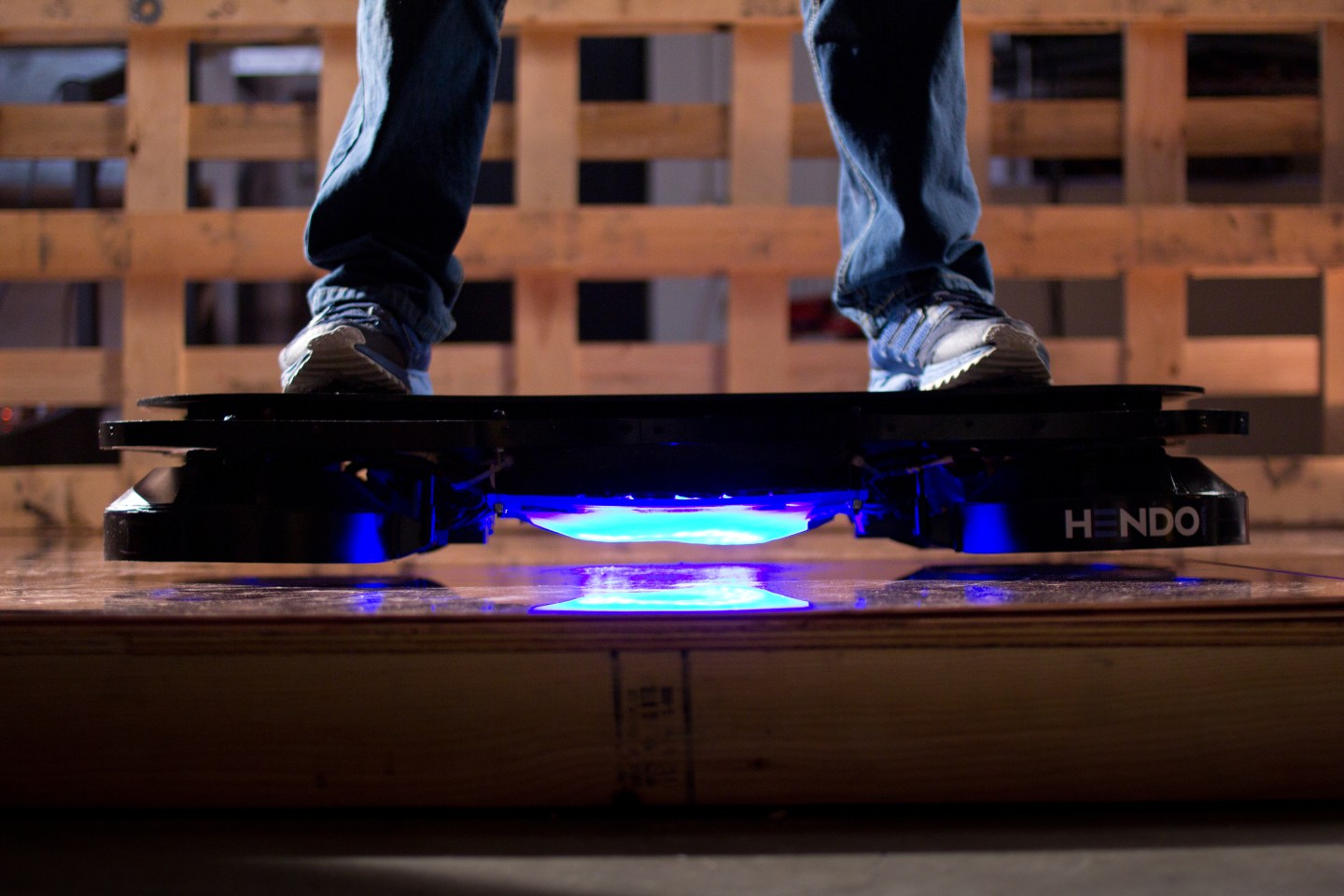
Last fall, small startup Arx Pax nearly broke the internet with a Kickstarter campaign that many thought was too good to be true—it was building a real-life hoverboard, straight out of Back to the Future. The ten Hendo boards being offered (for $10,000 each) sold out swiftly, in part thanks to a video of skate legend Tony Hawk zipping across a copper-plated halfpipe, a half-inch off the ground.

But the hoverboard is just a first step for Arx Pax. According to CEO Greg Henderson, the technology that makes the hoverboard possible—a new kind of magnetic levitation that Arx Pax labels Magnetic Field Architecture—has wide-ranging, transformative implications.

Arx Pax’s system is potentially much less expensive than existing maglev systems, which rely on complex electromagnetic systems in both vehicle and tracks and can cost tens of millions of dollars per mile.

Despite its widely acknowledged advantages in safety, speed, and efficiency in transit applications, governments and transit authorities have been extremely slow to adopt maglev due to cost. In a 2012 report, the Federal Transit Administration found that these costs, which it characterized as “intimidating,” were a major barrier to maglev adoption in the U.S.

But Arx Pax’s magnetic engine is entirely contained within the object being levitated, and the only required infrastructure is a conductive surface, such as the copper-lined halfpipe used to demo the hoverboard. This means systems of any scale could be laid quickly and cheaply. Even more impressive, the surface can be multi-use—for instance, a roadway consisting of a layer of asphalt over copper could accommodate both maglev and conventional vehicles.

The Arx Pax engine can also generate thrust and directional control magnetically, so it doesn’t need a track for guidance. One of Arx Pax’s prototypes is a scaled-down hover vehicle called the Manta Ray, which zigs and zags as neatly as a remote control car. According to Henderson, this points towards “a new type of vehicle, a hybrid vehicle that can drive conventionally, or can hover . . . [with] all the freedom of a car and all the efficiency of a train.”

But this futuristic dream of roads full of flying cars faces some obstacles. Arx Pax’s hover engine is power-hungry, needing 40 watts of energy to levitate one kilogram. According to James Wieler, former VP of engineering for longtime maglev developer Magnemotion, “40 watts per kilogram is a killer in terms of transportation.” By contrast, the M3 maglev system that Magnemotion piloted was able to levitate over 10,000 pounds with a hundred watts.

And all of the Arx Pax’s energy has to come from on-board batteries. “Batteries are getting better,” says Wieler, “But you probably need an order of magnitude improvement” for the kind of hybrid levitating car Henderson envisions. The Hendo hoverboard offers a ride time of only 7 minutes.

The scalability and flexibility of Arx Pax’s technology may be its greatest competitive advantage. Though the company is building the Hendo hoverboard itself, its plan going forward is to primarily license its technology.

“Our goal,” says Henderson, “is to put this technology in the hands of folks to come up with new solutions to problems we don’t even know about.” Arx Pax sold about 700 of its developer kits, The White Box, through its Kickstarter campaign. One such solution that Henderson mentions is hovering carts for clean room applications, where wheels and their moving parts are sources of contamination.

Henderson says that Arx Pax has already entertained buyouts from larger companies, but chooses to remain in control. “We didn’t want to end up on someone’s shelf, bought up or stifled, [with] this technology limited in some way.”


About the Author
By David Z. Morris
See full bioRight Arrow Button Icon

Latest in Tech

InnovationBrainstorm Design
Video games can teach designers deeper lessons than ‘high score streaks’ and gamification
By Angelica AngDecember 3, 2025
2 hours ago
LawInternet
A Supreme Court decision could put your internet access at risk. Here’s who could be affected
By Dave Lozo and Morning BrewDecember 2, 2025
11 hours ago
AITikTok
China’s ByteDance could be forced to sell TikTok U.S., but its quiet lead in AI will help it survive—and maybe even thrive
By Nicholas GordonDecember 2, 2025
12 hours ago
United Nations
AIUnited Nations
UN warns about AI becoming another ‘Great Divergence’ between rich and poor countries like the Industrial Revolution
By Elaine Kurtenbach and The Associated PressDecember 2, 2025
13 hours ago
Anthropic cofounder and CEO Dario Amodei
AIEye on AI
How Anthropic’s safety first approach won over big business—and how its own engineers are using its Claude AI
By Jeremy KahnDecember 2, 2025
13 hours ago
Nvidia founder and CEO Jensen Huang reacts during a press conference at the Asia-Pacific Economic Cooperation (APEC) CEO Summit in Gyeongju on October 31, 2025.
AINvidia
Nvidia CFO admits the $100 billion OpenAI megadeal ‘still’ isn’t signed—two months after it helped fuel an AI rally
By Eva RoytburgDecember 2, 2025
15 hours ago

Most Popular

placeholder alt text
Economy
Ford workers told their CEO 'none of the young people want to work here.' So Jim Farley took a page out of the founder's playbook
By Sasha RogelbergNovember 28, 2025
5 days ago
placeholder alt text
Success
Warren Buffett used to give his family $10,000 each at Christmas—but when he saw how fast they were spending it, he started buying them shares instead
By Eleanor PringleDecember 2, 2025
22 hours ago
placeholder alt text
Economy
Elon Musk says he warned Trump against tariffs, which U.S. manufacturers blame for a turn to more offshoring and diminishing American factory jobs
By Sasha RogelbergDecember 2, 2025
16 hours ago
placeholder alt text
C-Suite
MacKenzie Scott's $19 billion donations have turned philanthropy on its head—why her style of giving actually works
By Sydney LakeDecember 2, 2025
22 hours ago
placeholder alt text
North America
Jeff Bezos and Lauren Sánchez Bezos commit $102.5 million to organizations combating homelessness across the U.S.: ‘This is just the beginning’
By Sydney LakeDecember 2, 2025
17 hours ago
placeholder alt text
AI
More than 1,000 Amazon employees sign open letter warning the company's AI 'will do staggering damage to democracy, our jobs, and the earth’
By Nino PaoliDecember 2, 2025
24 hours ago
Rankings
  • 100 Best Companies
  • Fortune 500
  • Global 500
  • Fortune 500 Europe
  • Most Powerful Women
  • Future 50
  • World’s Most Admired Companies
  • See All Rankings
Sections
  • Finance
  • Leadership
  • Success
  • Tech
  • Asia
  • Europe
  • Environment
  • Fortune Crypto
  • Health
  • Retail
  • Lifestyle
  • Politics
  • Newsletters
  • Magazine
  • Features
  • Commentary
  • Mpw
  • CEO Initiative
  • Conferences
  • Personal Finance
  • Education
Customer Support
  • Frequently Asked Questions
  • Customer Service Portal
  • Privacy Policy
  • Terms Of Use
  • Single Issues For Purchase
  • International Print
Commercial Services
  • Advertising
  • Fortune Brand Studio
  • Fortune Analytics
  • Fortune Conferences
  • Business Development
About Us
  • About Us
  • Editorial Calendar
  • Press Center
  • Work At Fortune
  • Diversity And Inclusion
  • Terms And Conditions
  • Site Map

© 2025 Fortune Media IP Limited. All Rights Reserved. Use of this site constitutes acceptance of our Terms of Use and Privacy Policy | CA Notice at Collection and Privacy Notice | Do Not Sell/Share My Personal Information
FORTUNE is a trademark of Fortune Media IP Limited, registered in the U.S. and other countries. FORTUNE may receive compensation for some links to products and services on this website. Offers may be subject to change without notice.