• Home
  • Latest
  • Fortune 500
  • Finance
  • Tech
  • Leadership
  • Lifestyle
  • Rankings
  • Multimedia
FinanceAusterity

Government austerity in the U.S.: More common than you think

By
Chris Matthews
Chris Matthews
Down Arrow Button Icon
By
Chris Matthews
Chris Matthews
Down Arrow Button Icon
April 13, 2015, 1:43 PM ET
US Treasury Secretary Jack Lew  visit EU
US and EU flags seen during Treasury Secretary Jack Lew a press conference after a meeting at EU Commission headquarters in Brussels, Belgium on 26.01.2015 Lew said the US economy still needs pushing to continue growth, and that US alone could not lead global economic recovery. Reports also state Lew said Greece is moving on to solve their problems after having to make tough decisions. In the meantime, European financial markets on Monday shrugged off the news that the anti-austerity SYRIZA party had emerged as the victor in Greece's national election, with both shares and the euro gaining ground. by Wiktor Dabkowski Photo by: Wiktor Dabkowski/picture-alliance/dpa/AP ImagesPhotograph by Wiktor Dabkowski — picture-alliance/dpa/AP

Does government spending help or hurt the economy?

Of the many questions economists wrestle with, this one attracts more attention than any other simply because it affects all taxpayers and consumers of government-provided services.

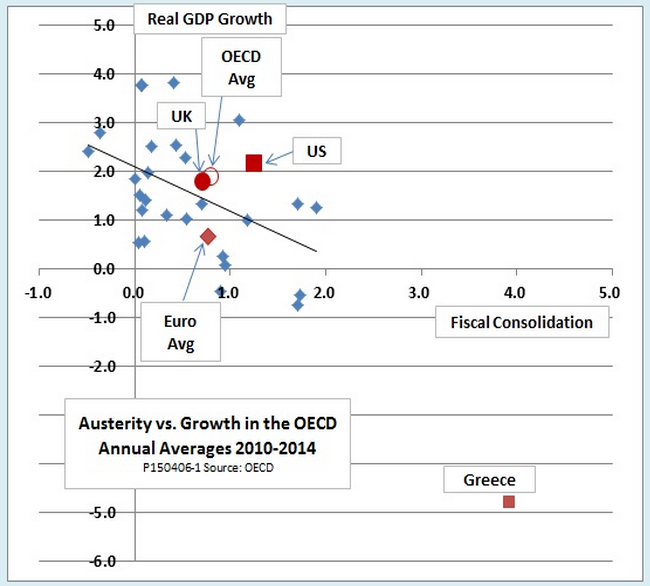
The Great Recession has been a grand experiment that economists will use for generations to understand how government stimulus and austerity affect the economy, especially during severe economic downturns. As economist Ed Dolan points out in a recent blog post, this question has dominated the upcoming parliamentary elections in the U.K.

Dolan put together this chart, which includes the level of austerity (labeled on the x axis as “fiscal consolidation’) and economic growth:
Screenshot 2015-04-13 at 12.12.31 PM


As you can see, there is a very weak correlation between fiscal austerity and slower economic growth. Between 2010 an 2014, the United States, for instance, both practiced more austerity and grew more quickly than the average OECD country.

This might come as a surprise to those who follow the economic press closely. After all, the common narrative is that Europe was more eager to commit to austerity following the recession than the United States, where President Obama resisted calls from Congress to cut spending even after the Democrats lost control of Congress in 2010.

But what is often lost in the debate over debt and deficits is that so much government spending—roughly 40%—takes place at the state and local levels. Often, states are constitutionally required to run a balanced budget, so austerity during downturns is inevitable.

Second, Dolan adjusts government spending figures so that he can ignore so-called “automatic stabilizers” like unemployment insurance and the deficits that are incurred because of reduced tax receipts during a recession. Ignoring these factors, Dolan argues, gives us a better picture of what the actions of current policy makers have done to the economy.

Dolan uses this chart to argue that even though the British election appears to be dominated by the issue of austerity, “It [the U.K.] has had neither an exceptional amount of fiscal consolidation nor exceptional growth performance.” Therefore, he wonders “what the fuss is all about,” suggesting that there are more pressing issues British voters should focus on.

For Americans, the chart is instructive in other ways. One could quibble over whether eliminating automatic stabilizers is really a good strategy for analyzing the performance of public policy in the U.S. because extending unemployment benefits has been one of the few spending measures that Democrats and Republicans have been able to agree on during the recovery years.

Nevertheless, it’s informative to look at federal, state, and local government spending holistically and see that the U.S. actually engaged in more austerity and grew faster than its wealthy peers. The data overall show austerity most certainly didn’t lead to better growth, but it at least didn’t prevent the U.S. from outperforming the economic performance of other OECD countries.

Finally, it’s important to understand how America’s federalist system might distort the public debate over stimulus during the downturn. The stimulus package signed by President Obama in 2009 was huge in dollar terms—north of $800 billion. But when you consider that federal spending during downturns must make up for inevitable cutbacks in state spending, this figure seems much smaller.

About the Author
By Chris Matthews
See full bioRight Arrow Button Icon

Latest in Finance

Finance
Lorem ipsum dolor sit amet, consectetur adipiscing elit, sed do eiusmod tempor incididunt ut labore et dolore magna aliqua. Ut enim ad minim veniam
By Fortune Editors
October 20, 2025
Finance
Lorem ipsum dolor sit amet, consectetur adipiscing elit, sed do eiusmod tempor incididunt ut labore et dolore magna aliqua. Ut enim ad minim veniam
By Fortune Editors
October 20, 2025
Finance
Lorem ipsum dolor sit amet, consectetur adipiscing elit, sed do eiusmod tempor incididunt ut labore et dolore magna aliqua. Ut enim ad minim veniam
By Fortune Editors
October 20, 2025
Finance
Lorem ipsum dolor sit amet, consectetur adipiscing elit, sed do eiusmod tempor incididunt ut labore et dolore magna aliqua. Ut enim ad minim veniam
By Fortune Editors
October 20, 2025
Finance
Lorem ipsum dolor sit amet, consectetur adipiscing elit, sed do eiusmod tempor incididunt ut labore et dolore magna aliqua. Ut enim ad minim veniam
By Fortune Editors
October 20, 2025
Finance
Lorem ipsum dolor sit amet, consectetur adipiscing elit, sed do eiusmod tempor incididunt ut labore et dolore magna aliqua. Ut enim ad minim veniam
By Fortune Editors
October 20, 2025

Most Popular

Finance
Lorem ipsum dolor sit amet, consectetur adipiscing elit, sed do eiusmod tempor incididunt ut labore et dolore magna aliqua. Ut enim ad minim veniam
By Fortune Editors
October 20, 2025
Finance
Lorem ipsum dolor sit amet, consectetur adipiscing elit, sed do eiusmod tempor incididunt ut labore et dolore magna aliqua. Ut enim ad minim veniam
By Fortune Editors
October 20, 2025
Finance
Lorem ipsum dolor sit amet, consectetur adipiscing elit, sed do eiusmod tempor incididunt ut labore et dolore magna aliqua. Ut enim ad minim veniam
By Fortune Editors
October 20, 2025
Finance
Lorem ipsum dolor sit amet, consectetur adipiscing elit, sed do eiusmod tempor incididunt ut labore et dolore magna aliqua. Ut enim ad minim veniam
By Fortune Editors
October 20, 2025
Finance
Lorem ipsum dolor sit amet, consectetur adipiscing elit, sed do eiusmod tempor incididunt ut labore et dolore magna aliqua. Ut enim ad minim veniam
By Fortune Editors
October 20, 2025
Finance
Lorem ipsum dolor sit amet, consectetur adipiscing elit, sed do eiusmod tempor incididunt ut labore et dolore magna aliqua. Ut enim ad minim veniam
By Fortune Editors
October 20, 2025
Rankings
  • 100 Best Companies
  • Fortune 500
  • Global 500
  • Fortune 500 Europe
  • Most Powerful Women
  • Future 50
  • World’s Most Admired Companies
  • See All Rankings
Sections
  • Finance
  • Leadership
  • Success
  • Tech
  • Asia
  • Europe
  • Environment
  • Fortune Crypto
  • Health
  • Retail
  • Lifestyle
  • Politics
  • Newsletters
  • Magazine
  • Features
  • Commentary
  • Mpw
  • CEO Initiative
  • Conferences
  • Personal Finance
  • Education
Customer Support
  • Frequently Asked Questions
  • Customer Service Portal
  • Privacy Policy
  • Terms Of Use
  • Single Issues For Purchase
  • International Print
Commercial Services
  • Advertising
  • Fortune Brand Studio
  • Fortune Analytics
  • Fortune Conferences
  • Business Development
About Us
  • About Us
  • Editorial Calendar
  • Press Center
  • Work At Fortune
  • Diversity And Inclusion
  • Terms And Conditions
  • Site Map

Latest in Finance

Sam Altman looks down and to the side, frowning.
AIOpenAI
Sam Altman says he’s ‘0%’ excited to be CEO of a public company as OpenAI drops hints about an IPO: ‘In some ways I think it’d be really annoying’
By Sasha RogelbergDecember 19, 2025
14 hours ago
CryptoKlarna
Klarna partners with Coinbase to receive stablecoin funds from institutional investors
By Ben WeissDecember 19, 2025
15 hours ago
AIDebt
AI hyperscalers have room for ‘elevated debt issuance’ — even after their recent bond binge, BofA says
By Jason MaDecember 19, 2025
15 hours ago
Late Apple cofounder Steve Jobs
SuccessCareers
Steve Jobs sold his Volkswagen to raise $1,300 for Apple’s first computer. He became a millionaire just two years later at 23
By Emma BurleighDecember 19, 2025
15 hours ago
Thomas “Tom” McInerney is President, CEO and a Director of Genworth Financial
CommentaryCaregiving
I’m a CEO who’s spent nearly 40 years talking to presidents, lawmakers and leaders about our long-term care crisis. They knew this moment was coming
By Thomas McInerneyDecember 19, 2025
16 hours ago
jewelry
EconomySmall Business
‘This year is just not a jewelry Christmas’: Meet a 64-year-old small businesswoman who’s seen her Main Street decline for the last decade
By Makiya Seminera and The Associated PressDecember 19, 2025
17 hours ago

Most Popular

placeholder alt text
Economy
The $38 trillion national debt is to blame for over $1 trillion in annual interest payments from here on out, CRFB says
By Nick LichtenbergDecember 17, 2025
3 days ago
placeholder alt text
AI
Meta’s 28-year-old billionaire prodigy says the next Bill Gates will be a 13-year-old who is ‘vibe coding’ right now
By Eva RoytburgDecember 19, 2025
21 hours ago
placeholder alt text
Success
As graduates face a ‘jobpocalypse,’ Goldman Sachs exec tells Gen Z they need to know their commercial impact 
By Preston ForeDecember 18, 2025
2 days ago
placeholder alt text
Success
The scientist who helped create AI says it’s only ‘a matter of time’ before every single job is wiped out—even safer trade jobs like plumbing
By Orianna Rosa RoyleDecember 19, 2025
18 hours ago
placeholder alt text
Success
Billionaire who sold two companies to Coca-Cola says he tries to persuade people not to become entrepreneurs: ‘Every single day, you can go bankrupt’
By Dave SmithDecember 19, 2025
17 hours ago
placeholder alt text
Economy
‘This is a wacky number’: economists cry foul as new government data assumes zero housing inflation in surprising November drop
By Eva RoytburgDecember 18, 2025
2 days ago

© 2025 Fortune Media IP Limited. All Rights Reserved. Use of this site constitutes acceptance of our Terms of Use and Privacy Policy | CA Notice at Collection and Privacy Notice | Do Not Sell/Share My Personal Information
FORTUNE is a trademark of Fortune Media IP Limited, registered in the U.S. and other countries. FORTUNE may receive compensation for some links to products and services on this website. Offers may be subject to change without notice.