• Home
  • Latest
  • Fortune 500
  • Finance
  • Tech
  • Leadership
  • Lifestyle
  • Rankings
  • Multimedia
FinanceHousing

A nation of renters: Why it’s so hard for Americans to buy a home

By
Chris Matthews
Chris Matthews
Down Arrow Button Icon
By
Chris Matthews
Chris Matthews
Down Arrow Button Icon
April 10, 2015, 11:27 AM ET
Vacancy Rate For U.S. Apartments Reaches Highest Rate In 20 Years
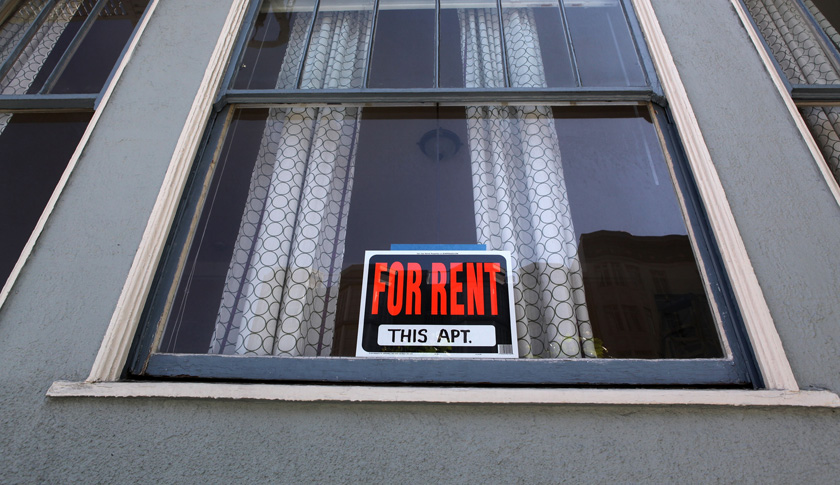
SAN FRANCISCO - JULY 08: A sign advertising an apartment for rent is displayed in a window July 8, 2009 in San Francisco, California. As the economy continues to falter, vacancy rates for U.S. apartments have spiked to a twenty two year high of 7.5 percent, just short of the record high of 7.8 percent set in 1986. (Photo by Justin Sullivan/Getty Images)Justin Sullivan Getty Images

In normal times, homeownership is not a financial home run.

Home values over the long run tend to rise just slightly faster than inflation, making it a worse investment than, say, investing in the stock market.

But these are not normal times. Though the economic recovery is six years in the making and home prices have recovered to their pre-bubble norms, the real estate market has changed radically—mostly for the worse.

Even creditworthy borrowers are having difficulty securing a mortgage to buy a home. Real estate data firm Zillow released a report this week showing that buying a home makes financial sense, on average, after living in the same home for just two years. This varies depending on location. For instance, in expensive areas like Washington, D.C. and Los Angeles, buying a home starts to make sense after you’ve lived there for 4.2 and 5 years, respectively.

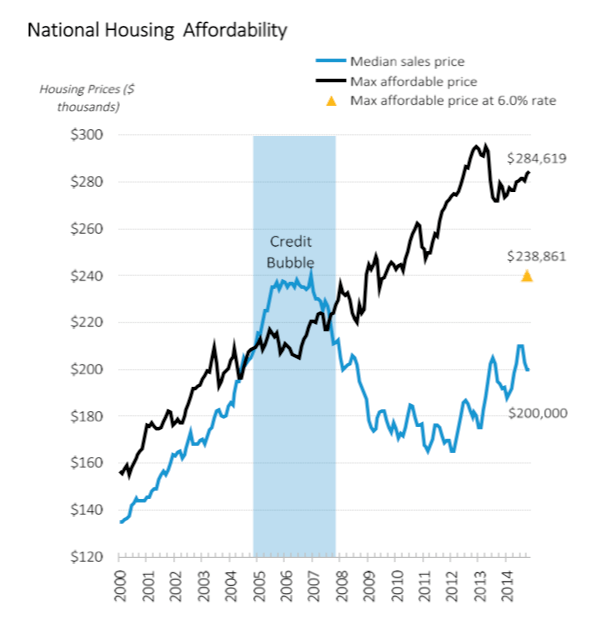
Even as housing prices have recovered, rents in many areas have been climbing even faster, tilting the math in these cities toward buying versus renting. But as the housing finance industry continues to absorb the effects of the housing bust and the subsequent regulatory response, lenders are still gun shy about getting involved in residential real estate. Laurie Goodman, an economist at the Urban Institute, displayed this in a presentation given last month. Here’s one of her slides, which shows the evolution of the median home price, and the homes that median Americans can afford to buy, if he devotes a third of his income to mortgage payments, fees, and taxes:
Screen Shot 2015-04-10 at 9.11.08 AM

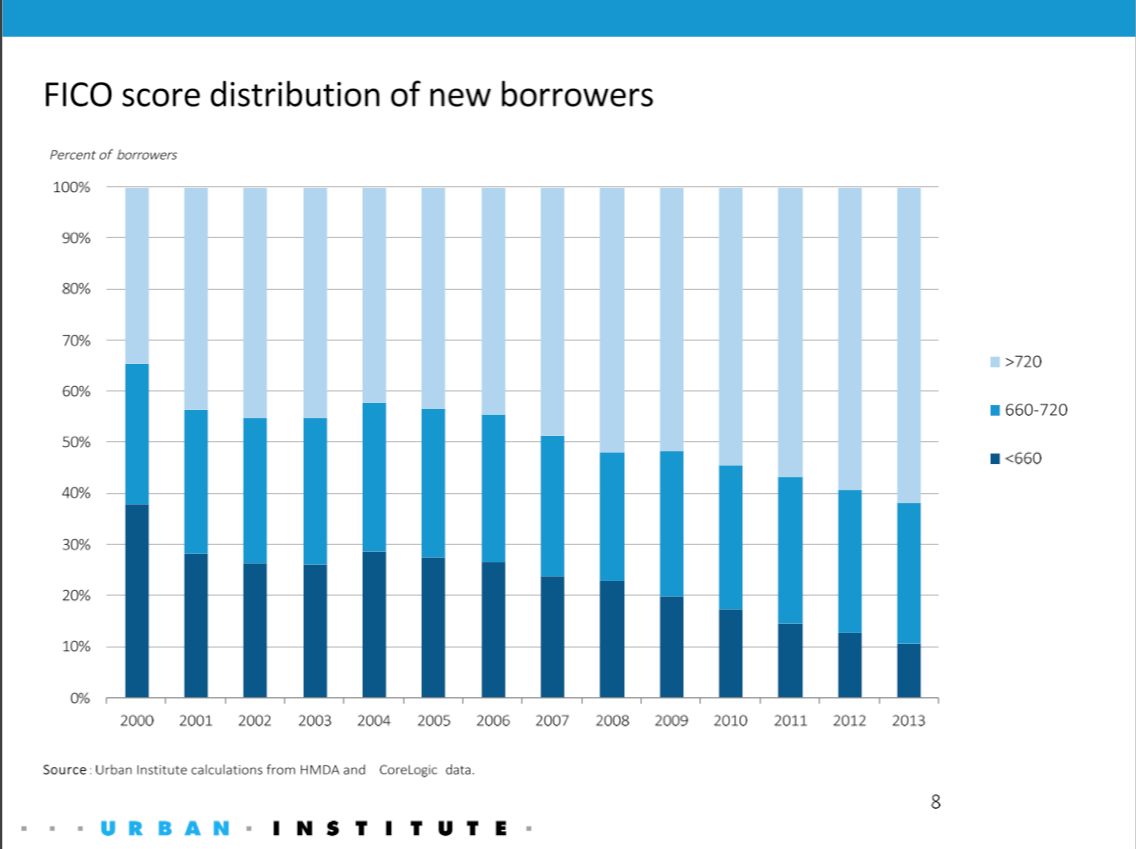
As you can see, the gap between what the average Americans can afford and the median sales price is much larger than it had been prior to the housing bubble. Another chart shows that this is largely because lenders are being extremely picky about whom they lend to:
Screen Shot 2015-04-10 at 9.11.41 AM

Here we see that folks with FICO scores above 720 are receiving the majority of new loans, whereas in 2000, before the real estate market was close to bubble territory, the distribution was much more even. Goodman argues that the reason for this shift is that the mortgage finance system still hasn’t recovered from post-crisis uncertainty.

Government-backed Fannie Mae and Freddie Mac are still serving as the anchor of mortgage finance in this country. Most loans are guaranteed by the housing giants, and lenders are scared of selling anything but the most flawless loans to them out of fear that the agencies will force lenders to buy back the loans if they fail. At the same time, heightened regulatory scrutiny has forced mortgage originators to spend far more time on each mortgage they underwrite, to the point that the average lender is processing one-sixth of the mortgages per month they were doing back in 2001.

Meanwhile, any urgency in Washington to reform housing finance and limit Fannie Mae and Freddie Mac’s role in this space has evaporated. A recent report from Standard and Poors argued, “We expect Fannie and Freddie to be around for the foreseeable future in their current form, and we think the government will support them.”

Under its previous leader, Ed DeMarco, Fannie and Freddie moved to raise the fees they charge to insure mortgages in an effort to encourage private mortgage guarantors to enter the market. But under new leadership, which is facing the reality that the status quo of these government-backed entities may continue for some time, further fee increases have been delayed. Meanwhile, according to S&P, “the enterprises must continue to pursue initiatives to expand what loan originators consider an eligible borrower, including evaluating alternative credit scoring models, assessing impediments to credit access, and clarifying operational standards with other market participants.”

There are signs that these efforts are starting to work. For instance, the share of first-time home buyer loans Fannie and Freddie are purchasing inched up last year. But, as S&P puts it, “The FHFA has pushed for more clarity in the market, mainly by making it easier for originators to be free of representation and warranty claims and trying to increase standardized documentation, but those efforts have probably only marginally helped.”

Since mortgage finance reform is unlikely in the near future, Fannie and Freddie are going to have to work much harder to reassure originators that they won’t get stuck buying back mortgages that default. Obviously, we don’t want to return to the lax standards of the housing bubble, nor should taxpayers be put on the hook for poorly underwritten loans. But we should be able to find a happy medium between the reckless housing bubble years and today, when few but the most creditworthy can secure a home loan.


About the Author
By Chris Matthews
See full bioRight Arrow Button Icon

Latest in Finance

Finance
Lorem ipsum dolor sit amet, consectetur adipiscing elit, sed do eiusmod tempor incididunt ut labore et dolore magna aliqua. Ut enim ad minim veniam
By Fortune Editors
October 20, 2025
Finance
Lorem ipsum dolor sit amet, consectetur adipiscing elit, sed do eiusmod tempor incididunt ut labore et dolore magna aliqua. Ut enim ad minim veniam
By Fortune Editors
October 20, 2025
Finance
Lorem ipsum dolor sit amet, consectetur adipiscing elit, sed do eiusmod tempor incididunt ut labore et dolore magna aliqua. Ut enim ad minim veniam
By Fortune Editors
October 20, 2025
Finance
Lorem ipsum dolor sit amet, consectetur adipiscing elit, sed do eiusmod tempor incididunt ut labore et dolore magna aliqua. Ut enim ad minim veniam
By Fortune Editors
October 20, 2025
Finance
Lorem ipsum dolor sit amet, consectetur adipiscing elit, sed do eiusmod tempor incididunt ut labore et dolore magna aliqua. Ut enim ad minim veniam
By Fortune Editors
October 20, 2025
Finance
Lorem ipsum dolor sit amet, consectetur adipiscing elit, sed do eiusmod tempor incididunt ut labore et dolore magna aliqua. Ut enim ad minim veniam
By Fortune Editors
October 20, 2025

Most Popular

Finance
Lorem ipsum dolor sit amet, consectetur adipiscing elit, sed do eiusmod tempor incididunt ut labore et dolore magna aliqua. Ut enim ad minim veniam
By Fortune Editors
October 20, 2025
Finance
Lorem ipsum dolor sit amet, consectetur adipiscing elit, sed do eiusmod tempor incididunt ut labore et dolore magna aliqua. Ut enim ad minim veniam
By Fortune Editors
October 20, 2025
Finance
Lorem ipsum dolor sit amet, consectetur adipiscing elit, sed do eiusmod tempor incididunt ut labore et dolore magna aliqua. Ut enim ad minim veniam
By Fortune Editors
October 20, 2025
Finance
Lorem ipsum dolor sit amet, consectetur adipiscing elit, sed do eiusmod tempor incididunt ut labore et dolore magna aliqua. Ut enim ad minim veniam
By Fortune Editors
October 20, 2025
Finance
Lorem ipsum dolor sit amet, consectetur adipiscing elit, sed do eiusmod tempor incididunt ut labore et dolore magna aliqua. Ut enim ad minim veniam
By Fortune Editors
October 20, 2025
Finance
Lorem ipsum dolor sit amet, consectetur adipiscing elit, sed do eiusmod tempor incididunt ut labore et dolore magna aliqua. Ut enim ad minim veniam
By Fortune Editors
October 20, 2025
Rankings
  • 100 Best Companies
  • Fortune 500
  • Global 500
  • Fortune 500 Europe
  • Most Powerful Women
  • Future 50
  • World’s Most Admired Companies
  • See All Rankings
Sections
  • Finance
  • Leadership
  • Success
  • Tech
  • Asia
  • Europe
  • Environment
  • Fortune Crypto
  • Health
  • Retail
  • Lifestyle
  • Politics
  • Newsletters
  • Magazine
  • Features
  • Commentary
  • Mpw
  • CEO Initiative
  • Conferences
  • Personal Finance
  • Education
Customer Support
  • Frequently Asked Questions
  • Customer Service Portal
  • Privacy Policy
  • Terms Of Use
  • Single Issues For Purchase
  • International Print
Commercial Services
  • Advertising
  • Fortune Brand Studio
  • Fortune Analytics
  • Fortune Conferences
  • Business Development
About Us
  • About Us
  • Editorial Calendar
  • Press Center
  • Work At Fortune
  • Diversity And Inclusion
  • Terms And Conditions
  • Site Map

Latest in Finance

An elderly man prepares ingredients, grating carrots on a plate in a home setting, emphasizing independence and routine.
North Americaaging
More Americans will die than be born in 2030, CBO predicts—leaving immigrants as the only source of population growth
By Eva RoytburgJanuary 7, 2026
7 hours ago
Delta plane flying
North AmericaAir Travel
These are the 10 most on-time airlines in the world, and only one American company made the cut
By Jacqueline MunisJanuary 7, 2026
10 hours ago
corner office
Future of WorkJobs
AI layoffs are looking more and more like corporate fiction that’s masking a darker reality, Oxford Economics suggests
By Nick LichtenbergJanuary 7, 2026
10 hours ago
Real EstateHousing
Trump threatens to ban Wall Street from buying the house next door, saying ‘American Dream is increasingly out of reach for far too many people’
By Nick LichtenbergJanuary 7, 2026
11 hours ago
trump
Economynational debt
The $38 trillion national debt is one thing 82% of Americans agree on: ‘Voters are understandably concerned,’ watchdog says
By Nick LichtenbergJanuary 7, 2026
11 hours ago
Real EstateHousing
Americans missed out on a ‘once-in-a-lifetime’ chance to buy a house—the 3 shifts it would take to make housing affordable are ‘very unlikely’
By Sydney LakeJanuary 7, 2026
11 hours ago

Most Popular

placeholder alt text
Law
Amazon is cutting checks to millions of customers as part of a $2.5 billion FTC settlement. Here's who qualifies and how to get paid
By Sydney LakeJanuary 6, 2026
2 days ago
placeholder alt text
Economy
Mark Cuban on the $38 trillion national debt and the absurdity of U.S. healthcare: we wouldn't pay for potato chips like this
By Nick LichtenbergJanuary 6, 2026
2 days ago
placeholder alt text
Future of Work
'Employers are increasingly turning to degree and GPA' in hiring: Recruiters retreat from ‘talent is everywhere,’ double down on top colleges
By Jake AngeloJanuary 6, 2026
2 days ago
placeholder alt text
Personal Finance
Janet Yellen warns the $38 trillion national debt is testing a red line economists have feared for decades
By Eva RoytburgJanuary 5, 2026
2 days ago
placeholder alt text
Success
The college-to-office path is dead: CEO of the world’s biggest recruiter says Gen Z grads need to consider trade and hospitality jobs that don't even require degrees
By Orianna Rosa RoyleJanuary 6, 2026
2 days ago
placeholder alt text
Personal Finance
Current price of silver as of Tuesday, January 6, 2026
By Joseph HostetlerJanuary 6, 2026
2 days ago

© 2025 Fortune Media IP Limited. All Rights Reserved. Use of this site constitutes acceptance of our Terms of Use and Privacy Policy | CA Notice at Collection and Privacy Notice | Do Not Sell/Share My Personal Information
FORTUNE is a trademark of Fortune Media IP Limited, registered in the U.S. and other countries. FORTUNE may receive compensation for some links to products and services on this website. Offers may be subject to change without notice.