• Home
  • Latest
  • Fortune 500
  • Finance
  • Tech
  • Leadership
  • Lifestyle
  • Rankings
  • Multimedia
Leadership

American taxpayers give an $18 billion gift to the post office every year

By
Chris Matthews
Chris Matthews
Down Arrow Button Icon
By
Chris Matthews
Chris Matthews
Down Arrow Button Icon
March 27, 2015, 12:22 PM ET

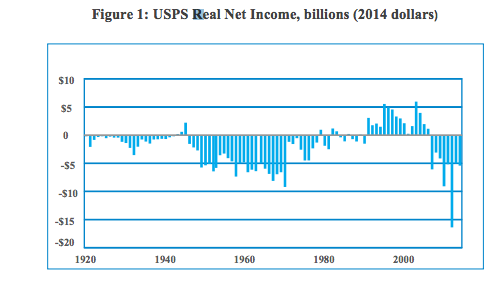
The United States Postal Service’s financial troubles have been well publicized in recent years. The worst of it came in 2012, when the USPS lost a whopping $15.9 billion dollars, followed by $4.8 billion and $5.3 billion in 2013 and 2014, respectively.

Post office officials have often attributed the losses to the decline in demand for first class mail in favor of more efficient modes of communication, and congressional mandates that the USPS do things like deliver mail on Saturdays and to unprofitable parts of the country. In fact, the USPS claims that if it weren’t for such requirements, it would more or less break even.

But as Robert Shapiro—former Treasury undersecretary and chairman of the economic consultancy Sonecon—points out in a new analysis, American taxpayers subsidize the USPS at a rate that surpasses the costs associated with any Congressional mandate. He estimates that, all told, the subsidies and legal monopolies that Congress bestows upon the post office is worth $18 billion annually. These include:

Laws that bar any other shipping service from delivering mail and packages directly to residential and business mailboxes. Shapiro estimates that this gives the Post Office a $14 billion annual boost, more than three times what the Postal Regulatory Commission estimates it to be. Shapiro argues that the PRC’s analysis doesn’t take into account the productivity gains that the Post Office would be forced to make if it really had to compete for mailbox delivery. He points out that productivity at USPS has only grown by 0.7% per year versus 2.5% for its competition.

Tax breaks. The Post Office is exempt from state and local property and real estate taxes, along with other burdens like tolls, vehicle registration fees, and parking tickets. These exemptions save the USPS $2.18 billion per year.

Cheap borrowing. The Postal Service, writes Shapiro, “can borrow from the U.S. Treasury through the Federal Financing Bank, at highly-subsidized interest rates.” It currently borrows the legal limit of $15.2 billion at a rate of 1.2%. Without this access, it would be paying somewhere between $415 million and $490 million per year more in interest.

Finally, Shapiro points out that the USPS pays its workers salaries and benefits far above the rates paid to similar workers in the private sector. Labor accounted for 78% of the organization’s costs in 2014, “with about 89% of those costs involving employees represented by collective bargaining.” These higher labor costs, plus the absence of a need to innovate due to government-granted monopolies, has freed the USPS from $20 billion in labor and productivity costs per year, Shapiro estimates. “While we do not technically count this as a subsidy,” he writes, it represents an economic burden on others arising directly from USPS’s monopoly position.” Postage, for instance, would likely be cheaper for everyone if the organization were subject to the same competitive pressures as private firms.

It’s remarkable that the United States, which has a reputation for being more free market-oriented than other rich nations, maintains this government-mandated monopoly. Over the past several decades, the process of European integration led to the deregulation and privatization of European postal monopolies, with generally good results.

Given the inability for Congress and the White House to agree on even basic legislation, it’s unlikely that any major changes to the Post Office will be coming soon. After all, the Post Office’s losses aren’t an anomaly. It has spent a large part of its history in the red, as this chart from Shapiro shows:
Screen Shot 2015-03-27 at 9.49.58 AM

Meanwhile, the $18 billion in subsidies given to the USPS are spread imperceptibly over the entire country, while the costs of privatization would be borne heavily by a few. Folks in rural areas might have to pay much more to lure private businesses to deliver mail.

The Post Office employs 618,000 people—more than any civilian employer besides Wal Mart. Given the pay disparities between the Post Office and private employers, these people would be highly motivated to block any significant change to the current system.

That said, the benefits the rest of us bestow on the USPS are enormous. None of this will help you calm down the next time you are waiting on a line that just won’t move at your local post office.


About the Author
By Chris Matthews
See full bioRight Arrow Button Icon

Latest in Leadership

Finance
Lorem ipsum dolor sit amet, consectetur adipiscing elit, sed do eiusmod tempor incididunt ut labore et dolore magna aliqua. Ut enim ad minim veniam
By Fortune Editors
October 20, 2025
Finance
Lorem ipsum dolor sit amet, consectetur adipiscing elit, sed do eiusmod tempor incididunt ut labore et dolore magna aliqua. Ut enim ad minim veniam
By Fortune Editors
October 20, 2025
Finance
Lorem ipsum dolor sit amet, consectetur adipiscing elit, sed do eiusmod tempor incididunt ut labore et dolore magna aliqua. Ut enim ad minim veniam
By Fortune Editors
October 20, 2025
Finance
Lorem ipsum dolor sit amet, consectetur adipiscing elit, sed do eiusmod tempor incididunt ut labore et dolore magna aliqua. Ut enim ad minim veniam
By Fortune Editors
October 20, 2025
Finance
Lorem ipsum dolor sit amet, consectetur adipiscing elit, sed do eiusmod tempor incididunt ut labore et dolore magna aliqua. Ut enim ad minim veniam
By Fortune Editors
October 20, 2025
Finance
Lorem ipsum dolor sit amet, consectetur adipiscing elit, sed do eiusmod tempor incididunt ut labore et dolore magna aliqua. Ut enim ad minim veniam
By Fortune Editors
October 20, 2025

Most Popular

Finance
Lorem ipsum dolor sit amet, consectetur adipiscing elit, sed do eiusmod tempor incididunt ut labore et dolore magna aliqua. Ut enim ad minim veniam
By Fortune Editors
October 20, 2025
Finance
Lorem ipsum dolor sit amet, consectetur adipiscing elit, sed do eiusmod tempor incididunt ut labore et dolore magna aliqua. Ut enim ad minim veniam
By Fortune Editors
October 20, 2025
Finance
Lorem ipsum dolor sit amet, consectetur adipiscing elit, sed do eiusmod tempor incididunt ut labore et dolore magna aliqua. Ut enim ad minim veniam
By Fortune Editors
October 20, 2025
Finance
Lorem ipsum dolor sit amet, consectetur adipiscing elit, sed do eiusmod tempor incididunt ut labore et dolore magna aliqua. Ut enim ad minim veniam
By Fortune Editors
October 20, 2025
Finance
Lorem ipsum dolor sit amet, consectetur adipiscing elit, sed do eiusmod tempor incididunt ut labore et dolore magna aliqua. Ut enim ad minim veniam
By Fortune Editors
October 20, 2025
Finance
Lorem ipsum dolor sit amet, consectetur adipiscing elit, sed do eiusmod tempor incididunt ut labore et dolore magna aliqua. Ut enim ad minim veniam
By Fortune Editors
October 20, 2025
Rankings
  • 100 Best Companies
  • Fortune 500
  • Global 500
  • Fortune 500 Europe
  • Most Powerful Women
  • Future 50
  • World’s Most Admired Companies
  • See All Rankings
Sections
  • Finance
  • Leadership
  • Success
  • Tech
  • Asia
  • Europe
  • Environment
  • Fortune Crypto
  • Health
  • Retail
  • Lifestyle
  • Politics
  • Newsletters
  • Magazine
  • Features
  • Commentary
  • Mpw
  • CEO Initiative
  • Conferences
  • Personal Finance
  • Education
Customer Support
  • Frequently Asked Questions
  • Customer Service Portal
  • Privacy Policy
  • Terms Of Use
  • Single Issues For Purchase
  • International Print
Commercial Services
  • Advertising
  • Fortune Brand Studio
  • Fortune Analytics
  • Fortune Conferences
  • Business Development
About Us
  • About Us
  • Editorial Calendar
  • Press Center
  • Work At Fortune
  • Diversity And Inclusion
  • Terms And Conditions
  • Site Map

Latest in Leadership

PoliticsICE
Thousands protest in Minneapolis after deadly ICE shooting as agents continue raids throughout city. ‘We’re all living in fear right now’
By Rebecca Santana and The Associated PressJanuary 10, 2026
1 day ago
Future of WorkColleges and Universities
Top University of Minnesota grads are ‘at least as good, maybe better’ than the best and brightest from Harvard, former Goldman Sachs CEO says
By Jason MaJanuary 10, 2026
1 day ago
education
PoliticsMinnesota
Minneapolis is so unsafe in the ICE shooting aftermath that families can choose remote learning for their kids for the next month
By Rebecca Santana, Steve Karnowski, Bianca Vázquez Toness and The Associated PressJanuary 10, 2026
1 day ago
cappelli
AIHuman resources
AI adoption isn’t an easy way to cut jobs—or easy at all, Wharton professor says: ‘The key thing … is just how much work is involved in doing it’
By Nick LichtenbergJanuary 10, 2026
2 days ago
MagazineNetflix
Netflix’s $82.7 billion rags-to-riches story: How the a DVD-by-mail company swallowed Hollywood
By Natalie JarveyJanuary 10, 2026
2 days ago
shoplift
EconomyGen Z
Gen Z is rebelling against the economy with ‘disillusionomics,’ tackling near 6-figure debt by turning life into a giant list of income streams
By Jacqueline MunisJanuary 10, 2026
2 days ago

Most Popular

placeholder alt text
Economy
As U.S. debt soars past $38 trillion, the flood of corporate bonds is a growing threat to the Treasury supply
By Jason MaJanuary 10, 2026
1 day ago
placeholder alt text
Economy
Trump may be raising your taxes with his tariffs but he could actually cut inflation with them, too, SF Fed says
By Jake AngeloJanuary 6, 2026
5 days ago
placeholder alt text
Health
Bill Gates warns the world is going 'backwards' and gives 5-year deadline before we enter a new Dark Age
By Eleanor PringleJanuary 9, 2026
2 days ago
placeholder alt text
Success
Gen Z are arriving to college unable to even read a sentence—professors warn it could lead to a generation of anxious and lonely graduates
By Preston ForeJanuary 9, 2026
2 days ago
placeholder alt text
AI
This CEO laid off nearly 80% of his staff because they refused to adopt AI fast enough. 2 years later, he says he'd do it again
By Nick LichtenbergJanuary 11, 2026
7 hours ago
placeholder alt text
Economy
A Supreme Court ruling that strikes down Trump's tariffs would be the fastest way to revive the stalling job market, top economist says
By Jason MaJanuary 11, 2026
5 hours ago

© 2025 Fortune Media IP Limited. All Rights Reserved. Use of this site constitutes acceptance of our Terms of Use and Privacy Policy | CA Notice at Collection and Privacy Notice | Do Not Sell/Share My Personal Information
FORTUNE is a trademark of Fortune Media IP Limited, registered in the U.S. and other countries. FORTUNE may receive compensation for some links to products and services on this website. Offers may be subject to change without notice.