• Home
  • News
  • Fortune 500
  • Tech
  • Finance
  • Leadership
  • Lifestyle
  • Rankings
  • Multimedia
Real EstateEconomy

The housing recovery that never was

By
Chris Matthews
Chris Matthews
Down Arrow Button Icon
By
Chris Matthews
Chris Matthews
Down Arrow Button Icon
March 17, 2015, 1:52 PM ET
A Toll Brothers Inc. Development Ahead Of New Home Sales Data
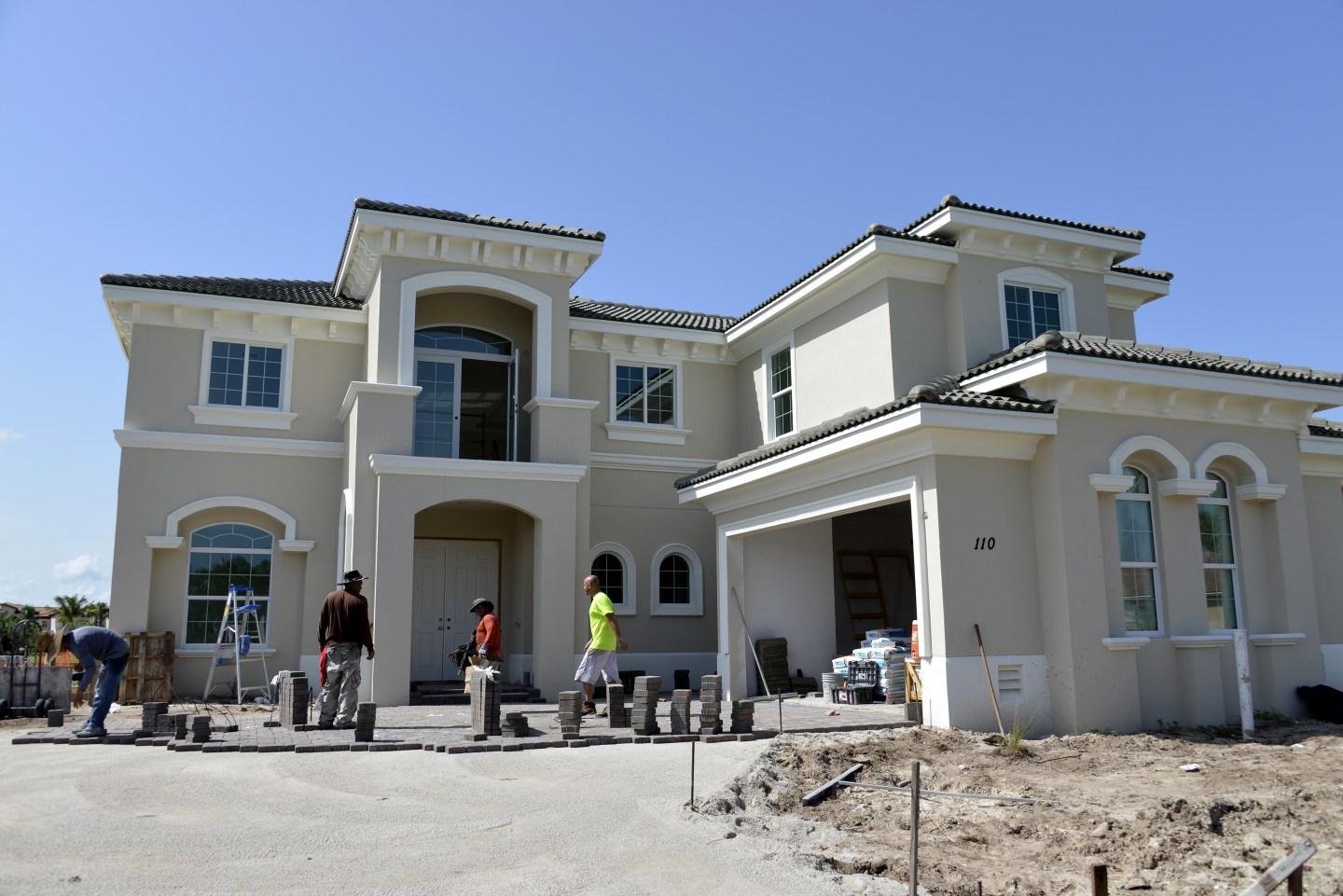
Workers install a paved driveway at the Toll Brothers Inc. Jupiter Country Club housing development in Jupiter, Florida, U.S., on Wednesday, Aug. 20, 2014. The U.S. Census Bureau is scheduled to release new home sales data on Aug. 25. Photographer: Mark Elias/Bloomberg via Getty ImagesPhoto by Bloomberg—Getty Images

Much has been made of the housing recovery in recent years, but when pundits talk about the phenomenon, they often fail to define their terms.

Real estate has recovered in the sense that home prices have regained their pre-bubble levels. The real estate market on average is fairly priced once again, but the home-building industry — the sector of the economy that fueled past recoveries and provides good-paying, middle-skilled jobs to blue-collar America — is still stuck in the doldrums.

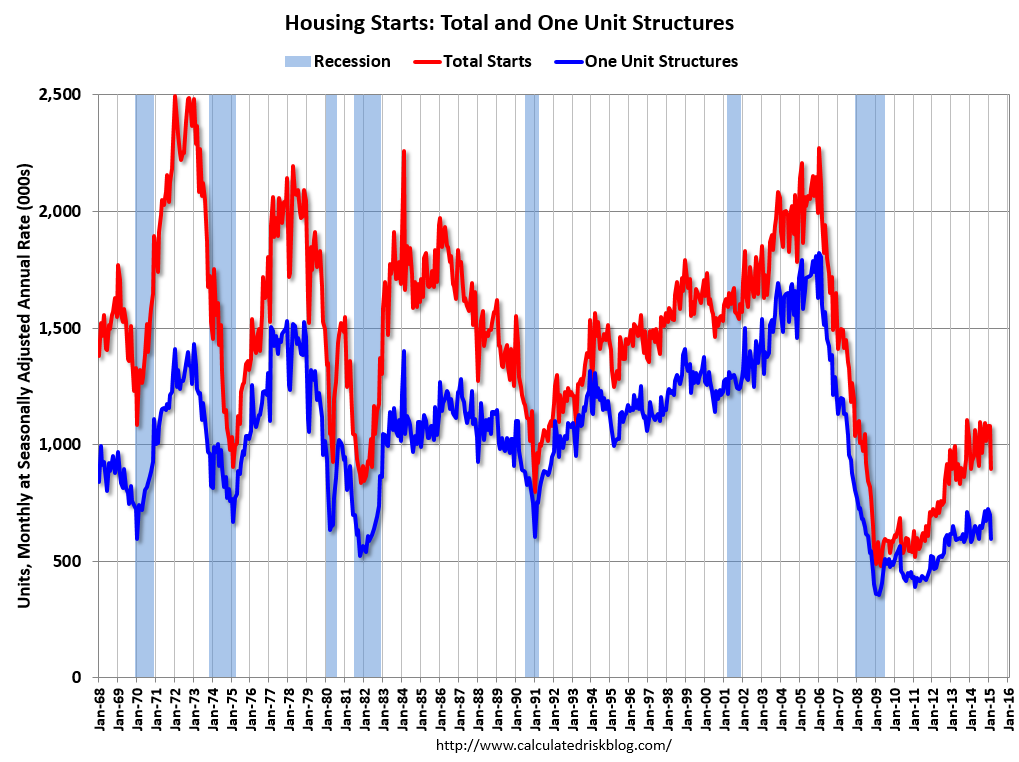
That fact was reinforced by data released Tuesday by the Commerce Department, showing that new home construction fell by 17% in February to a seasonally adjusted annual pace of 897,000 units. That was the largest drop in four years, and it illustrates the continuing difficulty the home-building industry is having, even nearly a decade after the real estate bubble topped. Here’s a chart from Calculated Risk that breaks down housing starts between single-family homes and multifamily units:
StartsFeb2015

As you can see, while there has been some recovery in the pace of building multi-unit structures, the home-building industry is constructing roughly the same number of single-family homes as it was during the depths of the 1990 recession.

The decline in housing starts dovetails with the index of homebuilder confidence released on Monday from the National Association of Homebuilders, which fell two points in March to 53, after declining in February as well. Analysts are quick to blame these troubling data on poor winter weather, but that explanation doesn’t really hold water. First off, the housing starts data are seasonally adjusted. Second, while February was cold, there wasn’t as much precipitation as in January, as pointed out Tuesday morning by Trulia’s Chief Economist Jed Kolko:

Blame weather for dip in Feb home starts? Last month was cold, but was actually pretty dry. pic.twitter.com/nWa2coiQZn

— Jed Kolko (@JedKolko) March 17, 2015

The fact of the matter is, the home-building industry remains in a deep slump. One obvious reason for this is that ever since the Great Recession, Americans have been very reluctant to move into homes of their own. They’d rather double up with roommates, parents, or other relatives, and that is apparent in the fact that over the past two years, Americans have, on average, formed just 467,000 new households per year.

Over the past couple months, however, that trend looks to be reversing. The most recent data show that household formation in 2014 increased to 2 million, well above the long-term average of about 1.3 million new households per year:

US Household Formation Chart

US Household Formation data by YCharts

If this trend can hold, it could signal the next wave of the housing recovery that includes more higher-paying jobs for middle-class Americans in the construction industry. But we’ve had reason for false hope before, such as in 2012 when for a few months it appeared that we would see breakout growth in household formation, only for Americans to revert to their post-recession habits.

The question then for homebuilders and economists trying to predict future behavior is this: have Americans fundamentally changed their attitudes toward household formation? Are we now a nation of roommates and renters, cowed by the bursting of the housing bubble? This cultural change wouldn’t be without precedent. The 1929 stock market crash and the ensuing Great Depression fundamentally altered the risk appetite of a whole generation of Americans. It wasn’t until the 1950s and 1960s that the taboo against risky investing began to fade.

Perhaps the past few months of data are just a blip that will be corrected once home builders begin to sense that pent-up demand is about to let loose. But in the meantime, we’re still waiting for the real housing recovery to begin.


About the Author
By Chris Matthews
See full bioRight Arrow Button Icon

Latest in Real Estate

Personal FinanceReal Estate
Current ARM mortgage rates report for Dec. 4, 2025
By Glen Luke FlanaganDecember 4, 2025
9 hours ago
Personal Financemortgages
Current mortgage rates report for Dec. 4, 2025: Rates hold steady
By Glen Luke FlanaganDecember 4, 2025
9 hours ago
Personal FinanceReal Estate
Current refi mortgage rates report for Dec. 4, 2025
By Glen Luke FlanaganDecember 4, 2025
9 hours ago
Personal Financemortgages
Home equity loan vs. home equity line of credit (HELOC)
By Joseph HostetlerDecember 3, 2025
19 hours ago
Tony Cuccio posing in a chair
C-SuiteMillionaires
Tony Cuccio started with $200 selling beauty products on Venice Beach. Then he brought gel nails to the masses—and forged a $2 billion empire
By Dave SmithDecember 3, 2025
1 day ago
Personal Financemortgages
Current mortgage rates report for Dec. 3, 2025: Rates fluctuate slightly upward
By Glen Luke FlanaganDecember 3, 2025
1 day ago

Most Popular

placeholder alt text
North America
Jeff Bezos and Lauren Sánchez Bezos commit $102.5 million to organizations combating homelessness across the U.S.: ‘This is just the beginning’
By Sydney LakeDecember 2, 2025
2 days ago
placeholder alt text
Economy
Two months into the new fiscal year and the U.S. government is already spending more than $10 billion a week servicing national debt
By Eleanor PringleDecember 4, 2025
6 hours ago
placeholder alt text
Economy
Ford workers told their CEO 'none of the young people want to work here.' So Jim Farley took a page out of the founder's playbook
By Sasha RogelbergNovember 28, 2025
6 days ago
placeholder alt text
North America
Anonymous $50 million donation helps cover the next 50 years of tuition for medical lab science students at University of Washington
By The Associated PressDecember 2, 2025
2 days ago
placeholder alt text
Economy
Scott Bessent calls the Giving Pledge well-intentioned but ‘very amorphous,’ growing from ‘a panic among the billionaire class’
By Nick LichtenbergDecember 3, 2025
23 hours ago
placeholder alt text
Innovation
Google CEO Sundar Pichai says we’re just a decade away from a new normal of extraterrestrial data centers
By Sasha RogelbergDecember 1, 2025
3 days ago
Rankings
  • 100 Best Companies
  • Fortune 500
  • Global 500
  • Fortune 500 Europe
  • Most Powerful Women
  • Future 50
  • World’s Most Admired Companies
  • See All Rankings
Sections
  • Finance
  • Leadership
  • Success
  • Tech
  • Asia
  • Europe
  • Environment
  • Fortune Crypto
  • Health
  • Retail
  • Lifestyle
  • Politics
  • Newsletters
  • Magazine
  • Features
  • Commentary
  • Mpw
  • CEO Initiative
  • Conferences
  • Personal Finance
  • Education
Customer Support
  • Frequently Asked Questions
  • Customer Service Portal
  • Privacy Policy
  • Terms Of Use
  • Single Issues For Purchase
  • International Print
Commercial Services
  • Advertising
  • Fortune Brand Studio
  • Fortune Analytics
  • Fortune Conferences
  • Business Development
About Us
  • About Us
  • Editorial Calendar
  • Press Center
  • Work At Fortune
  • Diversity And Inclusion
  • Terms And Conditions
  • Site Map

© 2025 Fortune Media IP Limited. All Rights Reserved. Use of this site constitutes acceptance of our Terms of Use and Privacy Policy | CA Notice at Collection and Privacy Notice | Do Not Sell/Share My Personal Information
FORTUNE is a trademark of Fortune Media IP Limited, registered in the U.S. and other countries. FORTUNE may receive compensation for some links to products and services on this website. Offers may be subject to change without notice.