• Home
  • Latest
  • Fortune 500
  • Finance
  • Tech
  • Leadership
  • Lifestyle
  • Rankings
  • Multimedia
TechGoogle

Google: Our new system for recognizing faces is the best one ever

By
Derrick Harris
Derrick Harris
Down Arrow Button Icon
By
Derrick Harris
Derrick Harris
Down Arrow Button Icon
March 17, 2015, 5:05 PM ET
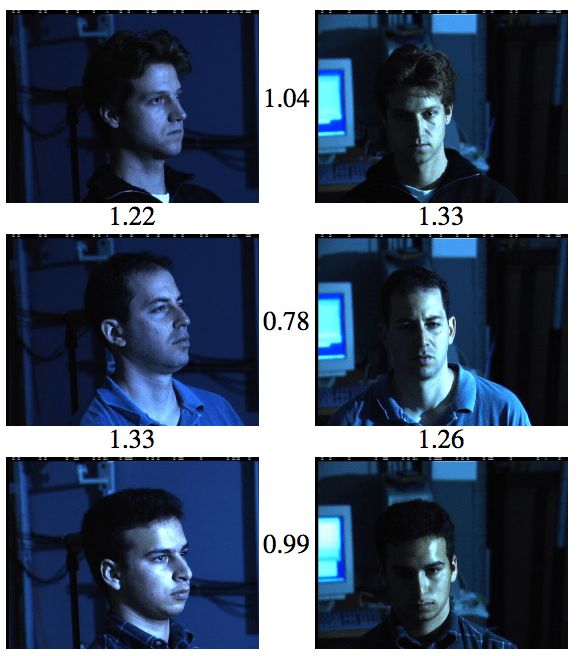
Google FaceNet facial recognition figure 1
Pose and illumination are a long standing challenge for face recognition. This shows the "distances" between pairs of faces in different combinations. (A distance of 0.0 means the faces are identical.)Courtesy: Google

“I never forget a face,” some people like to boast. It’s a claim that looks quainter by the day as artificial intelligence research continues to advance. Some computers, it turns out, never forget 260 million faces.

Last week, a trio of Google (GOOG) researchers published a paper on a new artificial intelligence system dubbed FaceNet that it claims represents the most-accurate approach yet to recognizing human faces. FaceNet achieved nearly 100-percent accuracy on a popular facial-recognition dataset called Labeled Faces in the Wild, which includes more than 13,000 pictures of faces from across the web. Trained on a massive 260-million-image dataset, FaceNet performed with better than 86 percent accuracy.

Researchers benchmarking their facial-recognition systems against Labeled Faces in the Wild are testing for what they call “verification.” Essentially, they’re measuring how good the algorithms are at determining whether two images are of the same person.

In December, a team of Chinese researchers also claimed better than 99 percent accuracy on the dataset. Last year, Facebook researchers published a paper boasting better than 97 percent accuracy. The Facebook (FB) paper points to researchers claiming that humans analyzing images in the Labeled Faces dataset only achieve 97.5 percent accuracy.

However, the approach Google’s researchers took goes beyond simply verifying whether two faces are the same. Its system can also put a name to a face—classic facial recognition—and even present collections of faces that look the most similar or the most distinct.

This is all just research, but it points to a near future where the types of crime-fighting, or surveillance-enhancing, computers we often see on network television and blockbuster movies will be much more attainable. Or perhaps a world where online dating is even simpler (and shallower) than swiping left or right on Tinder.

Have a thing for Brad Pitt circa 1998? Here are the 500 profiles that look the most like him.

At first we’ll see systems like Google’s FaceNet and Facebook’s aforementioned system (dubbed “DeepFace”) make their way onto those company’s web platforms. They will make it easier, or more automatic, for users to tag photos and search for people, because the algorithms will know who’s in a picture even when they’re not labeled. These types of systems will also make it easier for web companies to analyze their users’ social networks and to assess global trends and celebrity popularity based on who’s appearing in pictures.

Though Google and Facebook’s advances in facial recognition are relatively new, computer systems like this can be found all around us today. They incorporate an artificial intelligence technique called deep learning, which has proven remarkably effective at so-called machine perception tasks such as recognizing objects (by some metrics, machines are now better at this than are people), recognizing voices, and understanding the content of written text.

Aside from Google and Facebook, companies including Microsoft (MSFT), Baidu, and Yahoo (YHOO) are also investing heavily in deep learning research. The algorithms already power everyday features such as voice control on smartphones, Skype Translate, predictive text-messaging applications, and advanced image-searching. (If you have images uploaded to a Google+ account, go ahead and search them for specific objects.) Spotify and Netflix (NFLX) are investigating deep learning to power smarter media recommendations. PayPal (EBAY) is using it to fight fraud.

There are also several technology startups using deep learning to analyze medical images in real time, and to provide capabilities such as text analysis, computer vision, and voice recognition as cloud computing services. Twitter, Pinterest, Dropbox, Yahoo, and Google have all acquired deep learning startups in recent years. And IBM (IBM) just bought a Denver-based startup called AlchemyAPI to help make its Watson system smarter and bolster its new Bluemix cloud platform. (The idea: Developers can easily connect mobile and web applications to cloud services and therefore build smart applications without ever studying the complex computer science that underpins artificial intelligence.)

That’s not all. As consumer robots, driverless cars and smart homes become real, deep learning will be there, too, providing the eyes, ears, and some of the brains for our new toys. DARPA, the U.S. Department of Defense’s research agency, is also investigating how deep learning techniques might be able to help it make sense of the streams of communications crossing intelligence networks everyday.

Something tells me it’s looking at Google’s FaceNet and getting pretty excited, too.

Derrick Harris (@derrickharris) is a freelance writer.

About the Author
By Derrick Harris
See full bioRight Arrow Button Icon

Latest in Tech

Finance
Lorem ipsum dolor sit amet, consectetur adipiscing elit, sed do eiusmod tempor incididunt ut labore et dolore magna aliqua. Ut enim ad minim veniam
By Fortune Editors
October 20, 2025
Finance
Lorem ipsum dolor sit amet, consectetur adipiscing elit, sed do eiusmod tempor incididunt ut labore et dolore magna aliqua. Ut enim ad minim veniam
By Fortune Editors
October 20, 2025
Finance
Lorem ipsum dolor sit amet, consectetur adipiscing elit, sed do eiusmod tempor incididunt ut labore et dolore magna aliqua. Ut enim ad minim veniam
By Fortune Editors
October 20, 2025
Finance
Lorem ipsum dolor sit amet, consectetur adipiscing elit, sed do eiusmod tempor incididunt ut labore et dolore magna aliqua. Ut enim ad minim veniam
By Fortune Editors
October 20, 2025
Finance
Lorem ipsum dolor sit amet, consectetur adipiscing elit, sed do eiusmod tempor incididunt ut labore et dolore magna aliqua. Ut enim ad minim veniam
By Fortune Editors
October 20, 2025
Finance
Lorem ipsum dolor sit amet, consectetur adipiscing elit, sed do eiusmod tempor incididunt ut labore et dolore magna aliqua. Ut enim ad minim veniam
By Fortune Editors
October 20, 2025

Most Popular

Finance
Lorem ipsum dolor sit amet, consectetur adipiscing elit, sed do eiusmod tempor incididunt ut labore et dolore magna aliqua. Ut enim ad minim veniam
By Fortune Editors
October 20, 2025
Finance
Lorem ipsum dolor sit amet, consectetur adipiscing elit, sed do eiusmod tempor incididunt ut labore et dolore magna aliqua. Ut enim ad minim veniam
By Fortune Editors
October 20, 2025
Finance
Lorem ipsum dolor sit amet, consectetur adipiscing elit, sed do eiusmod tempor incididunt ut labore et dolore magna aliqua. Ut enim ad minim veniam
By Fortune Editors
October 20, 2025
Finance
Lorem ipsum dolor sit amet, consectetur adipiscing elit, sed do eiusmod tempor incididunt ut labore et dolore magna aliqua. Ut enim ad minim veniam
By Fortune Editors
October 20, 2025
Finance
Lorem ipsum dolor sit amet, consectetur adipiscing elit, sed do eiusmod tempor incididunt ut labore et dolore magna aliqua. Ut enim ad minim veniam
By Fortune Editors
October 20, 2025
Finance
Lorem ipsum dolor sit amet, consectetur adipiscing elit, sed do eiusmod tempor incididunt ut labore et dolore magna aliqua. Ut enim ad minim veniam
By Fortune Editors
October 20, 2025
Fortune Secondary Logo
Rankings
  • 100 Best Companies
  • Fortune 500
  • Global 500
  • Fortune 500 Europe
  • Most Powerful Women
  • Future 50
  • World’s Most Admired Companies
  • See All Rankings
Sections
  • Finance
  • Fortune Crypto
  • Features
  • Leadership
  • Health
  • Commentary
  • Success
  • Retail
  • Mpw
  • Tech
  • Lifestyle
  • CEO Initiative
  • Asia
  • Politics
  • Conferences
  • Europe
  • Newsletters
  • Personal Finance
  • Environment
  • Magazine
  • Education
Customer Support
  • Frequently Asked Questions
  • Customer Service Portal
  • Privacy Policy
  • Terms Of Use
  • Single Issues For Purchase
  • International Print
Commercial Services
  • Advertising
  • Fortune Brand Studio
  • Fortune Analytics
  • Fortune Conferences
  • Business Development
About Us
  • About Us
  • Editorial Calendar
  • Press Center
  • Work At Fortune
  • Diversity And Inclusion
  • Terms And Conditions
  • Site Map
Fortune Secondary Logo
  • About Us
  • Editorial Calendar
  • Press Center
  • Work At Fortune
  • Diversity And Inclusion
  • Terms And Conditions
  • Site Map
  • Facebook icon
  • Twitter icon
  • LinkedIn icon
  • Instagram icon
  • Pinterest icon

Latest in Tech

LawMedia
DOJ probes Netflix’s power over filmmakers in Warner deal review
By Josh Sisco and BloombergFebruary 21, 2026
9 hours ago
Big TechTech
Microsoft CEO Satya Nadella says Bill Gates told him his big bet on OpenAI would be a flop: ‘Yeah, you’re going to burn this billion dollars’
By Marco Quiroz-GutierrezFebruary 21, 2026
17 hours ago
InnovationNuclear Energy
U.S. military airlifts small nuclear reactor for the first time, flying a minivan-sized microreactor nearly 700 miles on a C-17
By Matthew Daly and The Associated PressFebruary 21, 2026
17 hours ago
taylor
CommentaryMarketing
How fandom became culture’s power center — and a blueprint for Gen Z’s economic influence
By Reid LitmanFebruary 21, 2026
20 hours ago
Startups & VentureEntrepreneurs
‘I have a chip on my shoulder.’ Phoebe Gates wants her $185 million AI startup Phia to succeed with ‘no ties to my privilege or my last name’
By Sydney LakeFebruary 21, 2026
21 hours ago
tanmai
AIdisruption
You have 18 months to figure out your office job, $1 billion CEO says. But it’s not going away
By Nick LichtenbergFebruary 21, 2026
21 hours ago

Most Popular

placeholder alt text
Innovation
The U.S. spent $30 billion to ditch textbooks for laptops and tablets: The result is the first generation less cognitively capable than their parents
By Sasha RogelbergFebruary 21, 2026
22 hours ago
placeholder alt text
Big Tech
Peter Thiel and other tech billionaires are publicly shielding their children from the products that made them rich
By Marco Quiroz-GutierrezFebruary 21, 2026
21 hours ago
placeholder alt text
Economy
Fed confirms it obeyed U.S. Treasury request for an unusual ‘rate check,’ weakening the dollar against foreign currencies
By Jim EdwardsFebruary 19, 2026
3 days ago
placeholder alt text
Startups & Venture
'I have a chip on my shoulder.' Phoebe Gates wants her $185 million AI startup Phia to succeed with 'no ties to my privilege or my last name'
By Sydney LakeFebruary 21, 2026
21 hours ago
placeholder alt text
Future of Work
Elon Musk bans résumés and cover letters in hiring for his chip team. These are the 3 bullet points he’s looking for instead
By Jake AngeloFebruary 20, 2026
2 days ago
placeholder alt text
Arts & Entertainment
Gen Zers and millennials flock to so-called analog islands 'because so little of their life feels tangible'
By Michael Liedtke and The Associated PressFebruary 20, 2026
2 days ago

© 2026 Fortune Media IP Limited. All Rights Reserved. Use of this site constitutes acceptance of our Terms of Use and Privacy Policy | CA Notice at Collection and Privacy Notice | Do Not Sell/Share My Personal Information
FORTUNE is a trademark of Fortune Media IP Limited, registered in the U.S. and other countries. FORTUNE may receive compensation for some links to products and services on this website. Offers may be subject to change without notice.