When you think of fantasy sports, you think of football.
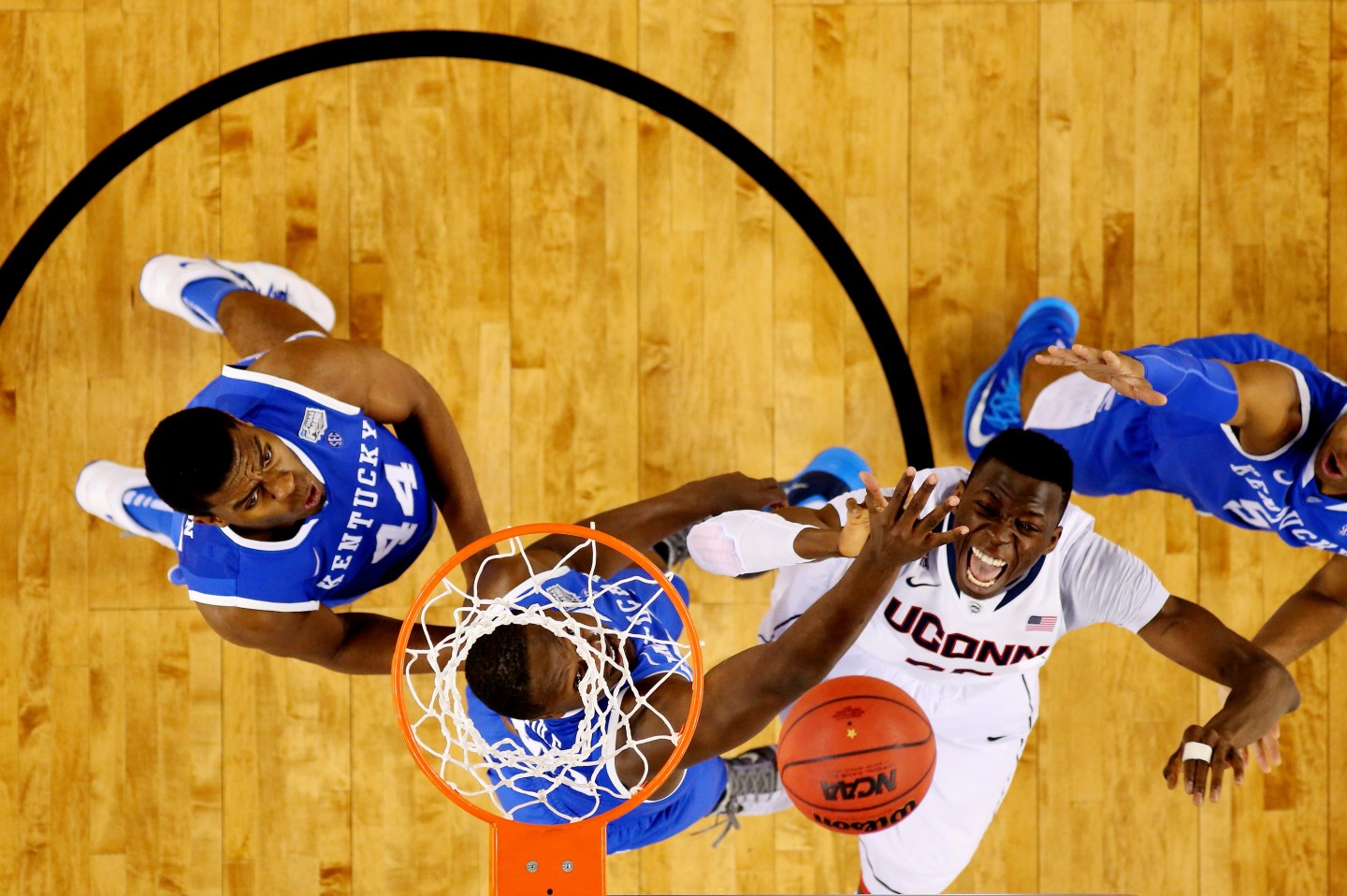
But football is just the entry point for most fantasy players—the gateway drug. For those who participate in other fantasy sports online, there’s basketball, and baseball, and fantasy hockey. And now the two biggest players in online daily fantasy gaming are going big on fantasy March Madness, a.k.a. the NCAA Division I basketball tournament.
Estimates of the size of the overall fantasy sports market vary wildly. Market research firm IBISWorld, in its most recent report on fantasy sports services in the U.S., has the industry growing at 12% a year, but clocks it at a mere $1 billion in annual revenue, which seems too low. An organization called the Fantasy Sports Trade Association, on the other hand, generously estimates it at more than 10 times that size.
Either way, it is a business that continues to open up, with room for small players (see: “Can Draft woo the casual fan to fantasy sports?“), and many experts believe the day will come when consumer spending on the cottage industry of fantasy football eclipses spending on actual live football.
For now, FanDuel and DraftKings have carved out leadership positions—and a strong rivalry—in the online daily fantasy realm, where seasoned players (think spreadsheets) go head-to-head each day to win big money, in contrast to the season-long leagues most casual players create with friends. It is generally thought that FanDuel is bigger in revenue, while DraftKings is growing faster. As Fortune reported in February, FanDuel may be approaching a $1 billion valuation—and therefore a candidate for our Unicorn List—and is eyeing an IPO in 2016.
Both sites began offering fantasy games for college basketball in the last two years, but now both are going bigger on the NCAA Men’s basketball tournament than they have before.
The structure of March Madness, which goes round by round (and rounds take longer than one day to complete) is not well suited, at first look, to daily fantasy, where you draft new players each day. But these two businesses are rolling with it.
FanDuel’s March Madness tournament is called Survive the Madness, and will pay out $250,000 in total to winners. The entrant pool is capped at 2,870 entrants, and entrants must pay $100 to enter the league. You might wonder why a business would want to limit potential paying customers, but the law requires these companies to cap the total participants for each contest, and to guarantee a total amount of prize money beforehand. Besides, says a FanDuel spokesperson, “Even if 10,000 people could join, I don’t think they would, because they would see their chances are lower.”
There are six rounds in FanDuel’s tournament, and at the end of every week, the bottom half of teams will be eliminated before the next round. The top half re-picks players every day. If a user makes it to the third round, he or she is guaranteed to win some amount of money.
A total payout of $250,000 may seem tiny—strictly in terms of revenue from entry fees, one can do the math and see that FanDuel will bring in $287,000 on the tournament and pay almost all of that back out. And it is indeed tiny compared to the nearly $10 million the site says it pays out each day. (In 2014, FanDuel paid out more than $550 million total, across all sports.) But the same March Madness tournament last year on FanDuel only had a payout of $50,000.
“The March Madness tournament gives fans the chance to be even more engaged in the games and players than they would be if they just picked a bracket,” says FanDuel CEO Nigel Eccles. “We’ve quintupled the size of our tournament because of how well March Madness works for a fantasy product.” Although college basketball is still a small business for fantasy sites, the media hype and fanfare around the tournament allows these companies to cross-market their other daily sports during that time.
Meanwhile, DraftKing is offering the March Mania Bracket Challenge. The tournament will give $20,000 to the top winner, out of $100,000 total. DraftKings paid out over $100 million last year overall.
The site says its participation in college basketball is up 7.7 times from last year—though it is easy to achieve big growth from a small starting point. (Fantasy football, as big as it is already, still grows each year for DraftKings, but college basketball is its fastest growing sport.)
The timing of March Madness is perfect for picking up football fans thirsty for more fantasy. “After the football season ends, people are looking around for the next thing to try,” says Femi Wasserman, VP of communications at DraftKings. “They typically lead with football, and then they realize that they really like daily fantasy. So we cross-market when other sports are ending, we offer various incentives, and one of our biggest focuses is measuring how many different sports people are playing.”
With all the ongoing fervor over the question of whether collegiate athletes deserve compensation, paid fantasy games involving college basketball may seem like it would cause problems. But the law considers your money at FanDuel or DraftKings to be an entry fee in a contest, not a bet placed on an individual player. “I’m not aware of any NCAA concerns, nor have we had any pushback,” says Wasserman. “It kind of just feels like March Madness is so big, so massive, and so well understood at this point, that some of the things you could normally be concerned about aren’t issues here.”