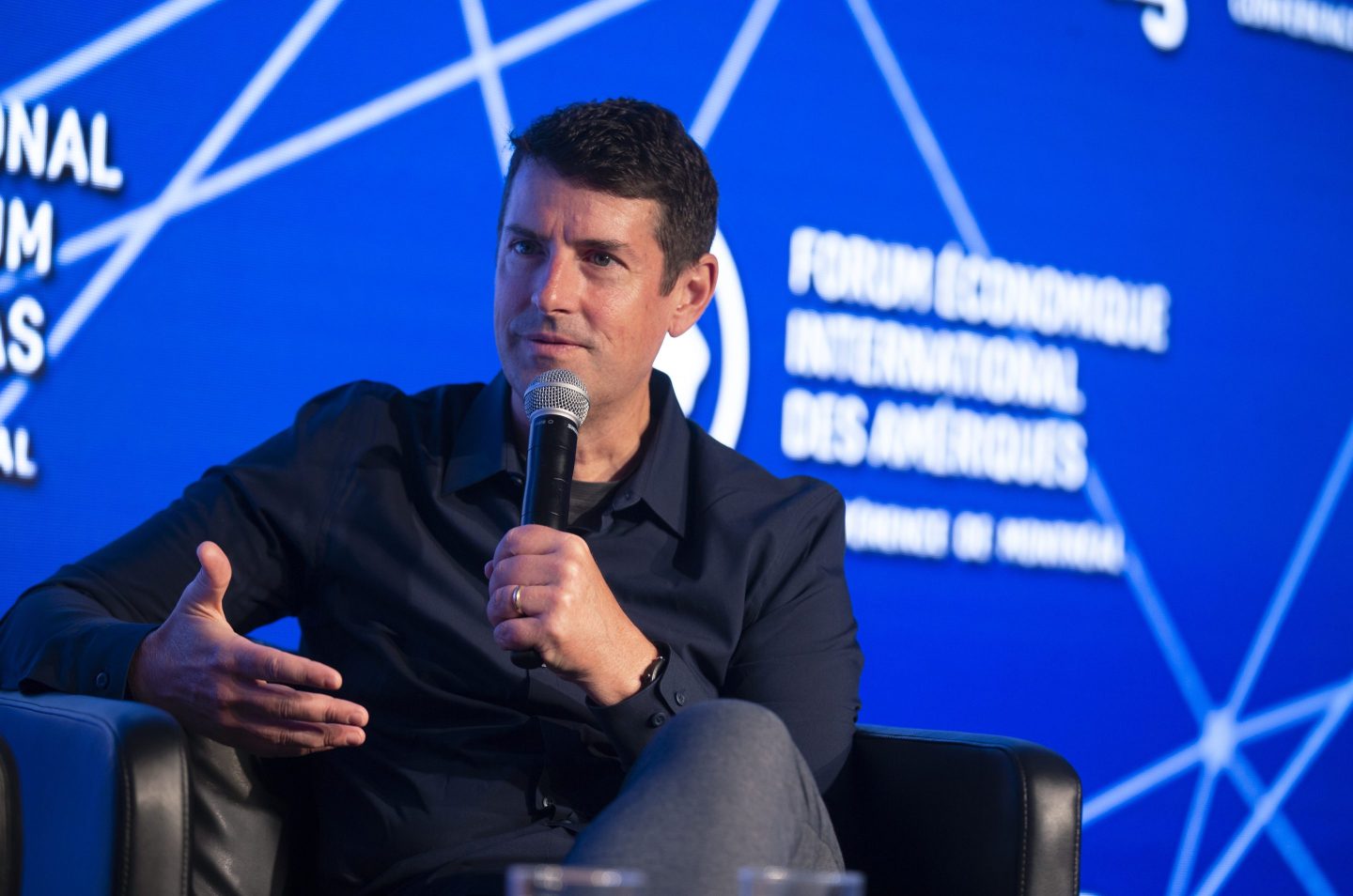
Late Wednesday, United Technologies said it was mulling the sale of helicopter-maker Sikorsky, a fabled member of the UTC family since 1925. It’s a clear sign that UTC’s new CEO, Greg Hayes, is putting his distinctive stamp on the aerospace and building systems colossus following the abrupt, mysterious departure late last year of his predecessor, Louis Chenevert. At an analyst meeting today, following the Sikorsky disclosure, Hayes presented an impressive strategic plan that encompassed the new, the old, and the unusual.
In the early 1990s, General Electric’s then CEO Jack Welch liked to dismiss rival UTC as a “popcorn stand.” But UTC proceeded to pop while GE fizzled, generating 12% annual returns to shareholders over the past eight years, versus flat returns for GE. For Hayes, the challenge is to keep delivering double-digit earnings gains by exploiting the best growth pockets in mature businesses, from jet engines to elevators. UTC is all about expanding sales a bit faster than the overall economy, and at the same time lifting margins so that profits wax at double-digit rates. It’s all about the magic of “operating leverage,” turning better-than-average revenue growth into sumptuous gains in profits.
First, let’s examine how Hayes’ plan diverges from UTC tradition—that’s the “new.” Although Chenevert sold many peripheral businesses, from rocket engines to fuel cells, he never shed a major UTC franchise on the scale of Sikorsky. As Sikorsky’s performance fell farther and farther behind aerospace and building systems, Chenevert never publicly discussed dispatching the chopper-maker. It isn’t known if his determination to keep Sikorsky in the fold caused conflict with the board or hastened his departure.
By contrast, Hayes stated from his first weeks as CEO that he’d consider selling any business at the right price, pointing early on to a Sikorsky exit. The gambit makes sense: Sikorsky’s projected growth rate in revenues is only around 2%, far below those of the other franchises. Its profit margin stands at 10% of sales, versus 15% for engine-maker Pratt & Whitney and over 20% at Otis, the elevator manufacturer. To perpetuate its success, UTC needs to pick the best growth corners in all of its major sectors, and Sikorsky’s relatively plodding prospects simply don’t fit.
Another fresh initiative is loosening central control, what Hayes calls “de-layering.” Until early this year, an umbrella organization called Propulsion and Aerospace oversaw Pratt & Whitney and Aerospace Systems, a group that makes electrical, heating and air conditioning systems or modules for airliners. Hayes folded Propulsion and Aerospace, and its chief, Alain Bellemare departed; he’s now CEO of Canada’s Bombardier. Now, the presidents of P&W and Aerospace Systems report directly to Hayes. “I want more oversight by the guys on the line,” he explained at the analyst meeting.
New imperatives also arise from new conditions. Hayes is facing a potential profit squeeze from the euro’s sharp decline against the dollar. One of UTC’s biggest businesses is servicing and repairs for its Otis elevators. To compensate for the euro drag, Hayes plans to lower central corporate costs by $100 million a year, and make a comparable reduction in overhead at the business units. He’s also planning to shrink what he considers excessive inventories, a move that would save interest expense on carrying stocks of parts, and swell free cash flow.
In the “old” category, Hayes is extending Chenevert’s practice of imposing daunting “stretch goals” on his lieutenants. In building systems, accounting for 45% of UTC’s sales, Hayes pledges to drive revenues from $30 billion in 2014 to $50 billion by 2020, and lift margins from around 18% to 20%. Getting there requires 9% annual sales gains, and double-digit earnings growth, in the mature HVAC and elevator markets. The challenge will be particularly difficult given the economic slowdown in China, by far the world’s biggest elevator market, and a major source of UTC’s past growth.
To reach his targets, Hayes will need to make some terrific acquisitions. M&A is a longstanding strength at UTC. Chenvert’s purchase of Goodrich’s aerospace systems franchise in 2012 for $18.5 billion was the biggest deal in the industry’s history, and proved an outstanding bargain. Hayes states that UTC could spend as much as $30 billion on acquisitions over the next five years. He doesn’t like small deals, saying that takeovers in the $1 billion range take lots of management time, but don’t add enough growth to repay the effort. As for another Goodrich-sized deal, he promises never to “bet the company,” and stresses the difficulty of folding a giant new business into an existing one.
Hence, Hayes is aiming at half-a-dozen deals in the $5 to $6 billion range. Given the problems in China, it’s likely that UTC will need great M&A choices to make its growth goals. Hayes is mainly looking in Asia and Europe, where UTC has parked most of its cash.
His agenda embraces the unusual as well. Sikorsky has a book value of just $1.5 billion, a fraction of the price it would fetch from a corporate buyer such as Boeing or Textron. That would stick UTC with a big tax bill. So it’s most likely that UTC will spin off Sikorsky to its shareholders as an independent enterprise, in a tax-free transaction. Analysts are speculating that UTC could pile billions of dollars of its debt onto Sikorsky, and use the proceeds to purchase stock. That’s a classic from the typical spinoff playbook.
Hayes, however, promises to avoid loading debt onto a newly independent Sikorsky. At the analyst meeting, he said that he wants a healthy Sikorsky that isn’t forced to use most of its resources making interest payments. After all, his shareholders will also be shareholders in the new Sikorsky. Wall Street would love the usual, but it’s the unusual that makes sense.