
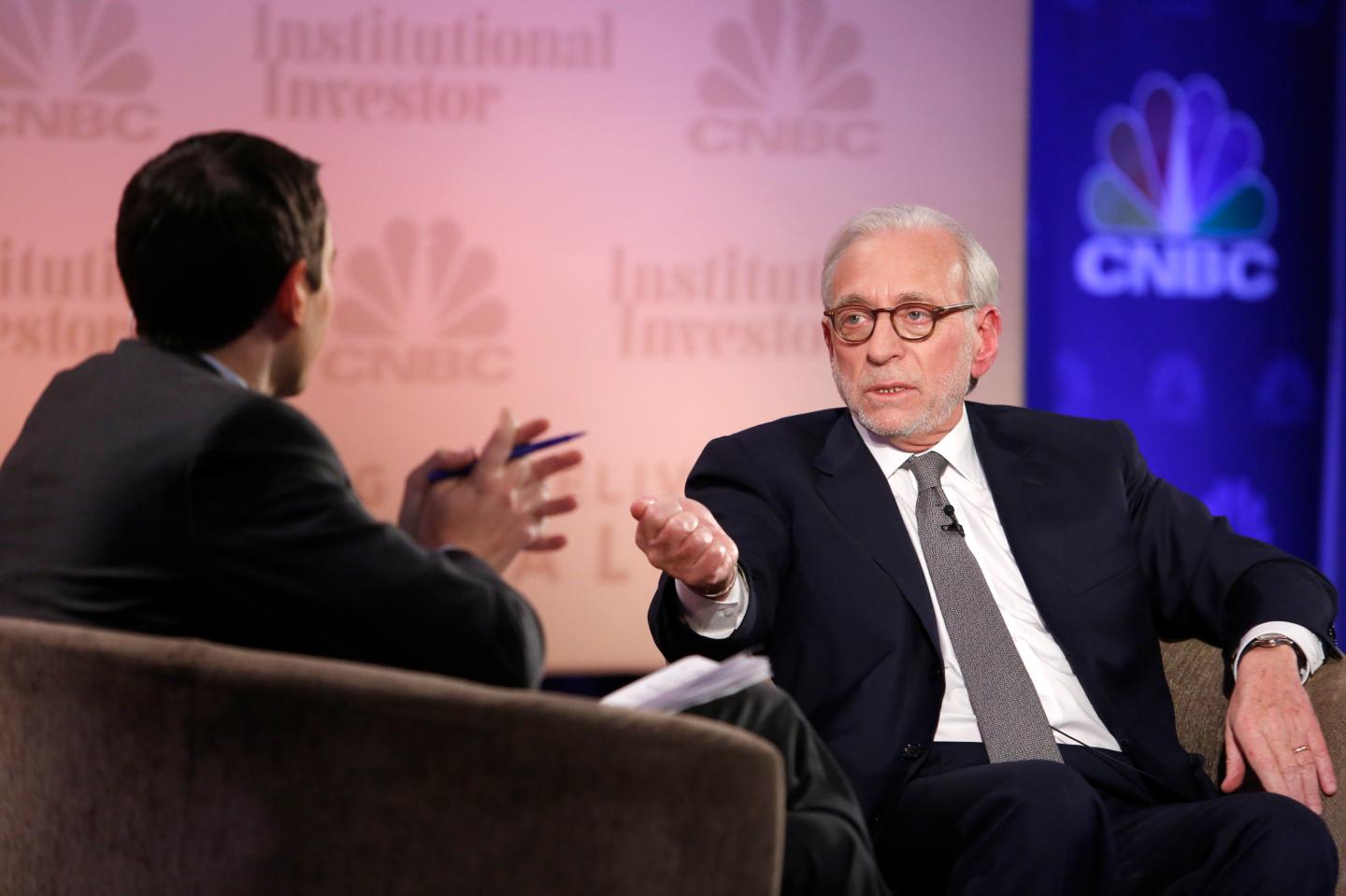
The standoff between veteran investor Nelson Peltz and chemical giant DuPont is growing increasingly tense—and could prove to be a landmark in the annals of activism.
On Jan. 8, Trian Fund Management, headed by Peltz and his partners Peter May and Ed Garden, said that it will launch a proxy fight seeking four board seats at DuPont’s (DD) annual meeting, traditionally held in April. Only Carl Icahn—in his activist campaigns against Time Warner and eBay—has attacked bigger targets. But in both cases, Icahn settled, ending the proxy contest before a vote. If the DuPont contest does go to a vote—highly probable given its vehement resistance—and Peltz wins one or more board seats, he’ll be the first activist to win board representation in a company the size of DuPont, which has a market value of $67 billion.
A Peltz victory might embolden fellow activists to cross swords with colossi formerly deemed too powerful to attack. Hence, it’s especially important to weigh the arguments from both sides. Is DuPont a bloated underperformer that needs radical change, as Peltz insists? Or is this industrial legend doing just fine—as demonstrated by its recent strong stock performance—and destined to fare even better thanks to a daring restructuring plan, as DuPont CEO Ellen Kullman argues?
Peltz’s Trian Fund Management owns $1.8 billion in DuPont stock. That’s slightly under 3% of the company’s total equity. So to win the proxy fight, Peltz will need plenty of big institutions to join his cause. And DuPont is lobbying the same investors by touting Kullman’s strategy. The crossfire of charges and counter-charges is already so intense that you can’t blame shareholders big and small from being confused.
But let’s ignore the din, and look at the numbers that illustrate whether DuPont is really a winner or a laggard. Kullman’s initiatives may succeed, and investors may endorse them in a proxy vote. But the best metrics for measuring DuPont’s performance vs. its peers point to a clear conclusion: Right now, DuPont is performing poorly.
Before we dig into those metrics in detail, let’s start with a brief chronology of Peltz’s pursuit of DuPont. In August 2013, Trian took a big stake in the industrial conglomerate, which makes chemicals and plastics as well as agricultural, bioscience, and nutritional products. Peltz is a self-described “operational activist” who targets companies that, by his measures, are performing far below their potential. He frequently advocates for splitting what he regards as the unwieldy and unfocused into two or more units that would prove far more profitable operating separately. Peltz has prevailed in campaigns to divide big companies such as Cadbury Schweppes (which split into Dr Pepper Snapple Group for beverages and Cadbury for sweets) and Kraft Foods (Mondelez for snacks, and Kraft Foods for groceries). He also pressured Wendy’s into selling coffee chain Tim Hortons. For the most part, the standalone companies created by these breakups are today generating bigger profits apart than they did combined. Naturally, we don’t know if they would have thrived in combination. Along the way, Peltz has greatly enriched Trian’s investors. According to industry sources, Trian has returned 55% net of fees over the past two years and now manages $11 billion, double the number two years ago.
Peltz has proposed a familiar “split-the-business” strategy for DuPont. He first approached the company after buying that initial stake in August 2013. For more than a year, Peltz and his partners negotiated privately with DuPont’s board and Kullman but got nowhere. So in September 2014, Trian sent a pointed letter to DuPont’s directors. It praised the company’s decision to spin off its large performance chemicals business—a transaction that is slated for completion this year and moves DuPont in the direction of Peltz’s plan. But Trian demanded that DuPont go much further by dividing the rest of the company into two parts: a “growth” business encompassing agriculture and nutrition; and a mature, cyclical franchise producing performance materials, safety products, and electronics.
But Peltz’s proposal failed to sway DuPont’s board. So Trian responded on Jan. 8, pledging a proxy fight for board seats.
DuPont contends that it will prove far more profitable as a diversified conglomerate, where the broad portfolio of products benefit from integrated research, a strong capital base, and a world-class brand. Kullman acknowledges that DuPont needs to reduce its corporate overhead, but insists that it’s already producing good operating results compared to its competitors. In its most recent proxy statement from April 2013, the board claims a big increase in profit margins, and praises management for the successful integration of Danisco, a Danish enzyme-maker it purchased in 2011 for $5.8 billion.
Most of all, DuPont lauds its superior return to shareholders in recent years. Since Kullman took charge at the start of 2009, DuPont has delivered gains of 266% including dividends, beating the 159% return for the S&P 500.
For his part, Peltz argues in his public statements that “the conglomerate structure is destroying shareholder value.” He asserts that DuPont needs to reduce corporate expenses by as much as $4 billion a year, far above Kullman’s goal. Most of all, he cites DuPont’s “persistent underperformance,” rejecting its claims that margins and revenues are growing in most of its businesses and insisting that DuPont falls far short of best-in-class competitors in almost all its major franchises. Splitting DuPont into high-growth and mature businesses, Peltz argues, would create two nimble, sharply focused enterprises with like businesses and far lower corporate costs.
As for DuPont’s stock performance, Peltz takes a longer view than the company. He points out that, despite recent gains, DuPont’s share price is still below its 1999 level. Furthermore, he argues that his stock purchases have helped drive DuPont’s recent improved performance.
What’s certain is that the future of DuPont’s share price will be determined in large part by how profitably it runs its businesses. That will depend on its returns on capital: how much profit it derives from every dollar invested in the assets used to make advanced seeds for crops and producing chemicals, resins, and all its other products.
The true picture of the company’s profitability is also masked by the complexity of DuPont’s operations, and the plethora of asset sales and special charges that it has taken in recent years.
One measure cuts through the muck, however, and gives a clear picture of how DuPont is actually performing. The metric is called COROA—for “cash operating return on assets.” It was developed by Jack Ciesielski, author of the Analyst’s Accounting Observer. COROA is the best measure of how well a company is deploying the assets entrusted to it by shareholders.
COROA is the ratio of two essential numbers. The first is “operating cash flows.” We start with cash from operations as reported on the cash flow statement. To that figure Ciesielski adds cash taxes and cash interest that were subtracted in calculating reported cash flows. By adding back taxes and interest, COROA removes the influence of taxes and leverage, which aren’t related to operations, to get a pure view of how well a company performs in making and selling its products. The second key number is “total assets.” That consists of assets as reported on the balance sheet, plus accumulated depreciation. The sum of the two represents the dollars spent on all the assets being used to generate cash flows. COROA is operating cash flow divided by total assets. The higher the ratio, the more annual cash that the company is generating for every dollar it paid for its assets.
So how is DuPont doing? Ciesielski ran two comparisons. The first measures DuPont against the 29 Russell 1000 chemical industry companies. The second benchmarks DuPont versus the 17 companies that it cites as its “peer group” in its most recent proxy statement. (Trian does not use COROA in its analysis of DuPont’s results.)
For 2013, the most recent year for which complete numbers were available, DuPont posted a COROA of 7.1%. That’s roughly 4 percentage points below the chemical industry average of 11.2%. DuPont also trailed the industry in 2011 and 2012. How about its peer group? These are the companies that DuPont compares itself to in its proxy, basing compensation, in part, on how well it performs compared to the companies on the list. It’s important to note that many of these peer companies have businesses, and product mixes, far different from DuPont’s. No one expects DuPont to approach the COROA of a Johnson & Johnson or Merck. Still, the results aren’t encouraging. DuPont’s peer group posted an 11.7% COROA in 2013, which means that DuPont lagged by 4.6 percentage points.
How did the venerable conglomerate fare vs. individual companies in its peer group? DuPont trailed 3M (16.2%), Caterpillar (12.8%), Dow Chemical (10%), Honeywell (11.3%), and Boeing (8.5%). In fact, DuPont finished behind all but one of the 17 companies in its peer group. (It managed to tie the Swiss agricultural producer Syngenta.) DuPont did do better in 2012, when its COROA of 9.2% would have beaten Dow Chemical, Air Products, and several others.
Another important metric is the return that current management is generating on all the assets it has added since taking charge. Kullman became CEO at the start of 2009. From that point through the end of 2013, DuPont added $18 billion in net additional assets (that’s based on an average of assets deployed during the year). But operating cash flow has grown by just $900 million. So the return on those $18 billion in assets is just 5%.
Kullman is promising great things for the future. But in 2014, the trend is down. Analyst Mark Connelly of CLSA projects cash from operations, as reported, for 2014 of $2.5 billion, well below the 2013 figure. We can’t calculate final COROA since DuPont hasn’t reported full 2014 results yet, but the company’s COROA is certain to fall behind last year’s number.
Why is DuPont underperforming in COROA? For analyst Connelly, it’s mainly about Kullman’s inability to both substantially grow the business and conquer its huge cost structure. “Sales have barely grown since 2011,” he says. “When business is bad they’ve been selling assets. You have these drops in cash from operations and big chunks of cash from asset sales.” Kullman should be praised for attempting to change the DuPont culture, says Connelly, “But it’s proving far harder to change than she thought.”
Fortune sent DuPont the full COROA analysis so it could comment for this story. The company provided the following statement: “DuPont utilizes a number of metrics to assess its long-term performance, including cash based metrics. Certain metrics do not adequately reflect performance in the midst of significant transformation, such as the one DuPont is currently undertaking to drive higher growth and higher value through significant portfolio transformation, investments in innovation, re-engineering of business processes and significant returns of capital to shareholders.”
DuPont cited its superior stock performance in recent years, and said, “We believe our total shareholder return, which has outperformed the S&P 500, our peers, and relevant market indices over the past six years, is the most fundamental measure of what we have delivered for our shareholders.”
There’s no denying that DuPont’s stock has seen strong gains during Kullman’s tenure. And markets are forward-looking. So it’s possible that investors have endorsed DuPont stock because they believe that Kullman’s strategy will produce great operating results in the future. It is also possible investors think that Peltz’s pressure will greatly improve DuPont.
But future cash returns on every dollar of new investment are what will ultimately drive DuPont’s stock up or down. That’s what COROA is all about. And on that basic measure, DuPont, for now, appears to be a tired giant that’s falling short.