
• Home
  • Latest
  • Fortune 500
  • Finance
  • Tech
  • Leadership
  • Lifestyle
  • Rankings
  • Multimedia
LeadershipMinimum Wage

Fast food workers’ $15 demand: How aiming high launched a social movement

Claire Zillman
By
Claire Zillman
Claire Zillman
Editor, Leadership
Down Arrow Button Icon
Claire Zillman
By
Claire Zillman
Claire Zillman
Editor, Leadership
Down Arrow Button Icon
December 4, 2014, 4:44 PM ET
FAST FOOD PROTESTS
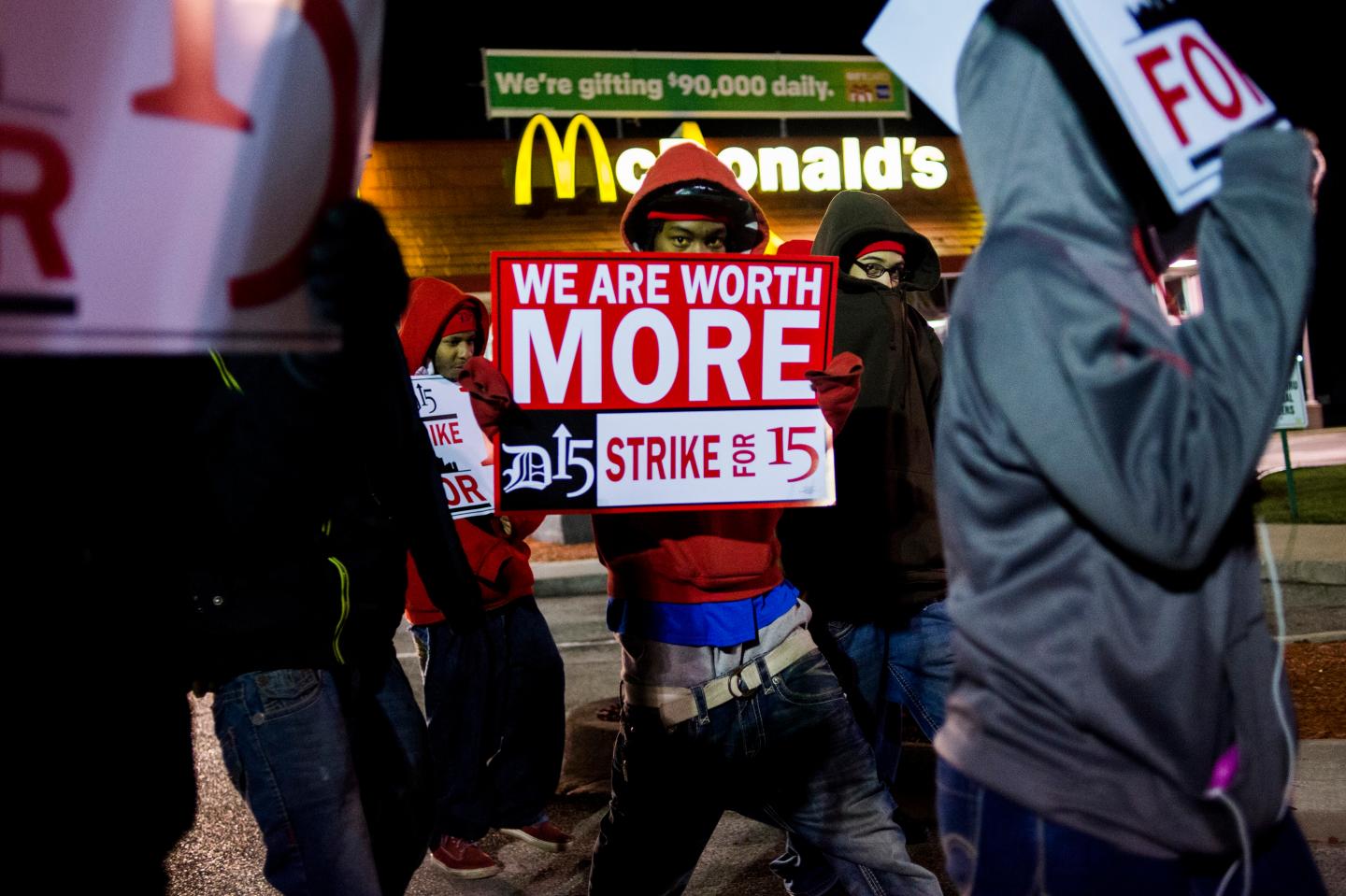
Nathaniel Loyd, 23, center, holds a sign during a demonstration for an increased minimum wage on Thursday, Dec. 4, 2014 at McDonald's in Mt. Morris Township, Mich. Activists, fast-food workers and others are calling for increasing the minimum wage to $15 per hour and allowing workers to form unions without corporate opposition, as part of nationwide demonstrations. (AP Photo/The Flint Journal, Jake May ) LOCAL TELEVISION OUT; LOCAL INTERNET OUTPhotograph by Jake May — MLive.com/AP

Fast food workers in some 190 cities walked off the job on Thursday, seeking the same demand they’ve been making for the past two years: $15 an hour in pay.

It’s been the fast food movement’s rallying cry since November 2012, when 200 workers in New York City first abandoned their registers and food prep stations in protest of employers who rake in billions of dollars in profits while paying what the employees characterize as poverty wages.

The workers settled on that $15 figure—as Kendall Fells, organizing director of Fast Food Forward, tells it—two months before, in a space in downtown Brooklyn made available by a teachers union. Ten dollars an hour was the first suggested demand, but the group of about 80 workers eventually determined that that figure wouldn’t free them from dependence on public assistance. The next number thrown out was $20, but “the majority [of the group] didn’t think $20 was achievable,” Fells says, leaving $15 as the eventual winner.

The group didn’t refer to any statistics or living wage calculators. “It wasn’t some [New York Times] Upshot or 538 analysis,” says Fells, who’s “on loan” from the Service Employees International Union, a group backing the fast food push. “They wanted a wage that would allow them to afford to eat and get a roof over their heads.” (The SEIU did not respond to a request for comment for this article.)

The fast food workers launched their campaign with the $15 per hour demand as their cornerstone, even though in November 2012, that dollar amount seemed like a pie-in-the-sky request, even unreasonable and out-of-touch. At the time, it was higher than any city or state minimum wage in the country and more than double the minimum federal rate.

Though Fells characterizes the $15 demand as an off-the-cuff calculation, asking for so much has proved to be a brilliant strategy.

A wage of $15 per hour is now the battle cry for low-wage workers nationwide, and it’s transformed labor organizing from a process often centered on nickel-and-dime negotiations with a single employer into a social justice movement that transcends industry and geographic boundaries. Not to mention the tangible results: Seattle passed a $15 minimum wage in June. San Francisco’s minimum wage is set to meet that mark in 2018. Los Angeles is considering raising its minimum wage to that figure. And, just this week, Chicago increased its minimum wage into similar territory, passing a law that will hike its minimum pay rate to $13 per hour by 2019.

“It’s changed public policy across the country,” says Steven Ashby, a professor at University of Illinois at Urbana-Champaign’s School of Labor and Employment Relations. Fifteen dollars per hour, he says, doesn’t seem like that huge of a leap anymore.

“If [the fast food workers] had asked for 50 cents more [than they were making], then it becomes a particular ask,” says Tom Juravich, professor of labor studies at University of Massachusetts Amherst. All the attention would have been on that dollar amount, he says. Or if the group had supported President Barack Obama’s $10 per hour proposal, it would have created a storyline—a labor group agreeing with a Democratic president—that’s nothing new.

Instead, by demanding what seemed like a long-shot wage raise, the group—intentionally or not—refocused the conversation on the circumstances that prompted workers to ask for so much, Juravich says. “We used to assume that people who worked in fast food or in a coffee shop were like us—they have homes, cars, kids,” Juravich says. The fast food campaign “showed us that they’re not. They’re really struggling to find adequate housing, safe places to live, and decent food. It pulled people out of the shadows a bit and into the public consciousness.”

Though that strategy has upended many labor organizing norms, it has historical precedent.

Consider the 1934 textile strikes that took place in the southern United States, during which tens of thousands of workers across the industry—frustrated by 55-60 hour weeks that typically yielded as little as $10 in pay—walked off the job and demanded 30-hour work weeks and $20 per week. Several workers were killed and many more injured or jailed during a series of strikes that year, and there were few immediate results. Decades later, however, the movement is credited with aiding the passage of the National Labor Relations Act, which provides workers with organizing protections.

SEIU’s Justice For Janitors campaign in the 1990s, which led to the unionization of custodial workers, is similar to the fast food movement in that it drummed up public support by focusing on social justice themes. It wasn’t cast as “we want a dollar more,” Juravich says. It was about establishing a base line of fairness for a group of workers who were spread across many cities, worked for different employers, but yet experienced similar disenfranchisement.

The $15 demand also gives the fast food movement staying power. “It’s not as though we’ve got [employers] jumping to sign on to this,” Juravich says. It’s not a goal that can be easily or quickly met. “I think that characterizing it this way allowed it to sustain,” he says.

About the Author
Claire Zillman
By Claire ZillmanEditor, Leadership
LinkedIn iconTwitter icon

Claire Zillman is a senior editor at Fortune, overseeing leadership stories. 

See full bioRight Arrow Button Icon

Latest in Leadership

Finance
Lorem ipsum dolor sit amet, consectetur adipiscing elit, sed do eiusmod tempor incididunt ut labore et dolore magna aliqua. Ut enim ad minim veniam
By Fortune Editors
October 20, 2025
Finance
Lorem ipsum dolor sit amet, consectetur adipiscing elit, sed do eiusmod tempor incididunt ut labore et dolore magna aliqua. Ut enim ad minim veniam
By Fortune Editors
October 20, 2025
Finance
Lorem ipsum dolor sit amet, consectetur adipiscing elit, sed do eiusmod tempor incididunt ut labore et dolore magna aliqua. Ut enim ad minim veniam
By Fortune Editors
October 20, 2025
Finance
Lorem ipsum dolor sit amet, consectetur adipiscing elit, sed do eiusmod tempor incididunt ut labore et dolore magna aliqua. Ut enim ad minim veniam
By Fortune Editors
October 20, 2025
Finance
Lorem ipsum dolor sit amet, consectetur adipiscing elit, sed do eiusmod tempor incididunt ut labore et dolore magna aliqua. Ut enim ad minim veniam
By Fortune Editors
October 20, 2025
Finance
Lorem ipsum dolor sit amet, consectetur adipiscing elit, sed do eiusmod tempor incididunt ut labore et dolore magna aliqua. Ut enim ad minim veniam
By Fortune Editors
October 20, 2025

Most Popular

Finance
Lorem ipsum dolor sit amet, consectetur adipiscing elit, sed do eiusmod tempor incididunt ut labore et dolore magna aliqua. Ut enim ad minim veniam
By Fortune Editors
October 20, 2025
Finance
Lorem ipsum dolor sit amet, consectetur adipiscing elit, sed do eiusmod tempor incididunt ut labore et dolore magna aliqua. Ut enim ad minim veniam
By Fortune Editors
October 20, 2025
Finance
Lorem ipsum dolor sit amet, consectetur adipiscing elit, sed do eiusmod tempor incididunt ut labore et dolore magna aliqua. Ut enim ad minim veniam
By Fortune Editors
October 20, 2025
Finance
Lorem ipsum dolor sit amet, consectetur adipiscing elit, sed do eiusmod tempor incididunt ut labore et dolore magna aliqua. Ut enim ad minim veniam
By Fortune Editors
October 20, 2025
Finance
Lorem ipsum dolor sit amet, consectetur adipiscing elit, sed do eiusmod tempor incididunt ut labore et dolore magna aliqua. Ut enim ad minim veniam
By Fortune Editors
October 20, 2025
Finance
Lorem ipsum dolor sit amet, consectetur adipiscing elit, sed do eiusmod tempor incididunt ut labore et dolore magna aliqua. Ut enim ad minim veniam
By Fortune Editors
October 20, 2025
Fortune Secondary Logo
Rankings
  • 100 Best Companies
  • Fortune 500
  • Global 500
  • Fortune 500 Europe
  • Most Powerful Women
  • Future 50
  • World’s Most Admired Companies
  • See All Rankings
Sections
  • Finance
  • Fortune Crypto
  • Features
  • Leadership
  • Health
  • Commentary
  • Success
  • Retail
  • Mpw
  • Tech
  • Lifestyle
  • CEO Initiative
  • Asia
  • Politics
  • Conferences
  • Europe
  • Newsletters
  • Personal Finance
  • Environment
  • Magazine
  • Education
Customer Support
  • Frequently Asked Questions
  • Customer Service Portal
  • Privacy Policy
  • Terms Of Use
  • Single Issues For Purchase
  • International Print
Commercial Services
  • Advertising
  • Fortune Brand Studio
  • Fortune Analytics
  • Fortune Conferences
  • Business Development
  • Group Subscriptions
About Us
  • About Us
  • Editorial Calendar
  • Press Center
  • Work At Fortune
  • Diversity And Inclusion
  • Terms And Conditions
  • Site Map
  • About Us
  • Editorial Calendar
  • Press Center
  • Work At Fortune
  • Diversity And Inclusion
  • Terms And Conditions
  • Site Map
  • Facebook icon
  • Twitter icon
  • LinkedIn icon
  • Instagram icon
  • Pinterest icon

Latest in Leadership

yale
PoliticsColleges and Universities
Teacher, blame thyself: Yale report savages Ivy League schools for destroying American trust in higher education
By Nick LichtenbergApril 15, 2026
5 hours ago
People protesting against tax giants.
PoliticsTaxes
How a free tax filing system from the government went from 296,000 users to zero in just one year
By Catherina GioinoApril 15, 2026
8 hours ago
Boss has lunch with her workers outside
Successcompany culture
A $24 billion Dutch lender is cutting its workforce—and to get the remaining staff on board, the CEO is having sandwiches with them
By Emma BurleighApril 15, 2026
10 hours ago
Sal Khan
SuccessEducation
This CEO has teamed up with Google, Microsoft, and McKinsey to build an AI degree that could rival Harvard—and it will cost only $10,000 to attend
By Preston ForeApril 15, 2026
11 hours ago
Why insurance giant Travelers’ CTO is placing fewer, bigger bets on AI
NewslettersCIO Intelligence
Why insurance giant Travelers’ CTO is placing fewer, bigger bets on AI
By John KellApril 15, 2026
11 hours ago
horowitz
AIdisruption
A16z’s Ben Horowitz sees ‘AI anxiety’ consuming Silicon Valley founders. Workers’ fear of something else is killing adoption
By Nick LichtenbergApril 15, 2026
11 hours ago

Most Popular

Jeff Bezos pledged $10 billion for climate change. With the 2030 clock ticking, his wife, Lauren Sánchez Bezos, is leading the charge to spend it
Environment
Jeff Bezos pledged $10 billion for climate change. With the 2030 clock ticking, his wife, Lauren Sánchez Bezos, is leading the charge to spend it
By Fortune EditorsApril 15, 2026
11 hours ago
Billionaire philanthropist MacKenzie Scott has donated again—a week after gifting millions to a college, she's just given $70 million to Meals on Wheels America
Success
Billionaire philanthropist MacKenzie Scott has donated again—a week after gifting millions to a college, she's just given $70 million to Meals on Wheels America
By Fortune EditorsApril 13, 2026
2 days ago
Palantir CEO says working at his $316 billion software company is better than a degree from Harvard or Yale: ‘No one cares about the other stuff’
Success
Palantir CEO says working at his $316 billion software company is better than a degree from Harvard or Yale: ‘No one cares about the other stuff’
By Fortune EditorsApril 14, 2026
2 days ago
Retirees are facing a $345,000 bill they never saw coming — and most aren't prepared
Commentary
Retirees are facing a $345,000 bill they never saw coming — and most aren't prepared
By Fortune EditorsApril 14, 2026
2 days ago
Economists warned California not to raise the minimum wage to $20. They were wrong in almost every way so far, another economist says
Economy
Economists warned California not to raise the minimum wage to $20. They were wrong in almost every way so far, another economist says
By Fortune EditorsApril 15, 2026
15 hours ago
The billionaire Anthropic cofounder who majored in literature says knowing how to ask the right questions beats knowing how to code
Success
The billionaire Anthropic cofounder who majored in literature says knowing how to ask the right questions beats knowing how to code
By Fortune EditorsApril 14, 2026
1 day ago

© 2026 Fortune Media IP Limited. All Rights Reserved. Use of this site constitutes acceptance of our Terms of Use and Privacy Policy | CA Notice at Collection and Privacy Notice | Do Not Sell/Share My Personal Information
FORTUNE is a trademark of Fortune Media IP Limited, registered in the U.S. and other countries. FORTUNE may receive compensation for some links to products and services on this website. Offers may be subject to change without notice.