• Home
  • News
  • Fortune 500
  • Tech
  • Finance
  • Leadership
  • Lifestyle
  • Rankings
  • Multimedia
Oil

Oil at 3-year low as OPEC squabbles over sharing pain of lower prices

By
Geoffrey Smith
Geoffrey Smith
Down Arrow Button Icon
By
Geoffrey Smith
Geoffrey Smith
Down Arrow Button Icon
October 13, 2014, 7:25 AM ET
Shaybah, Saudi Arabia
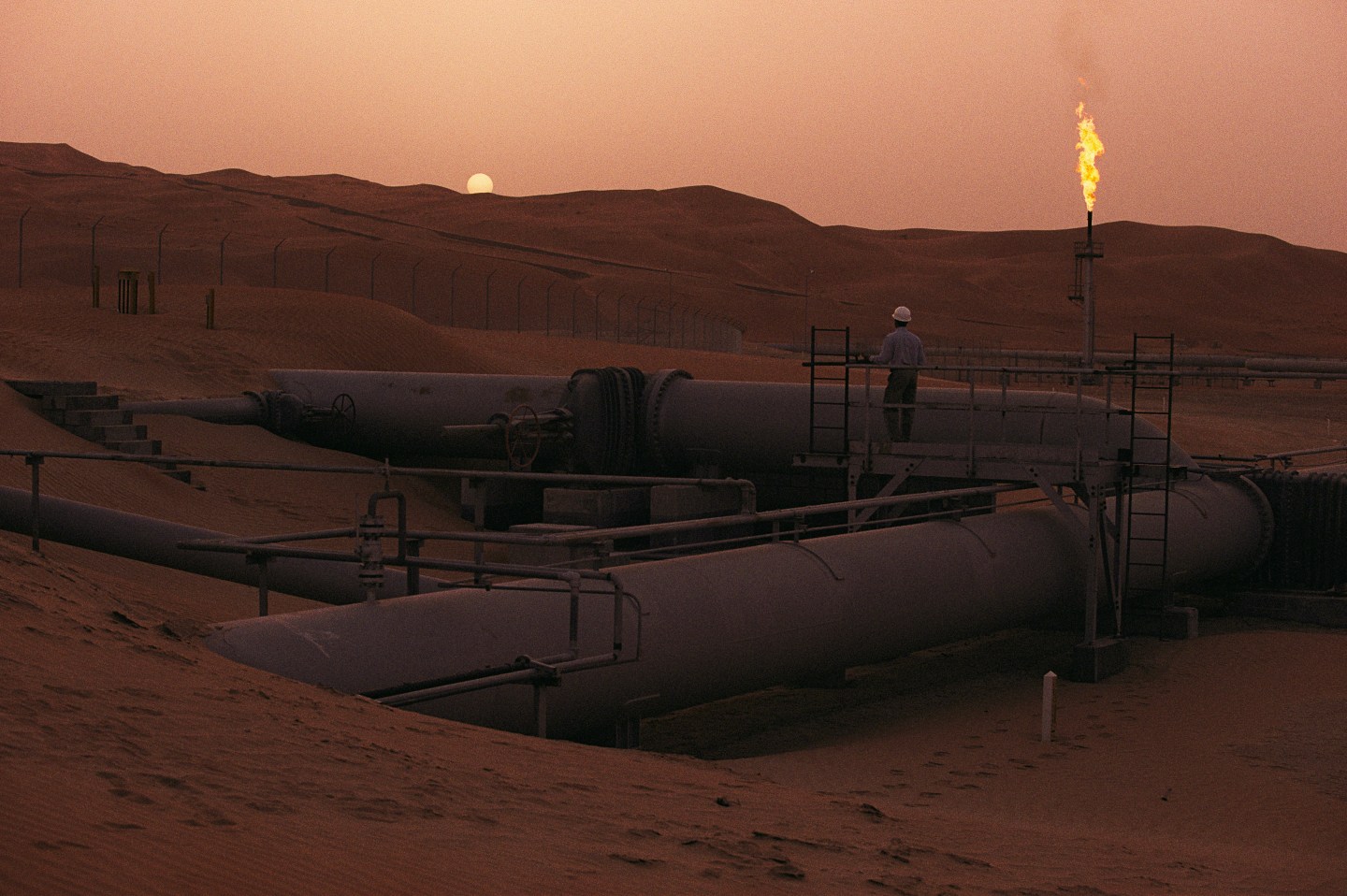
Shaybah, Saudi Arabia. Shaybah oil field at sunrise. (Photo by Reza/National Geographic/Getty Images)Reza National Geographic--Getty Images

The price of crude oil fell to a new three-year low Monday as a split between the world’s most important producers on how to share the pain of lower prices becomes increasingly apparent.

Prices for the U.S. and European benchmark blends nearly 2% in early trading Monday, on a Reuters report suggesting that Saudi Arabia was willing to accept a price of as low as $80 a barrel for the next year or two, in order to defend its share of the global market. The New York Mercantile Exchange’s crude contract traded at $84.65 by 0700 EDT, down from a peak of over $107 a barrel as recently as June.

Saudi Arabia is the largest producer in the Organization of Petroleum Exporting Countries, the cartel which produces a third of the world’s oil supply and essentially keeps the balance of supply and demand in the market. As Saudi Arabia can undercut almost every other country if it wants to, it has a huge influence on regulating OPEC’s overall supply.

The price of the world’s most important commodity is under pressure from both directions: demand is weakening as the European and Chinese economies slow down, while global supply is increasing as Iraqi and Libyan exports rebound from war-related disruptions, and the U.S. pumps ever more oil from shale deposits. (The long-term demand outlook is also looking rockier, because of new technologies such as electric cars.)

The sharpest decline in recent weeks was due to Saudi Arabia slashing official selling prices for customers in Asia and Europe signalling that it was prepared to remove the floor for prices for the short term. Iran and Iraq have both followed suit in recent days.

Such developments invariably create tensions within OPEC, whose 12 members have very different agendas.

Venezuela and Iran, two countries which need as high a price as possible to support their budget spending, have both signalled their unhappiness and are pressing for an emergency meeting of OPEC ministers to agree coordinated production cutbacks. A top adviser to the Iranian oil ministry, Mehran Amirmoeini, warned at the weekend about a repeat of the havoc of 1998, when an “inadequate reaction by OPEC” to the Asian financial crisis brought the price crashing down to $8 a barrel.

Saudi and its gulf allies, Kuwait and the United Arab Emirates, have so far appeared unmoved.

“I don’t think today there is a chance that (OPEC) countries would reduce their production,” state news agency KUNA quoted Kuwaiti minister Ali al-Omair as saying Sunday.

Saudi Arabia’s willingness to accept a price war may benefit U.S. and European consumers in the form of lower gasoline prices, but will have big knock-on effects in other oil-producing countries.

It will certainly make life harder for shale oil producers in the U.S., as up to 40% of alternative U.S. oil supplies may be unprofitable at prices below $80 a barrel, according to analysts at Deutsche Bank.

But the chief effects are on other petro-states. Russia, for example, needs an oil price of $114/bbl for its budget to balance this year, and it needs a balanced budget all the more because western financial sanctions mean that it can’t finance a budget deficit by borrowing in international capital markets right now. The ruble hit a new all-time low of 40.438 to the dollar in early trading Monday and has lost 16% against the dollar since July. Against a backdrop of falling revenue, finance minister Anton Siluanov warned last week that the country’s ambitious plans to raise defense spending had become unaffordable.

A spokesman for Russian state-controlled giant OAO Rosneft took a swipe at Saudi “manipulation” of the oil price on Sunday, warning that it would “end badly” for the Kingdom. Saudi-Russian relations have soured over Russia’s support for the Assad regime in Syria. Russia has also grumbled about Saudi sponsorship of radical Islam in its southern republics.
About the Author
By Geoffrey Smith
See full bioRight Arrow Button Icon

Latest in

CryptoBinance
Binance has been proudly nomadic for years. A new announcement suggests it’s finally chosen a headquarters
By Ben WeissDecember 7, 2025
3 hours ago
Big TechStreaming
Trump warns Netflix-Warner deal may pose antitrust ‘problem’
By Hadriana Lowenkron, Se Young Lee and BloombergDecember 7, 2025
7 hours ago
Big TechOpenAI
OpenAI goes from stock market savior to burden as AI risks mount
By Ryan Vlastelica and BloombergDecember 7, 2025
7 hours ago
InvestingStock
What bubble? Asset managers in risk-on mode stick with stocks
By Julien Ponthus, Natalia Kniazhevich, Abhishek Vishnoi and BloombergDecember 7, 2025
7 hours ago
EconomyTariffs and trade
Macron warns EU may hit China with tariffs over trade surplus
By James Regan and BloombergDecember 7, 2025
7 hours ago
EconomyTariffs and trade
U.S. trade chief says China has complied with terms of trade deals
By Hadriana Lowenkron and BloombergDecember 7, 2025
7 hours ago

Most Popular

placeholder alt text
Real Estate
The 'Great Housing Reset' is coming: Income growth will outpace home-price growth in 2026, Redfin forecasts
By Nino PaoliDecember 6, 2025
2 days ago
placeholder alt text
AI
Nvidia CEO says data centers take about 3 years to construct in the U.S., while in China 'they can build a hospital in a weekend'
By Nino PaoliDecember 6, 2025
2 days ago
placeholder alt text
Economy
The most likely solution to the U.S. debt crisis is severe austerity triggered by a fiscal calamity, former White House economic adviser says
By Jason MaDecember 6, 2025
1 day ago
placeholder alt text
Economy
JPMorgan CEO Jamie Dimon says Europe has a 'real problem’
By Katherine Chiglinsky and BloombergDecember 6, 2025
1 day ago
placeholder alt text
Big Tech
Mark Zuckerberg rebranded Facebook for the metaverse. Four years and $70 billion in losses later, he’s moving on
By Eva RoytburgDecember 5, 2025
3 days ago
placeholder alt text
Politics
Supreme Court to reconsider a 90-year-old unanimous ruling that limits presidential power on removing heads of independent agencies
By Mark Sherman and The Associated PressDecember 7, 2025
15 hours ago
Rankings
  • 100 Best Companies
  • Fortune 500
  • Global 500
  • Fortune 500 Europe
  • Most Powerful Women
  • Future 50
  • World’s Most Admired Companies
  • See All Rankings
Sections
  • Finance
  • Leadership
  • Success
  • Tech
  • Asia
  • Europe
  • Environment
  • Fortune Crypto
  • Health
  • Retail
  • Lifestyle
  • Politics
  • Newsletters
  • Magazine
  • Features
  • Commentary
  • Mpw
  • CEO Initiative
  • Conferences
  • Personal Finance
  • Education
Customer Support
  • Frequently Asked Questions
  • Customer Service Portal
  • Privacy Policy
  • Terms Of Use
  • Single Issues For Purchase
  • International Print
Commercial Services
  • Advertising
  • Fortune Brand Studio
  • Fortune Analytics
  • Fortune Conferences
  • Business Development
About Us
  • About Us
  • Editorial Calendar
  • Press Center
  • Work At Fortune
  • Diversity And Inclusion
  • Terms And Conditions
  • Site Map

© 2025 Fortune Media IP Limited. All Rights Reserved. Use of this site constitutes acceptance of our Terms of Use and Privacy Policy | CA Notice at Collection and Privacy Notice | Do Not Sell/Share My Personal Information
FORTUNE is a trademark of Fortune Media IP Limited, registered in the U.S. and other countries. FORTUNE may receive compensation for some links to products and services on this website. Offers may be subject to change without notice.