
• Home
  • Latest
  • Fortune 500
  • Finance
  • Tech
  • Leadership
  • Lifestyle
  • Rankings
  • Multimedia
LeadershipStartups & Venture

Why startups fail, according to their founders

By
Erin Griffith
Erin Griffith
Down Arrow Button Icon
By
Erin Griffith
Erin Griffith
Down Arrow Button Icon
September 25, 2014, 3:00 PM ET
Exhausted Businessman with Laptop and Cell Phone
Exhausted Businessman with Laptop and Cell PhoneDann Tardif/LWA/Fuse Getty Images/Fuse

When the founder of a startup company shuts down her or his business, it’s customary to pen an essay that tells the rest of the community what went wrong. Call it a failure post-mortem. Nine out of 10 startups fail, which is why the failure post-mortem has become so common that it’s practically a Silicon Valley cliché. Some of these essays are honest, enlightening, and brave. Others point fingers or issue backward non-apologies. Medium, the publishing platform, is the preferred medium.

The proliferation of the failure post-mortem has helped create a bizarre cult of failure that seems wrong-headed. Celebrating failure (“Fail fast” goes the mantra) seems to let people off the hook for bad behavior. Upon closer inspection, it seems less misguided than necessary. Starting a high-growth business is a roller coaster. Founder-CEOs feel pressure to keep up the facade of success, even when things are actually falling apart behind the scenes. Only recently, after the tragic suicide of Jody Sherman, CEO of a startup called Ecomom, did the technology community begin to publicly acknowledge the problems with its “entrepreneur as hero” narrative. Publicly admitting to failure, and examining it, can take guts. It also distills the narrative to a case study from which other entrepreneurs can learn.

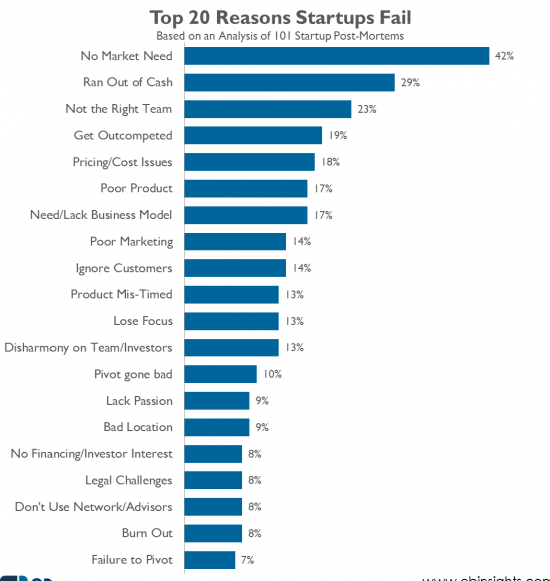
CB Insights recently parsed 101 post-mortem essays by startup founders to pinpoint the reasons they believe their company failed. On Thursday the company crunched the numbers to reveal that the number-one reason for failure, cited by 42% of polled startups, is the lack of a market need for their product.

That should be self-evident. If no one wants your product, your company isn’t going to succeed. But many startups build things people don’t want with the irrational hope that they’ll convince them otherwise.

The most prominent modern example of this phenomenon is the mobile phone. People dismissed it as a novelty in its early days. Obviously, cell phones are no longer a novelty. The late Apple co-founder Steve Jobs famously said, “A lot of times, people don’t know what they want until you show it to them.” The problem is that entrepreneurs have taken that to heart. For every $19 billion company like Uber, the private transportation service, there are countless frivolous products that never catch on.

Beyond the idea, there are more practical reasons startups fail. Polled founders also cited a lack of sufficient capital (29%), the assembly of the wrong team for the project (23%), and superior competition (19%) as top reasons for failure.
Unknown

The self-assessment lines up, for the most part, with what industry experts have said. Paul Graham, a partner at the Y Combinator startup accelerator, wrote in 2007 that startups usually die because they run out of money or a founder leaves.

Steve Hogan, who runs a startup turn-around shop called Tech-Rx, says companies with founded by one person—that is, no partners—are most likely to fail. He ranks product demand, or a lack thereof, second. The existence of a co-founder helps avoid many of the reasons cited at the bottom of the CB Insights chart, he says, including disharmony, poor marketing, and the wrong team.

Running out of cash does not cause a startup’s failure, Hogan says—it’s merely a symptom of another issue. Excluding instances of “stupid spending” or the inability to raise capital in the first place, startups tend to run out of cash when a CEO has overlooked all other indicators of failure. “Unfortunately, sometimes it’s the only ‘symptom’ that the leadership sees,” he says.

About the Author
By Erin Griffith
See full bioRight Arrow Button Icon

Latest in Leadership

Donald Trump
HealthHealth Insurance
‘Tragedy in the making’: Top healthcare exec on why insurance will spike to subsidize a tax cut to millionaires and billionaires
By Nick LichtenbergDecember 12, 2025
3 hours ago
three men in suits, one gesturing
AIBrainstorm AI
The fastest athletes in the world can botch a baton pass if trust isn’t there—and the same is true of AI, Blackbaud exec says
By Amanda GerutDecember 12, 2025
3 hours ago
Brainstorm AI panel
AIBrainstorm AI
Creative workers won’t be replaced by AI—but their roles will change to become ‘directors’ managing AI agents, executives say
By Beatrice NolanDecember 12, 2025
4 hours ago
Ryan Serhant lifts his arms at the premiere of Owning Manhattan, his Netflix show
Successrelationships
Ryan Serhant, a real-estate mogul who’s met over 100 billionaires, reveals his best networking advice: ‘Every room I go into, I use the two C’s’
By Dave SmithDecember 12, 2025
5 hours ago
Fei-Fei Li, the "Godmother of AI," says she values AI skills more than college degrees when hiring software engineers for her tech startup.
AITech
‘Godmother of AI’ says degrees are less important in hiring than ‘how quickly can you superpower yourself’ with new tools
By Nino PaoliDecember 12, 2025
6 hours ago
C-SuiteFortune 500 Power Moves
Fortune 500 Power Moves: Which executives gained and lost power this week
By Fortune EditorsDecember 12, 2025
6 hours ago

Most Popular

placeholder alt text
Economy
Tariffs are taxes and they were used to finance the federal government until the 1913 income tax. A top economist breaks it down
By Kent JonesDecember 12, 2025
12 hours ago
placeholder alt text
Success
At 18, doctors gave him three hours to live. He played video games from his hospital bed—and now, he’s built a $10 million-a-year video game studio
By Preston ForeDecember 10, 2025
3 days ago
placeholder alt text
Success
Palantir cofounder calls elite college undergrads a ‘loser generation’ as data reveals rise in students seeking support for disabilities, like ADHD
By Preston ForeDecember 11, 2025
1 day ago
placeholder alt text
Arts & Entertainment
'We're not just going to want to be fed AI slop for 16 hours a day': Analyst sees Disney/OpenAI deal as a dividing line in entertainment history
By Nick LichtenbergDecember 11, 2025
1 day ago
placeholder alt text
Investing
Baby boomers have now 'gobbled up' nearly one-third of America's wealth share, and they're leaving Gen Z and millennials behind
By Sasha RogelbergDecember 8, 2025
4 days ago
placeholder alt text
Uncategorized
Transforming customer support through intelligent AI operations
By Lauren ChomiukNovember 26, 2025
16 days ago
Rankings
  • 100 Best Companies
  • Fortune 500
  • Global 500
  • Fortune 500 Europe
  • Most Powerful Women
  • Future 50
  • World’s Most Admired Companies
  • See All Rankings
Sections
  • Finance
  • Leadership
  • Success
  • Tech
  • Asia
  • Europe
  • Environment
  • Fortune Crypto
  • Health
  • Retail
  • Lifestyle
  • Politics
  • Newsletters
  • Magazine
  • Features
  • Commentary
  • Mpw
  • CEO Initiative
  • Conferences
  • Personal Finance
  • Education
Customer Support
  • Frequently Asked Questions
  • Customer Service Portal
  • Privacy Policy
  • Terms Of Use
  • Single Issues For Purchase
  • International Print
Commercial Services
  • Advertising
  • Fortune Brand Studio
  • Fortune Analytics
  • Fortune Conferences
  • Business Development
About Us
  • About Us
  • Editorial Calendar
  • Press Center
  • Work At Fortune
  • Diversity And Inclusion
  • Terms And Conditions
  • Site Map

© 2025 Fortune Media IP Limited. All Rights Reserved. Use of this site constitutes acceptance of our Terms of Use and Privacy Policy | CA Notice at Collection and Privacy Notice | Do Not Sell/Share My Personal Information
FORTUNE is a trademark of Fortune Media IP Limited, registered in the U.S. and other countries. FORTUNE may receive compensation for some links to products and services on this website. Offers may be subject to change without notice.