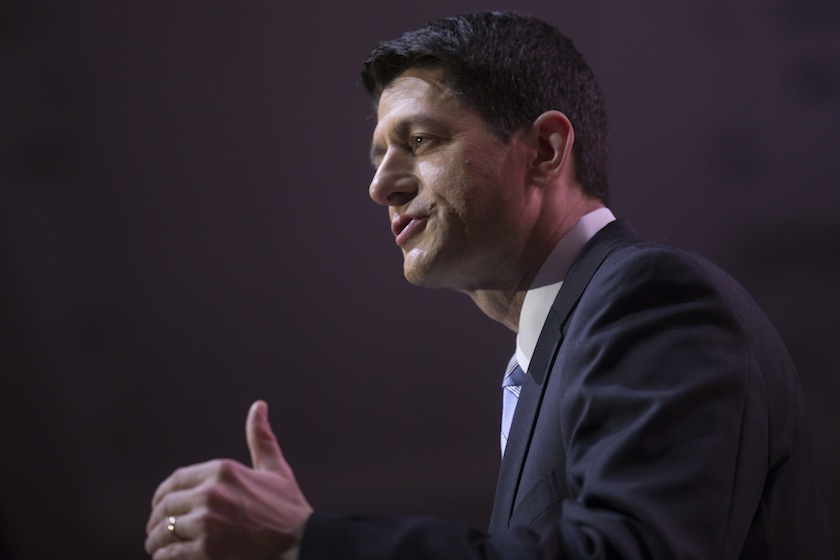
Dear American Liberals: I understand why you really, really don’t like Paul Ryan.
After all, he was the Republican nominee for vice president. He’s an avowed acolyte of Ayn Rand, a progenitor of free market fundamentalism. And though he is often presented as the Republican Party’s most innovative and powerful mind, many of his actual policy proposals—like cutting entitlement spending and taxes on the rich—are really just the same recycled solutions conservatives have been offering for decades.
So, it’s not surprising that parts of the media were geared up to eviscerate Ryan’s latest policy proposal, a plan aimed at reducing poverty in America; a problem that by some measures has shown little improvement since the 1960s, when the federal government first introduced programs like Medicare and Medicaid.
Ryan’s proposal aims to combine 11 federal means-tested benefit programs, like the food stamp program and section-8 housing assistance, into a single “opportunity grant” that would be sent to the states and spent in whatever way they see fit. The states would need to include in their plans an individualized roadmap, with measurable benchmarks for success and a signed contract that could lead to incentives or penalties if the aid recipients exceed or fail to meet those goals.
Salon described the plan as an attempt “to treat the poor in as paternalistic and insulting a way as possible.” Annie Lowrey of New York Magazine echoed this notion, accusing Ryan of presupposing “that the poor somehow want to be poor; that they don’t have the skills to plan and achieve and grow their way out of poverty.”
Granted, these assertions represent just one criticism of one part of Ryan’s plan. But the disagreement shows why there is so much hostility between political factions in America today, and why it has become so difficult for conservatives and liberals to compromise.
Lowrey does highlight a difference between the conservative and liberal view of the poor: conservatives tend to believe that people are poor because they aren’t working hard enough, while liberals believe it is due to factors outside of their control.
It should come as no surprise, then, in a country pretty evenly split between these two ideas, that the U.S. government would be gridlocked and unable to do a better job of increasing economic mobility. But that’s why both factions should welcome giving states greater control over how they administer means-tested aid.
If you think that Ryan’s plan is too “paternalistic,” you likely believe that the current welfare system is too paternalistic as it is. After all, the U.S. spends a lot of money on maintaining a massive bureaucracy to make sure poor people spend money only on things the federal government deems necessary. Instead of just giving low-income Americans cash to spend as they see fit, we’ve created the food stamp program and a whole federal agency concerned with providing housing assistance, for example.
If you believe that low-income Americans are poor for reasons that are largely out of their control, why not trust these people with a simple cash payment that can be spent as they see fit? What if a state like New York or California were to try such a plan through a pilot program instituted under a version of the Ryan reform and made it forgiving enough that the cash would only be taken away in the most egregious of cases? If such a program could prove that the liberal vision of poverty actually reflects reality, that would be a huge victory for progressives.
And there’s plenty else in Ryan’s plan for liberals to like. He puts forward ideas for prison sentencing reform that would cut back on mandatory minimums for drug offenders and give judges more leeway in their sentencing, something that has been a progressive policy goal for decades. Ryan also proposes expanding the Earned Income Tax Credit so that younger and childless workers can take advantage of one of the best antipoverty programs the federal government has ever implemented. Sure, he funds this by cutting other means-tested programs (and corporate welfare, like the Department of Agriculture’s Market Access Program). But remember, this is a proposal coming from Paul Ryan, the guy who ran for vice president when the Republican Party was arguing that too few people pay federal income taxes. The Ryan proposal would lessen the tax burden on poor Americans, not increase it.
In other words, this proposal represents a high-profile Republican moving towards the center in an attempt to reform federal programs and make American lives better. Once upon a time, this might have been the catalyst for a piece of legislation in which both Republicans and Democrats ended up giving and getting a little of what they want.
Liberals, you, have spent years bemoaning the fact that Republicans in Congress have been completely unwilling to compromise, and the Ryan proposal is the first sign in a long time that Republican intransigence might be thawing just a bit.
Yes, Paul Ryan does not view the world like you do. But half the country doesn’t see the world like you do either. Both sides should be looking for compromise wherever they can get it.