• Home
  • Latest
  • Fortune 500
  • Finance
  • Tech
  • Leadership
  • Lifestyle
  • Rankings
  • Multimedia
Apple

The invisible hand that pushed Apple up and down for six years

By
Philip Elmer-DeWitt
Philip Elmer-DeWitt
Down Arrow Button Icon
By
Philip Elmer-DeWitt
Philip Elmer-DeWitt
Down Arrow Button Icon
December 16, 2013, 3:55 PM ET


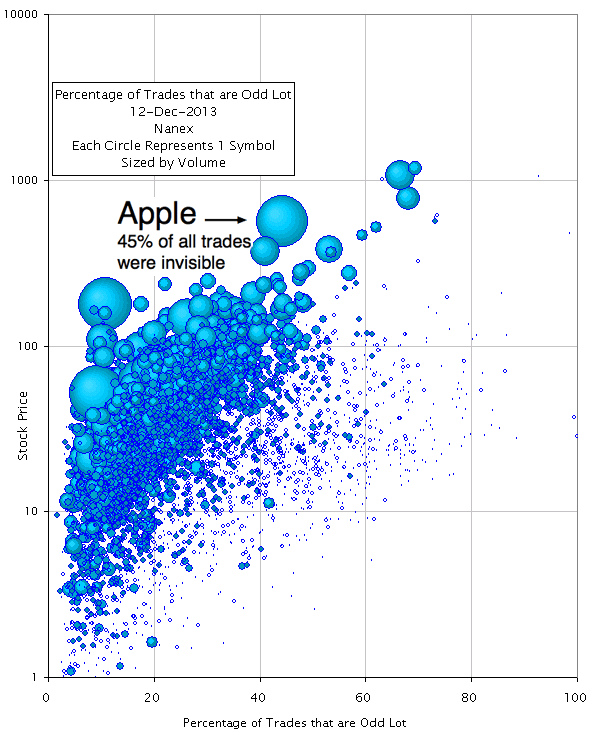
Source: Nanex. Click to enlarge.

What if you could see the prices of the stocks you’re following only once a day, but other investors following the same stocks could see the prices as they changed?

That, in broad strokes, was the situation from 2007 (when the Securities Exchange Commission created a national market system) until last Monday, Dec. 9, when NASDAQ and the NYSE began reporting small trades of less than 100 shares to the “consolidated tape” — the stream of prices visible to the public.

That might seem like a minor change, and for most stocks it probably is. Although trade in so-called “odd lots” has increased five fold in the past 20 years, according to Reuters, it still only accounts for 5% of total U.S. equity volume.

But for a high-priced stock like Apple (AAPL), which was selling in lots of 100 for more than $56,000 Monday, odd lots are a very big deal. Most investors can’t afford to drop $56,000 in a single trade. According Nanex CEO Eric Hunsader, 45% of all trades in Apple are in lots of less than 100 shares, and therefore invisible to the public under the old regime.

Why does this matter? For one thing it means that for years, trading volume in Apple was being misreported — a situation that can lead to a stock being mis-priced. The system also advantaged one kind of trader over another.

A 2011 study out of Cornell University found that computer algorithms were using odd lot trades for what the researchers called “price discovery” — pinging the market with thousands of tiny orders designed to both disguise their intentions and to smoke out the big institutional orders than can push a stock up or down. For the past six years, high-frequency trading computers — wired directly to the stock exchanges — could see this information. The public — until last week — could not.

Some Apple investors believe this might explain a lot of the strange behavior they’ve observed in Apple since 2007 — when the launch of the iPhone coincided with the promulgation of the SEC’s Regulation NMS, which created the national electronic market system that high-frequency traders exploit. Apple’s share price has moved both ways — to extraordinary highs and confidence-shattering lows — at volumes much lower than theory would predict. Invisible odd lot trades could explain the discrepancy.

How will the new reporting regime affect the average Apple investor?

“Several things will happen,” says Nanex’s Hunsader, a critic of high-frequency trading. “First, games that used to rely on that asymmetric information will no longer work. That in itself is good, with no effort on the part of the investor. Second, it will allow retail applications to better detect the supply/demand picture, etc. By knowing where these odd-lot trades are executing for example.”


“Asymmetric information is always bad for the market,” Hunsader concludes, “because it drives away some participants from the market. The most resilient market is one with the widest diversity of participants.”
About the Author
By Philip Elmer-DeWitt
See full bioRight Arrow Button Icon

Latest in

Julian Braithwaite is the Director General of the International Alliance for Responsible Drinking
CommentaryProductivity
Gen Z is drinking 20% less than Millennials. Productivity is rising. Coincidence? Not quite
By Julian BraithwaiteDecember 13, 2025
8 minutes ago
carbon
Commentaryclimate change
Banking on carbon markets 2.0: why financial institutions should engage with carbon credits
By Usha Rao-MonariDecember 13, 2025
1 hour ago
Nicholas Thompson
C-SuiteBook Excerpt
I took over one of the most prestigious media firms while training for an ultramarathon. Here’s what I learned becoming CEO of The Atlantic
By Nicholas ThompsonDecember 13, 2025
2 hours ago
Sarandos
Arts & EntertainmentM&A
It’s a sequel, it’s a remake, it’s a reboot: Lawyers grow wistful for old corporate rumbles as Paramount, Netflix fight for Warner
By Nick LichtenbergDecember 13, 2025
3 hours ago
Lauren Antonoff
SuccessCareers
Once a college dropout, this CEO went back to school at 52—but she still says the Gen Zers who will succeed are those who ‘forge their own path’
By Preston ForeDecember 13, 2025
3 hours ago
Oracle chairman of the board and chief technology officer Larry Ellison delivers a keynote address during the 2019 Oracle OpenWorld on September 16, 2019 in San Francisco, California.
AIOracle
Oracle’s collapsing stock shows the AI boom is running into two hard limits: physics and debt markets
By Eva RoytburgDecember 13, 2025
4 hours ago

Most Popular

placeholder alt text
Economy
Tariffs are taxes and they were used to finance the federal government until the 1913 income tax. A top economist breaks it down
By Kent JonesDecember 12, 2025
1 day ago
placeholder alt text
Success
Apple cofounder Ronald Wayne sold his 10% stake for $800 in 1976—today it’d be worth up to $400 billion
By Preston ForeDecember 12, 2025
23 hours ago
placeholder alt text
Success
40% of Stanford undergrads receive disability accommodations—but it’s become a college-wide phenomenon as Gen Z try to succeed in the current climate
By Preston ForeDecember 12, 2025
23 hours ago
placeholder alt text
Economy
For the first time since Trump’s tariff rollout, import tax revenue has fallen, threatening his lofty plans to slash the $38 trillion national debt
By Sasha RogelbergDecember 12, 2025
18 hours ago
placeholder alt text
Economy
The Fed just ‘Trump-proofed’ itself with a unanimous move to preempt a potential leadership shake-up
By Jason MaDecember 12, 2025
17 hours ago
placeholder alt text
Success
At 18, doctors gave him three hours to live. He played video games from his hospital bed—and now, he’s built a $10 million-a-year video game studio
By Preston ForeDecember 10, 2025
3 days ago
Rankings
  • 100 Best Companies
  • Fortune 500
  • Global 500
  • Fortune 500 Europe
  • Most Powerful Women
  • Future 50
  • World’s Most Admired Companies
  • See All Rankings
Sections
  • Finance
  • Leadership
  • Success
  • Tech
  • Asia
  • Europe
  • Environment
  • Fortune Crypto
  • Health
  • Retail
  • Lifestyle
  • Politics
  • Newsletters
  • Magazine
  • Features
  • Commentary
  • Mpw
  • CEO Initiative
  • Conferences
  • Personal Finance
  • Education
Customer Support
  • Frequently Asked Questions
  • Customer Service Portal
  • Privacy Policy
  • Terms Of Use
  • Single Issues For Purchase
  • International Print
Commercial Services
  • Advertising
  • Fortune Brand Studio
  • Fortune Analytics
  • Fortune Conferences
  • Business Development
About Us
  • About Us
  • Editorial Calendar
  • Press Center
  • Work At Fortune
  • Diversity And Inclusion
  • Terms And Conditions
  • Site Map

© 2025 Fortune Media IP Limited. All Rights Reserved. Use of this site constitutes acceptance of our Terms of Use and Privacy Policy | CA Notice at Collection and Privacy Notice | Do Not Sell/Share My Personal Information
FORTUNE is a trademark of Fortune Media IP Limited, registered in the U.S. and other countries. FORTUNE may receive compensation for some links to products and services on this website. Offers may be subject to change without notice.