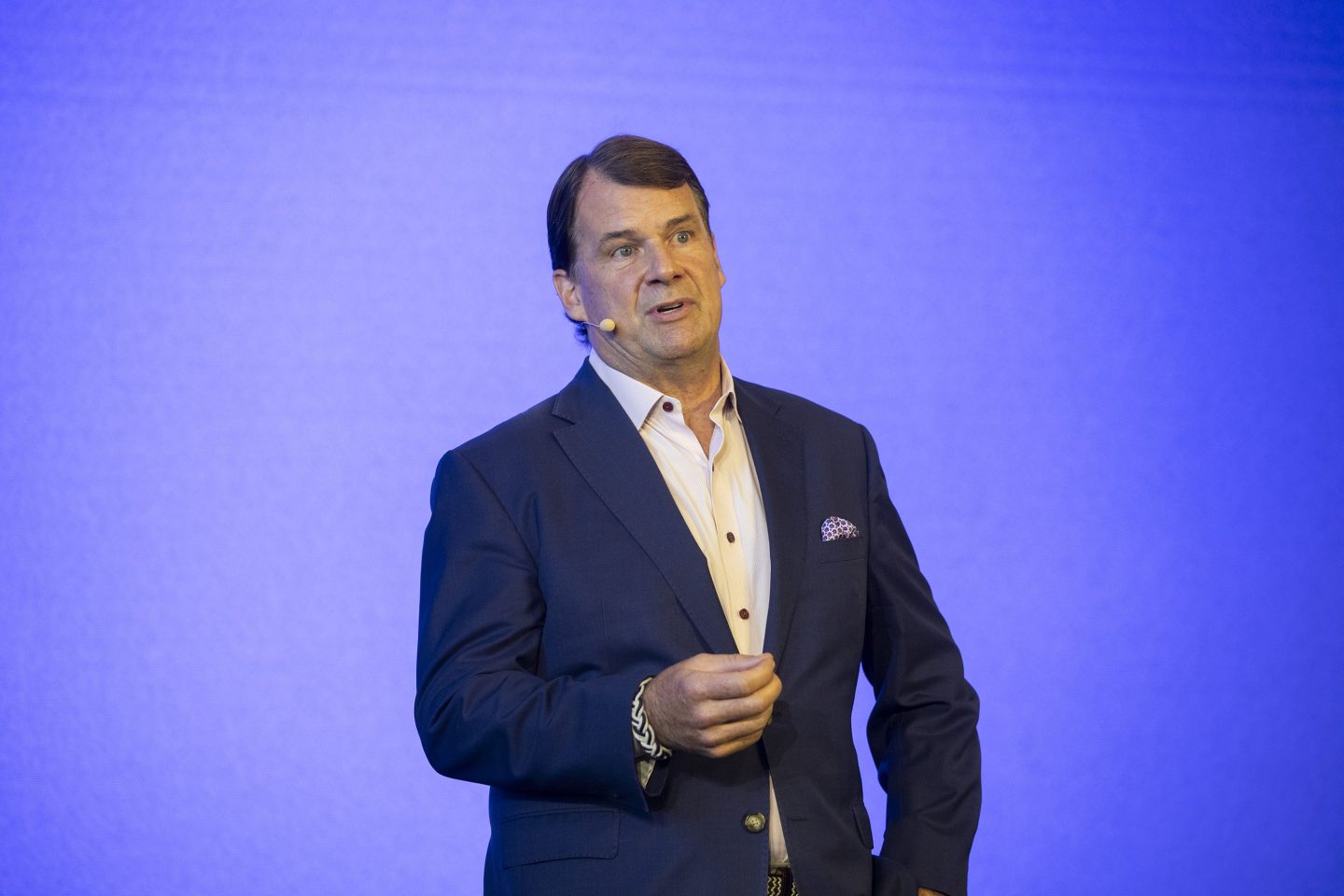
Bob McDonald
FORTUNE — Procter & Gamble CEO and Chairman Robert McDonald has had a challenging year. The CEO of the $83.6 billion company has had to lower guidance three times this year, worrying analysts and depressing the stock price. On October 25th, the company beat its (previously lowered) expectations for the first quarter of fiscal 2013, earning $1.06 per share excluding charges.
McDonald has endured criticism from former employees and retirees, who receive their benefits primarily in P&G stock. And in July, activist investor William Ackman of Pershing Square Capital Management announced he had purchased $1.8 billion in P&G shares, suggesting that he would soon demand major changes. At a meeting between the two, Ackman reportedly asked for McDonald’s resignation.
Now McDonald has decided to speak out. In an exclusive interview with Fortune Senior Editor Jennifer Reingold, he proclaims confidence that the company’s turnaround plan is gathering steam. What follows is an edited transcript.
So the numbers came in where people had hoped that they would…
Our results for the first quarter were at the high end of our expectations on the top line and ahead of the plan on operating profit and cash. This puts us on track to meet our commitments for the fiscal year.
What surprised you about the results?
I wouldn’t say it was a surprise. But the three parts of our plan are working. The whole idea is a total shareholder return that gets us back into the top third of our corporate peer group. The three parts are this 40-20-10,plan, focusing on our 40 biggest category/country combinations, primarily in the US and in China. We focused the resources there first, then on the 20 biggest innovations. We’ve been having something we call jam sessions, where we bring in top leaders and functional experts and have them ideate. We’ve been doing this for 6-9 months, since about the time we put Jorge Mesquita in place [as President, New Business Creation and Innovation]. And then there are the 10 emerging markets that are critically important.
On the innovation piece, [on our earnings call] we purposely went through a number of the new innovations that we brought to market. Tide Pods, for example, added to the Tide market share.
The third piece was the productivity improvement. That was the piece that was confirmation to the analyst community and to investors that we could deliver savings that resulted in margin expansion. Our plan saves $2 billion a year, which would be 11 index points in EPS. If we capture half of that, it would be 5-6 points. That caused the core operating margin to improve by 90 basis points. We showed 150 basis points of productivity improvements. That may have been the piece that was reinforcing.
Have you named your new productivity czar?
He’ll be pleased to hear your characterization, but we haven’t announced it yet. It’s a group president who has done this before in a business unit. He has a lot of experience and will be working directly for me. The idea is to set up a council of senior group presidents in the company, all of whom are highly respected, who will work with me to reorganize the way we do work. We will reorganize the structure of the company if that’s needed in order to improve.
When will that council begin to meet?
Within the next couple of weeks. What I want to do is create a culture of productivity. The way you do that is you involve people in the various business units and they create a guiding coalition and that’s what we’re going to do. You have to be sure that we have balance. Innovation and productivity are not contradictory.
Productivity is an enabler. It allows you to invest back into innovation or by being able to have a shock absorber against surprises. The Procter & Gamble Company has been around 175 years, and we are celebrating our birthday at the end of this month. I was rereading an article in Fortune from 1981. It talked about the difficulty John Smale had and interviewed a retiree who said the company didn’t have enough innovation. It talked about the stock price falling from 1973 to 1980.
One of the things that makes this company unique is the way it reinvents itself over a period of time. Each of us that is asked to be CEO at one time during their tenure is required to reinvent the company so it becomes ready for the next 175 years.
How come this didn’t happen before, Bob? You have been CEO now for several years. The idea of NOW creating a culture of productivity strikes me as strange; Most CEOs say something like that when they start their job. What happened to the productivity of the company?
We faced one of the worst economies that we’ve had since the Great Depression. We had $3.5 billion of incremental commodity costs that affected our profitability. Our plan is a reaction to the situation.
Yet other companies have had this economic headwind but have done better. What part do you wish you had done differently?
I laid out all those reasons in the June Deutschebank Conference in Paris.
Tell me again. I know you’ve given a lot of thought to this. Aren’t there any lessons learned?
The plan that we’ve put in place suggests what we’ve learned. We’re focused on improving discontinuous innovation. We’re reducing enrollment in the company by 5700, saving $10 billion.
So what I would take out of that is that the lesson would be that you spent too much money.
We had the commodity headwinds, right, which had we not priced would have reduced our profitability by that amount.
But it didn’t take with the community that invested in your stock. Former executive Gary Martin writes this [critical] letter. Ackman meets with you. That message did not get through. Is that a fair statement?
We provided the message. Investors now are confident that we’re delivering against the plan. In the April through June quarter, we said we were ahead of the plan and the investors reacted positively there. When we announced April through June the stock went up $2 that day. Maybe the message was out there and investors were looking for confidence but those results are being delivered.
Looking back at the past six months, you have faced a whole lot of criticism from outsiders, investors, and retirees. You personally have been under pressure. Are there things you have learned from this process, any lessons that have come out of this experience for you that will lead you to do things differently?
One of my beliefs is that organizations need to renew themselves and that leaders need to do the same thing, so any leader should be constantly learning. So we learn and we adapt.
Let’s talk about Bill Ackman and Pershing Square. You’ve had one direct meeting so far?
We talk to all of our investors. I keep the meetings confidential.
You’re not going to confirm that you had a meeting with Bill Ackman? Let’s at least admit what we all know to be true.
My integrity is important to me and I’m not going to divulge confidences. All the investors have different ideas and it would not be fair to divulge one’s vs. another’s.
Warren Buffett said on CNBC last week that he is selling P&G stock. Why?
He said he was selling the stock to buy a position. He’s one of our largest investors. Warren said the valuation is high.
Is it?
Obviously we want more shareholders to buy more. Even without the price appreciation you make 5-6% on the stock just from the dividends and the share repurchase. Last quarter we had a doggone good cash quarter. We returned $4.2 billion to shareholders.
I thought six months ago you had said you weren’t going to start share repurchases. Is this a reaction to the pressure?
It was one of the positives that came out of the April through June earnings announcement. We overdelivered expectations in the April through June quarter, which gave us confidence.
What is morale like right now inside P&G? There’s been a lot of change and a lot of public stuff out there.
The interesting thing, and I’m with people in the organization all the time, is that everybody in this company is laser like focused on delivering this plan, which we know will return us to the position we want to be in. They are focused like a laser and they’re energized.
Sometimes you are energized because you don’t want to get fired. I’m really asking about the morale.
When we announced the April through June quarter and there was some evidence there that the plan was working, that reinforces the behavior of the employees. P&G people want to be winners. When you turn over my ID badge we have our five values. P&G people want to win. When we’re not winning we focus very hard on developing a plan to get back to winning.
So morale is better? Are you satisfied with where morale is in the company?
Morale is better, sure, it is better. I’m not satisfied with our results. We’re not there yet. We’re working our way back; we’re confident in the plan.
How about your own personal morale? Do you feel confident that you will be the CEO of this company in a year?
Jennifer, my morale is high. I am totally focused on delivering this plan. I’ve been in this company for 32 years. I love this company. I’ve got support from the board of directors and from the leadership of the company. But this is not about me.
But it has become about you, whether you wanted it to or not.
This is the greatest company in the world. We’ll be 175 years old October 31. I am totally committed to create another 175 years and the board is too.
I believe that you are committed. But is everyone committed behind you?
Absolutely. There is no question about the commitment of the leadership of this company, about the commitment of the board of directors. It’s there.
Let’s talk about succession planning. Has anything changed in terms of how that is being done at the company? Has there been any sort of change in how you look at potential successors?
The Procter & Gamble Company (PG) has a history of rigorous succession planning, and leadership development. We’re always working on succession planning. It’s a constant. I taught a class just this week. We have a deep bench and that deep bench gives us the luxury of being able to put the right leaders in the right jobs.
There have been some executive departures recently. Do you still feel confident with the talent pipeline? Is there a concern that people are leaving for reasons you don’t want them to leave for?
We have a deep bench. Every company has managers leave for various reasons. We have a narrow pyramid. I have no concern about that. I feel great about the leadership team we have, and I now feel like we have the right people in the right jobs. And I’m excited about the leadership team we have.
So is it safe to say you feel comfortable with this group and that this is the team you want to go with? No major changes expected?
I also told you that succession planning, getting people the right experiences, is a constant activity here.
The purpose of the company [to touch and improve lives] was the most consistent theme of all of your public statements over the past two to three years. And now it seems to be completely absent from the discussion, at least with Wall Street. What happened to purpose?
The purpose of our company is still to touch and improve lives.
But you’re not saying that publicly in the same way you were.
If you had been with me at Indiana University recruiting recently, I talked about purpose and it resonated with the students that I was recruiting. But in the end we’ve got to deliver the financial results that we’re after. The message changes depending on the situation and what we’re talking about now is delivering.
Are those two messages incompatible?
We think there’s a virtuous circle that we have to do well financially, and we have to do it by giving our customer superior products.
How do you balance the pressure for the short term with the long-term goals?
I think you said my favorite word, which is to balance, the short term and long term, balance innovation and productivity, balance purpose and financial results, it’s all about balance. And to me balance comes from purpose, which obviously over the long term, comes from the strength of your culture. I do not find them incompatible. I think we can deliver the short term and long term.
Do you feel the company got a little out of balance?
In businesses where we were executing our business model we did well and businesses where we weren’t, we didn’t do as well. The business model for me is what’s important. Our insights and technology making superior products, getting them in people’s hands, producing them and developing the #1 and #2 brand in the category. There are some places where we’ve done that extremely well, like Pampers, and some where we haven’t done it as well yet. We are laser focused.
How are you feeling about all this, Bob? Is this difficult on a personal level?
I don’t let it be about me. I am totally, totally engaged and energized in delivering the results that this company should deliver. What a great opportunity for me to be part of the resurgence of this delivery of improved results. I’m totally into this.
[Former CEO A.G. Lafley] recently said. “If you believe in the crucible of the marketplace, then this is a great time for Bob McDonald.” Do you agree?
Absolutely, positively. Go back through my life and look at some of the tests I’ve been through. I love this test. I’m totally focused on delivering this plan.
Some of the people I have spoken to have said that some of the seeds of the problem came from AG Lafley, and that you’ve had to clean up some of the mess. How would you respond to that?
In the Procter & Gamble Company we are an institution. I’ve been here for 32 years. So I take responsibility for what has gone on in this company for 32 years and it’s not in my character to disparage anyone I work with, certainly not a Procter & Gamble employee and certainly not a mentor and a friend.
I know it’s popular to personalize things but I’m sure AG would say this is not about him, not about me, but it’s about an institution that’s been around 175 years. And we want it to be around another 175 years because it is a force for good in this world. And throughout this 175 years things happen, but the P&G company has always come back stronger. That’s to me the story, a company that’s been around that along, that has been around longer than most companies, most nations, how does it reinvent itself periodically in order to continue to be on top?
But in part because of its long history, the expectations for this company are extremely high.
I agree with that and I welcome it. And we’ll deliver and live up to it.