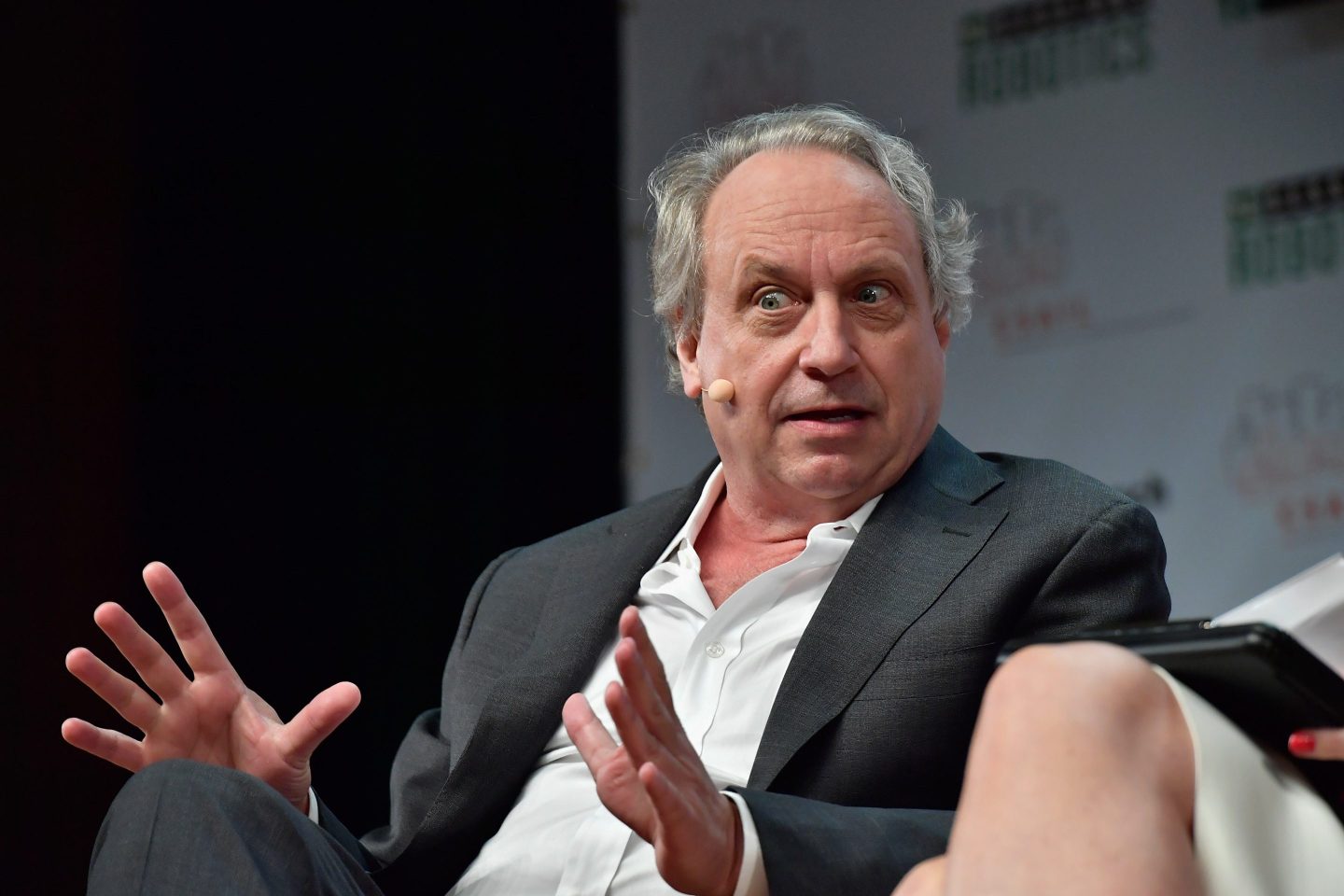
Don Graham, chairman and CEO of The Washington Post Co. joined his daughter, Laura O’Shaughnessy, CEO, SocialCode, and her husband, Tim O’Shaughnessy, Co-founder and CEO, LivingSocial, to talk about the growth and opportunities in social media. Walter Isaacson, President and CEO, The Aspen Institute, moderated.
[cnnmoney-iframe src=”http://fora.tv/program_landing_frameview?id=16163&type=clip&autoplay=0″ w=614 h=384]
Below is an unedited transcript:
WALTER ISAACSON: That was Don Graham, all of you all know, chairman and CEO of the Washington Post Company. Many distinguishing characteristics. Was there early on at Facebook, but as a young guy coming out of college, first went to Vietnam, which was unusual, I think in ’67, ’68 for somebody — and then joined the Washington, D.C. police force. So, when it comes to the notion of connecting journalism, technology, and service, nobody better than Don Graham. Thank you, Don, for being here. (Applause.)
MORE: Don Graham: Why a paywall won’t work for the Post
Laura O’Shaughnessy and Tim O’Shaughnessy, just so you’ll know the joke about the family panel, Laura is the daughter of Don Graham. They both worked for Steve Case I think, met at Revolution, married, and then started complementary businesses in a way. Right? Yours is basically a way to help businesses monetize on Facebook and social networks?
LAURA O’SHAUGHNESSY: That’s right.
WALTER ISAACSON: Is that the short form of it? And then LivingSocial, as everybody knows, is sort of a cross between a social network and a coupon and merchandising system.
Let me start with you, Don, what did you learn from Facebook that applies to the business of newspapers?
DON GRAHAM: Well, thank you, Walter. We wanted to applaud the people at Fortune who, only the Fortune Brainstorm TECH conference of all leading tech conferences has seen fit to reach out to the newspaper industry for technology advice. (Laughter.) And we think that was very far-sighted. (Laughter.)
This is well enough known that Fortune has actually written about it. I’m met Mark, I think, in January of 2005, it might have been late 2004. And I’ve just learned a ton from the guy. I mean, I am lucky to have Laura’s one of four kids I’ve got, all of whom in one way or another, technology plays a huge role in their lives. I’ve had built-in tech advisors.
Follow here for all #FortuneTech coverage.
Of course, you know, I’ve had to explain to them, they wanted to read Greek history and whatnot. I had to explain to them that this Internet thing really had potential. But once it got going.
WALTER ISAACSON: But I’ve watched on the Washington Post, I now have basically my personalized page that learns what I want and gives me things.
DON GRAHAM: Yeah.
WALTER ISAACSON: I also have used Trove, which is a wonderful way of aggregating the type of stories I want based on my interests, including I can put in New Orleans renovations or jazz music and get everything. All of those are social networking functions that you’ve tried to add to the paper. How does that work?
DON GRAHAM: And the biggest of all is Washington Post (WPO) Social Reader on Facebook (FB), which over 25 million people have downloaded since last September.
You know, news companies have to become much smarter about technology. And we have to start, as everybody does, with readers, with users. And it is plain that users want something different than companies like ours are giving them. I love WashingtonPost.com, I was present at its creation, I’m crazy about it. We’ve got great people working on it, we’ve got great stories today. And the family tech people, obviously, also include Katharine Weymouth, my niece, the publisher of the Washington Post, but somebody had to buy the store, so she’s home.
And we do. We’ve stared Social Reader, which because I think social news will be a part of what people want from a news site in the future. We started Trove and Personal Post because I think personalization is clearly something people want with their news site in the future.
WALTER ISAACSON: You and Katharine Weymouth, the now publisher, right?
DON GRAHAM: Right.
WALTER ISAACSON: You are among the most fervent that charging money for content won’t work. Why?
DON GRAHAM: Well, we’re not fervent, but it just fit into our circumstances. The New York Times or Wall Street Journal, very intelligently, can say we’re going to charge, but we’re not going to charge you if you subscribe to the newspaper, and you can subscribe to the Wall Street Journal here in Aspen, or pretty much anyplace in the country.
The Washington Post circulates in print only around Washington, D.C., but way over 90 percent — I think over 95 percent of our Internet audience is outside Washington, D.C. We can’t offer you that print or online choice. So, the pay model would work very differently for us.
And, you know, so circumstances have made it so we are the one great news site, stemming from a company with a big news room, that’s free at this point, and we’re going to try to make something of that.
WALTER ISAACSON: Laura, you’ve tried to figure out for companies how the eyeballs that they get on Facebook and other social networks can be used to their economic advantage. What have you figured out in that regard?
LAURA O’SHAUGHNESSY: So we work with Fortune 500 brands to help them create these really targeted communities, and then reach out to engage those communities and then convert them to whatever action they find most valuable. So, whether it’s watch a video about my new car or sign up for my credit card or whatever that happens to be.
And what we found out is when you build up these targeted groups, it pays off enormously down the road. So, people build up these fan communities that are really made up of their core audience and converting those guys downstream to those deeper actions is five times more efficient than trying to target an ad to somebody who has never really joined the group.
WALTER ISAACSON: When you say it’s five times more efficient, first of all, how do you know?
LAURA O’SHAUGHNESSY: So we track every step in a conversion probe when we’re running a campaign to elicit those downstream actions. So, we can very easily measure the conversion rate for random person who’s not a fan of the page and a fan.
WALTER ISAACSON: Now, in terms of CPMs, cost per thousand, let’s compare what I guess I’ll say Katharine does, because Don does it all, but the CPMs per the imprint of a page on the Washington Post versus how much it would cost for you to try to cause somebody to do something. What’s the most efficient advertising model?
LAURA O’SHAUGHNESSY: We don’t really compare the two types of advertising. They’re really different. When you’re doing a homepage ticker for the Post, it’s this elaborate, interactive experience. And at this time, neither Facebook nor Twitter nor LinkedIn has that type of advertising experience.
WALTER ISAACSON: Yeah, about how that $100,000 is spent to launch a new carbonated beverage —
LAURA O’SHAUGHNESSY: Right.
DON GRAHAM: It depends on what you want to do. If you want to buy an ad in tomorrow’s Washington Post, you want to buy an ad to sell shoes, you will sell a lot of shoes. That’s why Macy’s will have an ad in tomorrow’s Post, that’s why Bloomingdale’s will have an ad in tomorrow’s Post. But if you’ve heard Sheryl Sandberg or Dave Fisher, or Caroline talk about the effectiveness of advertising on Facebook in the last two years, you’ve heard them tell the story about American Express and Small Business Saturday. About how Amex decided that they wanted to build their reputation with small business, and they wanted to turn the Saturday after Thanksgiving into Small Business Saturday where people would use their American Express cards at small businesses.
Their agency called Laura I think on November 7th, 2010, and said we promised Ken Chenault a million fans for Small Business Saturday and we have 35,000?
LAURA O’SHAUGHNESSY: There was a tiny number.
DON GRAHAM: And she turned it into the fastest-growing fan page in the history of Facebook. You’ve heard that story a million times, but SocialCode’s at the center of that story. And if you’d like to know how to turn your large brand into a Facebook power house, talk to her. (Laughter.)
WALTER ISAACSON: A million fans, how does that translate into money for American Express?
LAURA O’SHAUGHNESSY: Well, since that campaign, we’ve worked with American Express very closely on their social media effort and their different agencies on their social media effort. And their goals are very different. That particular campaign is group oriented at consumers to try to educate them about their small business effort. And we worked with them to understand about the deals that they can get at these small businesses at different times.
There are some of these communities that are targeted at small business communities, and so we’re working with them kind of in all these different kind of goals that they have for these different communities.
WALTER ISAACSON: Tim, in some ways, you’re in quite an established business, which is coupons basically or discounts. But you’ve transformed it by connecting it to social networks. How does that work?
TIM O’SHAUGHNESSY: Sure. So, I think, first off, I think you should spend your 100 grand on your carbonated beverage with me. (Laughter.)
LAURA O’SHAUGHNESSY: We’re all going to fight for it.
WALTER ISAACSON: We were talking about synergies in companies like Time Warner where each of the divisions — but I love it was in the family.
(Crosstalk.)
DON GRAHAM: You were so successful with that, Walter, we’ve modeled ourselves after you.
WALTER ISAACSON: Yeah, the family model of anti-synergy.
TIM O’SHAUGHNESSY: Yeah. You know, I think that local businesses have been trying to figure out how can I have a measureable, trackable way to do advertising? And that’s what we came along to be able to do. You work with us, it’s a no-risk environment where you know exactly how much you’re going to go pay to get customers to walk through your door, and that’s a really hard problem to solve.
And if you take the brand itself, you know, LivingSocial, a definition of it would probably be something like things you do in real life with your friends. And that’s what we really want to be about, and we want to bring value to you from a financial perspective, we want to make your life more convenient, we want to let you do things that you couldn’t have done before. So, there certainly is an element of price and discounts, but for example, it’s how can you change how people interact with their local communities and how can you change how they interact with local commerce? And how can you connect communications through commerce? And I think that’s the larger goal.
So, people think of us as daily deals, but an interesting stat is over 25 percent of our revenue at this point in time is from non-daily-deals products. So, we’ve been able to evolve to that. And of that, a reasonable percentage of it is actually full press. So, when you think about — and how has that happened? You know, you really leverage the social component. You provide experiences — people want to go out to eat with multiple folks. And Facebook, Twitter, the various social networks are really an accelerant for us. So, we would exist without them, but when you want to try and aggregate a lot of people in a hurry, boy, they’re very, very helpful to actually be able to go and do that.
WALTER ISAACSON: You know, you’ve mentioned that being local and local community. And I was a little surprised when you, Don, said that 90 percent of your Internet readership is very non-local.
DON GRAHAM: More than. More than. Because people are interested — you know, we’re the principal news source in the capital of the free world.
WALTER ISAACSON: But the social web as well as the Internet has never really conquered local. Is that going to be the next wave?
TIM O’SHAUGHNESSY: Yes. I mean, if you look at the size of the marketplace, we have two areas that we are attacking. Consumers look at us as a commerce site that they buy something through. Merchants look at us as an advertising mechanism, and those are each two huge markets. And there hasn’t really been able to be an aggregation of consumers on a local level in a way where you can have a transaction-oriented business.
DON GRAHAM: I’ll do an ad for Tim. Tim started off running a company that had nothing to do with the business he’s in now, but many of you used his products. He built a Facebook app-building company originally called The Hungry Machine that built the virtual bookshelf on Facebook, which I used extensively, and then built the pick your five, the largest application then in the history of Facebook. That allowed him to get a whole lot of e-mails and local identifiers for people. And he then built LivingSocial, to a great extent, on Facebook.
The three of us were having dinner one night, and Tim said, “You know, if I didn’t have my hands full, I would try to start an advertising agency to help people use Facebook because we’ve had the people in to advise us who are supposedly the best in the business and they don’t know anything at all. We know more than they do.” So Laura and I said, “That sounds like a good idea.” (Laughter.) And with some consulting help and some help from another part of our own company where we were extensively buying ads on Facebook, you know, we got into the business and it’s proven to be a sensational business.
LAURA O’SHAUGHNESSY: Yeah. And I would also say on social media, it’s a little bit of a different play, but there are some very successful local outcomes where like we worked with a retail store to target people within a 25-mile radius of their store and offer them a coupon, and it actually drives people into the store. So, it’s a different product, but it can be incredibly successful and a way to hone in.
WALTER ISAACSON: And the shift of media from being computer-based to being mobile, GPS-based. How does that affect you?
LAURA O’SHAUGHNESSY: Yes. I think we’re just starting to see the beginning of it. As you know, Twitter and Facebook have just started to roll out some mobile products, and they’re just working incredibly well for clients.
WALTER ISAACSON: Before I go to the audience, one last question that you’re on the board of Facebook.
DON GRAHAM: I am.
WALTER ISAACSON: You’ve created apps based on Facebook. And like so many companies, you depend on the kindness, in some ways, of Facebook. Are you worried that there can be a conflict as there was for a while with Zynga and others when you’re building on the Facebook platform?
DON GRAHAM: Oh, sure.
WALTER ISAACSON: I want to see if I can get dissent within the family where you’re defending it and they aren’t.
DON GRAHAM: Half the people in this audience have built apps on Facebook, and Facebook — the fabulous thing about Facebook, and for developers the frustrating thing, is that Facebook changes so fast, but that’s part of Facebook’s personality. And if you want to develop on Facebook, you have to be content with that.
Social Reader —
WALTER ISAACSON: Wait, is that like building a building on shifting sands?
DON GRAHAM: You’ve got to be good. Social Reader, which I love and use every day has been fascinating. There’s a guy in this audience who will be talking later today, Ben Elowitz, from a company — an entertainment-focused media company called Wetpaint. Ben has used our app and his own Facebook apps to become, in no time, in a year and a half, he is on his way to being the number-one entertainment site on the Web. Entirely from his sophistication in building on Facebook.
WALTER ISAACSON: But didn’t Facebook recently change a trending stories box that pulled the rug out from under you?
DON GRAHAM: It changed things, and we have to be smart enough to adapt to that, period. You know, how else in the world are you going to address a billion people a day? And if the price is you have to be smart enough to adapt to changing circumstances, you do.
Now, Walter, we have a question for you. Your book on Steve Jobs probably has 100 percent penetration in this audience. And I heard Mark over several years — I mean, Steve Jobs meant an enormous amount of the education of Mark Zuckerberg, and Mark will talk about that till the cows come home. But tell us the other side of that. What was Steve’s first impressions of Facebook? How did the Mark-Steve relationship work from Steve’s point of view?
WALTER ISAACSON: Yeah. Well, I asked Jobs a year ago when he was quite ill who he really admired in the Valley. The first name off his lips was Mark. A, because mark was trying to build a great company, not just cash in on a product. But, secondly, because he had an intuitive feel for how to always be passionate about that product and do things that cause you to be on shifting sand. Which is, oh, I can make trending stories, that will help our users more even if it does undermine something older that we had. He’s willing to cannibalize the older things.
And so he felt a great kinship, I think, to Mark Zuckerberg. And the odd thing, and I’m not sure if it’s in my book, but Steve never cracked the code on social media. There are very few people in this room who can probably remember Ping, which was a musical social media site done on the iTunes platform. I asked him why he hadn’t been able to crack the code. And he said, “Maybe because Mark did it so well and there isn’t a need for a whole lot of social networks, and Facebook has got it licked.”
Anyway, we’re not here to talk about that. Way in the back there.
QUESTION: Tim, I’m curious. Last year, you obviously didn’t want to talk about IPOs in the past. But you did mention, I think I wrote about it, you said one of the things LinkedIn had just gone public, and you said that LinkedIn has seen a massive spike in traffic and users after the IPO and that kind of intrigued you that an IPO could be a customer acquisition vehicle. I’m curious, since then, Facebook, Zynga, Groupon have all had IPOS who have arguably hurt the companies from a PR perspective. Have you changed your mind? Does going public potentially hurt LivingSocial from a customer acquisition perspective because IPOs are no longer considered a wonderful thing right now for most these companies?
TIM O’SHAUGHNESSY: I think that when you look at an IPO from a branding perspective and turn it into a branding event, if you’re thoughtful and are clear in the goals that you’re trying to accomplish and feel strong about the business metrics of your business, it absolutely can be a positive thing for you.
So, you’re always going to have in a limited data set of three or four companies, you’re always going to be able to point to people that have done it well or people that have done it poorly. And I think that if you execute your plan well, you absolutely can have it be a positive branding event. And I think the passage of time over the last several decades has shown that that is absolutely the case for a lot of companies out there.
DON GRAHAM: The conversation in this room has flitted around IPOs, but it’s really focused on founders. LivingSocial has become the amazing company it is and has a great future because of him, if I can do a commercial for my son-in-law. (Laughter.) I have no financial interest in it, but a company like — you know, an IPO is an event of what? Six months. The management of a company by a founder, in this case, can be something that goes on for years and decades. And in assessing a company like LivingSocial, you really want to assess him.
WALTER ISAACSON: Now, reading between the lines of that, it means that when you do go public, it’s good to have a class-B stock or something to keep the founder in power, something the Washington Post company does, something Facebook does, and something I assume LivingSocial will do.
DON GRAHAM: No, something the New York Times does, something lots of tech companies —
WALTER ISAACSON: Aspen Institute is going to do that when we go public.
DON GRAHAM: Well, I advise it.
LAURA O’SHAUGHNESSY: Good idea. (Laughter.)
WALTER ISAACSON: But should there be those type of class-B stocks?
DON GRAHAM: Well, investors can assess companies with A and B stock like they assess anything. You know, if you buy a share of Google, you’re betting on the business judgment of Larry and Sergey. To date, that’s been pretty good.
QUESTION: I have two questions. The first one, Don, I want to know more about the Social Reader. You know, can any newspaper company do it? How come only the Washington Post does it, and you’re on the board. What are the benefits if the Washington Post besides audience? You know, how come Arthur Sulzberger doesn’t do it? Number one.
Number two, I’m interested in you guys. How do you work together? Do you have family summits? Do you have Sunday morning sit-downs where you talk about business?
DON GRAHAM: Well, in answer to the second, the fourth very powerful member, who for some reason was not invited to the panel, is their one-year-old son, Peter. And he has a lot to say and he’d have liked to join the panel and talked about trucks and trains.
QUESTION: But do you formally get together?
DON GRAHAM: No. We get together around Peter, mostly. But, yeah, we talk absolutely all the time. If you’re my age and living in this world and trying to understand technology, you better talk to people in their 20s and 30s. You know, I happen to have the advantage of association. I’d be crazy not to talk.
LAURA O’SHAUGHNESSY: Well, I think we should flip that around, too, and just say that I think as people recognize, from my perspective, Don’s one of the best business minds in the country, and we’re so lucky to be able to kind of pick his brain on a huge matter.
DON GRAHAM: So to go to Social Reader, and edit me as I talk, but I think most of you in this room, I would assume that most people have used social news products on Facebook and we’re not the only newspaper doing this. The Guardian in the U.K. got off the ground, but they didn’t build it themselves, they used an app-building company that’s very good and has also built for several others.
There are plenty of other social readers, but we thought it was interesting because there is a subset of people, it isn’t everybody, it certainly isn’t most people my age, who say, gee, Laura read that story, Tim read that story, that means I’m that much more interested in it. And I think that’s truer of younger people than of people my age.
So, we tried — we have a very good tech team at WaPo Labs and we have a very good core newspaper, you know, news stories to build around. And we reached out to partners like Wetpaint, but also like Reuters and AP and like the Hindustan Times because it suddenly turned out 15 percent of our readers were in India although we had no Indian news on the site.
Yeah, what I read on Social Reader is completely different from what Tim reads or Laura reads or somebody else would read. Social will be a part — only a part, but I would say a rather important part — of news sites in the future. You’d be crazy to build a news site today without a social component.
WALTER ISAACSON: And you’re building Trove that doesn’t fully have a social component.
DON GRAHAM: Trove, which Walter uses and Tim uses and I use every day, is a personalized news aggregator. I love it. It was also built by WaPo Labs and the Trove software is the core of Social Reader. Social Reader tries to figure out what you are interested in and feed you stories based on what your friends are reading and based on your own interests. So, it feeds me lots of stories about electoral politics and the Washington Nationals and feeds Tim stories about the Minnesota Twins, which he keeps up this ridiculous interest in, God knows why. (Laughter.)
ERIC MACK: Eric Mack from CNET. I’d just like to hear a little bit more about how mobile figures into all of this. Apps and everything are great, but there’s a huge demographic shift coming in the coming decade, and I’d just like to hear more about how mobile figures into how you do social and your business models.
DON GRAHAM: The guy with the most sophisticated mobile app is right here.
TIM O’SHAUGHNESSY: We’ve got about 25 percent of our purchases actually come through mobile devices at this point in time. So, it has moved from the nominal to substantive part of our business. And we wish it were more, and we think if we did a better job it would be more. But I think when you look at where the advertising is going to be driven from and where do the dollars that fund that development look like, there are giant inefficiencies that exist in the market, which means that there’s huge opportunity.
So, one of the things, we did an internal research study, and we went and we looked at a bunch of small businesses that were out there. And we found that less than 1 percent of them had a mobile-enabled website. So, if you’re the local baker, whatever, you go to their site on your iPhone and it’s got some Flash there that doesn’t show up, it’s a miserable experience, not optimized for what you’re trying to do.
Now, if you actually go and look at what percentage of searches for those companies are actually coming from a mobile device, it’s between about 15 and 40 percent depending on the category. And I’m sure there are some very smart people from Google who can provide more insight on that, but 1 percent of small businesses have a mobile-enabled site, and yet 15 to 40 percent of the traffic to it is coming from a mobile search. It’s a huge inefficiency, it’s a huge area that’s going to be monetized over the next couple of years when people start to figure out what’s a good mousetrap in order to connect those.
WALTER ISAACSON: Wow, that’s fascinating.
TIM O’SHAUGHNESSY: So I think that’s an area that we focus on.
DON GRAHAM: And watch the Washington Post in the next six months for two dramatic iterations of our mobile site. Shailesh Prakash, the new VP of IT at the Post is a star. And labs team is working with him on something new and something different in Post Mobile.
MIGUEL HELFT: Miguel Helft with Fortune. Don, with Social Reader and similar apps, especially in the early days, sharing kind of went from I choose to share something to this sort of over sharing, every story I read was being shared with everybody else. And a lot of people were turned off by that, it was overwhelming. Did you guys fine-tune that? Did you find the right balance between letting me know who I want to know what they’re reading and overwhelming me with social information?
DON GRAHAM: Now, I’m 67 and I didn’t start out saying I want people to know what I read and I want to know what other people are reading. But once I started trying it, I found it was fascinating. I found I was more interested in a tech story if Tim was reading it or if Mark was reading it or if my friends at Facebook were reading it.
And, yes, to the reaction you focused on, Miguel, we and Facebook want to make it very, very clear that everyone knows that if they sign onto Social Reader, everything they read will be shared with their friends. That’s what our permissions box says in so many words. That’s important. We want to be transparent, we want to be understood, but there are a lot of people now who are perfectly happy to share what they read. And if Walter’s reading a news story, honestly, it’ll make that story of greater interest to me.
WALTER ISAACSON: Thank you. Our last question.
QUESTION: Hi, this is mostly for Don. I just wanted to hear your take on the issues of the news filter bubble with regard to social in general and in particular with regard to Social Reader.
DON GRAHAM: I’m sorry, are you asking — how is your question different to Miguel’s?
QUESTION: I’m sorry?
DON GRAHAM: News filter bubble.
QUESTION: News filter bubble.
DON GRAHAM: Explain.
QUESTION: People living in a social world where they get personalized news, end up getting only news that is filtered for their interests and don’t get the breadth of news.
DON GRAHAM: You know, to build a great news site in the future, you’re going to have to be an amazing technologist. And companies like the Washington Post are going to have to try like mad. We start out with great content. And you’re right, if all you see is news related to preferences you’ve expressed and there’s an earthquake in Japan and you haven’t expressed an interest in either Japan or earthquakes, you’re still going to want to know there was an earthquake in Japan, and we’d better tell you.
So, a site that works for you better be a mix of the crucial news stories of the day plus the ones that seem like they’d be of great interest to you.
Now, there hasn’t been enough credit given to me, frankly. I’m in my 42nd year at the Post. And one speaker after another has gotten up and talked about how wonderful the political climate in Washington is and how well the city and the government are working. (Laughter.) But it is the quality of distress with this city that’s expressed throughout this conference, it’s a big news story right now. On the front page of the Post today, there’s a story by a reporter named Lori Montgomery. You want to know what’s going on in Washington as we walk up to the fiscal cliff, read her. This is about the second day after the Patty Murray speech about going over the fiscal cliff as a political tactic, and there’s a fantastic story about Josh Partlow, a heartbreaking story about what it feels like in Afghanistan as the U.S. prepares to leave and what that feels like to a bunch of Afghans who have been hit by it both ways.
We’ve got to find a way of conveying that content to people who like it and also to people who might like it if they took a shot.
WALTER ISAACSON: Let me use your question to just wrap this up with a word of praise to the family on stage here. Because the answer to your question is that people who are in media have to come from a core set of values.
DON GRAHAM: Yes.
WALTER ISAACSON: A core set of values that isn’t just how many eyeballs and how fast can I use a Twitter feed in order to get a trending story using the words “Justin” and “Bieber” close to one another.
There is no family I know, starting with Mrs. Graham to a granddaughter here who have cared more about having that person in Afghanistan who may not have been captured by your preferences and your social reader, but that’s an awesome story, so is — I mean, the whole front page. I go to the Washington Post front page or WashingtonPost.com every day, every morning when I wake up. And it’s because of the basic values that we’re not there just to cater to whatever is new and fashionable, but we care about reporting and journalism because it plays a role. Thank you all for being here.
DON GRAHAM: Thank you. (Applause.)