The last time Apple chairman Steve Jobs appeared in public before resigning as chief executive in late August was not at one of Apple’s meticulously choreographed product launches. It took place in the unremarkable chambers of the Cupertino City Council, where Jobs made an unannounced appearance in June to unveil plans for a new, one-building Apple campus, not far from Apple’s existing headquarters at One Infinite Loop. Yet in many ways the presentation was quintessential Jobs: He pitched the gargantuan, ring-shaped structure with a mix of flair, theatrics, and hyperbole. “It is a little like a spaceship landed,” Jobs said at one point. He later added, “I think we do have a shot at building the best office building in the world.” It wasn’t long before tech bloggers were buzzing about the iSpaceship.
The campus, if approved and constructed, will house nearly 13,000 employees. Along with the existing headquarters, which has space for 2,800 people and which Apple (AAPL) intends to keep, the iSpaceship will provide plenty of room to grow for years to come. (Apple now has about 12,000 people in Cupertino, the majority of them in a smattering of aging buildings it rents and which it plans to vacate.)
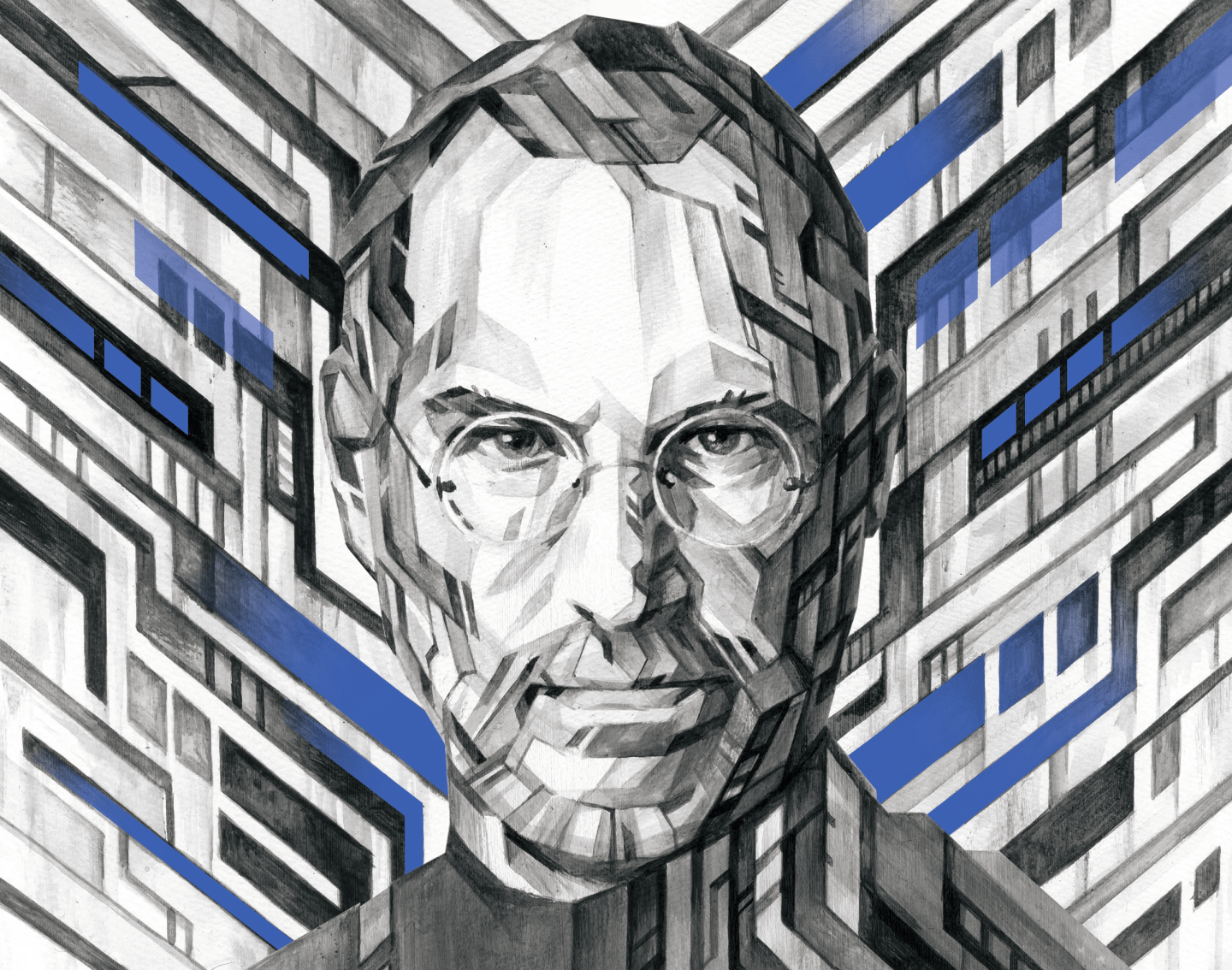
The iSpaceship, a futuristic behemoth enveloped in giant sheets of curved glass, has the elegance and pizzazz of so many other Apple creations. It’s also the most visible manifestation that Jobs has been hard at work on what might be his most important product. It is neither an iPhone nor an iPad but rather an enduring and permanent Apple that has the architecture, the processes, the tools—and the soul—to outlive its iconic co-founder. Jobs’ legacy as a visionary inventor whose ideas and products reshaped industries is well established. His bigger challenge is to leave behind an institution that carries his DNA and continues to deliver one blockbuster hit after another while pushing the technology industry in new directions, even without Jobs at the helm. If successful it would be his most singular achievement.

The post-Jobs Apple will begin its life at the pinnacle of strength, riding the popularity of the iPhone and iPad, its most successful devices. But the Apple that Jobs created, and the Apple he wants to leave behind, peddles more than mere products. It peddles an elegance and simplicity that pervades everything from products and services (think iTunes) to its stores. “Apple has beautiful artifacts, but what Jobs has been building is a company whose legacy is ideas,” says Paul Saffo, the veteran Silicon Valley tech forecaster.
Indeed, Apple’s gadgets are far more than a collection of great products. They are an ecosystem of related devices that are ushering in a new era of computing. Until recently, however, that ecosystem was incomplete. Jobs sought to add the missing piece in June when he introduced iCloud, a set of online services designed to tie all of Apple’s products together and make it easier for millions of people to access music, photos, files, and software across devices.
It would be easy to dismiss iCloud as little more than a set of useful software tools. Jobs doesn’t see it that way. He sees it as a fundamental piece of Apple’s future, and to make it a reality, he has built one of the world’s largest data centers—the size of nine football fields—which opened recently in Maiden, N.C. With a price tag that will reach $1 billion, the building is indicative of iCloud’s central role in extending Apple’s franchise. It also is the physical embodiment of a culture of cannibalization that Jobs has lived by and that he no doubt wants to embed into a post-Jobs Apple. “We are going to demote the PC and the Mac to just be a device,” Jobs said when he unveiled iCloud. “We are going to move the digital hub, the center of your digital life, into the cloud.” Jobs first established his legacy by helping create the PC era in the 1980s. Now he’s unsentimentally closing out that chapter to extend both his legacy and Apple’s central role in a new post-PC, post-Jobs era.

The plan, like so many of Jobs’ moves, could seem almost foolhardy at first blush. When Jobs opened Apple’s first store in Tyson’s Corner, Va., the company’s foray into retailing was met with skepticism and even scorn. Ten years and more than 345 stores later, Apple has become one of the most admired retailers in the world. Jobs’ decision has become a teachable moment. Literally. A team of business professors hired by Apple has written case studies about the stores and other major Apple moves. They are taught internally by top executives to more-junior managers and are meant to serve as a reference for future generations of Apple leaders. Called Apple University, it was inspired by a similar program at Pixar, the animation studio Jobs sold to Disney (DIS). Top leaders, meanwhile, attend secret annual retreats where they absorb the Jobs Way. He discusses products, vision, and strategy. “Steve has always approached everything with the same energy and detail,” said Regis McKenna, a marketing guru who worked with Jobs in the 1980s. “He’s taken the same attitude he has toward products and design and applied it to management.”
Even as Jobs has been working to imprint Apple with his vision, he has been cementing his personal legacy. For the past 18 months Jobs has cooperated with Walter Isaacson, the former managing editor of Time, who is writing his biography. While Jobs is said to have no editorial control over the book, which comes out in November, it will be the first authorized biography of Jobs. It suggests an effort by Jobs to tell the official story of his life—and as such will probably serve as an instruction manual on Jobsian culture: It is sure to be important reading for future Apple employees.
Jobs, of course, was not about to hand off his most important product—Apple itself—lightly. Twice before he put Tim Cook, his trusted lieutenant, to the test. Both times Cook performed as well as anyone could have expected. In January, Jobs went on medical leave for the third time. He retained the CEO title and once again put Cook in charge, and during this most recent “interim” period Apple’s lead in tablets grew, its phone business accelerated, and the company briefly became the most valued in America, surpassing Exxon Mobil (XOM).
Jobs began to consider his resignation in earnest in late July, according to people who know him, after he realized that he would not be able to go back to Apple full-time. These people say that Jobs suffers ups and downs. Some days he is able to hold meetings and weigh in on decisions. Some days he remains house-bound and cancels appointments. While he could have chosen the status quo—remaining CEO, with Cook leading day-today operations—Jobs decided to take the next step in the transition. On Aug. 24, he went to Apple headquarters for an emotional board meeting, where he made his resignation official. Apple announced the news later in the day.
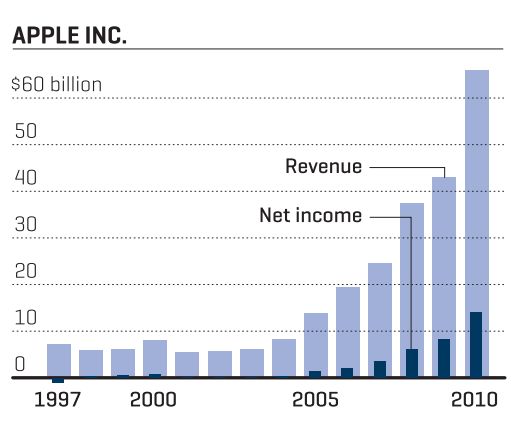
The people who know him say that little will change at Apple for now—as long as Jobs’ health doesn’t take a turn for the worse. As chairman, Jobs will stay involved in the things he likes—fine-tuning products, for example—much as he has since January. But the transition to a post-Jobs Apple, precipitated by Jobs’ ailing health, will have moved further along. Apple will have taken one more gradual step in a smooth and orderly succession that Jobs planned so as to lessen the shock on employees and investors.
It will take years to find out whether Jobs has succeeded in creating a company that can not only outlive him but also continue to be a formidable innovation pacesetter. There are plenty who believe that without Jobs, some of Apple’s magic will be lost. “We know less about this than we’d like,” says Nancy F. Koehn, a historian at the Harvard Business School. (Apple is known for its secrecy and declined to comment for this story.) Koehn said Jobs had an unmatched set of skills that include vision, intuition, creativity, and leadership. “There is no evidence that any of these has been institutionalized,” she says. “If Steve has a great intuition about what consumers want, how is the company without Steve going to know what consumers want?”
Jobs, for his part, says the post-Jobs Apple is ready for primetime. “I believe Apple’s brightest and most innovative days are ahead of it,” he wrote in his resignation letter. And some in the outside world appear to agree. Despite talk that Apple may never be the same, the company’s shares barely budged. It seems that Wall Street, at least, took one look at the post-Jobs Apple and decided it liked what it saw.
A version of this article was originally published in the September 26, 2011 issue of Fortune.