Artificial food dyes have been a hot topic over the past few years, prompting California lawmakers to propose and pass several bills designed to tamp down on their use in the state. The latest, called the California School Food Safety Act, was signed into law last month, making it illegal for public schools to offer food to children that contains any of six different artificial dyes, including Red No. 40 and Yellow No. 5, when it goes into effect at the end of 2027.
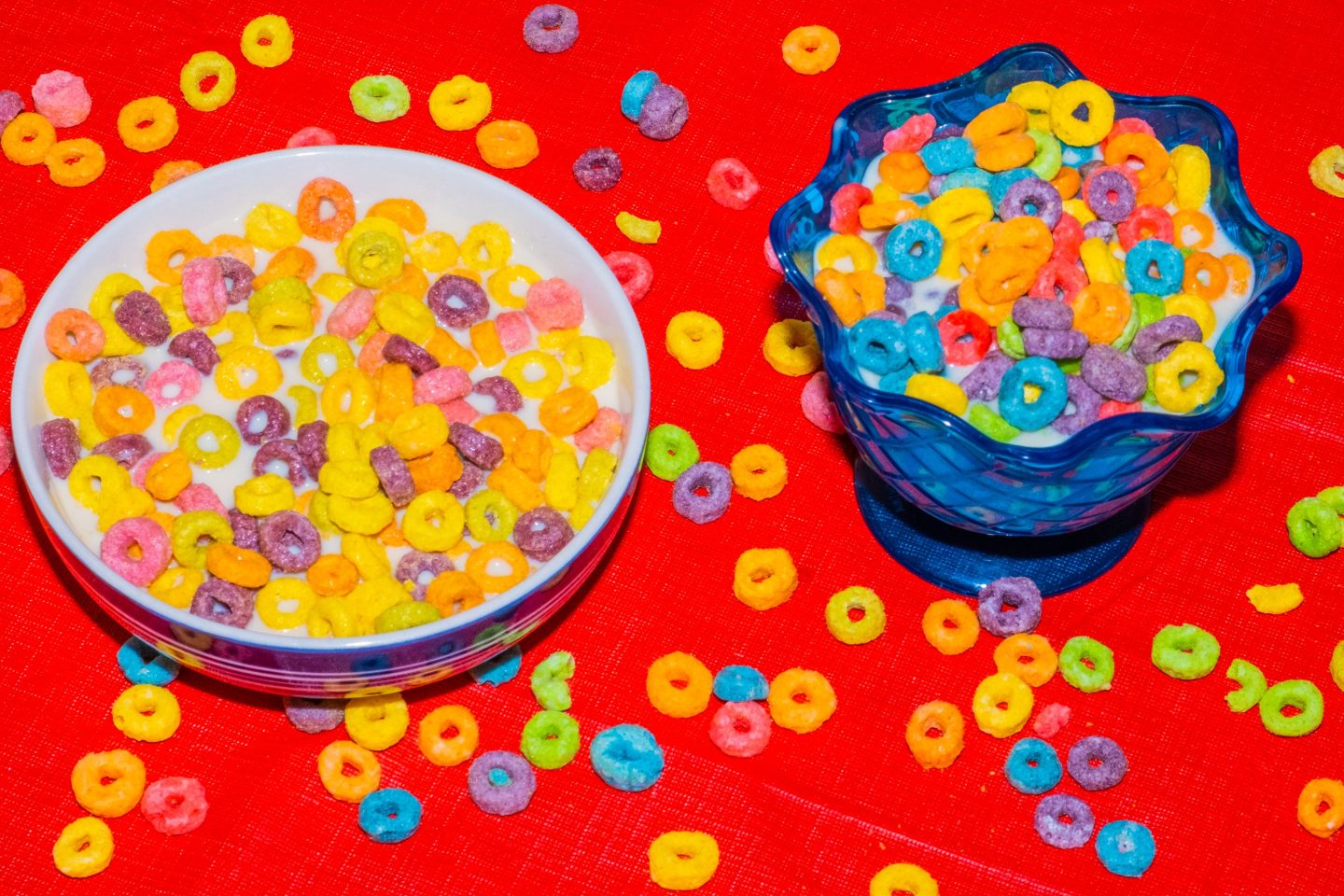
California tends to be a leader in food safety legislation, and now people in other areas of the country are pushing for products to change their use of synthetic food dyes. Earlier this week, protesters gathered outside the Michigan headquarters of WK Kellogg Co. to demand that the company remove artificial food dyes from its Froot Loops, Apple Jacks, and other breakfast cereals.
Kellogg had pledged back in 2015 to remove artificial dyes from its foods by 2018. But that hasn’t happened, despite the company making changes to its formulas in other countries—coloring Froot Loops in Canada with concentrated carrot juice, watermelon juice, and blueberry juice, for example—where artificial colors are more tightly regulated.
Actress Eva Mendes promoted the protest to her nearly 7 million followers on Instagram, writing, “I grew up on cereal. I still love it but I won’t eat @kelloggsus anymore after I found out that so many of the ingredients they use here in the US are BANNED in other countries. Why? Because they’re harmful for children.” She also encouraged her followers to sign a petition created by Vani Hari, a.k.a. the “Food Babe,” which asks Kellogg to remove all artificial dyes and preservative butylated hydroxytoluene (BHT), a suspected endocrine disrupter, from its cereals.
Kellogg insists that its cereals are safe to eat, noting that its ingredients meet federal standards from the U.S. Food and Drug Administration. “The quality and safety of our foods is our top priority,” a spokesperson for the company said in a statement to Fortune. “Our products—and the ingredients we use to make them—are compliant with all applicable relevant laws and regulations, and we remain committed to transparently labeling our ingredients so consumers can easily make choices about the food they purchase.”
While artificial food dyes are nothing new, the furor surrounding them is—so it’s understandable to have questions about why so many are concerned with these additives. Here’s what experts want you to know.
What is artificial food dye?
Artificial food dye is an additive used to color a product. “The dye is artificial if it originates from a nonfood source,” explains Jamie Alan, PhD, an associate professor of pharmacology and toxicology at Michigan State University. “For example, red dye No. 40 is made from petroleum products.” Blue No.1 and Red No.3 are also made from petroleum.
By comparison, natural food dyes “are those that are extracted from plants or animal tissues,” such as beet juice for red coloring and spirulina, an algae, for blue, says Francisco Diez-Gonzalez, PhD, professor and director of the Center for Food Safety at the University of Georgia.
Foods that have artificial food dye
Artificial food dye shows up in a wide range of products, including some that are less obvious, Diez-Gonzalez says. Those include:
- Cookies
- Snacks
- Cereals
- Beverages
- Canned products
- Ice cream
- Candies
- Bakery products
- Yogurt
- Applesauce
- Some dried fruits
- Relish
Many of the products that contain artificial food dyes are marketed to kids, points out Melanie Benesh, vice president of government affairs for nonprofit safety researcher Environmental Working Group.
“Six out of seven of these dyes were approved by the FDA by 1931, and many have not been meaningfully reviewed for safety by the agency in decades,” Benesh says.
Further, says Alan, “these dyes also show up in medication.”
What does research say about its safety?
A growing body of research has linked artificial food dyes, especially Red No. 40, to a slew of health issues. “There is data in animals that some of these dyes may cause cancer,” Alan says. “While there is certainly the potential to cause cancer, there haven’t been any human studies with definitive data to support this.”
But studies on humans do show that some dyes can amplify certain behaviors—especially in kids—like hyperactivity. “Some children are more sensitive than other children, and sometimes even a small dose can cause these effects,” Alan says.
The latest bills in California are based on data from a 2021 report published by the California Office of Environmental Health Hazard Assessment that analyzed data from studies on both animals and humans who were exposed to food dyes.
The report included “challenge studies,” for which children were given dyes and observed to see how they reacted afterward. In 16 of the 25 studies that were included in the report, there was a link between children ingesting the dyes and having hyperactivity and other neurobehavioral problems afterward.
A 2022 mouse study found that Red No. 40 and Red No. 17 could trigger inflammatory bowel diseases like ulcerative colitis and Crohn’s disease, while a 2023 study on mice linked Red No. 40 to DNA damage and colonic inflammation. Some people may also experience “allergy-like symptoms” from having these dyes, Diez-Gonzalez says.
But Diez-Gonzalez notes that it’s important for people to be aware that more research is needed. “The cancer concerns mostly originate from animal studies that often use very large experimental doses,” he says. “For several of those dyes, the evidence of a harmful effect has not been conclusive.”
Why are these dyes approved by the FDA?
It’s important to note that these food dyes are approved by the Food and Drug Administration and that they appear in foods under what’s considered “acceptable daily intake levels.” That means it’s estimated that the artificial food dyes can be consumed daily over a lifetime without causing a risk to your health.
But Alan says that the approval is “almost a technicality at this point” given that a growing body of research suggests they aren’t all that safe. “Some of these dyes are banned from cosmetics—Red No. 3 is an example—but not banned from food,” she says. “When they were approved for food, there was less data. When they were being reviewed for cosmetics, the FDA had more data. To this point, the FDA has not made any action to ban these in food.”
But several of these dyes are tightly regulated in other countries. Products sold in Europe that contain Yellow No. 5 and No. 6, and Red No. 40, for example, must carry a warning label that says the dyes “may have an adverse effect on activity and attention in children.”
In a statement to Fortune, the FDA said that it has “robust programs that assure the safety of chemicals used in food before they come onto the market,” conducting safety evaluations for approximately 150 submissions per year for both new chemicals and new uses of existing chemicals in the food supply, including color additives. ”We also reassess the safety of chemicals in food as new, relevant data become available,” the statement continued, calling that task “a priority,” and noting it had reviewed the safety of several artificial colors in 2011 and 2016, but that the FDA also needs more resources “to do the labor-intensive work that is required of a science-based agency in chemical reassessment.”
With additional funding, “the agency could be much more ambitious in the number of existing chemicals being assessed and increase the speed at which we are able to do this work,” the FDA spokesperson said.
What can you do?
There are a few things you can do to try to avoid or minimize your contact with these dyes.
“Choosing whole foods over processed foods is a good start,” Alan says. “However, I recognize that this is not an option for people because of a plethora of reasons.”
If it’s tough to avoid processed foods altogether, he suggests doing your best to minimize how much is in your diet. From there, be sure to read labels before purchasing to see if a product you’re interested in contains artificial food dyes.
Diez-Gonzalez recommends looking for these artificial food dyes in particular, as they are derived from petroleum or other chemicals:
- Blue No. 1
- Blue No. 2
- Green No. 3
- Orange B (used in hot dogs and some sausage casings)
- Citrus Red No. 2 (to color the skin of some oranges)
- Red No. 3
- Red No. 40
- Yellow No. 5
- Yellow No. 6
“The regulation requires that manufacturing companies list individually each of the dyes in the list of ingredients in the package,” he says. “If a consumer is interested in avoiding them, the best strategy is to read the labels and only purchase foods that do not include any dyes.”
More on nutrition:
- 4 best supplements for an energy boost, according to experts
- 8 healthy fast food picks for when you’re eating on the go
- Chick-fil-A’s banana pudding milkshake is back. You won’t believe how many carbs it has
- It’s not 8 glasses a day anymore. Here’s how much water you should drink each day
Subscribe to Well Adjusted, our newsletter full of simple strategies to work smarter and live better, from the Fortune Well team. Sign up for free today.