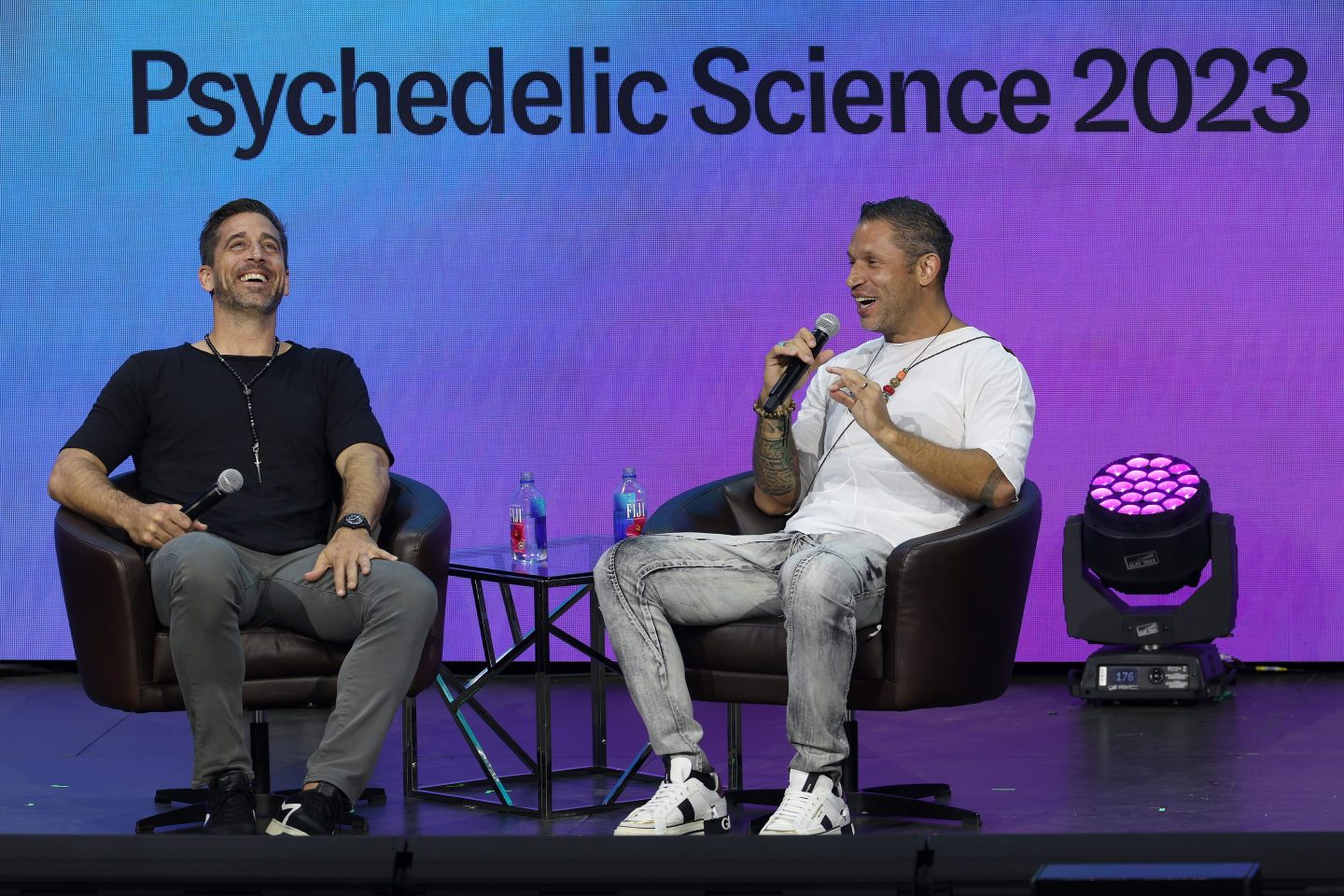
Psychedelics are all the rage. Well-known figures like quarterback Aaron Rodgers, singer Miley Cyrus and boxer Mike Tyson testify to their transformative impact. Less visible consumers are “microdosing” or signing up for retreats with shamanic guides in this rapidly expanding subculture. In June 2023, the Multidisciplinary Association of Psychedelic Studies held a conference in Denver promoting research around psychedelics – part of a larger wave of enthusiasm for the benefits of substances like ecstasy, “magic” mushrooms and LSD to treat PTSD, anxiety, depression, addiction and other afflictions.
The current “psychedelic renaissance” is often talked about as revolutionary for the future of the human species. But as a religion scholar who studies the sacred uses of drugs, I think it would be valuable to look backward, not forward, to understand their significance. As usual, the past is present: Humans have incorporated drugs into their spiritual lives for millennia.
Drugged animals?
In fact, the consumption of psychoactive “drugs” is a feature of other species. The 1989 book “Intoxication” by Ronald Siegel, a psychopharmacology researcher at the University of California, Los Angeles, raised public and scientific awareness of the fact that animals will seek out intoxicating substances.
Signs of stoner life in the animal kingdom go way beyond cats and their catnip. Birds and bees, elephants and bighorn sheep, and a range of other species in the wild return again and again – religiously, you might say – to substances that are dangerous but have appealing effects.
Among the more celebrated examples of this phenomenon are Siberian reindeer, which partake in the consumption of the fly agaric mushroom, a hallucogenic. Ethnobotanist Giorgio Samorini has described how during the summer the reindeer seek out the mushroom, consume it and exhibit uncharacteristic behavior like twitching their heads, running aimlessly and making strange sounds.
Siegel argued that there is evidence humans and other organisms have a universal drive for intoxication via psychoactive substances – a fourth basic drive along with those directed toward sex, food and water. In his view, drugs seem to ignite certain kinds of brain activities and interconnections that relate to biologically and evolutionarily advantageous behaviors, like creativity and performance enhancement.
Biology professor Oné R. Pagán makes a similar argument in his 2021 book “Drunk Flies and Stoned Dolphins.”
Drugged ancestors?
But there is much more to human drug use than animal instincts. In fact, the archaeological record seems quite overwhelming in linking psychoactive substances in nature to ancient religious rituals.
One of the more recent archaeological discoveries about drug use in the Bronze Age, roughly 3,000 years ago, was found during excavations at a funeral site on the island of Minorca, off the coast of Spain. Researchers chemically analyzed human hair samples that had been put in tubes made of wood or antler and placed near the dead. The results provided direct evidence of the consumption of psychoactive compounds produced by a variety of nightshade plants – mandrake, henbane and joint pine, in this case. Some of these compounds are stimulants, like ephedrine, and others can produce powerful hallucinations, delirium and out-of-body experiences.
Switching continents, a funerary space in western China also points to deep-rooted connections among drugs, altered states and ritual life. In this case, researchers found cultivated cannabis plants with fairly high concentrations of the psychoactive compound THC that were burned around 2,500 years ago in wooden containers, likely during ceremonies for the dead. While this is not direct evidence of drug consumption, the authors – who also found a harp at the site – suggest funerary rites may have included music and hallucinogenic smoke “to guide people into an altered state of mind.”
Throughout many eras, the prevalence of drug use for ritual purposes certainly went beyond mortuary rites and has been tied to a variety of rites of passage, healing practices and collective ceremonies.
Sacred drugs?
What led our prehistoric ancestors to these powerful plants and fungi, and why did they use them over and over?
It would be very easy to project contemporary desires onto them: to battle depression or escape everyday life; to heal wounds, both physical and mental; to get high and just feel good; to self-medicate; to increase focus; to enhance performance; to sleep peacefully. The list goes on and on.
On the other hand, the needs and desires of people living today have been shaped by modern societies. Evidence about why humans used drugs in prehistorical cultures around the globe points to some of the most elementary, yet critical, driving forces then and now: religious sensibilities, social bonding and group identity.
In the study of the funeral site in the western Mediterranean, for example, the research team concluded that, given the potential toxicity of the alkaloids, someone with very expert knowledge about these compounds must have been involved in their production and consumption, likely a shaman. In research about prehistoric societies, the term “shaman” is a catch-all designation for individuals whose roles included religious leadership, healing and spirit communication, among others. In more contemporary lingo, they were key “influencers” in their communities’ religious lives.
The lead author of this study, Elisa Guerra Doce – a professor at the University of Valladolid in Spain – has written extensively on drug plants and fermented beverages in ancient cultures. In one paper, an overview of the archaeological evidence of psychoactive substances in prehistoric societies, she underscores the pervasive connections between drugs and religion, reinforcing an increasingly common argument that “the deliberate induction of altered states of consciousness plays a key role in the belief systems of traditional societies all over the world.”
Drugged today
Drugs are ubiquitous in American society, even if we don’t always think of them as “drugs”: from drinking the morning cup of coffee to sipping a glass of wine in the evening; from swallowing prescription pills to ripping on a bong; from inhaling the nicotine in a vape to tripping at a psychedelically assisted therapy session.
What do the animalistic and ancient roots of humans’ interaction with drugs tell us about this contemporary landscape?
One take-away, I would argue, is that perhaps the desire to consume such substances and alter consciousness is a natural part of what it means to be human. Like us, people thousands of years ago experienced pain and pleasure, euphoria and death. Like us, they sought to understand reality and their place in it. The use of drugs in these experiences was not universal, but it was not uncommon either – especially in religious life.
Here and now, these types of uses for psychedelics have often been rebranded as clinical science, not spirituality. They are targeted to specific illnesses, like addiction or PTSD, and discussed in terms of scientific successes, empirical data and patient satisfaction surveys. Yet even in the modern context, the deeper interconnections between drugs and religious life are hard to dismiss.
Gary Laderman is Goodrich C White Professor of Religion, Emory University.
This article is republished from The Conversation under a Creative Commons license. Read the original article.