Key takeaways
- An estimated 10% of the global population suffers from rare disease; 80% of rare disorders are thought to be genetic.
- Whole genome sequencing (WGS) can provide diagnoses in about 40% of cases, for several hundred dollars per patient.
- In the U.S., access to the technology depends factors like the state where patients live, their insurance, and their financial resources.
No one wants to find themselves sick or in need of a medical diagnosis. But there are those out there who already are—and are desperately seeking answers.
For rare disease patients, a diagnosis, even one with a poor outcome, is often a luxury—long sought after, hard won, and, in a worst-case scenario, forever elusive. The average time to diagnosis, if one can be found: eight years.
It’s an emotionally and often financially draining time referred to as the “diagnostic odyssey.” While each patient’s journey is unique, they’re fraught with common obstacles: medical trauma, gaslighting, bankruptcy, and missed opportunities for life-changing—and potentially life-saving—treatment.
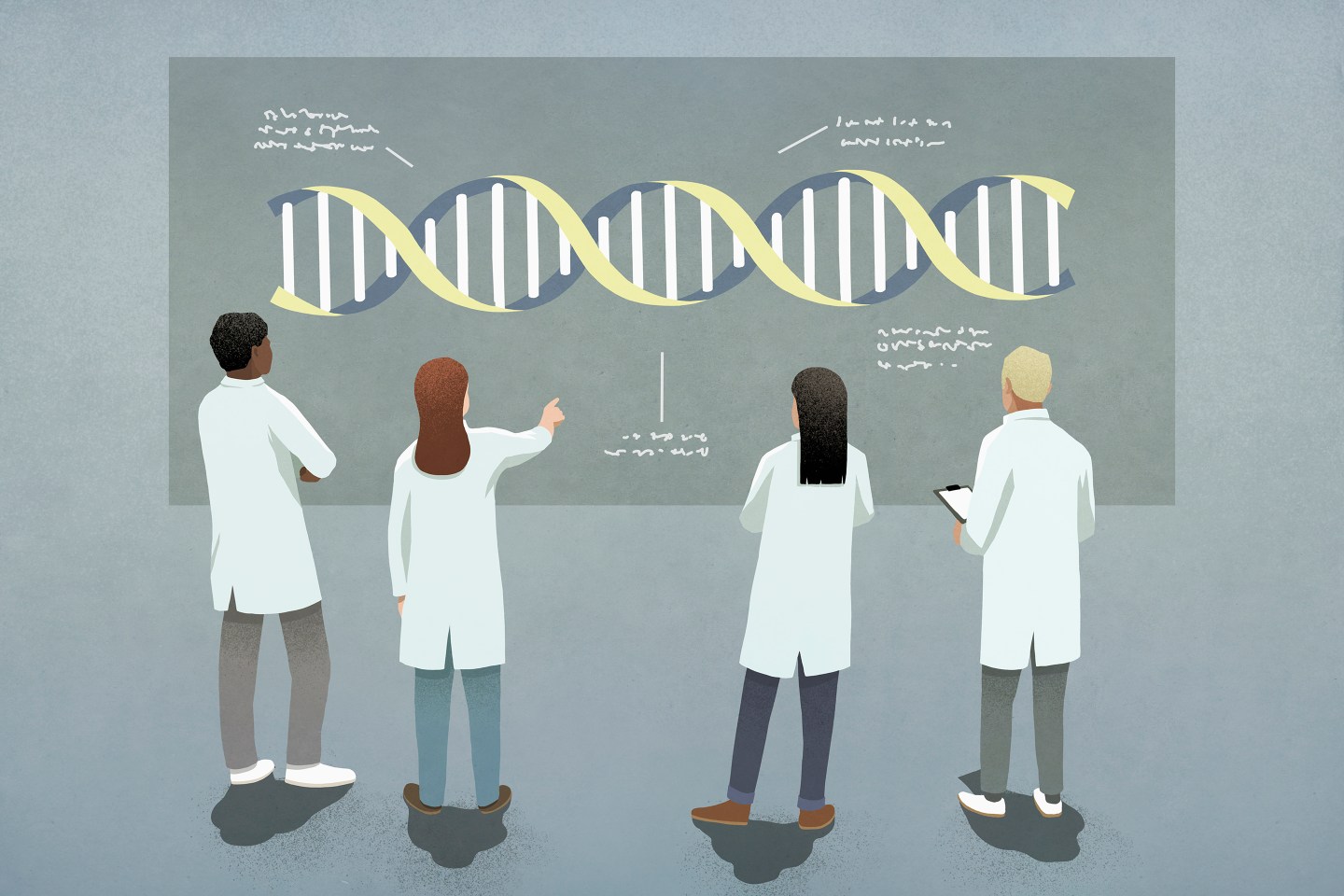
An estimated 80% of rare disorders are due to genetic causes. In the U.K., patients suspected of having a rare disorder are beginning to receive free access to the best science has to offer at the moment—a genetic test that delivers diagnoses in about 40% of cases. Called whole genome sequencing (WGS), it allows scientists to examine all genetic “instructions” found in a cell and look for abnormalities.
In the U.S., whether or not a suspected rare disease patient can access such testing depends on myriad factors: which state they live in, which insurances they have, research projects and charity programs at the hospital they’re being seen at, and whether they can afford the hundreds it takes to pay out of pocket for the test.
“Genomes are standard of care in the U.K. for patients with a wide range of rare diseases,” Ryan Taft, vice president of scientific research at biotechnology company Illumina, tells Fortune. “I bring it up frequently, especially if I’m on Capitol Hill. This technology was grown here in the U.S.”
It’s a far cry from the state of things in America.
Says Taft: “We’re still catching up in catching on that it’s the right thing to do for patients in the U.S.”
Rare, yet common
The U.S. government defines a disease as rare if it affects fewer than 200,000 Americans. Rare diseases include more common rare disorders, like cystic fibrosis, as well as ultra-rare conditions, like fibrodysplasia ossificans progressiva, or “stone man syndrome,” in which muscle and connective tissue are gradually replaced by bone. All but a few types of cancer are rare, according to the National Organization for Rare Disorders.
Individually, rare diseases are rare. But collectively, they’re common. About 10% of the global population is thought to have a rare disorder, even if they’re not aware or haven’t shown symptoms yet, experts say.
In the U.S., an estimated 25 to 30 million residents are thought to be affected, with an economic burden of around $1 trillion annually, due to medical costs, forced retirement, absenteeism, and other factors like experimental treatments not covered by insurance. That figure was calculated by the Every Life Foundation for Rare Disorders, which only examined data for 379 rare conditions.
There are thought to be upwards of 10,000.
From a $100 million price tag to mere hundreds
It’s a nearly unfathomable toll, but one that can be reduced, experts say, by using WGS to shorten, and perhaps even eliminate, diagnostic odysseys and get patients to treatment quickly, when possible.
The cost of genetic testing has nosedived over the decades, from around $100 million in 2001 to right around $1,000 today, according to the U.S. National Institute of Health’s National Human Genome Research Institute. This month Illumina began offering $200 genome sequencing, Taft adds.
The steep dive in costs has made testing more enticing to insurance providers, especially given the potential savings. WGS for a patient now costs less than a one-day stay in the ICU and can shorten hospital stays, especially for patients in the neonatal ICU, Dr. Wendy Chung, chief of the division of clinical genetics in the department of pediatrics at Columbia University Irving Medical Center in New York, tells Fortune.
WGS can further reduce costs for insurance companies by eliminating unnecessary procedures and tests in patients who receive a diagnosis, she adds.
Chung heads up the Guardian Study, in partnership with sequencing companies GeneDx and Illumina. The project aims to diagnose 250 genetic conditions not identifiable by typical newborn screenings. All infants are eligible, whether or not they require a NICU stay. The program uses WGS and is provided at no cost to patients.
Dr. Stephen Kingsmore, president and CEO of Rady Children’s Institute for Genomic Medicine in California, launched a similar initiative in 2018. Called Project Baby Bear, the groundbreaking project provided rapid WGS to 178 babies in the NICU, providing diagnoses for 43% of them and saving $2.5 million in health care costs. Other states have since developed similar programs, like Project Baby Manatee in Florida and Project Baby Deer in Michigan.
Multiple studies have shown an average cost savings of about $15,000 per child who receives WGS, he says. And yet he calls the process of advocating a “state-by-state slough” that involves educating physicians, hospital administrations, and politicians of the benefits of whole genome sequencing—for ill infants, and for the undiagnosed in general.
“If we sound a little frustrated, we’ve been doing this for 11 years, and we’re a long way from this being the standard of care” in the U.S., Kingsmore says. Other countries like Australia are ahead of the U.S. in the newborn screening space, he says, adding that Taiwan, Singapore, and Japan are considering implementing such programs.
Taft echoes Kingsmore’s sentiment.
“I joke sometimes that I’ve spent the last 10 years proving the obvious,” he says. “Genomes are the best thing you can do for patients, if you can.”
A ‘tapestry of decision-making’
So why isn’t there broader coverage of whole genome sequencing in the U.S., if only for financial reasons?
The country is getting there, experts tell Fortune. But because there is no national health system as in the U.K., accomplishing the task is more arduous. It entails getting multiple parties—like state legislatures, insurance companies, and hospital systems—on board to piece together a quilt of coverage to blanket the country, with as few holes as possible.
The U.K. “doesn’t have the issue of this tapestry of decision-making,” Kingsmore says. “For us, it’s just a matter of working one state at a time to decide how they’re going to do this in their population.”
Even once WGS is available for insurance coverage in a state, there are other barriers, he says: “Physicians might not be aware this exists; hospital administration may not allow it in their hospital.”
“It’s going to take time.”
Several states provide coverage of WGS to Medicaid patients who need it, like Michigan, Maryland, Oregon, and California. And insurance companies are coming on board. United Healthcare recently began covering WGS, Kingsmore says.
Cigna recently updated its policy too, Taft adds. What’s more, the Senate appropriations bill passed in December instructs Medicaid and Medicare to investigate how to integrate such technologies into their coverage.
“It’s shifting,” he says. “The U.K. has shifted. The U.S. is moving that way. The world we want to see, where all of these patients can get access to technology like ours—it’s not science fiction. It’s within reach.”
‘Genomes for everyone’
Taft says WGS must “absolutely” become the standard of care in the NICU. “The evidence is there, we just need to develop the systems to deploy it,” he says. “It’s an implementation problem right now.” Using WGS as a supplemental newborn screening is a goal for down the road, he adds.
But he doesn’t want to forget about the “rare disease backlog” of patients—”250 million, at least, worldwide, wandering around with undiagnosed genetic diseases, who haven’t seen a NICU, won’t ever see a NICU, are too old for a NICU,” he says.
“We talk about a future of genomes for everyone, and I don’t mean that flippantly,” he says. “I literally think that’s the world we should be aiming for. That’s certainly true for any patient with any indication of a genetic disease.”
If the cost savings doesn’t win over decision-makers, Taft, Kingsmore, and Chung hope the humanity of it all might.
Kingsmore tells the story of “Baby Fitz,” in whom newborn genetic testing detected an exceedingly rare and usually fatal immune deficiency disease—severe combined immunodeficiency, also known as “bubble boy disease.” Essentially, he had no immune system. The condition was identified before he experienced any symptoms, and he was able to quickly receive gene therapy. He’s yet to experience any symptoms of the disease.
“That’s our mission, to end the diagnostic odyssey,” Kingsmore says.
And then some: “We want to go beyond the diagnosis and have effective therapies for these conditions.”
Taft recalls the case of a boy and his family’s 14-year diagnostic odyssey. The journey came to an end when the boy received genetic testing that showed he had a glucose transport deficiency syndrome, which could be treated with a ketogenic diet.
The boy experienced behavioral and cognitive improvements after going on the diet, Taft says. But being diagnosed in the NICU could have been a game-changer. He considers the story a “clarion call.”
When the child was born, WGS in the NICU wasn’t possible. “But it is today,” Taft says. “We have the technology, we have the evidence, we can do it.”
At this point, it’s a matter of finding the collective will to make it happen.
“Are we really saying that we’re withholding information from people that could help them make life and clinical decisions about the care of their child?” he says.
“That’s the decision we need to make as a society.”