• Home
  • Latest
  • Fortune 500
  • Finance
  • Tech
  • Leadership
  • Lifestyle
  • Rankings
  • Multimedia
PoliticsNATO
Europe

Spain wins exemption from NATO’s 5% defense spending goal

By
Andrea Palasciano
Andrea Palasciano
,
Daniel Basteiro
Daniel Basteiro
and
Bloomberg
Bloomberg
Down Arrow Button Icon
By
Andrea Palasciano
Andrea Palasciano
,
Daniel Basteiro
Daniel Basteiro
and
Bloomberg
Bloomberg
Down Arrow Button Icon
June 23, 2025, 5:00 AM ET
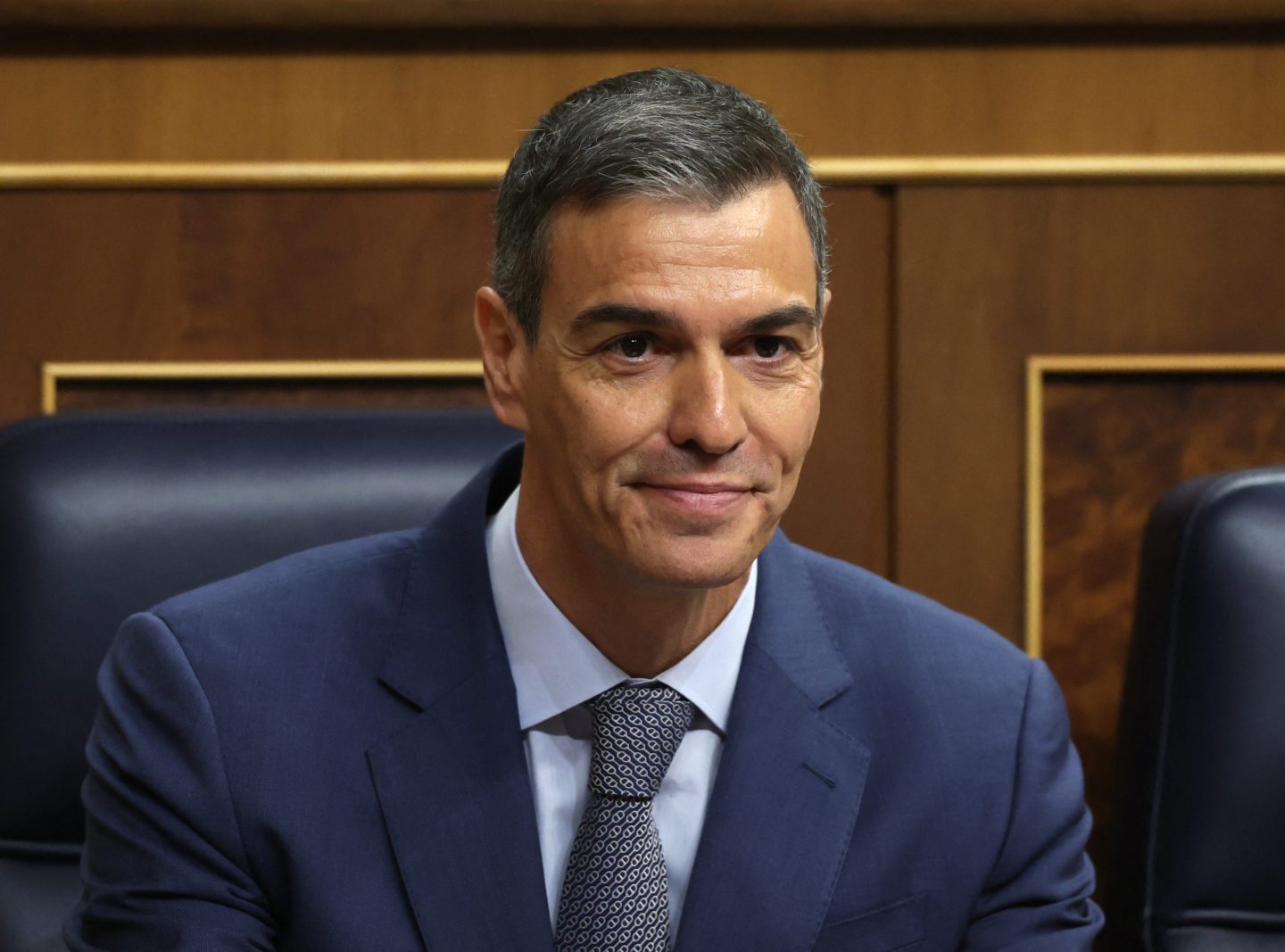
“We fully respect the legitimate desire of other countries of increasing their defense investment but we won’t do it,” Spanish Prime Minister Pedro Sanchez said.
“We fully respect the legitimate desire of other countries of increasing their defense investment but we won’t do it,” Spanish Prime Minister Pedro Sanchez said.PIERRE-PHILIPPE MARCOU—AFP via Getty Images

Spain obtained an exemption from NATO’s ambitious defense spending target of 5% of GDP after several days of diplomatic wrangling that drew scorn from Donald Trump, right before leaders of the military alliance gather on Tuesday.

Recommended Video

“We fully respect the legitimate desire of other countries of increasing their defense investment but we won’t do it,” Spanish Prime Minister Pedro Sanchez said on Sunday afternoon. The country can get defense expenditure up to 2.1%, “nothing more, nothing less.”

In a letter to North Atlantic Treaty Organization Secretary General Mark Rutte dated June 22 seen by Bloomberg, Sanchez said Spain will meet the alliance’s ambitious new weapons and troop targets, but without committing to the price tag that NATO had attached to it. 

Spain will decide on how to comply with the targets and that the statement adopted at the summit will give Spain “flexibility” to “determine its own sovereign path for reaching the capability targets,” Rutte said in his own letter to Sanchez on Sunday. 

NATO has said that 3.5% of GDP was needed to meet these targets, up from 2% currently, while an addition 1.5% in defense-related spending would help it reach Trump’s desired 5%. Earlier on Sunday, the group tweaked the draft statement’s language to “allies” commit to spending 5% of GDP on defense, from “we” commit, according to people familiar with the talks. 

The adjustment introduced a nuance meant to provide more flexibility to the commitment, said the people, who requested anonymity to discuss private considerations. 

Discussions on the summit statement “have concluded and the statement is now agreed by all Allies,” an alliance official said in response to questions. “We expect Allied leaders will formally approve this statement” when they meet at the summit in The Hague. The statement will be released to the public at that time, according to the official.

Sanchez’s opposition to the 5% target — calling it unreasonable and counterproductive for his nation — prompted Trump to deride Spain on Friday as a “low payer” that should step up on defense.

NATO members will meet in The Hague against the backdrop of Trump’s dramatic insertion of the US into Israel’s attacks on Iran, and as Europe awaits his decision on US troop levels in the region amid Russia’s war against Ukraine.

Allies had stepped up pressure on Spain to fall in line over the spending target, after persuading skeptics including Italy and Belgium to come around. 

Sanchez has offered to increase defense expenditure to 2.1% of GDP but faces push-back at home, including from allies in his government.

“We think that the debate must not be around percentages but around capabilities,” Spanish Foreign Minister Jose Manuel Albares told reporters in Brussels Monday. “We can reach the capabilities that have been fixed by the organization with 2.1% and that has been acknowledged and agreed by the organization.”

While Rutte initially proposed a 2032 date for reaching the spending target, the latest draft delays that to 2035. His wish to see mandatory yearly increases has also been stripped, which should make the process easier for spending laggards.

NATO’s existing target calls for member countries to spend 2% of GDP on defense. Under the new target, 1.5% would go to broader defense-related spending such as cybersecurity as well as infrastructure for moving troops and military equipment.

The agreed criteria are broad enough that all allies should be able meet that part of the plan quickly, the people said. The increase in core defense spending to 3.5% from 2% will be much harder to deliver.

As part of its routine process, NATO will review the kit and troops it deems necessary in 2029. The price tag attached to its capabilities could be tweaked at that point, potentially providing some breathing room for the lowest spenders 

Washington has been pushing for an unprecedented defense expenditure increase, arguing that European allies must take responsibility for their own security.

“I don’t think we should, but I think they should,” Trump said late Friday about reaching the 5% goal, introducing some last minute uncertainty after the US previously said it would commit to the target.
Join us at the Fortune Workplace Innovation Summit May 19–20, 2026, in Atlanta. The next era of workplace innovation is here—and the old playbook is being rewritten. At this exclusive, high-energy event, the world’s most innovative leaders will convene to explore how AI, humanity, and strategy converge to redefine, again, the future of work. Register now.
About the Authors
By Andrea Palasciano
See full bioRight Arrow Button Icon
By Daniel Basteiro
See full bioRight Arrow Button Icon
By Bloomberg
See full bioRight Arrow Button Icon

Latest in Politics

North AmericaMexico
U.S., Mexico strike deal to settle Rio Grande water dispute
By Fabiola Zerpa and BloombergDecember 13, 2025
7 hours ago
Danish military forces participate in an exercise with hundreds of troops from several European NATO members in the Arctic Ocean in Nuuk, Greenland, Monday, Sept. 15, 2025.
PoliticsDonald Trump
Danish intelligence report warns of U.S. economic leverage and military threat under Trump
By The Associated PressDecember 13, 2025
8 hours ago
Ukrainian President Volodymyr Zelensky gives a joint press conference in Kyiv, Ukraine in 2023 as European leaders visit the country 18 months after the start of Russia's invasion.
EuropeUkraine invasion
EU indefinitely freezes Russian assets to prevent Hungary and Slovakia from vetoing billions of euros being sent to support Ukraine
By Lorne Cook and The Associated PressDecember 13, 2025
8 hours ago
Spanish Prime Minister Pedro Sánchez often praises the financial and social benefits that immigrants bring to the country.
EuropeSpain
In a continent cracking down on immigration and berated by Trump’s warnings of ‘civilizational erasure,’ Spain embraces migrants
By Suman Naishadham and The Associated PressDecember 13, 2025
8 hours ago
Politicsdavid sacks
Can there be competency without conflict in Washington?
By Alyson ShontellDecember 13, 2025
13 hours ago
PoliticsAffordable Care Act (ACA)
With just days to go before ACA subsidies expire, Congress is about to wrap up its work with no consensus solution in sight
By Kevin Freking, Lisa Mascaro and The Associated PressDecember 13, 2025
14 hours ago

Most Popular

placeholder alt text
Success
Apple cofounder Ronald Wayne sold his 10% stake for $800 in 1976—today it’d be worth up to $400 billion
By Preston ForeDecember 12, 2025
2 days ago
placeholder alt text
Economy
Tariffs are taxes and they were used to finance the federal government until the 1913 income tax. A top economist breaks it down
By Kent JonesDecember 12, 2025
2 days ago
placeholder alt text
Success
40% of Stanford undergrads receive disability accommodations—but it’s become a college-wide phenomenon as Gen Z try to succeed in the current climate
By Preston ForeDecember 12, 2025
2 days ago
placeholder alt text
Economy
The Fed just ‘Trump-proofed’ itself with a unanimous move to preempt a potential leadership shake-up
By Jason MaDecember 12, 2025
1 day ago
placeholder alt text
Success
Apple CEO Tim Cook out-earns the average American’s salary in just 7 hours—to put that into context, he could buy a new $439,000 home in just 2 days
By Emma BurleighDecember 12, 2025
2 days ago
placeholder alt text
Economy
For the first time since Trump’s tariff rollout, import tax revenue has fallen, threatening his lofty plans to slash the $38 trillion national debt
By Sasha RogelbergDecember 12, 2025
1 day ago
Rankings
  • 100 Best Companies
  • Fortune 500
  • Global 500
  • Fortune 500 Europe
  • Most Powerful Women
  • Future 50
  • World’s Most Admired Companies
  • See All Rankings
Sections
  • Finance
  • Leadership
  • Success
  • Tech
  • Asia
  • Europe
  • Environment
  • Fortune Crypto
  • Health
  • Retail
  • Lifestyle
  • Politics
  • Newsletters
  • Magazine
  • Features
  • Commentary
  • Mpw
  • CEO Initiative
  • Conferences
  • Personal Finance
  • Education
Customer Support
  • Frequently Asked Questions
  • Customer Service Portal
  • Privacy Policy
  • Terms Of Use
  • Single Issues For Purchase
  • International Print
Commercial Services
  • Advertising
  • Fortune Brand Studio
  • Fortune Analytics
  • Fortune Conferences
  • Business Development
About Us
  • About Us
  • Editorial Calendar
  • Press Center
  • Work At Fortune
  • Diversity And Inclusion
  • Terms And Conditions
  • Site Map

© 2025 Fortune Media IP Limited. All Rights Reserved. Use of this site constitutes acceptance of our Terms of Use and Privacy Policy | CA Notice at Collection and Privacy Notice | Do Not Sell/Share My Personal Information
FORTUNE is a trademark of Fortune Media IP Limited, registered in the U.S. and other countries. FORTUNE may receive compensation for some links to products and services on this website. Offers may be subject to change without notice.