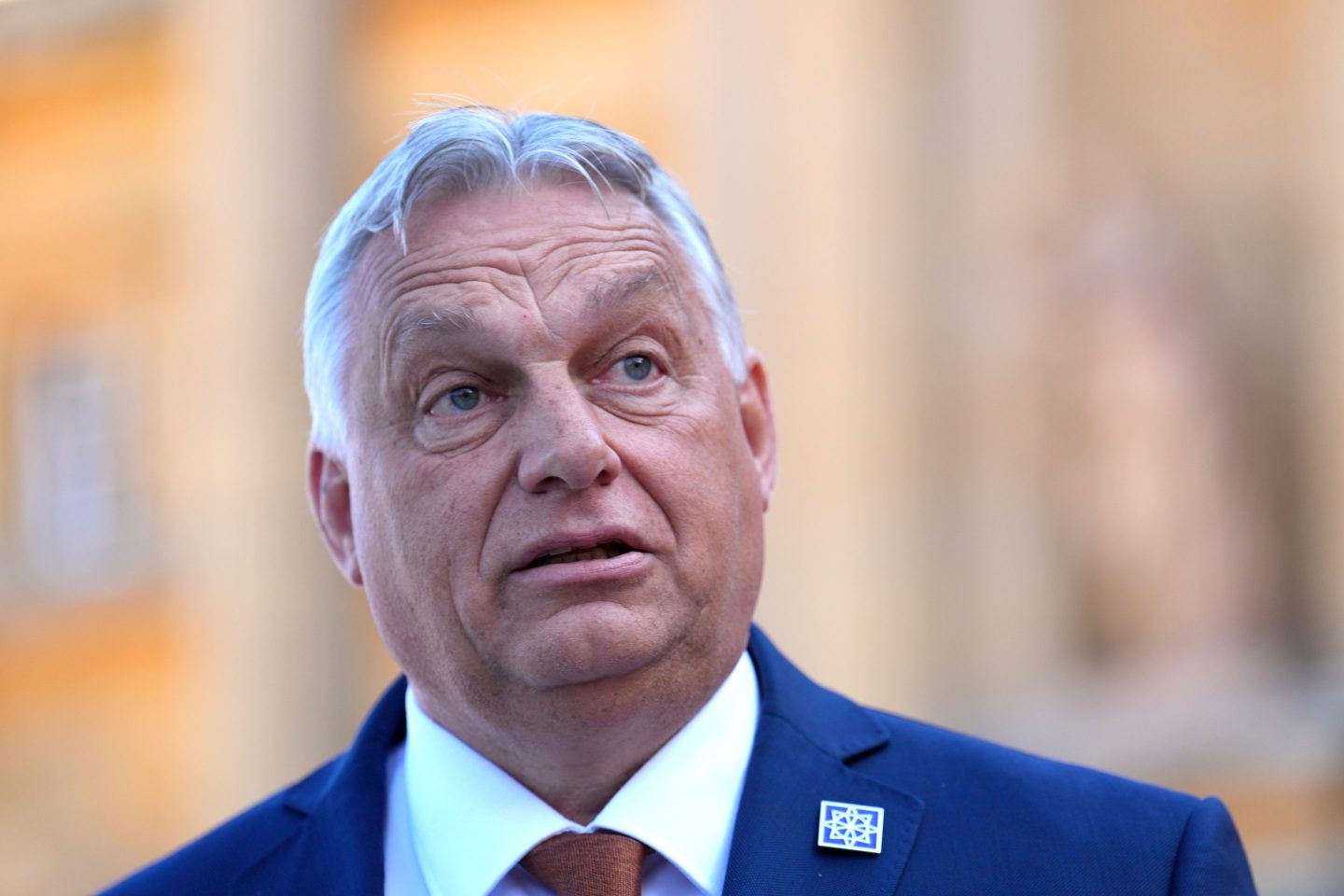
In the months leading up to elections for the European Parliament, Hungarians were warned that casting a ballot against Prime Minister Viktor Orbán would be a vote for all-out war.
The right-wing Fidesz party cast the June 9 election as an existential struggle, one that could preserve peace in Europe if Orbán won — or fuel widespread instability if he didn’t. To sell that bold claim, Orbán used a sprawling pro-government media empire that’s dominated the country’s political discourse for more than a decade.
The tactic worked, as it has since Orbán returned to power in 2010, and his party came first in the elections — though not by the margins it was used to. An upstart party, led by a former Fidesz insider, attracted disaffected voters and took 29% of the vote to Fidesz’s 44%.
“Everything has fallen apart in Hungary. The state essentially does not function, there’s only propaganda and lies,” said Péter Magyar, the leader of that new party who has emerged in recent months as perhaps the most formidable challenge yet to Orbán’s rule.
Magyar’s Respect and Freedom (TISZA) party campaigned on promises to root out deep-seated corruption in the government. He has also been outspoken about what he sees as the damage Orbán’s “propaganda factory” has done to Hungary’s democracy.
“It might be very difficult to imagine from America or Western Europe what the propaganda and the state machinery is like here,” Magyar said in an interview before elections with The Associated Press. “This parallel reality is like the Truman Show. People believe that it’s reality.”
Since 2010, Orbán’s government has promoted hostility to migrants and LGBTQ+ rights, distrust of the European Union, and a belief that Hungarian-American financier George Soros — who is Jewish and one of Orbán’s enduring foes — is engaged in secret plots to destabilize Hungary, a classic antisemitic trope.
Such messaging has delivered Orbán’s party four consecutive two-thirds majorities in parliament and, most recently, the most Hungarian delegates in the EU legislature.
But according to Péter Krekó, an analyst and head of the Political Capital think tank in Budapest, Orbán has created “an almost Orwellian environment” where the government weaponizes control of a majority of news outlets to limit Hungarians’ decisions.
“Hungary has become a quite successful informational autocracy, or spin dictatorship,” Krekó said.
The restriction of Hungary’s free press directly affects informed democratic participation. Opposition politicians have long complained that they only get five minutes of air time every four years on public television, the legal minimum, to present their platforms before elections.
In contrast, public television and radio channels consistently echo talking points communicated both by Fidesz and a network of think tanks and pollsters that receive funding from the government and the party. Their analysts routinely appear in affiliated media to bolster government narratives, while independent commentators rarely, if ever, appear.
During the campaign in May, Hungary’s electoral commission issued a warning to the public broadcaster for repeatedly airing Fidesz campaign videos during news segments, a violation of impartiality rules. The broadcaster carried on regardless.
Magyar, who won a seat in the European Parliament, credits his new party’s success partly to its ability to sidestep Orbán’s dominance by meeting directly with voters and developing a large following on social media.
But in largely rural Hungary, even those with a strong online presence struggle to compete with Fidesz’s control of traditional outlets.
According to press watchdog Reporters Without Borders, Orbán has used media buyouts by government-connected “oligarchs” to build “a true media empire subject to his party’s orders.” The group estimates that such buyouts have given Orbán’s party control of some 80% of Hungary’s media market resources. In 2021, it put Orbán on its list of media “predators,” the first EU leader to earn the distinction.
The title didn’t come out of nowhere: in 2016, Hungary’s oldest daily newspaper was suddenly shuttered after being bought by a businessman with links to Orbán. In 2018, nearly 500 pro-government outlets were simultaneously donated by their owners to a foundation headed by Orbán loyalists, creating a sprawling right-wing media conglomerate. And in 2020, nearly the entire staff of Hungary’s largest online news portal, Index, resigned en masse after its lead editor was fired under political pressure.
A network of independent journalists and online outlets that continue to function in Hungary struggles to remain competitive, said Gábor Polyák, head of the Media and Communication Department at Eötvös Loránd University in Budapest.
The government is the largest advertiser in Hungary, he said. A study by watchdog Mérték Media Monitor showed up to 90% of state advertising revenue is awarded to pro-Fidesz media outlets, keeping them afloat.
The government’s efforts to control media have moved beyond television, radio and newspapers, shifting into social media posts that are boosted by paid advertisements.
Hungary spent the most in the entire 27-member EU — nearly $4.8 million — on political ads on platforms owned by Facebook’s parent company, Meta, in a 30-day period in May and June, outspending Germany, which has more than eight times the population, according to a recent report based on publicly available data compiled by Political Capital, Mérték Media Monitor and fact-checking site Lakmusz.
The vast majority of that spending came from Fidesz or its proxies, the report found.
One major spender is Megafon, a self-declared training center for aspiring conservative influencers. In the same 30-day period, the group spent $800,000 on boosting its pro-government content on Meta platforms, more than what was spent in total by 16 EU countries in the same period.
With government narratives so pervasive across mediums, a level of political polarization has emerged that can reach deep into the private lives of Hungarians. In recent years, the views of Andrea Simon, a 55-year-old entrepreneur from a suburb of Budapest, and her husband Attila Kohári began to drift apart — fed, according to Simon, by Kohári’s steady diet of pro-government media.
“He listened to these radio stations where they pushed those simple talking points, it completely changed his personality,” Simon said. “I felt sometimes he’d been kidnapped, and his brain was replaced with a Fidesz brain.”
In December, after 33 years of marriage, they agreed to divorce.
“I said to him several times, ‘You have to choose: me or Fidesz,’” she said. “He said Fidesz.”
Still, like many Hungarians who hold fast to traditional values in a changing world, Kohári remains a faithful supporter of Orbán and his policies, despite the personal cost.
His love of his country and belief that Orbán has led Hungary in the right direction have him “clearly convinced that my position is the right one,” he said. “But it ruined my marriage.”
The media divide also has consequences for Hungary’s finances, says independent lawmaker Ákos Hadházy, who has uncovered dozens of suspected cases of graft involving EU funds.
Such abuses, he said, go largely unaddressed because the majority of voters are unaware of them.
“Following the Russian model, (the government) controls state media by hand and spends about 50 billion forints ($135 million) a year on advertisements … that sustain their own TV networks and websites,” he said. “The people that consume those media simply don’t hear about these things.”
On a recent day in Mezőcsát, a small village on the Hungarian Great Plain, Hadházy inspected the site of an industrial park that was built with 290 million euros ($310 million) in EU funds. The problem, he said, is that since the site was completed in 2017, it has never been active, and the money used to build it has disappeared.
Hadházy said that Hungarians “who consciously seek out the real news hear about these cases and don’t understand how it’s possible that there are no consequences when I present such things almost daily.”
He continued: “But it’s not important for the government that nobody hears about them, it’s important that more people hear their lies, and that’s the way it is now. Far more people hear their messages than the facts.”