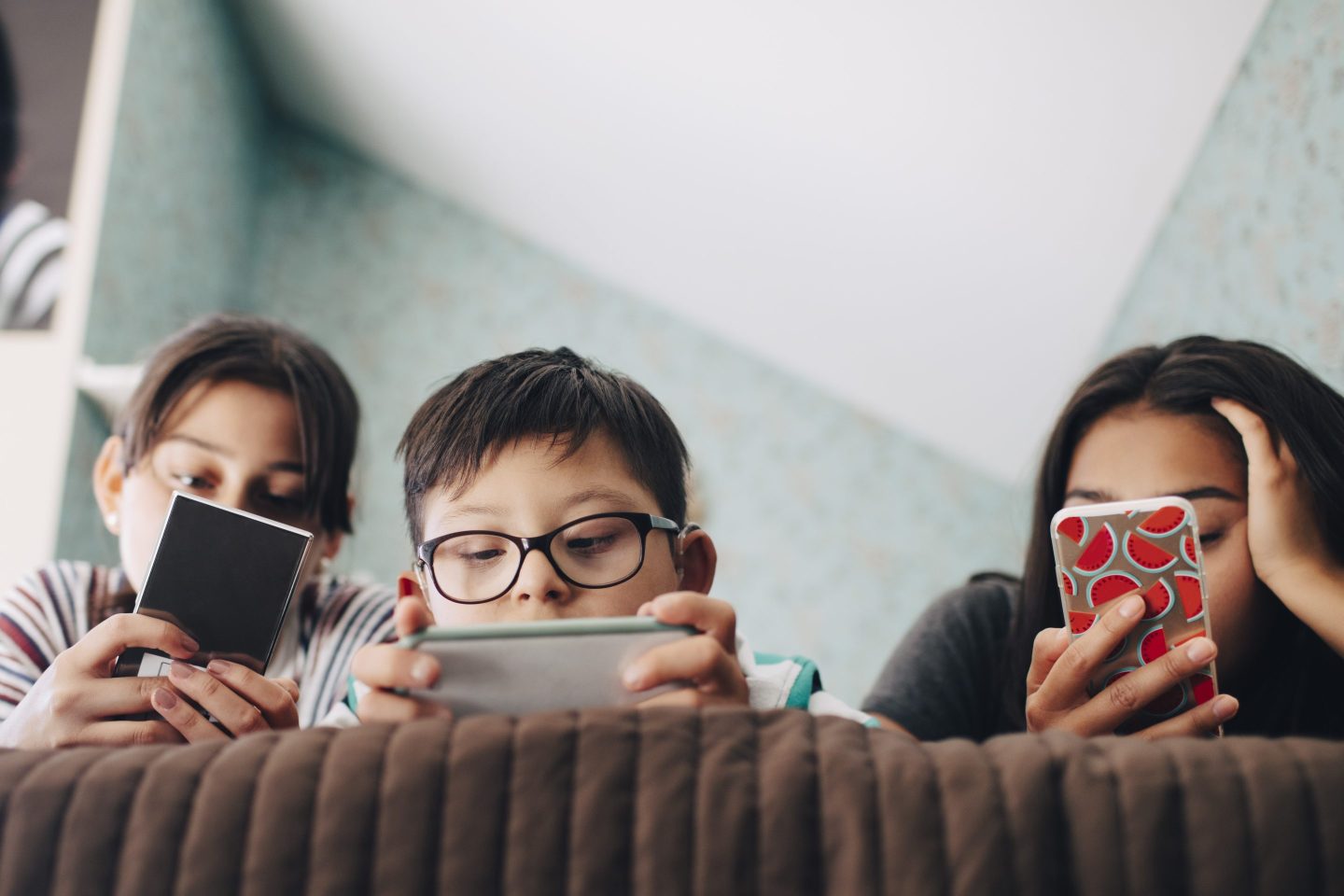
Try saying “no” when a child asks for a smartphone. What comes after, parents everywhere can attest, begins with some variation of: “Everyone has one. Why can’t I?”
But what if no pre-teen in sight has one — and what if having a smartphone was weird? That’s the endgame of an increasing number of parents across Europe who are concerned by evidence that smartphone use among young kids jeopardizes their safety and mental health — and share the conviction that there’s strength in numbers.
From Spain to Britain and Ireland, parents are flooding WhatsApp and Telegram groups with plans not just to keep smartphones out of schools, but to link arms and refuse to buy young kids the devices before — or even into — their teenage years.
After being inspired by a conversation in a Barcelona park with other moms, Elisabet García Permanyer started a chat group last fall to share information on the perils of Internet access for children with families at her kids’ school.
The group, called “Adolescence Free of Mobile Phones,” quickly expanded to other schools and then across the entire country to now include over 10,000 members. The most engaged parents have formed pairs of activists in schools across Spain and are pushing for fellow parents to agree not to get their kids smartphones until they are 16. After organizing online, they facilitate real-world talks among concerned parents to further their crusade.
“When I started this, I just hoped I would find four other families who thought like me, but it took off and kept growing, growing and growing,” García Permanyer says. “My goal was to try to join forces with other parents so we could push back the point when smartphones arrive. I said, ‘I am going to try so that my kids are not the only ones who don’t have one.’”
A push, with the help of Spain’s government
It isn’t just parents.
Police and public health experts were sounding the alarm about a spike of violent and pornographic videos being witnessed by children via handheld devices. Spain’s government took note of the momentum and banned smartphones entirely from elementary schools in January. Now they can only be turned on in high school, which starts at age 12, if a teacher deems it necessary for an educational activity.
“If we adults are addicted to smartphones, how can we give one to a 12-year-old who doesn’t have the ability to handle it?” García Permanyer asks. “This has gotten away from us. If the Internet were a safe space for children, then it would be fine. But it isn’t.”
The movement in Britain gained steam this year after the mother of 16-year-old Brianna Ghey, who was killed by two teenagers last year, began demanding that kids under 16 be blocked from accessing social media on smartphones.
“It feels like we all know (buying smartphones) is a bad decision for our kids, but that the social norm has not yet caught up,” Daisy Greenwell, a Suffolk, England-area mother of three kids under age 10, posted to her Instagram earlier this year. “What if we could switch the social norm so that in our school, our town, our country, it was an odd choice to make to give your child a smartphone at 11? What if we could hold off until they’re 14, or 16?”
She and a friend, Clare Reynolds, set up a WhatsApp group called Parents United for a Smartphone-Free Childhood, with three people on it. She posted an invitation on her Instagram page. Within four days, 2,000 people had joined the group, requiring Greenwell and Reynolds to split off dozens of groups by locality. Three weeks after the original post, there was a chat group for every British county, one of the organizers said on WhatsApp.
It’s an uphill climb
Parents rallying to ban smartphones from young children have a long way to go to change what’s considered “normal.”
By the time they’re 12, most children have smartphones, statistics from all three countries show. Look a little closer, and the numbers get starker: In Spain, a quarter of children have a cellphone by age 10, and almost half by 11. At 12, this share rises to 75%. British media regulator Ofcom said 55% of kids in the UK owned a smartphone between ages 8 and 11, with the figure rising to 97% at age 12.
Ofcom added another statistic to their report last year: One in five toddlers, ages 3 or 4, owns a smartphone.
Parents and schools that have succeeded in flipping the paradigm in their communities told The Associated Press the change became possible the moment they understood that they were not alone. What started as a tool to keep in touch with buddies has morphed into something more worrisome to keep away from kids — akin, these parents assert, to things like cigarettes and alcohol.
In Greystones, Ireland, that moment came after all eight primary school principals in town signed and posted a letter last May that discouraged parents from buying their students smartphones. Then the parents themselves voluntarily signed written pledges, promising to refrain from letting their kids have the devices.
“The discussion went away almost overnight,” says Christina Capatina, 38, a Greystones parent of two preteen daughters who signed the pledge and says there are almost no smartphones in schools this academic year. “If (kids) even ask now, you tell them: We’re just following the rules. That’s how we live.”
For Mònica Marquès of Barcelona, no signed pledge was necessary to get the same result. She polled the parents of her daughters’ grade two years ago and she was surprised to see that “99% of them were as terrified or more so than I was.”
She shared the results of her questionnaire, and says that this year, when her daughter started high school, not one student in her grade had a smartphone.
And as for that other excuse that kids supposedly need a smartphone so parents can keep tabs on them, Marquès says an old-school cell phone without Internet access like the one her daughter carries is a perfect substitute.
An increasing scrutiny
Something like a consensus has built for years among institutions, governments, parents and others that smartphone use by children is linked to bullying, suicidal ideation, anxiety and loss of concentration necessary for learning. China moved last year to limit children’s use of smartphones, while France has in place a ban on smartphones in schools for kids aged six to 15.
The push to control smartphones in Spain comes amid a surge in notorious cases of children viewing online pornography, sharing videos of sexual violence, or even participating in creating “deep fake” pornographic images of female classmates using generative artificial intelligence tools. Spain’s government says that 25% of kids 12 and under and 50% of kids 15 and under have already been exposed to online pornography. Prime Minister Pedro Sánchez said Spain is facing an “authentic epidemic” of pornography targeted at minors.
The threats include adults taking advantage of minors they meet online, such as the recent arrest of two “influencers” in Madrid for having allegedly sexually assaulted underage girls who followed them on TikTok.
The dangers have produced school bans on smartphones and online safety laws. But those don’t address what kids do in off hours.
“What I try to emphasize to other principals is the importance of joining up with the school next door to you,” says Rachel Harper, principal of St. Patrick’s National School, one of the eight in Greystones to encourage parents to refrain from smartphones for their kids. “There’s a bit more strength that way, in that all the parents in the area are talking about it.”
The parents’ concerns are diverse. Some fear the day when their young kids ask to get a phone like their friends. Others have young teens with phones and regret they followed the herd during what they consider a naïve phase when screens were just a way to let kids have fun and chat with their friends. Parents speak of having emerged from a state of blissful ignorance about the internet.
The home isolation of the COVID-19 pandemic offered a firsthand glimpse of their kids staring at screens and getting clever about hiding what they were seeing there — and what was finding them.
“The screens were seen as an escape valve that let adults work and kept kids occupied, whatever that meant,” says Macu Cristófol, who started a group of concerned parents in Malaga, in southern Spain, after she heard of the ballooning parents group in Barcelona. “That was when I thought, where are we going? We have become hostages of screens.”
Capatina says she saw her 11-year-old daughter change the day she came home from a playground and shared that a girl there had recorded video of the scene on a smartphone.
“Panic, panic, panic,” Capatina recalls of her daughter’s reaction. “Nothing really major happened,” Capatina says, “but I saw the pressure and anxiety levels increasing where they hadn’t before. And I thought, that’s not healthy. Children shouldn’t have to worry about things like that.”
But if the kids can’t have smartphones, are the parents cutting back their own online time? That’s tough, multiple parents say, because they’re managing families and work online. Capatina, an interior designer, says she shows her kids what she’s been doing online — work, for example, or schedules — “to hold myself accountable.”
Laura Borne, a Greystones mom of kids ages 5 and 6 who have never known smartphones, says she is aware of the need to model online behavior — and that she should probably cut back.
“I’m trying my best,” she says. But just as with the children she parents, the pressures are there. And they’re not going away.