• Home
  • Latest
  • Fortune 500
  • Finance
  • Tech
  • Leadership
  • Lifestyle
  • Rankings
  • Multimedia
CommentaryEconomy
Europe

America’s productivity growth is recovering to pre-Great Financial Crisis rates. Europe has more work to do

By
Chris Bradley
Chris Bradley
,
Olivia White
Olivia White
, and
Jan Mischke
Jan Mischke
Down Arrow Button Icon
By
Chris Bradley
Chris Bradley
,
Olivia White
Olivia White
, and
Jan Mischke
Jan Mischke
Down Arrow Button Icon
May 22, 2024, 7:13 AM ET
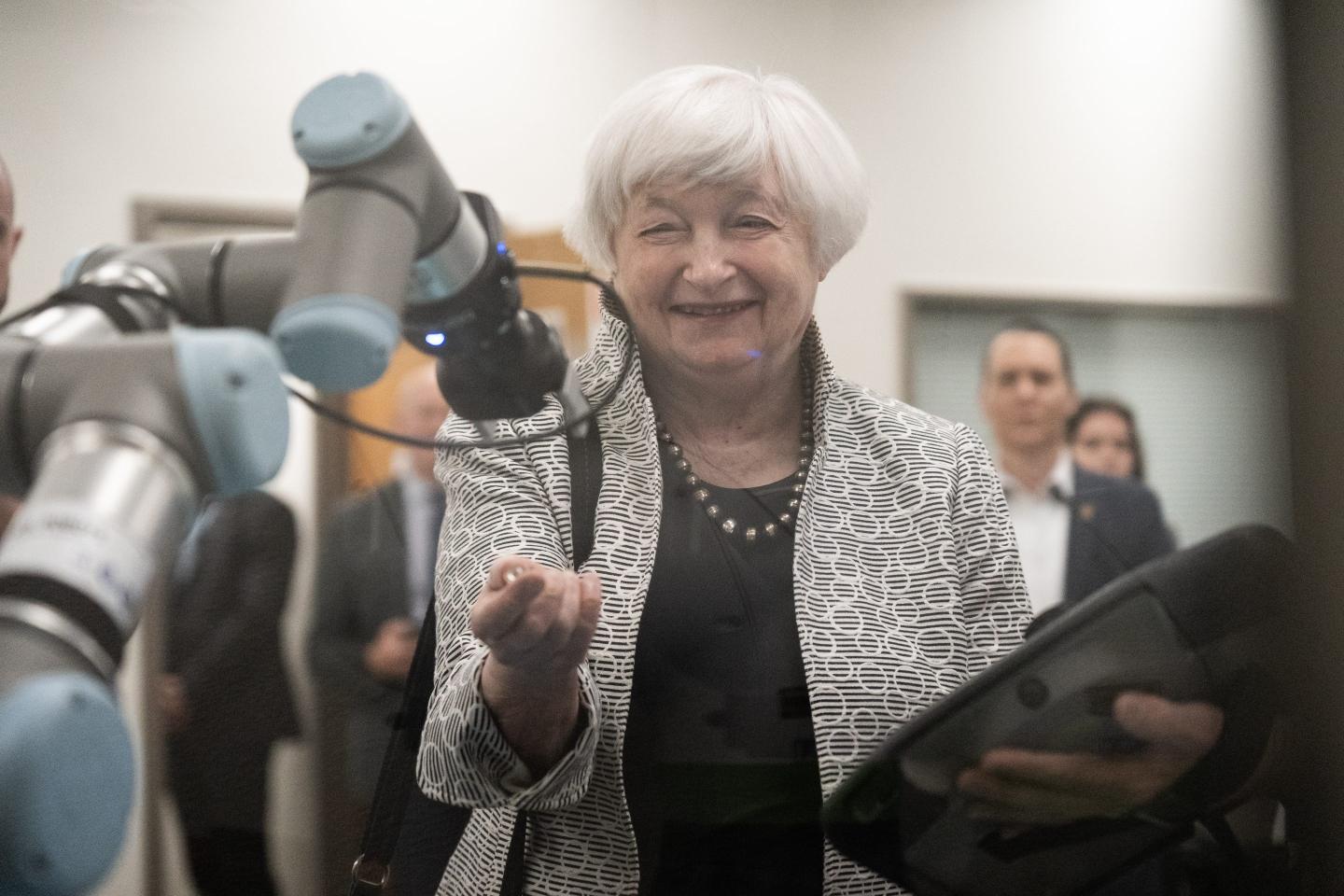
U.S. Treasury Secretary Janet Yellen interacts with a robotic arm during a tour of the Mesa Community College automation and engineering labs in Mesa, Arizona on May 4.
U.S. Treasury Secretary Janet Yellen interacts with a robotic arm during a tour of the Mesa Community College automation and engineering labs in Mesa, Arizona on May 4.Go Nakamura - Bloomberg - Getty Images

Labor productivity growth in the United States, Canada, and advanced economies in Western Europe and Asia, has been dismal for almost a generation, hovering around 1% a year. Is this lackluster performance all we can expect for the next generation?

It doesn’t have to be. In fact, to deal with rising inflation, wobbly balance sheets, aging populations, and the net-zero transition, it is urgent to do better. Recent research by the McKinsey Global Institute (MGI) argues that by doing two things—boosting investment and accelerating a broader digital transition—current drags on productivity growth can be removed.

What happened

Productivity in advanced economies had been deteriorating gradually before the 2008 global financial crisis (GFC), falling from an average of 2.2% a year in 1997-2002 to 1.6%  in 2002-2007.

The GFC was an inflection point: Productivity growth fell abruptly to about 1%—where it has been stuck ever since. Among the many reasons for this, two explain almost all of the decline: a secular decline in investment and the end of two manufacturing-related productivity waves.

In terms of investment, a series of crises—the dot-com crash in 2001, the GFC in 2008, and the pandemic in 2020, depressed growth in the ratio of capital invested per worker. From 1997 to 2019, capital investment in tangibles like machines and buildings fell from 22 to 14% of gross value added in the United States and from 25 to 17% in Europe. Investment in intangibles, such as software, grew over that period, but not nearly enough to make up the difference. Additionally, after the GFC, net investment—that is, after accounting for the degradation of capital stock—as a share of GDP fell by half in both the U.S. and Western Europe and has never fully recovered.

In terms of manufacturing, in the 1990s and early 2000s, Moore’s law (the doubling of the number of transistors in a microchip every two years) sharply accelerated productivity growth in electronics and computers. However, that effect ebbed as features like battery life became more important. The second productivity wave came with the rise of China and other emerging economies, in the form of restructuring and offshoring lifting productivity in advanced economies. By the mid to late-2000s, both waves had receded.

The good news is that investment does not have to stay depressed and that digital technologies and artificial intelligence could boost productivity the same way the two manufacturing waves did.

Investment

The U.S. and Europe capital investment gap, compared to the years before the GFC, amounts to 2 to 3% of GDP—approximately $1 trillion a year. MGI estimates that returning to that level could add 0.7 percentage points to productivity growth. Of course, many barriers, such as regulation and skills gaps, can stand in the way of greater investment. But when there is robust demand and tight labor markets—signals that present a clear case for capacity expansion and productivity-enhancing automation—business will respond.

In the U.S., this may help explain why business investment is pointing up, if only slightly—about 0.3 percentage points higher than in the pre-pandemic decade. Indeed, U.S. productivity growth has spiked of late—rising near or above 3% on an annualized basis for three consecutive quarters before moving closer to long-run averages in Q1 2024.

Western Europe has more work to do: The war on Ukraine and subsequent energy shock have reduced consumer purchasing power and competitiveness while adding uncertainty. Fiscal policy has been less generous in stimulating the economy than in the U.S. The region will have to restore competitiveness and create a stronger macro-environment to unleash investment.

Digital and AI

Productivity growth related to digital technology and artificial intelligence (AI) has been anticipated for a long time—and it’s far from over.

The information and communication technology (ICT) sector, which drives digital transformation, has contributed almost half a percentage point to productivity growth over the past two decades in the U.S. However, other sectors have found it difficult to convert their digital investment into measurable productivity advances. AI might be the answer. MGI research estimates that greater deployment of digital and AI capabilities could add 0.5 to 1.0 percentage points to annual productivity growth in advanced economies. Generative artificial intelligence could add another 0.5 percent.

In the U.S., the investments needed to make that possible could be underway. The so-called magnificent seven alone have invested $200 billion in research and development, according to McKinsey analysis based on S&P Global, in 2023 (about half the figure of all such R&D investment, public and private, in the European Union), plus a similar amount in capital expenditure.

Again, Europe clearly has more work to do. One issue is that tech ecosystems in Europe are still nascent. More could be done to nurture them, such as public innovation procurement in areas from health care to defense. Another is that fragmentation stands in the way of firms reaching the critical scale to undertake bold technology and digital investments. Cross-border consolidation and the introduction of common European business rules could help. And restructuring of pension funds could re-allocate more funds to venture capital.

While the price of productivity stagnation is invisible, it is high. By investing to regain pre-GFC productivity growth, advanced economies stand to gain between $1,500 and $8,000 in incremental GDP per capita by 2030. By stepping up the pace of investment and technological innovation, it is possible to leave the era of stagnation behind. It is time to step up.

Chris Bradley and Olivia White are senior partners in McKinsey & Company’s Sydney and San Francisco offices and directors of the McKinsey Global Institute. Jan Mischke is a McKinsey Global Institute partner in Zurich.

More must-read commentary published by Fortune:

  • Fannie Mae CEO: Beyoncé is right. Climate change has already hit the housing market—and homeowners aren’t prepared
  • Trade and investment data in the last two years dispel the deglobalization and decoupling myths as U.S.-China competition ignites ‘reglobalization’
  • Ex-Lululemon CEO: Gen Zers want sustainably made and compostable products. Firms taking heed today will be market leaders tomorrow
  • Congress could soon spell the end of employment arbitration—but it’s not all good news for American workers

The opinions expressed in Fortune.com commentary pieces are solely the views of their authors and do not necessarily reflect the opinions and beliefs of Fortune.

Join us at the Fortune Workplace Innovation Summit May 19–20, 2026, in Atlanta. The next era of workplace innovation is here—and the old playbook is being rewritten. At this exclusive, high-energy event, the world’s most innovative leaders will convene to explore how AI, humanity, and strategy converge to redefine, again, the future of work. Register now.
About the Authors
By Chris Bradley
See full bioRight Arrow Button Icon
By Olivia White
See full bioRight Arrow Button Icon
By Jan Mischke
See full bioRight Arrow Button Icon

Latest in Commentary

Finance
Lorem ipsum dolor sit amet, consectetur adipiscing elit, sed do eiusmod tempor incididunt ut labore et dolore magna aliqua. Ut enim ad minim veniam
By Fortune Editors
October 20, 2025
Finance
Lorem ipsum dolor sit amet, consectetur adipiscing elit, sed do eiusmod tempor incididunt ut labore et dolore magna aliqua. Ut enim ad minim veniam
By Fortune Editors
October 20, 2025
Finance
Lorem ipsum dolor sit amet, consectetur adipiscing elit, sed do eiusmod tempor incididunt ut labore et dolore magna aliqua. Ut enim ad minim veniam
By Fortune Editors
October 20, 2025
Finance
Lorem ipsum dolor sit amet, consectetur adipiscing elit, sed do eiusmod tempor incididunt ut labore et dolore magna aliqua. Ut enim ad minim veniam
By Fortune Editors
October 20, 2025
Finance
Lorem ipsum dolor sit amet, consectetur adipiscing elit, sed do eiusmod tempor incididunt ut labore et dolore magna aliqua. Ut enim ad minim veniam
By Fortune Editors
October 20, 2025
Finance
Lorem ipsum dolor sit amet, consectetur adipiscing elit, sed do eiusmod tempor incididunt ut labore et dolore magna aliqua. Ut enim ad minim veniam
By Fortune Editors
October 20, 2025

Most Popular

Finance
Lorem ipsum dolor sit amet, consectetur adipiscing elit, sed do eiusmod tempor incididunt ut labore et dolore magna aliqua. Ut enim ad minim veniam
By Fortune Editors
October 20, 2025
Finance
Lorem ipsum dolor sit amet, consectetur adipiscing elit, sed do eiusmod tempor incididunt ut labore et dolore magna aliqua. Ut enim ad minim veniam
By Fortune Editors
October 20, 2025
Finance
Lorem ipsum dolor sit amet, consectetur adipiscing elit, sed do eiusmod tempor incididunt ut labore et dolore magna aliqua. Ut enim ad minim veniam
By Fortune Editors
October 20, 2025
Finance
Lorem ipsum dolor sit amet, consectetur adipiscing elit, sed do eiusmod tempor incididunt ut labore et dolore magna aliqua. Ut enim ad minim veniam
By Fortune Editors
October 20, 2025
Finance
Lorem ipsum dolor sit amet, consectetur adipiscing elit, sed do eiusmod tempor incididunt ut labore et dolore magna aliqua. Ut enim ad minim veniam
By Fortune Editors
October 20, 2025
Finance
Lorem ipsum dolor sit amet, consectetur adipiscing elit, sed do eiusmod tempor incididunt ut labore et dolore magna aliqua. Ut enim ad minim veniam
By Fortune Editors
October 20, 2025
Fortune Secondary Logo
Rankings
  • 100 Best Companies
  • Fortune 500
  • Global 500
  • Fortune 500 Europe
  • Most Powerful Women
  • World's Most Admired Companies
  • See All Rankings
  • Lists Calendar
Sections
  • Finance
  • Fortune Crypto
  • Features
  • Leadership
  • Health
  • Commentary
  • Success
  • Retail
  • Mpw
  • Tech
  • Lifestyle
  • CEO Initiative
  • Asia
  • Politics
  • Conferences
  • Europe
  • Newsletters
  • Personal Finance
  • Environment
  • Magazine
  • Education
Customer Support
  • Frequently Asked Questions
  • Customer Service Portal
  • Privacy Policy
  • Terms Of Use
  • Single Issues For Purchase
  • International Print
Commercial Services
  • Advertising
  • Fortune Brand Studio
  • Fortune Analytics
  • Fortune Conferences
  • Business Development
  • Group Subscriptions
About Us
  • About Us
  • Lists Calendar
  • Press Center
  • Work At Fortune
  • Terms And Conditions
  • Site Map
  • About Us
  • Lists Calendar
  • Press Center
  • Work At Fortune
  • Terms And Conditions
  • Site Map
  • Facebook icon
  • Twitter icon
  • LinkedIn icon
  • Instagram icon
  • Pinterest icon

© 2026 Fortune Media IP Limited. All Rights Reserved. Use of this site constitutes acceptance of our Terms of Use and Privacy Policy | CA Notice at Collection and Privacy Notice | Do Not Sell/Share My Personal Information
FORTUNE is a trademark of Fortune Media IP Limited, registered in the U.S. and other countries. FORTUNE may receive compensation for some links to products and services on this website. Offers may be subject to change without notice.


Latest in Commentary

quesada
Commentaryfertilizer
Former president of Costa Rica on de-risking fertilizer shocks: how $700 billion in subsidies can do more
By Carlos Alvarado QuesadaApril 27, 2026
35 minutes ago
Woman tired while looking at computer
CommentaryProductivity
AI is frying our brains — here’s what leaders need to do about It
By David Rock and Chris WellerApril 26, 2026
1 day ago
250
Commentary250 Years of Innovation
The Declaration of Independence was America’s first founding bet. Business leaders must build on it
By Keith KrachApril 26, 2026
1 day ago
cook
Commentarychief executive officer (CEO)
Tim Cook built Apple into a $4 trillion company. Then his greatest strength became his biggest liability
By Andrea PetroneApril 25, 2026
2 days ago
mark
CommentaryJobs
I lost my job to AI. Here’s why mass layoffs won’t transform your company
By Mark QuinnApril 25, 2026
2 days ago
Asia is turning to coal in the Iran crisis, but nuclear power will be the real endgame
CommentaryNuclear Energy
Asia is turning to coal in the Iran crisis, but nuclear power will be the real endgame
By Julius Cesar TrajanoApril 24, 2026
3 days ago

Most Popular

Elon Musk says saving for retirement is irrelevant because AI is going to create a world of abundance: 'It won't matter'
Future of Work
Elon Musk says saving for retirement is irrelevant because AI is going to create a world of abundance: 'It won't matter'
By Marco Quiroz-GutierrezApril 26, 2026
1 day ago
The U.S. military may have already used up half of its most expensive missiles, and it could take up to 4 years to rebuild its stockpiles
Politics
The U.S. military may have already used up half of its most expensive missiles, and it could take up to 4 years to rebuild its stockpiles
By Sasha RogelbergApril 24, 2026
3 days ago
Baby boomers have now 'gobbled up' nearly one-third of America's wealth share, and they're leaving Gen Z and millennials behind
Investing
Baby boomers have now 'gobbled up' nearly one-third of America's wealth share, and they're leaving Gen Z and millennials behind
By Sasha RogelbergApril 26, 2026
1 day ago
More than 90,000 tech workers have been laid off this year. But here’s why companies like Microsoft are offering voluntary buyouts instead
Big Tech
More than 90,000 tech workers have been laid off this year. But here’s why companies like Microsoft are offering voluntary buyouts instead
By Jacqueline MunisApril 26, 2026
1 day ago
'You feel radicalized': A Meta AI exec watched agents beat her top workers. Now she's built a nonprofit to help Gen Z find jobs before they disappear
Future of Work
'You feel radicalized': A Meta AI exec watched agents beat her top workers. Now she's built a nonprofit to help Gen Z find jobs before they disappear
By Jake AngeloApril 26, 2026
2 days ago
This CEO lived on canned soup and took just two days off for his daughter’s birth. Now he admits he lost sight of proper work-life balance
Success
This CEO lived on canned soup and took just two days off for his daughter’s birth. Now he admits he lost sight of proper work-life balance
By Preston ForeApril 25, 2026
3 days ago