Ryanair is riding high. Europe’s largest low-cost airline reported a 34% increase in profit after tax to €1.92 billion ($2.09 billion) for the 12 months to Mar. 31. Full-year revenues rose 25% to €13.44 billion ($14.65 billion).
Although shares in the Dublin-headquartered company were down in morning trading, Ryanair’s stock has nonetheless dramatically outperformed its two main European competitors, Britain’s EasyJet and Hungary’s Wizz Air, when viewed over the long haul.
Since February 2020, just before the pandemic grounded airplanes across the continent, Ryanair shares have risen approximately 14%, while Wizz Air’s fell nearly 55% and EasyJet’s dropped nearly 72%.
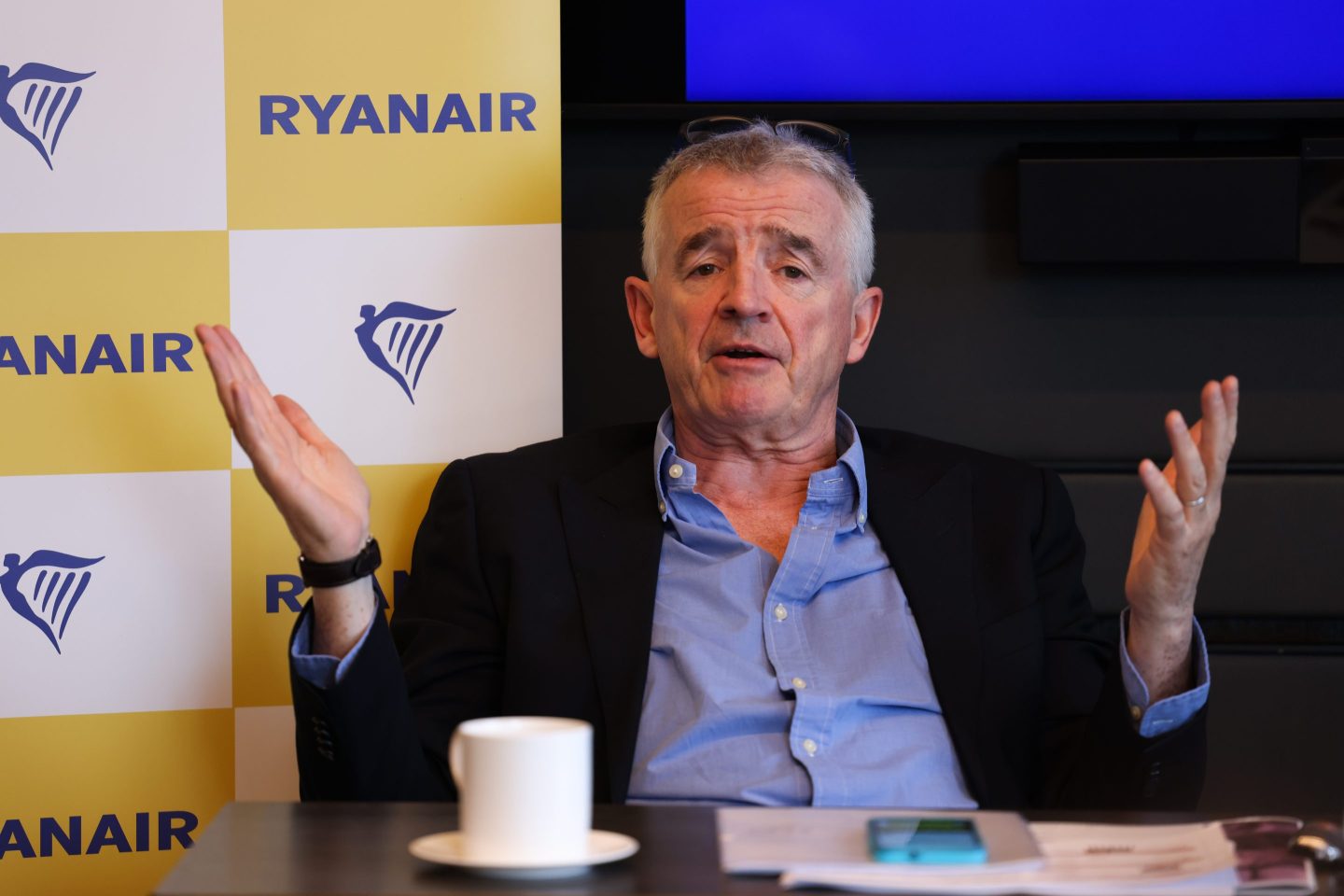
CEO Michael O’Leary is clearly doing something right. To help explain what that is, let’s look at what Ryanair has done differently from the larger of its competitors, EasyJet.
Low costs and no layoffs
Both companies entered the pandemic in good financial health: profitable, growing and—particularly in the case of Ryanair—armed with a strong balance sheet. However, COVID-19 spared no one.
In the year to September 2020, EasyJet went into the red for the first time, with a loss of £1.27 billion ($1.6 billion), briefly costing the Luton, England–based company its spot on the FTSE 100 index. Ryanair, in the year to March 2021, saw a profit of €1 billion ($1.09 billion) collapse to a loss of €815 million ($888 million).
However, Ryanair had two major advantages during the recovery phase, as travel restrictions were lifted in 2021 and into 2022.
The first and probably most important is that Michael O’Leary, who has run Ryanair since 1994, is a master at tightening corporate purse strings.
“Where Ryanair always seems to have an edge is cost management—it has a fierce reputation for keeping a lid on costs, such as having more efficient planes to lower fuel consumption and being quick at disembarking customers and then loading up for the next flight and back in the sky,” Dan Coatsworth, investment analyst at AJ Bell, told Fortune.
To get a sense of what this looks like in the accounts, Ryanair’s 2024 pretax profit of €2.13 billion ($2.32 billion) was nearly 16% of total revenue. In EasyJet’s last full-year results, ending Sept. 30, 2023, pretax profit was £455 million ($577.9 million), which was around 5% of its annual revenue of £8.17 billion ($10.4 billion).
This higher profitability gave Ryanair the room and the confidence to assume a higher level of debt during the pandemic—hitting €2.28 billion ($2.49 billion) in 2021 compared with easyJet’s £910 million ($1.16 billion)—in the knowledge it could pay it off, which both companies now have done.
That in turn contributed to the second advantage behind Ryanair’s recent success: O’Leary’s decision not to lay off staff during the dark months of lockdowns, unlike EasyJet’s outgoing CEO Johan Lundgren, who made the no doubt difficult decision to make 30% of its workers redundant in 2020.
O’Leary himself pointed to the way this paid off, by allowing Ryanair to rapidly ramp up flights once travel started to rebound, while others struggled to fill vacancies.
“Our decision to work with our unions and agree pay cuts to minimize job losses and keep crews current throughout the two years of COVID was vindicated in recent months, as many European airlines, airports, and handling companies struggled to restore jobs that were cut during the pandemic,” O’Leary said in July 2022, as reported in Travel Weekly.
Combined, Ryanair’s lower costs and staff retention enabled it to recover faster than EasyJet, which in turn has enabled it to grow its fleet much more quickly since, further compounding its lead.
The Irish company now has 584 aircraft, many of them fuel efficient Boeing 737 “Gamechangers,” substantially above the 475 in its fleet in 2019. By comparison, EasyJet had a fleet of 343 by the end of March, only marginally above the 331 craft it had in 2019.
Finally, with better growth prospects and profitability, Ryanair was able to avoid the rights issuances that EasyJet was forced to make in quick succession—a £419 million ($532 million) share placing in 2020 and a £1.2 billion ($1.52 billion) rights issue in 2021—that Coatsworth said hit the latter’s share price. “Significantly increasing the number of shares in issue dilutes existing investors and weighed on the share price as both fundraisings were done at a market discount,” he explained.
What is EasyJet doing to catch up?
Despite EasyJet’s torrid few years on the stock markets, Lundgren is leaving the business in a position to compete. By the year to September 2023, he had pulled EasyJet out of net debt territory with net cash of £41 million ($52.1 million). The low-cost airline also trimmed its off-season losses, during the half year to March 30, 2024, compared to the same period a year ago, pointing to its financial recovery.
With this in mind, the easyJet chief has set a lofty target of £7–£10 profit ($8.9–$10.27) per seat by 2028—double 2019 levels.
Strategically, while actively growing the “ancillary” revenue—separate charges for extras like seat selection and baggage allowances—that O’Leary made Ryanair famous for, Lundgren has simultaneously differentiated EasyJet by expanding its package holiday segment. In the last full financial year, the company recorded 77% customer growth in package holiday bookings, which generated more than a quarter of the group’s pretax profits.
While EasyJet’s model is different from Ryanair’s, relying less on being the cheapest ticket in town, and more on having premium airports closer to city centers and offering more favorable flight schedules, it remains competitive with the Irish company.
Whether Lundgren’s replacement will be able to take that further and close the gap is another question.