In the latest round of their decades-long battle for dominance in commercial aircraft, Europe’s Airbus established a clear sales lead over Boeing even before the American company encountered more fallout from manufacturing problems and ongoing safety concerns.
Airbus has outpaced Boeing for five straight years in plane orders and deliveries, and just reported a 28% quarterly increase in net profit. It was already winning market share by beating Boeing to develop a line of fuel-efficient, mid-sized aircraft that are cheaper for airlines to fly.
And now Boeing is facing a government-mandated production cap on its best-selling plane.
Yet the European company is unlikely to extend its advantage in the Airbus-Boeing duopoly much further despite having customers clamoring for more commercial aircraft, according to aviation analysts. The reason: Airbus already is making planes as fast as it can and has a backlog of more than 8,600 orders to fill.
Its ability to leverage Boeing’s troubles therefore is “very limited,” according to Jonathan Berger, managing director at Alton Aviation Consultancy. Between strained supply chains and the long lead times for a hugely complex and highly regulated product, a jetliner ordered from Airbus today may not arrive until the end of the decade.
Boeing also has a huge order backlog for more than 5,660 commercial planes. The mismatch between the post-COVID demand for flights and the aircraft supply pipeline is bad news for travelers as well as airlines.
“This has been an incredibly strong market recovery, and people need more jets than they’re getting,” said Richard Aboulafia, a managing director at AeroDynamic Advisory. “And until they get those jets, you don’t have enough capacity. Guess what goes up? Ticket prices.”
At the beginning of the year, Boeing seemed finally to be recovering from two crashes of Max jets in 2018 and 2019 that killed 346 people in Indonesia and Ethiopia. Then, on Jan. 5, a door plug blew out of an Alaska Airlines 737 Max 9, and the company has been reeling ever since.
Boeing has since slowed manufacturing at the order of the U.S. Federal Aviation Administration. It lost $355 million in the first quarter because of a decline in aircraft deliveries and compensation it paid to airlines for a temporary grounding of Max 9s. The Max was Boeing’s answer to Airbus’ A320 family of planes.
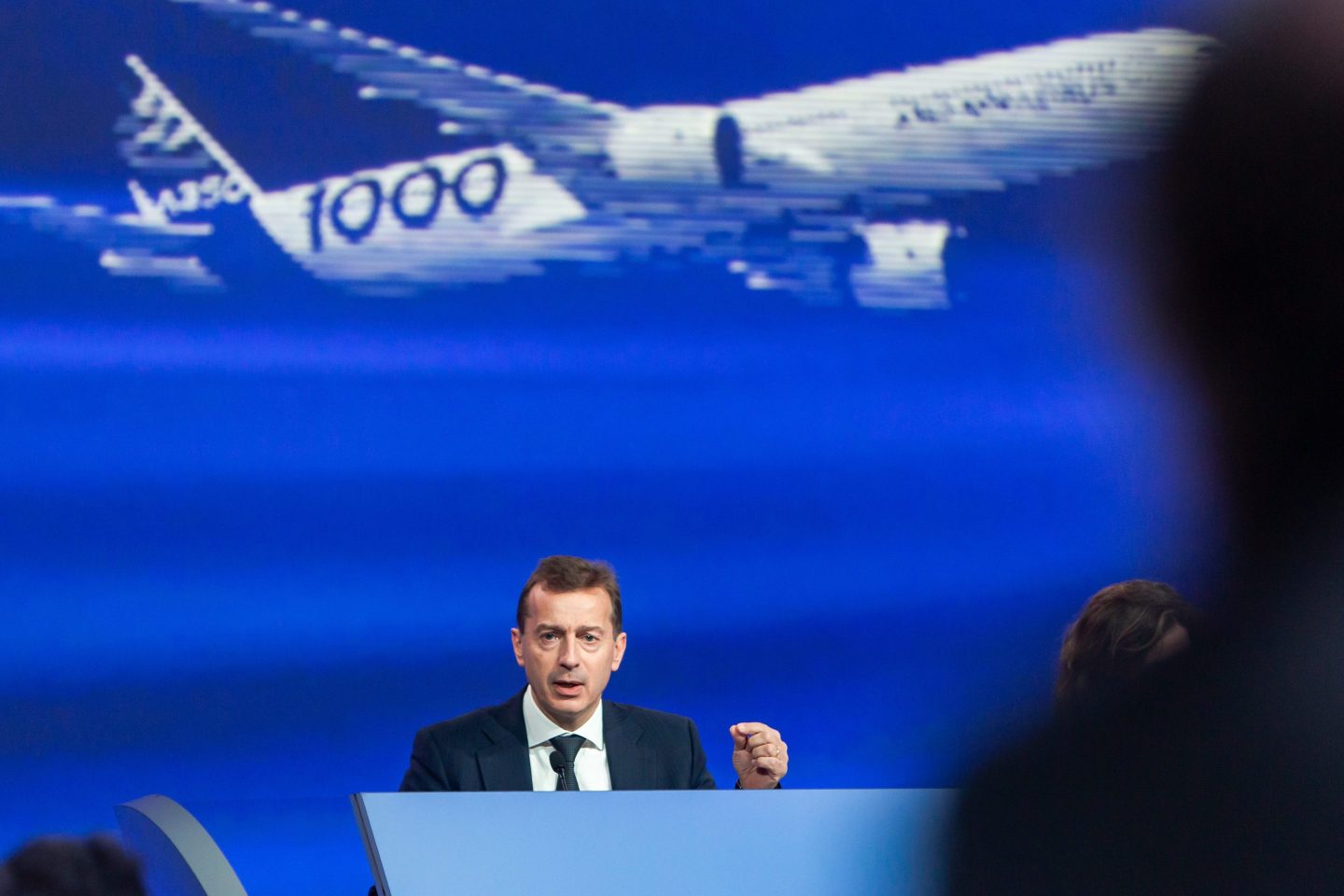
Airbus, which is registered in the Netherlands but has its main headquarters in France, is taking a conspicuously cautious and even modest stance toward its recent success and its rival’s woes. CEO Guillaume Faury has said he’s “not happy” about Boeing’s troubles and they’re not good for the industry as a whole.
In an April 25 call with journalists, Faury was reserved about how much the company could speed up production, even with 8.7 billion euros in cash on hand. Airbus was managing “a diversity of challenges” in getting the parts it needs, he said, and must “make sure that we ramp up at a pace that is compatible with the weakest suppliers.”
Faury stressed that any moves to expand production would be done with an eye to “our core pillars of safety, quality, integrity, compliance and security.”
Airbus and Boeing have manufacturing constraints in part because the two companies are not so much aircraft makers as “aircraft assemblers” that rely on thousands of parts made by other companies, from the fuselage and engines to electronics and interiors, Alton Aviation’s Berger noted. Since “the supply chains are going as fast as they can,” Airbus is not in a position to swoop in and take Boeing’s customers.
The European company scored a symbolic win, however, when United Airlines lined up leases for 35 Airbus jets because of delays that Boeing faces in getting its new, larger Max 10 approved by U.S. regulators.
Given that, “Airbus is playing it well. They’re being very, very humble. It’s smart because they can’t exploit it,” Berger said.
Airbus last year topped Boeing for the fifth straight year in the orders race, with 2,094 net orders and 735 delivered planes. Boeing had 1,314 net orders and delivered 528 aircraft.
Airbus currently leads Boeing in sales of large single-aisle planes 80%-20%, according to figures from Alton Aviation Consultancy. The matchup between the smaller Airbus A320 and Boeing’s 737 Max 7 and Max 8 is more even; Airbus is ahead on delivered planes but Boeing is ahead 54%-46% when the European company’s order backlog is counted.
Airbus’ success is not just due to Boeing’s missteps. The company is benefiting from its decision to launch the A321neo, a single-aisle aircraft with 180 to 230 seats. “Neo” stands for new engine option, meaning highly fuel efficient engines that save airlines money on one of their biggest costs. Boeing rushed to match with the Max, a 737 equipped with new, more efficient engines, only to run into trouble with the crashes and door plug.
Airbus also benefited from a deal to take over the smaller A220 developed by Canada’s Bombardier. Boeing is without a competing product in that niche. Analysts say Airbus has a further edge with the forthcoming A321XLR, a model that will allow airlines to use cheaper narrow-body jets on long-haul flights.
Yet the company already has pushed its deadline to produce 75 A320 and A321 jets per month from 2025 to 2026, and it moved the promised delivery date for the A321XLR from the second quarter of 2024 to the third.
“Boeing is winning some orders because Airbus can’t supply the airplanes,” Scott Hamilton, managing director of the Leeham Company consultancy, said. “So Airbus really can’t gain much more in the way of market share because they are sold out.”
The current pace of production at the two companies means older, less fuel-efficient planes are going to have to fly longer before being retired so airlines won’t be able to reduce fuel costs. And older planes require more maintenance to keep flying, which costs money but doesn’t affect safety if the maintenance is done right. For travelers, it means discounted tickets will be harder to come by.
Could another entrant shake up the duopoly, as Tesla did for autos? Not for years to come, analysts said.
Brazil’s Embraer makes smaller regional jets, and so far has not moved to compete with Boeing and Airbus. China’s COMAC has taken more than 1,000 orders for its narrow-body C919 plane but is “at least a decade or two” away from presenting a strong competitor, according to Berger.
That means a two-company race remains the game for now – even if one of them is under-performing.
“The airlines need at least two,” Berger said. “They don’t want to put themselves in a monopolistic situation. So everybody’s cheering for Boeing to get their act together.”