Cocoa’s journey from bean to bar winds through a rebagging plant like this one in San Pedro, Ivory Coast, where about 20 trailer trucks arrive every day brimming with tons of stock for international markets.
Workers wearing masks against the dust unload sacks weighing as much as 65 kilograms (143 pounds) and tear them open, prepping the contents for drying, sorting and cleaning. Others sweep loose beans on the floor into piles for collection.
Everywhere you look and walk there are cocoa beans. Millions and millions are delivered to similar facilities in West Africa and then shipped to warehouses in Amsterdam; Hamburg; and Antwerp, Belgium, for the world’s top chocolatiers.
Yet a massive change is afoot that threatens to upend this supply chain and jolt prices for sweets, skin-care products and herbal medicines. Starting Dec. 30, the European Union will require companies such as Cargill Inc., Ferrero Group, Nestle SA and Mars Inc. to prove that every bean they import to the continent didn’t contribute to deforestation somewhere else.
That means tracing cocoa from pod to port, a costly mandate for an industry already staggered by declining production and record prices for futures. But no proof means no sale — a significant penalty given the 27-member EU is the biggest buyer from Ivory Coast and Ghana.
“There is a gun to our head to set up systems and get ready,” said Paul Davis, president of the European Cocoa Association industry group. “We expect disruption for about one to two years, and that could mean higher pricing in Europe.”
Every shipment — in bags or in bulk — will have to list the GPS coordinates of the farms where the cocoa was grown, and that information needs to be uploaded into an EU database. Cargill, Ferrero and Nestle said they’re building up their geolocation networks in Ivory Coast, which supplies 44% of the world’s cocoa.
None of the companies contacted would say how much they’re spending on their efforts, and they wouldn’t discuss whether consumers ultimately will foot those costs in the form of more expensive chocolate. It’s also unclear if the burden will fall on farmers, who already are among the world’s poorest.
During a Feb. 22 earnings call, Nestle Chief Executive Officer Mark Schneider said he is “very confident” the company will have a deforestation-free supply chain by the deadline.
Yet even while working to meet the mandate, some are pushing the bloc to delay implementation, according to Peter Feld, CEO of Barry Callebaut AG.
“The EU regulation came in place and actually didn’t talk to any of the players in the industry,” Feld said during a Nov. 1 earnings call. “The players are all engaging with the EU Commission to lobby for a transition period.”
The EU Deforestation Regulation, or EUDR, also covers palm oil, coffee, soy, timber and cattle — notorious drivers of clear-cutting. The law, reaching from the Amazon to Africa to Asia, applies to raw materials as well as products such as leather and furniture.
Without it, about 248,000 hectares (613,000 acres) of forest would be lost every year by 2030, the bloc estimated.
Beans deemed non-compliant by companies likely will be sold in the US or Asia — decidedly smaller, less-lucrative markets for West African producers. If the EU learns that a shipment broke the law, the penalties include fines, confiscation or a temporary ban on trading in the bloc.
That’s created a pressing problem for the industry. Cocoa beans take about 12-18 months from the time of harvest to arrive in Europe, so the current crop has to comply with the regulation because it will land after Dec. 30.
Anxiety about the law enveloped the World Cocoa Foundation conference this month in Amsterdam, where a session on “The Known Unknowns of the EUDR” overflowed with regulators and industry executives.
Attendees peppered commission policy officer Zoe Druilhe for details on implementation but didn’t get all the answers they wanted.
Druilhe couldn’t specify when the EUDR website will go live or what reference map authorities will use to double-check the companies’ submissions.
“There is a high level of uneasiness among traders because the regulation will make it difficult for beans to enter the EU market,” said Fuad Mohammed Abubakar, head of Ghana Cocoa Marketing Company (UK) Ltd. “That will only push prices higher.”
London futures cost about $800 a ton more than those in New York, according to Bloomberg calculations based on most-active contracts.
Cocoa is responsible for 7.5% of the EU’s contribution to global deforestation, according to BloombergNEF. Some companies already track beans through voluntary sustainability programs, but the new law requires a deeper level of surveillance that starts with mapping the oft-fuzzy boundaries of remote, individual plots.
In Ivory Coast, the biggest cocoa grower, the due-diligence mandate will be a tall order. About 30% of the country’s planted area is within protected forests, despite laws against that, a 2022 research paper found.
The expansion of cocoa farms was linked to the loss of more than 360,000 hectares (890,000 acres) of forest from 2000 to 2020, according to the study. That’s twice the size of London.
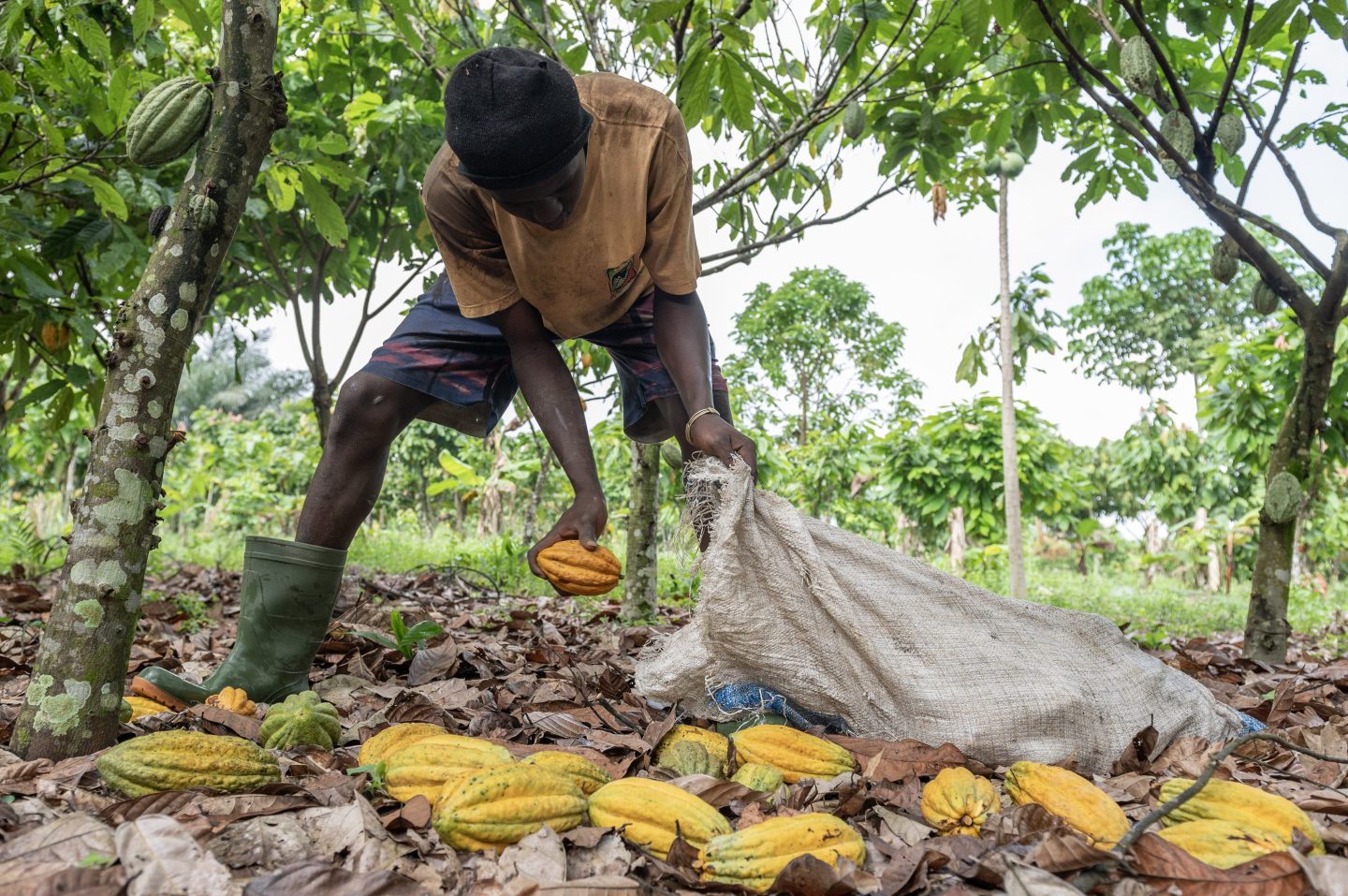
Visits by Bloomberg News to way stations across southwest Ivory Coast in late 2023 revealed the kinks that may interrupt EUDR’s implementation. Europe is trying to tame a supply chain that’s fractured, low-tech, disorderly and rife for abuse by thousands of small farmers and surreptitious middlemen.
Cocoa presently changes hands at least six times during its trek to the bloc, and it’s blended with other batches at every step. A bulk carrier could hold beans from more than 80,000 farms — and not all of them are known to the traders.
“The EU has gotten itself into a deep mire of complexities they don’t understand,” said Marc Donaldson, a cocoa sustainability consultant. “Tracking a bag of beans back to a farmer is mind-blowing.”
The first mixing comes immediately after harvest at a community buying center, where about 20-30 farmers drop off their product. These small centers dot Ivory Coast’s cocoa belt.
There, beans are shoveled into jute bags and trucked to a regional cooperative that receives deliveries from other community centers, as well. Product from as many as 2,000 farms may pass through here.
At the Casib Coop-CA in Gabiadji, bags from separate sources are opened and the contents poured onto a massive tarp outside for drying. Workers shuffle through that mottled brown carpet with bare feet — like kicking sand on the beach — to expose the harvest to some sun.
From here, the beans go to a facility such as the one owned by the Societe Ivoirienne de Transformation des Produits Agricoles about 5 miles from San Pedro’s port.
Multiple conveyor belts carry beans from multiple co-ops for cleaning, grading and yet more bagging together. Then, they’re taken to the docks and shipped abroad.
Complicating traceability efforts is the existence of a parallel, clandestine network that the Trase consultancy estimates may supply as much as 60% of Ivory Coast’s beans.
Local intermediaries, called pisteurs, drive pickup trucks to remote fields, pay farmers in cash for their harvest and bring the cargo straight to warehouses, bypassing previous checkpoints altogether.
Major traders need that so-called “indirect” supply to meet customer orders — and knowing which beans in the flatbed came from which farmer isn’t a priority.
“The cocoa that everyone claims being from protected areas is going somewhere, and someone’s buying it,” said Alex Assanvo, executive secretary of the Cote d’Ivoire-Ghana Cocoa Initiative created by the two nations. He believes government-run systems would ensure the data is standardized and all farmers are counted.
“Companies rarely disclose how much of their volumes comes from indirect sources,” said Valentin Guye, a researcher at Belgium’s UCLouvain university who studies cocoa supply chains.
Some avoid it. Ferrero doesn’t buy indirectly sourced cocoa, and it’s requiring suppliers to provide more details on where their beans originate, said Floriane Hédé, a traceability manager.
Cargill, the largest agricultural trader, works with about 400,000 cocoa farmers globally, Marijn Moesbergen, the cocoa sourcing lead, said in Amsterdam. The company is mapping plots in Ivory Coast, giving farmers unique QR codes to scan at community centers and tagging each bag.
“The risk is too high for anyone in the supply chain buying cocoa they can’t trace,” said Jack Steijn, co-founder of sustainable commodities consultancy Equipoise.