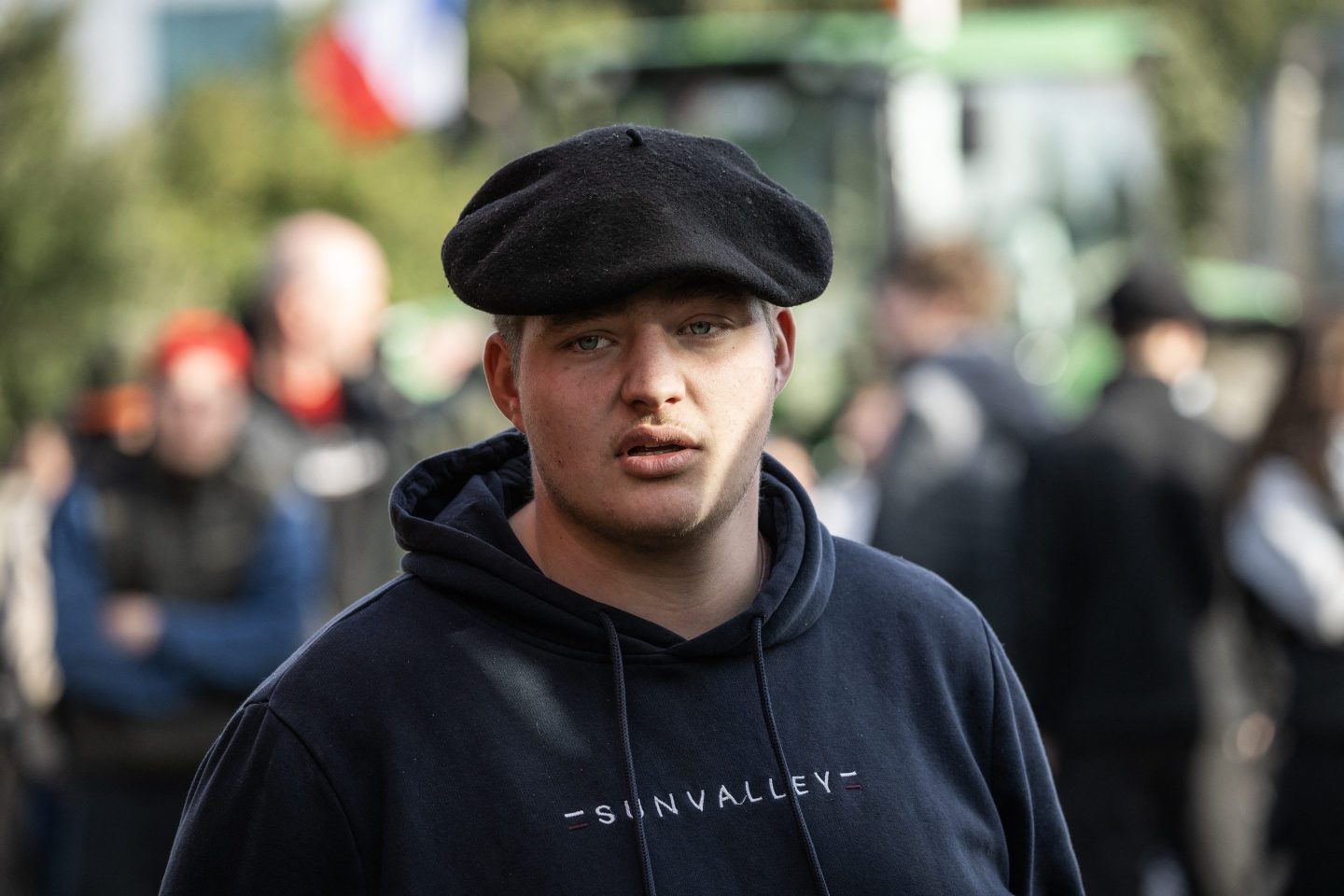
Eric Foucault is driving his hulking green tractor more slowly than he can walk. Shouting into his mobile phone above the cacophony of engines and horns, the farmer from south of Paris is one of 200 others clogging up the highway into the French capital.
Foucault and his fellow protesters are restless, their list of grievances long: soaring costs, increasing bureaucracy, new European Union regulations in its Green Deal and imports diluting their markets. “He who sows misery reaps anger,” says one of their placards.
Farmers have a long history of indignation, especially in France, and their latest moment is not confined to Europe. What’s different now is the breadth and potential impact in a year of heightened political risk because of elections in the EU, India, the US and dozens more places.
Across the world, agriculture is spreading as a key battleground. The people in power are trying to tame farmers while opponents from Donald Trump to far-right groups in Europe are trying to harness their anger. It’s become the latest skirmish in a wider culture war, much of it centered on the speed of the economic and social transition in response to climate change.
“Politicians only want to get elected, so they are latching onto the farmers movement,” said Foucault, 55, who farms wheat, barley, beets and rapeseed. “The right-wing parties, the environmentalists — everyone is piling in.”
The snake of agricultural vehicles converging on Paris on Jan. 26 was just one recent show of discontent. Dozens of tractors jammed streets in Brussels near EU institutions less than a week later as farmers aimed their resentment at the bloc’s leaders meeting nearby for a summit.
There have also been protests in Italy, Spain, Switzerland and Romania. Farmers in Poland have been at the forefront of opposition to grain arriving from neighboring Ukraine, forcing the government back to a negotiating table. In Germany, they blocked highways last month for a week to rail against cuts to subsidies for their diesel. Thousands gathered on the road leading up to the Brandenburg Gate in Berlin.
In the US, farmers complain they are being priced out by big companies. In India, which relies on hundreds of millions of smallholder farmers to feed itself, Prime Minister Narendra Modi has sought to mollify them with cash and subsidies, yet the capital locked down Tuesday due to grower demonstrations and the country faces a nationwide strike on Feb. 16 by farmers, trade unions, women’s organizations and students.
Taken together, farmers represent a significant challenge to governments that must navigate the tricky, but necessary transition to healthy, sustainable food production and diets, according to Chris Hegadorn, adjunct professor of global food politics at Sciences Po in Paris.
“You can live without an electric car, you can live without a mobile phone, but you’re not going to live without farmers and the food they produce,” said Hegadorn, a retired US diplomat. “Should we be paying attention? Absolutely.”
Officials are certainly taking note. In the past weeks, the EU has backtracked on some of its key environmental ambitions for farming, the source of more than a tenth of its greenhouse gas emissions.
European Commission President Ursula von der Leyen has been meeting with the agriculture industry to try and stave off discontent. In France, Europe’s top producer, President Emmanuel Macron’s government is pledging more money for farmers and pushing back against the EU’s trade talks with Latin American countries.
Recent elections have set precedents. In New Zealand, the new government of the farmer-friendly National Party proposed to delay what was set to be the world’s first ever farm emissions tax until 2030. Plans to curb nitrogen pollution in the Netherlands led to paralyzing protests before disgruntled farmers helped far-right Freedom Party leader Geert Wilders deliver a surprise election victory last year.
Even in Brazil, where nationalist leader Jair Bolsonaro lost power despite support from farmers, the agriculture business is working to derail President Luiz Inacio Lula da Silva’s environmental agenda.
On paper, agriculture’s contribution to the global economy is small relative to services and industry. Farming accounts for less than 2% of gross domestic product in the EU and just 1% in the US, while employing some 3% of the workforce in high-income countries, an ever-declining trend.
Yet farming resonates more in an era of concern about food supplies and as prices remain a key worry for voters. Ensuring affordable nourishment for growing populations is critical as climate change hits crops, war hampers access to export routes and countries put up trade barriers.Play Video
Trump, who has enjoyed robust support from American farmers despite the former president’s trade wars and wildly unpopular policy moves affecting crop-based biofuels, is once again trying to capitalize on the cultural discord in the US.
As he sweeps Republican state nominating contests, he’s taken the top US corn producer of Iowa. The Republican National Convention, where the nominee will be formally decided, will take place in Wisconsin, a stronghold of dairy farming. Wisconsin’s support clinched the presidency for Trump almost eight years ago, making him the first Republican presidential nominee to win the Midwestern state since 1984.
Cris Peterson and husband Gary, who own and run a fifth-generation family dairy farm in northwest Wisconsin, were among rural voters in crucial battleground farm states that helped propel Trump to victory against Hillary Clinton. Trump’s consistent attention to agriculture was a key part of the appeal, she said.
“In my whole life, nobody in a presidential race or who has gone on to be president has ever talked about farmers as much as Donald Trump did,” said Peterson, who set an alarm on her phone everyday for 8 p.m. to remind her to pray for Trump during his winning campaign. “I know he’s a big city slicker and everything, but somehow he knew that agriculture was really important to the country.”
Trump then lost Wisconsin and the White House to Biden four years ago. If he is named the Republican nominee later this year, Trump will once again need major support from farmers and rural communities if he wants to return to Washington.
There’s a restless mood ahead of the November vote among farmers. Income from farming is still historically high, but it’s poised for the biggest drop since 2006, with prices of everything from corn and soybeans to milk and pork plunging from recent highs. Biden’s push to accelerate the transition to electric vehicles has angered growers of crops used for biofuels, who contend that the US leader is overlooking the opportunity to also fight climate change with farm-based renewable liquid fuels.
What worries Wisconsin organic dairy farmer Darin Von Ruden is that benchmark milk prices will again favor big companies. “It’s a long battle and farmers don’t usually end up on the right side of that,” said Von Ruden.
It was during those Trump years — in 2019 — that Jim Goodman, a retired organic farmer in southwestern Wisconsin, sold his family’s fourth-generation dairy and beef farm. A year later, he voted for Biden.
While he made out alright, too many dairy farmers over the years have not, he said. The Biden administration has made some “good efforts” to bolster the rural economy and environment, but much more needs to be done to help farmers, including a moratorium on the expansion of corporate-owned farms, said Goodman, 69. He doesn’t know if he would back Biden again this election or support a third-party progressive candidate, like he did back in 2016.
In the US and Europe, farmers say they are now overburdened with red tape and rising costs when some 38% of land in Europe is farming, half in the US. It’s not like they didn’t get any financial help over the years, though.
Paradoxically, farmers in the EU have enjoyed highest-ever income levels in recent years, despite rising costs, according to Alan Matthews, professor emeritus of European agricultural policy at Trinity College Dublin.
The bloc has spent €2.5 billion ($2.7 billion) on crisis-related measures to support farmers since 2014 and has allocated up to €270 billion to its massive agricultural fund for the 2023-2027, about one-third of the common EU budget. Indeed, the Common Agricultural Policy, or CAP, has been the EU’s biggest spend for much of its history, though it has evolved in recent years to link funding to green requirements.
It all comes down to money in India, too, something which Modi is watching ahead of elections in spring. Farmer protests paralyzing much of Delhi in 2020 and 2021 forced the Indian premier to repeal agricultural market reforms. During campaigning this year, Modi has repeatedly included farmers as a group needing attention.
Not all farmers are convinced. The sector has been flooded with years-long issues like high debt, farm loans, price volatility and with damage to crops from climate change.
Avik Saha, national president of farming group Jai Kisan Andolan, said the way produce is priced in the market doesn’t benefit growers, despite government promises to intervene. His group was in the thick of the protests a few years ago and will be back on the streets this week. Major access roads were blocked in India’s capital on Tuesday after farmer group leaders said talks with government officials over loan waivers and guaranteed crop prices failed to reach an agreement.
“No more promises, we need action now,” said Saha. “Action means there should be a law on minimum price for crops. Give us laws now. The schemes on agriculture announced by the Narendra Modi government don’t serve any purpose.”
India has accounted for the biggest global share of farmer protests in the past three years, consultancy Verisk Maplecroft estimates. But it’s the mobilization in Europe that’s the most eye-catching right now — and the groups looking to profit politically.
What’s turbocharged the disquiet among farmers in Europe is the ambitious Green Deal, a package of EU legislation designed to zero out pollution by 2050. The clean overhaul involves a push for more organic farming and animal welfare improvements. Further requirements to cut pollution will be introduced as part of the interim climate goals for 2040, fueling uncertainty.
Some farmers worry that green policies will curb their yields and therefore their incomes, while the cost-of-living crisis makes it harder to pass on costs to consumers.
Far-right, Eurosceptic parties are trying to seize onto that. Farmers have differed with nationalist parties over immigration because they need access to migrant labor, but the two seem aligned over opposition to ambitious green policies, according to Simon Hix, professor of comparative politics at the European University Institute in Florence.
Hix is co-author of a report for the European Council on Foreign Relations that predicts that anti-EU populists will probably top the polls in nine member states in the European parliamentary elections in June. That includes France, where polls favor the far-right National Rally party led by Marine Le Pen. And the party is working hard to woo farmers.
Louis Aliot, first vice-president of National Rally and mayor of the southern city of Perpignan, is one of its officials to visit farmers blocking roads in France. He supports their allegation that the French market is being flooded with produce from places like Poland because of the EU’s open market, and the standards are different.
As he prepares to run in the EU election, Aliot wants some of the French agriculture to be protected from competition like movies are in the cinema. That would be in addition to France’s 17% share of the EU’s CAP budget.
“When we used to voice these concerns, we were accused of being demagogues even by some farmer unions,” said Aliot. “As you can see today, we were right all along. Some are saying we are surfing on the farmers’ wave. I say, it’s been 30 years we are surfing.”
Another of the nationalist disruptors to piggyback on the farmers is Hungarian Prime Minister Viktor Orban, who has been at loggerheads with the EU over everything from rule of law in his country to aid for Ukraine.
In January, Mathias Corvinus Collegium, a Budapest-based college that’s become a tool for Orban’s soft power, organized a meeting of European farmers in Brussels to launch collective resistance.
The organization is trying to forge a network of farmers from different countries, such as France, Germany and the Netherlands, so they “understand they aren’t alone,” said Frank Furedi, executive director of MCC Brussels division. The ultimate goal is a pan-European response to put pressure on the EU to change rules, he said.
“You get the impression that some people in Brussels imagine that the green agenda is far more important than farmers producing food,” said Furedi, a sociologist who focuses on contemporary culture. “You almost get the impression that sometimes they wish there was less farming in Europe, because apparently they think that would help the environment.”
For their part, officials in the EU have acknowledged the impact on farmers. Already this year, under pressure from protesters across Europe, the EU pushed back proposals that would require farmers to leave more of their land fallow to boost biodiversity. A flagship plan to halve the use of pesticides will be withdrawn because it became a “symbol of polarization,” EU chief von der Leyen announced on Feb. 6.
Back in France, Prime Minister Gabriel Attal this month set out steps to help farmers including financial support, a crackdown on unfair competition and tougher checks on the origin of products arriving from elsewhere.
For one, Amaury Babault, who represents the sixth generation of farmers in his family and is president of the youth farming union south of Paris, is skeptical his industry will remain on the agenda after people have voted.
“Political parties are trying to latch on to our movement, they only chime in when there are elections,” said Babault, 34, as he protested on the Paris highway on Jan. 26. “But us farmers, we don’t trust them. In France, people need farmers. Politicians? I’m not so sure.”