Following the recent Congressional hearing on UFOs and India’s successful landing of a lunar rover, there is much renewed public interest in what lies beyond our atmosphere. In fact, establishing a long-term human presence on the Moon is a closer reality than many may think. For the first time ever, NASA astronauts will soon find themselves living for extended periods on a moon-orbiting outpost and on the unforgiving lunar surface itself. In what is sure to be a rehearsal for an expedition to Mars, mastering lunar living is key to humanity’s continued exploration of space.
To make the mission of NASA’s historic Artemis program a reality, we must tackle the challenges of designing a living space for astronauts. Taking the shape of an orbiting lunar gateway, astronauts’ lunar home will feature spartan living quarters that will provide a more sustainable, comfortable, and extensive life-support framework on the moon. The design and development must center on safeguarding astronauts from radiation exposure and the extreme cold of the lunar nights.
First stop on the way to the Moon and Mars: An orbiting space station
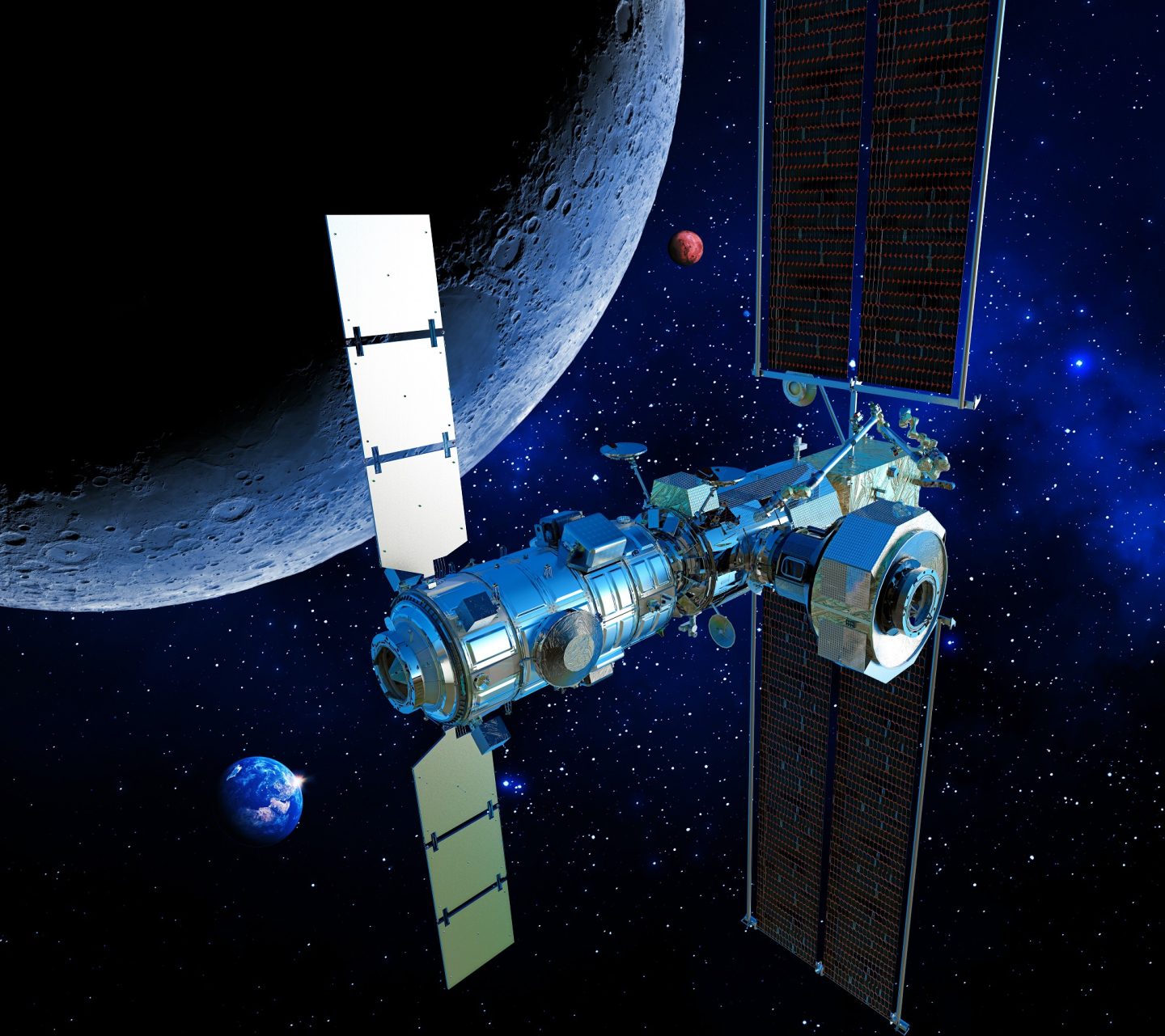
On Artemis missions, a trip to the Moon (scheduled for 2025) and eventually Mars will require a stopover at the Lunar Gateway, a space station that will support a sustainable human presence on the Moon and provide a staging area for future missions to the red planet.
Some of the components of the Gateway are being contributed by our company, which is working closely with NASA and the European Space Agency to design and build elements such as the International Habitat (I-HAB) module that will provide living quarters and support systems for crew members who will live and work in space.
The I-HAB is a pressurized module with habitability and life support functions, which also features docking capabilities for visiting space vehicles. The I-HAB represents a new generation of modules for deep space exploration, capable of meeting requirements for lighter structures, enhanced functional and avionic architecture, efficient thermal control, and innovative accommodations for a more comfortable interior.
The Gateway poses a new set of challenges for keeping astronauts safe, productive, and comfortable in an environment that is smaller than the International Space Station (ISS) and farther away from Earth.
Because the Gateway station is smaller than the ISS, the design needs more functionality in less volume. It also needs more automation because it’s not easy to reach, and it’s not permanently occupied so mission command must be able to intervene remotely when astronauts are not there.
Beyond supporting mission capabilities, the Gateway must also take into account the overall well-being of the astronauts who will work and live there, even if it’s only for around 30 days. The ISS is just 400 kilometers from Earth while the Gateway is 240,000 kilometers away, requiring a journey of three days to reach our home planet. That distance introduces more than just technological challenges–there are also psychological challenges.
Design decisions will factor in considerations for astronauts who will eventually inhabit the Moon and stay in space potentially for months at a time–much longer than those who visited during the U.S. Apollo missions.
Designing for life and work on the moon
Designing habitation systems for life on the Moon is about as difficult as it sounds. But beyond the obvious (extreme temperatures, a lack of oxygen, and the deadly vacuum of outer space), setting up shop on the lunar surface presents numerous challenges.
Sustainable power
The lunar night lasts approximately 14 Earth days, during which the Moon experiences extreme cold temperatures and complete darkness. To ensure the survivability and functionality of the lunar outpost, a sustainable power source is crucial. This could take the form of advanced power generation technologies such as solar panels and regenerative fuel cells to harness and store energy during the lunar day. These systems will provide the necessary power for life-support systems, communication, scientific experiments, and other essential operations throughout the lunar night.
Radiation protection
Unlike the Earth, the Moon lacks a protective atmosphere and magnetic field, leaving its surface exposed to intense solar radiation and cosmic rays. Radiation poses significant health risks to astronauts. Exploring various materials and configurations to create robust shielding solutions is key to ensuring that astronauts’ long-term health is safeguarded during their stay on the Moon.
Dust mitigation
Lunar dust, also known as regolith, is a pervasive challenge on the Moon. The fine particles can be abrasive, cling to surfaces, and pose risks to equipment and human health. This challenge requires the development of specialized seals, filtration systems, and surface coatings to minimize dust infiltration into living spaces and equipment.
Life-support systems
The Gateway will need closed-loop systems that recycle and regenerate vital resources such as air, water, and waste, reducing the reliance on resupply missions from Earth. This approach ensures long-duration missions are feasible and minimizes the need for excessive resource consumption.
Habitability and comfort
Living on the Moon for extended periods of time requires careful consideration of astronauts’ habitability and comfort. This involves developing ergonomic designs, efficient use of space, lighting systems, and temperature control mechanisms to create a living environment that supports the physical and mental well-being of astronauts.
When a view isn’t just a view
Despite its use for short-term stays, astronaut comfort is also being incorporated into the design of the Lunar Gateway. Allowing astronauts to see outside the Gateway is an important design consideration, as NASA learned during the design and use of the Cupola on the ISS. The Cupola is a control center in the ISS with seven portholes that allow astronauts to work while enjoying a 360-degree view of the outside, providing an exceptional observatory for studying the Earth and the entire cosmos.
With the Gateway, psychologists are collaborating with astronauts who worked on the ISS to design these habitats in space. Like the ISS Cupola, the Gateway needs spaces that will help them feel less claustrophobic while providing double functionality: a view of what’s outside the Gateway for robotic operations–and a break from the enclosed environment of the other modules.
One small lunar home, one giant leap for space exploration
Beyond providing the technical capabilities demanded by Artemis, participation in the program remains an immense source of pride among the company’s employees, who are keenly aware of their role in writing the latest chapter in the history of human space exploration.
For people working in the space business, developing this living space for astronauts is perhaps proving the greatest motivation of our professional lives. Unlike the Apollo program, which was a race between two players, today’s mission to return to the Moon is a true partnership between all those involved–and will play an important part in the journey to explore the Moon, Mars, and beyond.
Massimo Comparini is the deputy CEO and senior executive VP of observation, exploration, and navigation at Thales Alenia Space.
The opinions expressed in Fortune.com commentary pieces are solely the views of their authors and do not necessarily reflect the opinions and beliefs of Fortune.