
How enterprises are using agentic automation to transform at scale

Identifying the right mix of autonomous agents, automation, and human expertise separates AI winners from those stuck in pilot mode.
Rising costs, rapidly shifting customer expectations, and a mounting fear of being left behind have pushed nearly every business toward AI adoption. But 60% of AI initiatives stall out before they ever deliver value, derailed by poor planning and execution and short-sighted implementation.
Meanwhile, a different kind of organization is pulling ahead: one that uses AI not to make small tweaks but to reimagine entire workflows. Leaders of these companies aren’t chasing efficiency at the margins—they’re redesigning how work gets done and how business processes are orchestrated.
Driving this leap to powerful automation is the advent of intelligent AI agents. They don’t just follow scripts— they also assess, adapt, and act to achieve business outcomes.
For companies grappling with complex, high-stakes operations, the shift from rigid automation to adaptive decision-making, enhanced with AI, is transformational.
This distinction—knowing when to deploy autonomous agents, traditional automation, or human expertise—separates companies reaping meaningful return on investment from those struggling to convert AI pilots into production. “There’s a right time and place for an agent, and those who are thoughtful about identifying that sweet spot reap the rewards much faster,” says Graham Sheldon, chief product officer at agentic automation platform UiPath.
From rigid rules to adaptive intelligence
Sheldon frames this shift as AI capabilities progressing from left brain to right brain. “In the past, AI could handle left-brain tasks, such as automation and following rules,” he says. “Now, it is tapping into the right brain, such as creativity and adaptability, to be able to seek a goal and make a judgment call about what to do.”
Traditional automation handles rigid, rule-based work. AI agents, when equipped with the right tools and context, take that automation and scale to more complex creative determinations and recommendations rather than simply following predefined steps. This agentic approach is the core of the next wave of automation, in which AI can surface insights and trends to guide human decision-making. With an orchestration layer, enterprises can deploy the right mix of agents, robots, and human experts for each task across complex enterprise workflows while maintaining full visibility and governance. The result allows even junior employees to serve as skilled managers rather than rank-and-file operators. This combination of robots, agents, and people with orchestration is what the UiPath Platform is built on.
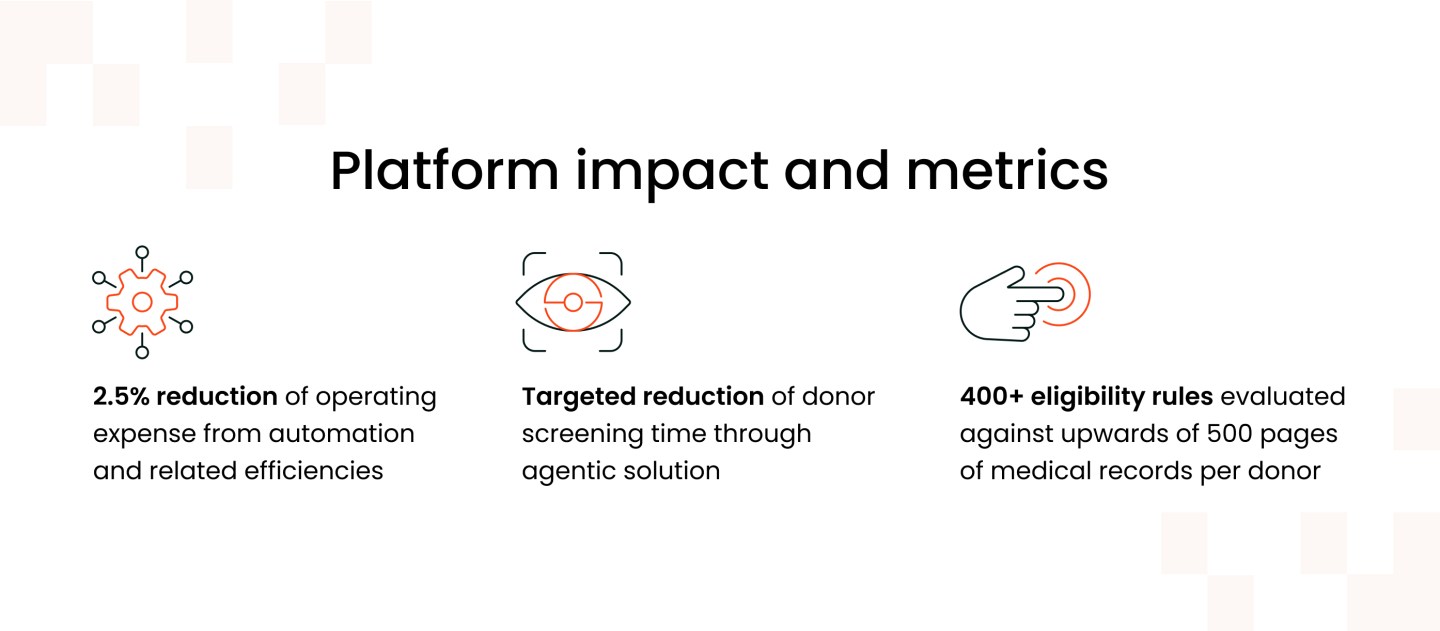
Consider the challenge facing Evergen, a regenerative medicine company that processes donated human and animal tissue for medical implants used in a variety of surgical applications, such as spinal fusion and nerve repair. The company’s traditional donor prescreening process is high-stakes, time-sensitive, and arduous, requiring clinical staff to review upwards of 500 pages of unstructured medical records per donor and cross-reference them against more than 400 eligibility rules. Because donor decisions needed to be made quickly, employees work around the clock, including weekends, late nights, and holidays.
Taking a shortcut could spell disaster: a missed detail on page 368 could mean recovered tissue would be declined later, wasting resources and, more importantly, squandering a precious donation that could have ultimately benefited another patient. AI transformation is often associated with using generative large language models to improve marketing copy or generate code, but “we don’t just make widgets,” says Adam Poniatowski, vice president of business transformation and IT, Evergen. “We create medical solutions that transform lives. They come from a donor, and there’s a family, and there’s a story. We help form the conclusion.” The right decision can be the difference between honoring a donor’s decision and creating that story for the donor family or missing the opportunity to help a patient have a healthy, productive, better life.
Working with UiPath, Evergen orchestrates agents, robots, and human experts in a coordinated workflow. Recovery partners will submit information digitally through a secure portal, robots will gather and route that data to downstream systems, and document-understanding agents will digitize and process medical records while agents cross-reference the information against complex clinical criteria. Throughout the process, human experts will provide validation and approval at critical points.
The expected results: a 2.5% reduction in operating expenses, significantly fewer late-stage tissue deferrals, and, most importantly, better stewardship of the gift of tissue donation.
These improvements wouldn’t be possible without proper oversight. “Ensuring there are humans in the loop who can oversee and provide additional governance is really, really powerful,” says Joe Miles, industry head for life sciences, UiPath. UiPath helps customers such as Evergen establish guardrails that dictate the actions an agent can take, when human escalation is required, and when a comprehensive audit trail is necessary. Skipping this step can create more work for an organization than if it had never integrated AI at all. Sheldon recalls headache-inducing stories from customers who gave an agent an application programming interface to update some spreadsheets, only to have it update the wrong ones—with no record of what changed.
In addition to governance, UiPath provides integrations with enterprise systems across the technology ecosystem. This agnostic approach extends to allowing employees in different divisions to interact with the platform however feels most natural. Developers more familiar with pro-code tools can build agents using Python-based frameworks, such as LangChain or LlamaIndex, while marketing teams might default to low-code tools. “AI adoption requires bringing those two constituencies together,” says Sheldon. This is where having a solution such as UiPath’s Maestro is critical. “Agentic adoption is most effective when you can bring developers together with process owners, allowing them to collaborate when designing customized workflows based on their needs and technical fluency.”
Scaling mission-critical processes
For enterprise AI to succeed, the key is focusing on core, mission-critical processes rather than incremental use cases, echoing a McKinsey finding that AI projects fail when they lack strategic focus. Organizations that succeed target processes in which the combination of agents, robots, and people delivers unique value, whether in plasma donation screening, revenue cycle management, or claims processing. The goal isn’t to replace standard processes, especially in highly regulated industries such as life sciences. Instead, the best AI tools integrate with existing systems to make them more accurate, reliable, and efficient.
This translates into enhancing human workflows rather than eliminating them. For Poniatowski—whose company doesn’t have headcount-heavy back-office teams—the strategic application of AI looks different than it does for large enterprises simply trying to trim headcount. “We’re focusing our AI on how we accelerate lead times to customers, speed up product launches, improve donation outcomes, and enhance the lives of more patients,” he says. “This technology doesn’t need to replace people, but it can be used to scale more effectively.” It’s an approach he recommends to other leaders working to obtain buy-in from executives wary of AI adoption.
“We have the opportunity to help reduce cost, time, and effort to develop these for life-saving therapies that will have a tremendous impact on our children, our parents, our friends, and our families,” says Miles.
As agentic automation matures, company leaders are discovering that the most profound changes aren’t always what they expected. Evergen initially pursued strict efficiency gains. In practice, the UiPath platform has led to better donation outcomes and increased employee engagement. Staffers now recognize that AI tools can help ensure patients can walk again or play with their kids.
Anecdotes like this make Sheldon optimistic about the future of work. “AI has the potential to make [all users] the best version of themselves,” he says. “Most customer service representatives would rather focus on solving new and hard problems than filling out standard forms. Doctors would rather spend time with patients than with paperwork. As AI agents handle more routine tasks, human talent can focus on judgment, coaching, and solving complex problems. At an organizational level, this opens up resources to experiment, discover new strategies, and rethink best practices.”
“By embedding agentic automation into our donor screening process, we’re not just transforming our business—we’re transforming donation outcomes,” says Poniatowski. “This is automation and AI with a direct, measurable impact on patients’ lives.”