Indonesian President Prabowo Subianto came to power last year off the back of a campaign with several grand promises. Chief among them: 8% annual economic growth by the end of his term in 2029.
His brainchild to get there is the country’s latest sovereign wealth fund, Danantara, short for Daya Anagata Nusantara, which means “the power of the future for Indonesia.” It’s tasked with boosting the economy, especially through domestic investments.
The fund is also taking over Indonesia’s dozens of state-owned enterprises (SOEs), consolidating and streamlining their operations to make them more competitive. The idea is that integrated management can lead to more effective and optimized national resources, resulting in higher economic growth and better jobs.
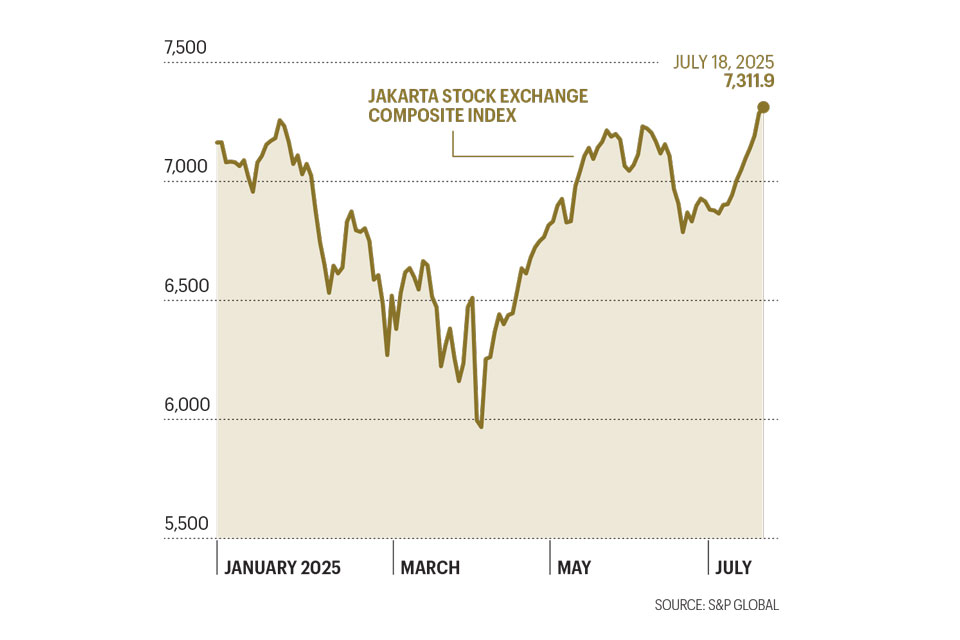
Yet critics have governance concerns because of a revised law that gives the president greater control of the entities and their billions of dollars in annual dividends. These concerns contributed to a dip in Indonesia’s stock market index when the fund was launched in late February. Danantara, which reports to the president, will eventually oversee all SOEs (including Global 500 companies Pertamina, the oil and gas giant, and electricity company Perusahaan Listrik Negara).
The idea of sovereign wealth funds—investment funds managed by state actors hoping to leverage their financial surplus—has existed since Kuwait set one up in 1953 to manage its oil revenues. This surplus can come from sales of natural resources in oil-rich nations like Saudi Arabia or Norway, foreign exchange as in China, or even bumper tax revenue in the case of Ireland. Sometimes the funds take an active role, backing up-and-coming startups, making a play for strategic sectors, or investing in companies based in their own country.
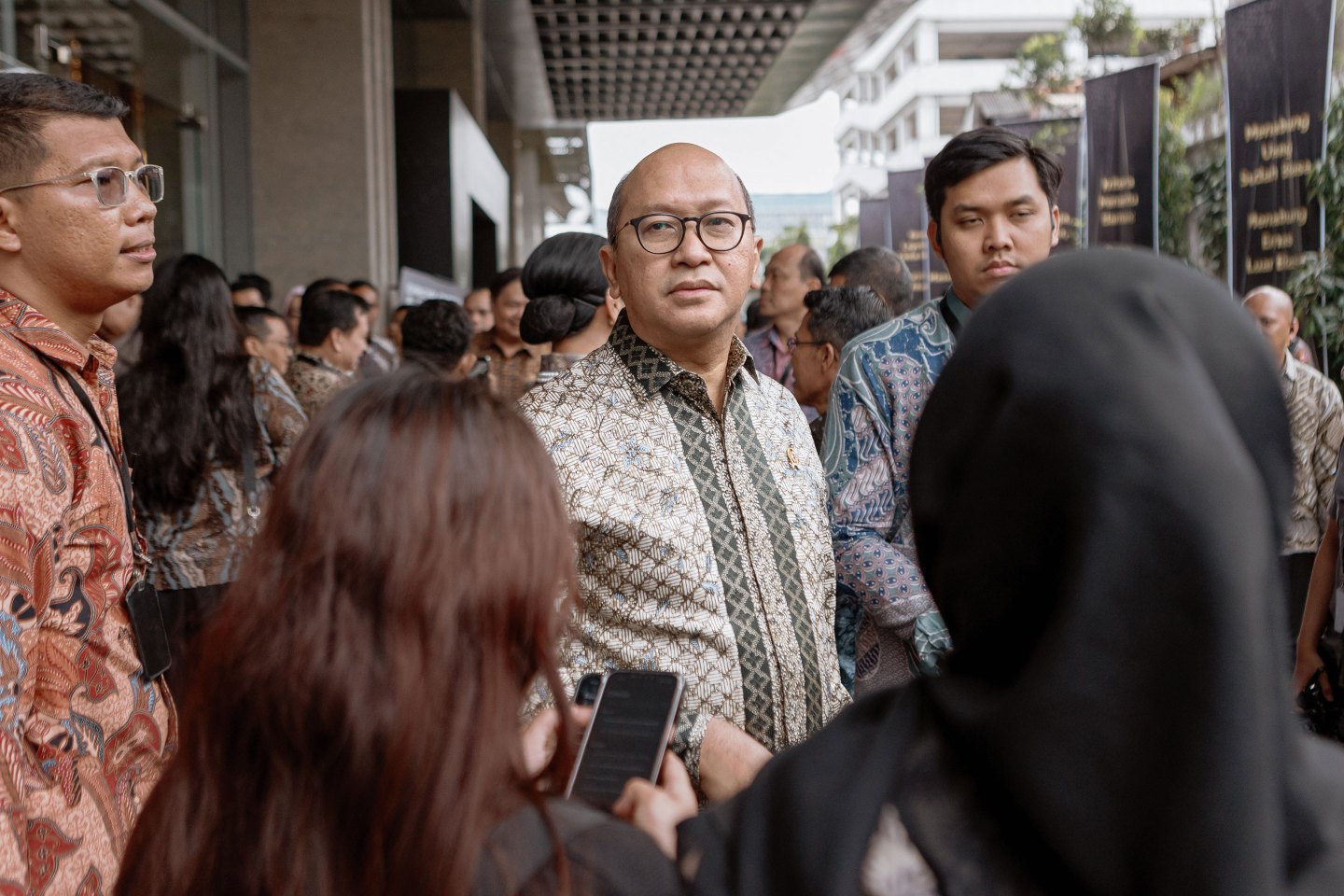
But Danantara is somewhat different in that it’s trying to manage and invest in its own state enterprises while investing surplus funds drawn from its SOEs’ dividends. The young entity’s CEO, Rosan Roeslani, argues this will finally help Southeast Asia’s largest economy develop its potential.
“We have this dual role: How can we optimize assets from state-owned enterprises to create more value, and at the same time create quality jobs?” Rosan tells Fortune. As a sovereign fund, there need to be returns, he notes, but the priority is “sustainable economic growth.”
Southeast Asia’s largest economy
Indonesia accounts for roughly 40% of the region’s population and landmass. About 280 million people are spread over some 17,000 islands, and the country had a GDP of $1.4 trillion in 2024, according to World Bank data. That puts Indonesia in the top 20 economies globally.
While Indonesia was hard-hit during the Asian Financial Crisis of 1997–98, it was one of the region’s strongest performers during the 2008–09 Global Financial Crisis, growing by 4.6% in 2009. From 2010 to 2024 its economy grew by an average 4.74% a year, per the World Bank.
But the country trails some of its neighbors in GNI per capita, which reached $4,910 in 2024. That’s enough to categorize it as an upper-middleincome country by the World Bank’s definition. Yet GNI per capita in Singapore, Malaysia, and Thailand reached $74,750, $11,670, and $7,120, respectively.
That means not all of Indonesia’s people are earning as much as their regional peers—despite
being blessed with abundant natural resources, like oil, gas, and critical minerals.
But Rosan thinks Danantara can help Indonesia successfully leverage its resources. “We want to develop a value-added downstream industry; doing that will improve our human capital, create more quality jobs, and obviously create a better economic return,” he says.
Indonesia has already attracted investments to its nickel industry as part of its downstreaming strategy after banning the export of raw nickel ore in January 2020—well before Danantara.
A new phase
Danantara must also streamline the country’s dozens of SOEs (an effort started under previous president Joko Widodo) and make them more competitive. “In the past, sometimes [SOEs] think they’re likely to monopolize. When you don’t have competition, sometimes you become more relaxed,” Rosan says.
Hilman Palaon, a research fellow at the Lowy Institute’s Indo-Pacific Development Centre, thinks Danantara marks a new phase. It’s “expected to play a key role in reshaping the SOE landscape: managing state investments, consolidating assets, and leading restructuring efforts,” he says.
That involves reducing red tape and unnecessary bureaucracy, as well as fixing Indonesia’s reputation for opaqueness and, sometimes, corruption.
“Maybe in the past, an SOE always had special treatment,” Rosan explains. “Usually if there’s a government project, there’s always priority that it should be awarded to another SOE. That kind of priority we are going to revise.”
Continued SOE reform is needed as these companies become increasingly important to the economy, notes Maxwell Abbott, an associate managing director and head of political risk and strategic intelligence for APAC at consultancy Nardello & Co.
The country has already taken a step in the right direction, he says: “In recent years, Indonesia has made significant progress in improving SOE performance and efficiency by consolidating the number of SOEs and improving anti-bribery protocols.”
Rosan argues that not all SOEs are saddled with this issue, but that SOEs in general should be more efficient, transparent, and digitized.
Artificial intelligence and digitization constitute one of eight sectors Danantara has targeted for investment, to grow Indonesia’s economy while raising the standard of living. Other sectors include renewable energy, food security, and health care.
“We are still way behind in terms of the health care industry. We still import 90% of our raw materials for pharmaceuticals,” Rosan says. “We are behind in terms of doctors…Just to meet the emerging-market standard, not OECD standard, we are short about 100,000 doctors.”
Danantara has already signed several memorandums of understanding or given loans to Indonesian companies in strategic sectors. It has an MOU with ACWA Power, a Saudi Arabian company specializing in desalination and green hydrogen tech, to explore renewable energy investments. Total funding is estimated to be as much as $10 billion.
It also has partnerships with QIA, Qatar’s sovereign wealth fund, and CIC, China’s sovereign wealth fund, aimed at facilitating investments to Indonesia. Domestically, Danantara has invested in Chandra Asri, a petrochemical and energy firm, and provided a $405 million loan to national airline Garuda Indonesia.
“Danantara’s early investment decisions show Prabowo wants to ensure domestic production of crucial industrial inputs and provide lifelines to struggling SOEs that play a prominent role in the national economy,” Abbott notes.
The legacy play
With more than $900 billion in assets and annual dividends of about $8 billion that can be used for investing, by Rosan’s estimation, Danantara isn’t just a new force in global finance; it’s a signal that Indonesia will now fully control its wealth responsibly, manage its resources with strategic foresight, and invest in its future.
“Danantara carries big ambitions,” says Palaon, the Lowy Institute research fellow. “It reflects Indonesia’s bold vision to break free from the middle-income trap and become a developed nation, but the real challenge lies in turning those ambitions into action.”
While Rosan has been a mainstay in Indonesian politics with different ministerial assignments, an ambassadorship to the U.S., and a role as Prabowo’s campaign manager and strategist, he’s also a finance guy. Before politics, he worked in banking and cofounded his own investment firm, Recapital Group.
“I came from the private sector and have actually been on the investment side. So this is [similar] to my previous job, investing in Indonesia or out of Indonesia,” he says.
Under him are several notable peers who also hail from the finance industry or the private sector, including Pandu Sjahrir, Danantara’s chief investment officer and an early backer of Southeast Asia tech giant Sea.
Danantara has also drafted non-Indonesians to sit on the board of advisors, serving on a voluntary and nonbinding basis: famed hedge fund manager Ray Dalio, prominent American economist Jeffrey Sachs, and former Thai prime minister Thaksin Shinawatra.
The two Americans are no strangers to the country: Dalio’s OceanX has been working with Indonesian officials to map its seabed, and Sachs previously advised the Indonesian government.
And while Thaksin’s role may raise some eyebrows because of corruption allegations, Rosan says Thaksin is respected in Southeast Asia and that his input would be useful.
If Danantara succeeds in transforming Indonesia’s economy and lifting living standards, then it will arguably bolster Prabowo’s legacy, which is still somewhat blotted by his time as an army commander during the Suharto-era dictatorship from the mid-1960s to the 1990s.
While more investments in the country coupled with more competitive SOEs would in theory create more jobs, Rosan is aware of the skepticism and expectation for the fund to perform.
“Obviously when a new entity receives more than $900 billion in total assets, the expectation is very high,” he says, adding that the fund will not only “perform” in terms of returns but will raise governance and compliance standards. “We are building trust right now by having the best talent, and also having good governance and transparency.”
It’s a strong claim. But when asked if he’s confident that the conversation around Danantara will be positive if he speaks to Fortune again in five years, Rosan responds with a firm yes. As he puts it, we’ll see “a lot of difference.”
This article appears in the August/September: Asia issue of Fortune with the headline “Danantara’s CEO thinks the new sovereign wealth fund can help Indonesia finally unlock its potential”