To gamers around the world, April 2—“Liberation Day”—meant something else.
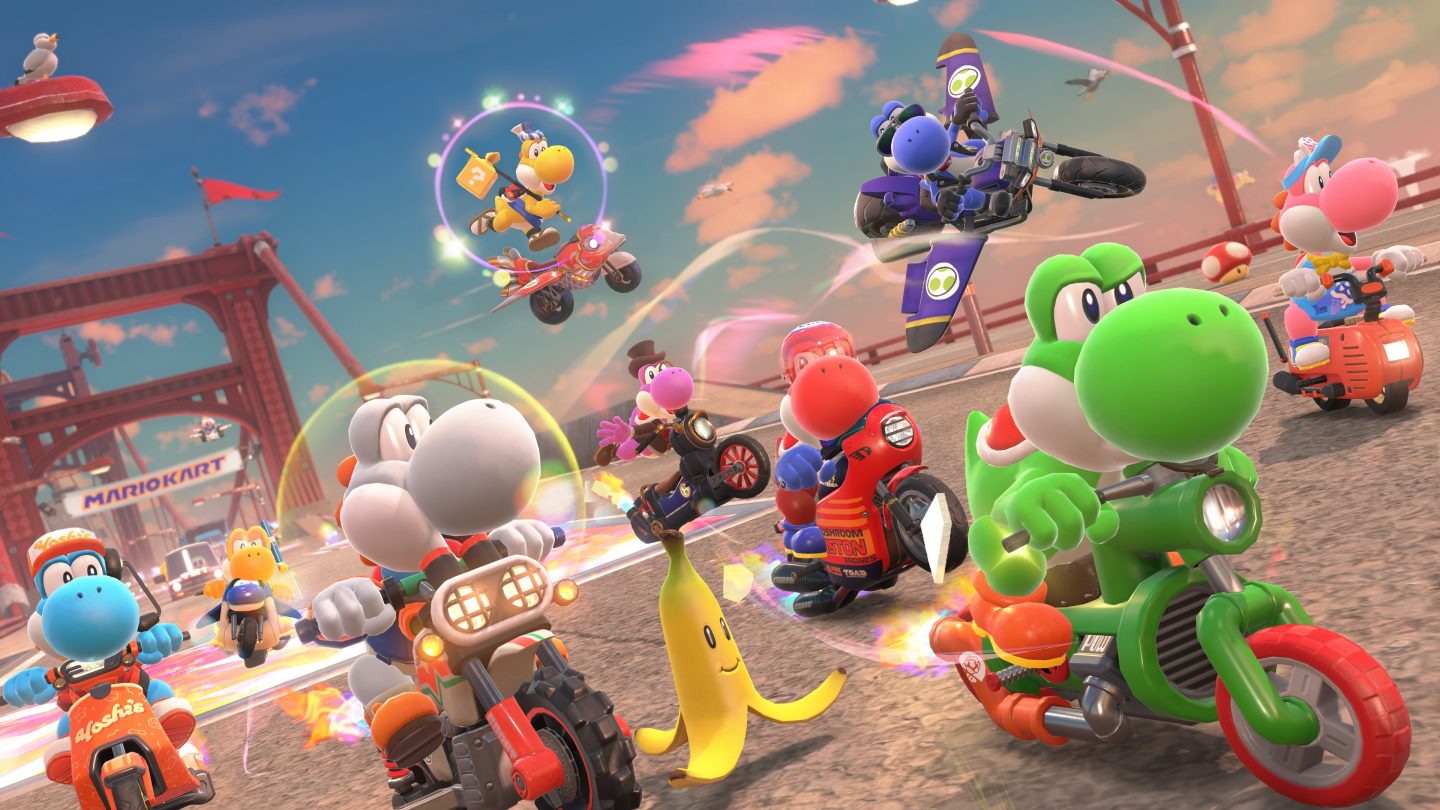
In a slick prerecorded video presentation, Nintendo unveiled the Switch 2, the long-awaited successor of its wildly popular Nintendo Switch handheld console. It was exactly what gamers were hungry for: details on the console’s more powerful specs; expanded access to Nintendo’s decades-old back catalog; and new entries in the popular Mario Kart and Donkey Kong series. Even a surprise price hike—$450 versus the Switch’s $300—didn’t dent enthusiasm.
A U.S. president could, though. A few hours later, Donald Trump announced his Liberation Day tariffs, including steep taxes on imports from China, Vietnam, Japan, and Cambodia—Nintendo’s manufacturing hubs.
It upended plans years in the making. The Switch 2’s June 5 launch was poised to be a shot in the arm for Nintendo and the video game industry. Nintendo needs “something new and exciting out in the marketplace that kicks that can down the road on the tech stuff for another decade, so they can continue to make the games they want to make,” explains Jeff Gerstmann, a journalist who has covered the industry for decades.
Now Nintendo (like nearly every other company) is trying to keep up, even as Trump has since suspended most of the tariffs amid negotiations. Two days after Liberation Day, Nintendo paused U.S. preorders to assess the “potential impact of tariffs.” It reopened them a few weeks later, maintaining the $450 price point and June 5 launch—but hiked prices on everything else, like controllers, “amiibo” figurines, and other accessories.
Like many other manufacturers, Nintendo (which didn’t respond to Fortune’s request for comment) is trying to figure out how to roll out a new product as the world’s largest consumer market takes a protectionist turn. The Switch 2 is still likely to be a success, even if not quite as much as Nintendo hoped a month ago. But it will also be one of the first tests of how consumer tech companies will stay afloat in a world of tariffs, decoupling, and protectionism.
If the video game industry has a champion, it’s Nintendo. Founded in 1889 as a playing-card maker, it has developed the most well-known portfolio of intellectual property apart from Walt Disney, thanks to franchises like Super Mario, The Legend of Zelda, and Pokémon.
But it’s also one of Asia’s most prominent consumer-tech companies, an Asian brand with true global reach. After struggling to stay relevant in the 2010s, Nintendo unveiled the Switch in 2017: an affordable handheld console that could connect to a television, but could also function without one.
It was a wildly successful move. With 150-million-plus units sold as of March 2025, the Switch is the third-bestselling console of all time, behind Sony’s PlayStation 2 and the Nintendo DS. COVID lockdowns made it a true household name, as consumers occupied themselves with video games. Nintendo, with its affordable console and a new game in the Animal Crossing series of cozy life simulators, was well-placed to capture that demand. Nintendo sold over 27 million consoles in 2020 alone.
But eight years is an eternity in the video game world, and the console was showing its age. Nintendo reported slowing sales as gamers tired of a system that struggled to run the newest games, even those specifically designed for the console. Nintendo was also holding back marquee releases, so many people put their Switches in a drawer and forgot about them.
Nintendo reported 1.2 trillion Japanese yen ($7.6 billion) in sales for its most recent fiscal year, which ended in March, a 30% drop from the previous fiscal year. Its ordinary profit saw an even bigger dip, dropping 45% year on year to reach 372 billion yen ($2.4 billion). And the company sold 11.5 million consoles in 2024, less than half of what it sold during the COVID boom years.
Still, investors have shrugged off Nintendo’s slowdown in anticipation of the Switch 2. Nintendo shares have been at record highs since December. Its market value is over $90 billion, making it Japan’s eighth-most-valuable firm and placing it ahead of many Japanese companies on the Fortune Global 500.
Nintendo was one of the first companies to shift manufacturing out of China to nearby Vietnam and Cambodia in 2019, after the first Trump administration threatened to impose tariffs on video game consoles made in China.
“The majority of their production is still done in China, but they’ve now switched to Vietnam to focus pretty much entirely on U.S. console production,” says Daniel Ahmad, an analyst with gaming-industry consultancy Niko Partners. That puts Nintendo “ahead of the game” compared with competitors Sony and Microsoft.
As the second Trump administration started up, Nintendo began front-running shipments to get ahead of possible future tariffs. JPMorgan estimated in early April that Nintendo had enough inventory to meet demand for six months to a year.
The Switch 2’s initial numbers likely won’t take a hit, even with the price hike. Preorders in markets like the U.S. and Japan sold out instantly, and the company is already apologizing for future shortages. Nintendo is even selling a cheaper version that works only with games bought in Japan, likely to avoid resellers trying to bring it to markets like mainland China, where the company doesn’t have an official presence.
The real question will come after the initial launch, when holiday shoppers start thinking about buying the latest version. “The big questions are around value—$450 is not a small amount of money,” Gerstmann says. The cost of games, too, is going up: Nintendo is targeting $70 to $80, as opposed to the $60 that has been traditional across the industry.
The company is trying to scale back expectations, forecasting lower-than-expected Switch 2 sales of 15 million (still roughly in line with how the first Switch sold after its launch in 2017). In a May briefing to investors, Nintendo president Shuntaro Furukawa said the company was factoring in a profit hit worth “several tens of billions of yen,” but noted the calculation was made on the basis of 145% tariffs on China and 10% tariffs on everyone else. (Trump soon after lowered tariffs on China to 30% for a 90-day period.)
Furukawa noted the company’s “basic policy” was to pass on tariffs to customers—but admitted a price hike might not be the greatest idea for a just-debuted console.
Nintendo isn’t alone in thinking about how to manage increasing costs and new tariffs. Citing costlier development and “market conditions,” Microsoft implemented a $100 price hike for the Xbox Series X and plans to start selling $80 games. Sony has avoided hiking PlayStation prices in the U.S., but raised prices elsewhere.
The video game industry has been grappling with higher costs for years. Ahmad first points to the COVID supply-chain shock, which pushed up prices of components like memory. Game development is also getting more expensive as graphics become more advanced, boosting staffing and technology costs. That rebounds in the real world; Ahmad notes that Nintendo uses cartridges, rather than discs. “If your game is 64 gigabytes and you get a 64-gigabyte cartridge, that’s going to cost more to publish.”
By making the first move to $80, Nintendo might have done the industry a favor. “I’m sure other publishers and manufacturers are super happy that Nintendo took the blow for them,” Gerstmann says. He speculates that Nintendo’s lower-end hardware, compared with Sony and Microsoft, might appeal to studios now trying to keep costs low: “There’s real potential for the Switch to change a lot of things about the way games are made.”
The world may have avoided the worst of U.S. tariffs for now—they stand at 30% on China and 10% on everyone else as U.S. officials try to negotiate with major trading partners. At those levels, tariffs are tough but manageable for global business.
But if negotiations break down—or if Trump lets his 90-day pause expire—then tariffs will shoot back up again: 54% on China, 46% on Vietnam, and 49% on Cambodia, giving Nintendo a lot to contend with.
Their struggles are indicative of a broader tension in Trump’s tariff regime: Vietnam and Cambodia are two popular “China plus one” destinations, countries where manufacturers based final assembly so as to avoid tariffs on China-made products.
Trump officials are reportedly pressuring trading partners to limit trade with China in order to isolate Beijing. But a surge in exports by Vietnam, Cambodia, and others will hurt Trump’s other goal: balancing U.S. trade with the rest of the world.
Nintendo’s customers are used to facing uncertain and hazardous environments in the company’s games. The question now: Can Nintendo, and other Asian manufacturers, show that same skill in navigating a more geopolitically fraught world?
This article appears in the June/July 2025: Asia issue of Fortune with the headline “Game on!”