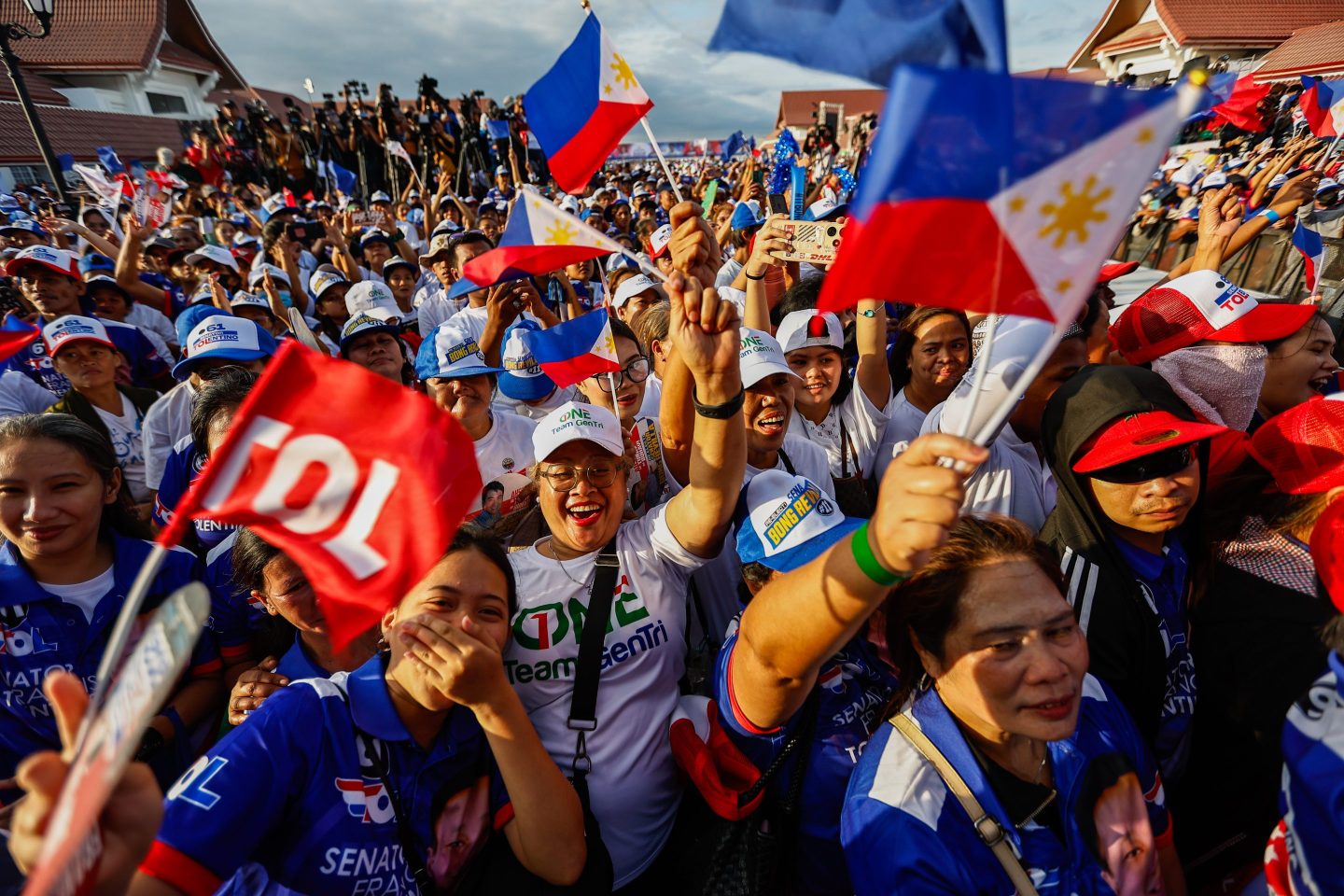
The Philippines’ May 12 midterm election is putting investors on alert for any changes to government policies, as the global trade war exposes weaknesses in one of Asia’s fastest-growing economies.
The vote to pick 12 senators, more than 300 congressmen and nearly 18,000 local officials comes as policymakers seek to boost investment and consumption against the backdrop of a more challenging external environment. It will also be a crucial test for both President Ferdinand Marcos Jr. and his estranged Vice President Sara Duterte, who are backing competing candidates.
“Investors are watching whether the elections will result in continuity that will ensure economic reforms,” said Jonathan Ravelas, managing director at eManagement for Business and Marketing Services, a Manila-based consultancy. “The Philippines cannot afford to have political instability, especially during this time of global uncertainty.”
The economy expanded 5.4% in the first quarter from a year earlier, slower than the 5.7% expansion forecast by analysts but marginally faster than the pace seen in the last quarter of 2024, according to data released Thursday. The government aims for growth of at least 6% this year after a slower-than-projected 5.7% expansion in 2024, though the economy is still outpacing most of Asia.
A Philippine trade delegation wrapped up initial talks with U.S. officials last week with more likely as Manila seeks to lower the Trump administration’s proposed 17% tariff. The planned levy is well below those threatened against most of Southeast Asia, including a 46% rate on Vietnam, and policymakers see the chance to win a competitive advantage—if they can continue domestic reforms.
“While the tariffs create opportunities to shift supply chains, EU investors remain cautious of long-term operational inefficiencies,” European Chamber of Commerce of the Philippines President Paulo Duarte said. “To seize this strategic window, the government must focus on lowering operational costs and improving ease of doing business.”
The country’s young, English-speaking workforce is a big asset for the economy, but challenges abound, said Ebb Hinchliffe, executive director at the American Chamber of Commerce of the Philippines. They include red tape, infrastructure and connectivity, energy costs and regulatory unpredictability, he said, echoing worries that have haunted Philippine businesses for decades.
While the Philippines has enacted legislation to attract investors—including a measure that cuts corporate taxes and the removal of foreign ownership limits in sectors including renewable energy—businesses want more reforms. But a shaky political situation after the midterms could keep the government’s focus off much-needed changes.
Finance Secretary Ralph Recto last month withdrew a proposal that sought to increase capital gains, donor and estate taxes to 10% from 6%, citing ample tax collection in the past three months. The bill would generate roughly 300 billion pesos ($5.4 billion) in additional revenue over the next five years.
Winning lawmakers will have their work cut out for them when the new Congress convenes in July. Pending bills include a measure to ban raw mineral exports to spur the downstream mining industry, a plan heavily opposed by a local nickel industry association.
And awaiting Marcos’ signature is a bill reducing the stock transaction tax to 0.1% from 0.6% to make the country more attractive compared with Southeast Asian neighbors. But it will also subject foreign firms to a 25% tax on dollar-denominated bonds out of the Philippines.
The average return on local assets in a midterm election year has been negative 0.3%, based on polls running back to 1995, compared with 12% gains during presidential election years since then, according to Ritchie Ryan Teo, chief investment officer at Sun Life Investment Management and Trust Corp.
“Enflamed disagreements between parties have occurred in past elections that have not derailed the capability for Congress to pass laws and budgets,” Teo said. “We are cautiously optimistic but this is definitely a space to watch.”
The outcome of the election is particularly critical for Duterte, as the 12 senators being elected will be among jurors for the vice president’s impeachment trial that starts in July.
“Businesses don’t seem to mind it as long as it does not spill over into their turf or their bottom line,” said Dereck Aw, a senior analyst at Control Risks. “If anything, some are even relieved that politicians are too busy feuding with each other to meddle in business, which the Philippine government has been known to do.”
Consumption, powered by remittances from Filipinos working abroad, who sent home a record $38.3 billion last year, accounts for about 70% of the country’s economic output. Manufacturing is less than 20%.
Amando Tetangco, a former central bank governor who now chairs top conglomerate SM Investments Corp., said a consumption-driven economy bodes well for the Philippines at a time of heightened global risks.
“This structure gives us a certain amount of protection. We are less vulnerable,” Tetangco said. “We may be less open than other countries (in terms of trade) but in this current environment it provides us some insulation from potential adverse effects of developments.”
The Philippines’ benchmark stock index has dropped 1% in the year through May 7, trailing the MSCI Asia Pacific index’s 5% gain. Local bonds have handed dollar-based investors a gain of 6.3%, while the peso is up around 4%.
“If you look at the last 20 years or so, we’ve had a lot of those political noises but the policy directions have remained largely the same,” Economic Planning Secretary Arsenio Balisacan said in an interview. “What matters is that the political noise will not cause a reversal of what is otherwise good policy,” he said.
For Teresita Sy-Coson, whose family leads SM that has interests in banking, property and retail, the way forward is to shrug off politics. “We just continue with the business, we are not listening to the noise,” she said.