• Home
  • Latest
  • Fortune 500
  • Finance
  • Tech
  • Leadership
  • Lifestyle
  • Rankings
  • Multimedia
FinanceTariffs and trade
Asia

Trump’s ‘Liberation Day’ tariffs crash markets and send world leaders scrambling to respond

Nicholas Gordon
By
Nicholas Gordon
Nicholas Gordon
Asia Editor
Down Arrow Button Icon
Nicholas Gordon
By
Nicholas Gordon
Nicholas Gordon
Asia Editor
Down Arrow Button Icon
April 3, 2025, 4:45 AM ET
Tariffs are especially steep in Asia, home to many of the largest exporters to the U.S. New tariffs across the region are far higher than the baseline 10% rate imposed on all U.S. imports.
Tariffs are especially steep in Asia, home to many of the largest exporters to the U.S. New tariffs across the region are far higher than the baseline 10% rate imposed on all U.S. imports. Chip Somodevilla—Getty Images

Global markets plunged Thursday morning as investors digested the sheer breadth and depth of the massive new tariffs regime announced by U.S. President Donald Trump that rips up the global trading system and places new duties on both “friend and foe.”

Recommended Video

Japan’s Nikkei 225 index fell by 2.8%, with carmaker Toyota falling by 5.2%. South Korea’s KOSPI was down by around 0.8%. India’s markets performed better, with the NIFTY 50 index falling by just 0.3%.

In Hong Kong, the benchmark Hang Seng Index dropped by 1.5%. Alibaba fell by 5.2%, while PC maker Lenovo dropped by 8.0%, as the U.S. expanded 25% tariffs to computer imports. Shenzhou International Group, a clothing supplier, plunged by a whopping 14.4% in Thursday trading. 

Germany’s DAX was off 2.4% in early trading, while the U.K.’s FTSE 100 index was down 1.2% and the broader STOXX Europe 600 was down 1.7%. Investors battered American markets even harder in premarket trading, sending the Dow tumbling 2.5% and the Nasdaq 100 and S&P 500 over 3%.

U.S. companies that rely on Asian supply chains plunged, with Nike falling by more than 7% in pre-market trading. 

No one, including close U.S. security allies, was spared. “In many cases the friend is worse than the foe,” Trump said when he unveiled the new tariffs. 

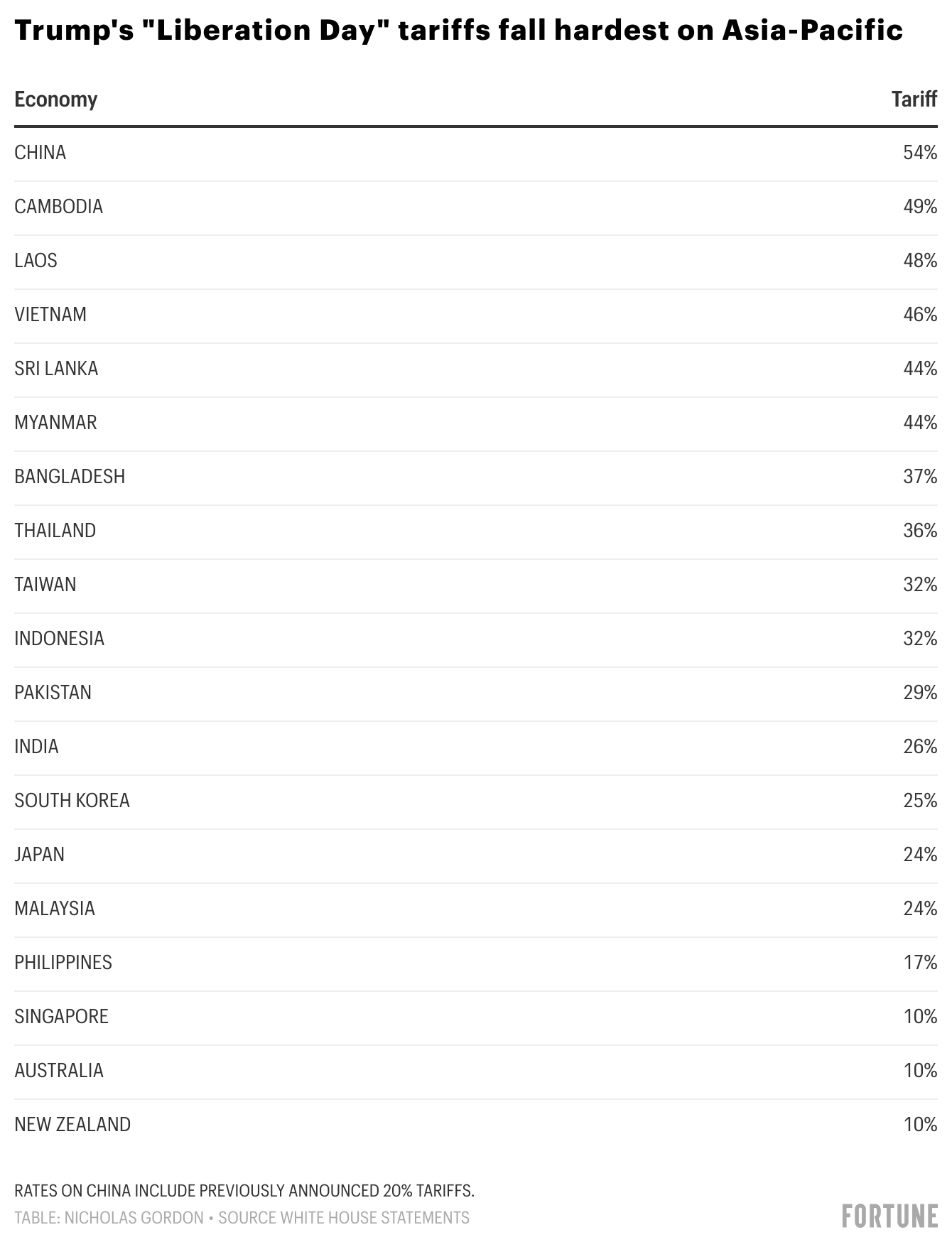
The tariffs are especially steep in Asia, home to many of the largest exporters to the U.S. New tariffs across the region are far higher than the baseline 10% rate imposed on all U.S. imports. 

Japan, South Korea, and the island of Taiwan all got tariffs of around 25%. China, long the focus of Trump’s trade ire, got a new 34% tariff on top of existing 20% tariffs. And emerging manufacturing hubs—which often benefited from supply chains shifting away from China–were hit even harder, with Vietnam and Cambodia getting tariff rates of 46% and 49% respectively. 

“Asia is going to be hit hard,” Deborah Elms, head of trade policy at the Hinrich Foundation, a trade-focused think tank. “At these tariff rates, many firms will be uncompetitive. They may try to adjust and find new markets, but this takes time and money.”

How bad are the tariffs?

Ahead of “Liberation Day,” Asian governments tried to ward off high tariff rates. Some, like Vietnam and India, unilaterally offered tariff concessions or promised to increase their U.S. imports. Others, like Thailand and Malaysia, adopted a “wait-and-see” attitude, perhaps hoping that keeping a low-profile might spare them from Trump ire. And China angrily promised retaliation if the U.S. decided to hike tariffs further.

In the end, nothing governments tried made a difference. “Reciprocal tariffs seem to be entirely based on the size of the bilateral trade deficit in goods in 2024. It is not obvious that anything else made a difference,” Elms of the Hinrich Foundation notes. (The White House has confirmed that it based its tariff calculations on the bilateral trade deficit divided by total imports)

Major exporters to the U.S. were hit hard. Vietnam, a major beneficiary of the “China plus one” approach to supply chain diversification, gets a new 45% tariff rate, despite promises by the Southeast Asian country to slash its tariffs on U.S. goods. 

Cambodia, Laos, Bangladesh and Sri Lanka—all major textile exporters to the U.S., among other goods—all now have new tariffs upwards of 37%, with Cambodia getting the worst at 49%

“It’s especially hard on the developing markets in the region like Cambodia that are facing serious economic pressures,” Elm says.

Japan, South Korea and the island of Taiwan, which export cars, electronics, and semiconductors to the U.S., also face steep tariffs of around 25%. 

India, too, got slapped with a 26% tariff, despite reportedly being open to slashing its own tariffs and personal rapport between Trump and Prime Minister Narendra Modi. “This is much worse than what we had anticipated,” writes Suresh Ganapathy, head of financials research, India, for Macquarie Capital. 

The new tariffs on China put its rate close to the 60% level Trump promised during last year’s campaign. Goldman Sachs economists previously predicted that tariffs at that level could shave as much as two percentage points off of China’s GDP growth. 

Trump also ordered the end of the de minimis tariff exception for small-value packages, starting May 2. Chinese e-commerce platforms like Shein and Temu have used that exemption to ship cheap products to the U.S. Temu operator PDD Holdings, which trades on the Nasdaq, fell by 5% in aftermarket trading.

A few countries in Asia-Pacific were spared, relatively speaking. Australia, New Zealand and Singapore now only have a 10% tariff, the baseline level for all imports.

Still, Australia isn’t getting off easy: Canberra has already complained about Trump’s previous 25% tariffs on steel and aluminum, with prime minister Anthony Albanese calling them a form of “economic self-harm.” On Thursday, Albanese said the tariffs had “no basis in logic,” but held off on promising retaliatory measures. The country’s benchmark S&P/ASX 200 index fell by just under 1%.

How are countries responding?

China called on the U.S. to “immediately cancel” its tariffs and promised countermeasures. “History has proven that raising tariffs does not solve the U.S.’s own problems,” China’s commerce ministry said. 

While Beijing hasn’t yet stated how it might respond to Trump’s new taxes, it has previously slapped retaliatory duties on U.S. imports like oil, natural gas, heavy machinery and agricultural products. 

China has its own economic problems—namely, weak consumption. Officials have promised more mmeasures to boost domestic spending in response to trade disruptions. “It is possible that we might see China announce more fiscal stimulus in order to counteract perceived macro weakness, providing some relief to the markets and consumers,” writes Kai Wang, Asia equity market strategist at Morningstar. 

Japan called the tariffs “extremely regrettable” on Thursday, and said it would continue to urge Washington to grant the tariff exemptions. The government has previously said it would offer domestic support to businesses hit by the new tariffs.

South Korea held an emergency meeting soon after Trump’s tariff announcement. “As the global trade war has become a reality, the government must pour all its capabilities to overcome the trade crisis,” acting president Han Duck-Soo told officials Thursday.

Taiwan called the tariffs “highly unreasonable” and said it would start “serious negotiations” with the U.S. Fortunately for the island, semiconductors, a key export, were excluded from the reciprocal tariffs.

What happens next?

“Eye-watering tariffs on a country-by-country basis scream ‘negotiation tactic,’ which will keep markets on edge for the foreseeable future,” writes Adam Hetts, global head of multi-asset for Janus Henderson Investors. “Fortunately, this means there’s substantial room for lower tariffs from here.”

Elms, however, disagrees that countries have much room to maneuver. “As you cannot retroactively adjust your past trade balance, it’s not clear what factors might lead to a different outcome now,” she says. 

What’s clear is that governments across the Asia-Pacific are now in a new world—one without a clear leader on global trade. 

“Many of the trade agreements, bilateral and multilateral, that the U.S. had signed are all in shreds right now,” Cornell economist Eswar Prasad said Thursday in an interview with Bloomberg. “The reality right now is that it seems to be every country for itself.”

“This is a full-scale unraveling of the liberal international economic order,” says Amitav Acharya, an international relations professor at American University.

“No one knows how this will end.”
Join us at the Fortune Workplace Innovation Summit May 19–20, 2026, in Atlanta. The next era of workplace innovation is here—and the old playbook is being rewritten. At this exclusive, high-energy event, the world’s most innovative leaders will convene to explore how AI, humanity, and strategy converge to redefine, again, the future of work. Register now.
About the Author
Nicholas Gordon
By Nicholas GordonAsia Editor
LinkedIn iconTwitter icon

Nicholas Gordon is an Asia editor based in Hong Kong, where he helps to drive Fortune’s coverage of Asian business and economics news.

See full bioRight Arrow Button Icon

Latest in Finance

Finance
Lorem ipsum dolor sit amet, consectetur adipiscing elit, sed do eiusmod tempor incididunt ut labore et dolore magna aliqua. Ut enim ad minim veniam
By Fortune Editors
October 20, 2025
Finance
Lorem ipsum dolor sit amet, consectetur adipiscing elit, sed do eiusmod tempor incididunt ut labore et dolore magna aliqua. Ut enim ad minim veniam
By Fortune Editors
October 20, 2025
Finance
Lorem ipsum dolor sit amet, consectetur adipiscing elit, sed do eiusmod tempor incididunt ut labore et dolore magna aliqua. Ut enim ad minim veniam
By Fortune Editors
October 20, 2025
Finance
Lorem ipsum dolor sit amet, consectetur adipiscing elit, sed do eiusmod tempor incididunt ut labore et dolore magna aliqua. Ut enim ad minim veniam
By Fortune Editors
October 20, 2025
Finance
Lorem ipsum dolor sit amet, consectetur adipiscing elit, sed do eiusmod tempor incididunt ut labore et dolore magna aliqua. Ut enim ad minim veniam
By Fortune Editors
October 20, 2025
Finance
Lorem ipsum dolor sit amet, consectetur adipiscing elit, sed do eiusmod tempor incididunt ut labore et dolore magna aliqua. Ut enim ad minim veniam
By Fortune Editors
October 20, 2025

Most Popular

Finance
Lorem ipsum dolor sit amet, consectetur adipiscing elit, sed do eiusmod tempor incididunt ut labore et dolore magna aliqua. Ut enim ad minim veniam
By Fortune Editors
October 20, 2025
Finance
Lorem ipsum dolor sit amet, consectetur adipiscing elit, sed do eiusmod tempor incididunt ut labore et dolore magna aliqua. Ut enim ad minim veniam
By Fortune Editors
October 20, 2025
Finance
Lorem ipsum dolor sit amet, consectetur adipiscing elit, sed do eiusmod tempor incididunt ut labore et dolore magna aliqua. Ut enim ad minim veniam
By Fortune Editors
October 20, 2025
Finance
Lorem ipsum dolor sit amet, consectetur adipiscing elit, sed do eiusmod tempor incididunt ut labore et dolore magna aliqua. Ut enim ad minim veniam
By Fortune Editors
October 20, 2025
Finance
Lorem ipsum dolor sit amet, consectetur adipiscing elit, sed do eiusmod tempor incididunt ut labore et dolore magna aliqua. Ut enim ad minim veniam
By Fortune Editors
October 20, 2025
Finance
Lorem ipsum dolor sit amet, consectetur adipiscing elit, sed do eiusmod tempor incididunt ut labore et dolore magna aliqua. Ut enim ad minim veniam
By Fortune Editors
October 20, 2025
Rankings
  • 100 Best Companies
  • Fortune 500
  • Global 500
  • Fortune 500 Europe
  • Most Powerful Women
  • Future 50
  • World’s Most Admired Companies
  • See All Rankings
Sections
  • Finance
  • Leadership
  • Success
  • Tech
  • Asia
  • Europe
  • Environment
  • Fortune Crypto
  • Health
  • Retail
  • Lifestyle
  • Politics
  • Newsletters
  • Magazine
  • Features
  • Commentary
  • Mpw
  • CEO Initiative
  • Conferences
  • Personal Finance
  • Education
Customer Support
  • Frequently Asked Questions
  • Customer Service Portal
  • Privacy Policy
  • Terms Of Use
  • Single Issues For Purchase
  • International Print
Commercial Services
  • Advertising
  • Fortune Brand Studio
  • Fortune Analytics
  • Fortune Conferences
  • Business Development
About Us
  • About Us
  • Editorial Calendar
  • Press Center
  • Work At Fortune
  • Diversity And Inclusion
  • Terms And Conditions
  • Site Map
  • Facebook icon
  • Twitter icon
  • LinkedIn icon
  • Instagram icon
  • Pinterest icon

Latest in Finance

PoliticsGreenland
Trumps threatens to impose tariffs on countries ‘if they don’t go along’ with his Greenland takeover plans
By Daniel Niemann, Darlene Superville and The Associated PressJanuary 16, 2026
11 hours ago
Economyjerome powell
Republican lawmakers close ranks around Powell, who spent years building ties in Congress. ‘He gets in there, pets the dog, shoots the breeze’
By Joey Cappelletti, Christopher Rugaber and The Associated PressJanuary 16, 2026
11 hours ago
EconomyFederal Reserve
Bond yields jump after Trump hints Hassett won’t be named Fed chair as Wall Street sees hawkish Warsh having easier path to replace Powell
By Christopher Rugaber and The Associated PressJanuary 16, 2026
11 hours ago
AIOpenAI
ChatGPT tests ads as a new era of AI begins
By Sharon GoldmanJanuary 16, 2026
13 hours ago
trump
Politicsstudent loans and debt
As Trump throws a bone to Gen Z on student debt, watchdog calls it an ‘incoherent political giveaway,’ straight out of Biden’s playbook
By Nick LichtenbergJanuary 16, 2026
13 hours ago
AITech
Trump says he’ll make tech firms pay for power. They’d love to
By Michelle Ma, Alicia Tang and BloombergJanuary 16, 2026
14 hours ago

Most Popular

placeholder alt text
Economy
America’s $38 trillion national debt is so big the nearly $1 trillion interest payment will be larger than Medicare soon
By Shawn TullyJanuary 15, 2026
2 days ago
placeholder alt text
Europe
Americans have been quietly plundering Greenland for over 100 years, since a Navy officer chipped fragments off the Cape York iron meteorite
By Paul Bierman and The ConversationJanuary 14, 2026
3 days ago
placeholder alt text
Health
The head of marketing at Slate posted on LinkedIn requesting cleaning services as a benefit at her company. The next day, HR answered her call
By Sydney LakeJanuary 15, 2026
2 days ago
placeholder alt text
Politics
Anthony Scaramucci thinks Trump's 'hard-left' move to cap credit-card fees is because he's 'texting back and forth with Mayor Mamdani'
By Nick Lichtenberg and Eva RoytburgJanuary 16, 2026
18 hours ago
placeholder alt text
Politics
Ford CEO Jim Farley says the White House will 'always answer the phone,' but needs Trump to do more to curtail China’s threat to America's autos
By Sasha RogelbergJanuary 16, 2026
1 day ago
placeholder alt text
Politics
The Nobel Prize committee doesn't want Trump getting one, even as a gift—but they treated Obama very differently
By Nick LichtenbergJanuary 16, 2026
13 hours ago

© 2025 Fortune Media IP Limited. All Rights Reserved. Use of this site constitutes acceptance of our Terms of Use and Privacy Policy | CA Notice at Collection and Privacy Notice | Do Not Sell/Share My Personal Information
FORTUNE is a trademark of Fortune Media IP Limited, registered in the U.S. and other countries. FORTUNE may receive compensation for some links to products and services on this website. Offers may be subject to change without notice.