• Home
  • Latest
  • Fortune 500
  • Finance
  • Tech
  • Leadership
  • Lifestyle
  • Rankings
  • Multimedia
TechSamsung
Asia

Samsung’s chip division underwhelms in costly AI memory race

By
Yoolim Lee
Yoolim Lee
and
Bloomberg
Bloomberg
Down Arrow Button Icon
By
Yoolim Lee
Yoolim Lee
and
Bloomberg
Bloomberg
Down Arrow Button Icon
January 30, 2025, 10:53 PM ET
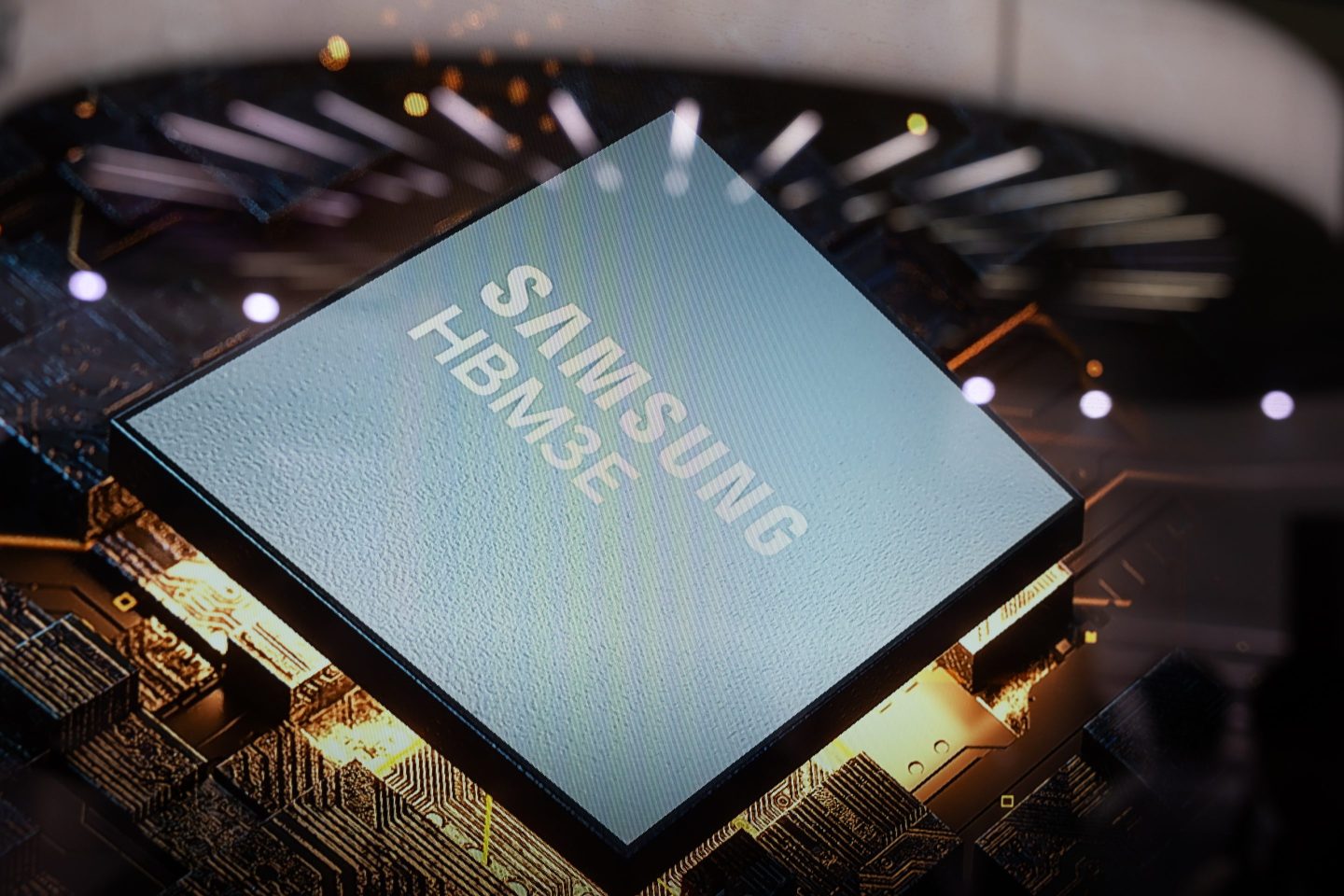
A Samsung Eletronics 12-layer HBM3E memory chip on a monitor at the Semiconductor Exhibition (SEDEX) in Seoul on Oct. 23, 2024.
A Samsung Eletronics 12-layer HBM3E memory chip on a monitor at the Semiconductor Exhibition (SEDEX) in Seoul on Oct. 23, 2024.SeongJoon Cho—Bloomberg via Getty Images

Samsung Electronics Co.’s pivotal chip division reported a smaller-than-expected profit as the company fights to close the gap on archrival SK Hynix Inc. in the artificial intelligence arena. 

Recommended Video

Samsung is ratcheting up its research and operating costs, with executives saying the spending on memory would stay at a similarly elevated level as last year. Total capital expenditures came to 53.6 trillion won ($37 billion) in 2024.

That push resulted in getting long-delayed approval for Samsung’s supply of 8-layer HBM3E — a less advanced variety of the high-bandwidth memory that SK Hynix supplies — from Nvidia Corp. for use with AI processors tailored for the Chinese market.

But the effort, along with exposure to legacy DRAM, is weighing on South Korea’s largest company. Samsung’s semiconductor unit reported operating profit of 2.9 trillion won ($2 billion) for the December quarter, missing analysts’ average projections. It also forecast limited earnings growth in the current quarter. The company’s net income came to a bigger-than-expected 7.58 trillion won ($5.23 billion), thanks to a boost from its network business.

The stock price of Samsung fell 2.4% on Friday, the first trading day in Seoul after the Lunar New Year holiday. SK Hynix shares dropped 9.9%, reflecting in part concern that DeepSeek’s low-cost AI would upend the entire premise of big spending on data centers and powerful chips.

Samsung executives said on Friday the company expanded its HBM3E supply to multiple providers of graphic processing units and datacenter customers in the fourth quarter. Still, U.S. export restrictions on AI chips will likely weigh on its first-quarter earnings before overall memory chip demand starts recovering in the second quarter.

“We expect a temporary constraint on HBM sales in the first quarter,” partly due to U.S. curbs as well as efforts to launch an improved version of its HBM3E chips, Kim Jaejune, executive vice president of Samsung’s memory business, said during an earnings call. “There’s been a shift among major customers who are opting to wait for enhanced HBM3E products, which may potentially result in a temporary gap in HBM demand.”

At CES earlier this month, Nvidia Chief Executive officer Jensen Huang said Samsung will have to engineer a new design. “But they can do it. They are working very fast. They’re very committed to do it.”

“We firmly believe that the current challenges can be resolved swiftly,” Chief Financial Officer Park Sooncheol said. “And by overcoming these challenges Samsung can enter a new phase of growth.” 

This year, Samsung will focus on cutting its exposure to conventional DRAM and NAND for PCs and mobile devices while chasing higher-margin arenas of server DRAM and HBM, where demand “remains strong,” executives said. It’s stepped up spending on research and development and front-end capacity expansion in its efforts to catch up with both SK Hynix and Micron Technology Inc. But the foundry business will remain weak, while mobile and PC demand will remain soft, they said. 

Its smartphones, TVs and other appliances are facing growing competition, the company said, with executives citing ongoing uncertainties and delays in economic recovery.

Investors remain concerned about Samsung’s ability to claw its way back into the market for high-bandwidth memory chips, designed to work with Nvidia’s AI accelerators. The company has struggled to get its latest products certified by Nvidia — providing an unusually long window for SK Hynix and Micron to carve out commanding leads in the booming HBM market.

Samsung has reorganized its team of engineers, hoping to reverse its market position with the next generation of HBM chips, or HBM4. Both Samsung and SK Hynix aim to become Nvidia’s main vendor for HBM4 chips as they work to mass-produce them in the second half of this year. 

“We still think that it is possible for Samsung to right the ship eventually in its HBM business and boost the country’s equity market, but a lot will hinge on its ability to achieve genuine commercial breakthroughs with the leading fabless AI names,” said Homin Lee, a Singapore-based senior macro strategist at Lombard Odier. “Time is running out as memory is becoming increasingly commoditized, with Chinese rivals catching up fast in the DDR5 segment despite export controls.” 

SK Hynix posted record quarterly income earlier this month, eclipsing Samsung’s operating profit for the first time. Hynix said HBM made up 40% of its overall DRAM chip revenue in the quarter and it expects HBM sales to more than double this year. 

In November, Samsung announced a plan to buy back about 10 trillion won of its own stock. Executives on the earnings call said the company is in the process of canceling some 3 trillion won of shares and it’s exploring the timing for the remaining 7 trillion won. 

Join us at the Fortune Workplace Innovation Summit May 19–20, 2026, in Atlanta. The next era of workplace innovation is here—and the old playbook is being rewritten. At this exclusive, high-energy event, the world’s most innovative leaders will convene to explore how AI, humanity, and strategy converge to redefine, again, the future of work. Register now.
About the Authors
By Yoolim Lee
See full bioRight Arrow Button Icon
By Bloomberg
See full bioRight Arrow Button Icon

Latest in Tech

Sarandos
Arts & EntertainmentM&A
It’s a sequel, it’s a remake, it’s a reboot: Lawyers grow wistful for old corporate rumbles as Paramount, Netflix fight for Warner
By Nick LichtenbergDecember 13, 2025
1 hour ago
Oracle chairman of the board and chief technology officer Larry Ellison delivers a keynote address during the 2019 Oracle OpenWorld on September 16, 2019 in San Francisco, California.
AIOracle
Oracle’s collapsing stock shows the AI boom is running into two hard limits: physics and debt markets
By Eva RoytburgDecember 13, 2025
2 hours ago
robots
InnovationRobots
‘The question is really just how long it will take’: Over 2,000 gather at Humanoids Summit to meet the robots who may take their jobs someday
By Matt O'Brien and The Associated PressDecember 12, 2025
15 hours ago
Man about to go into police vehicle
CryptoCryptocurrency
Judge tells notorious crypto scammer ‘you have been bitten by the crypto bug’ in handing down 15 year sentence 
By Carlos GarciaDecember 12, 2025
16 hours ago
three men in suits, one gesturing
AIBrainstorm AI
The fastest athletes in the world can botch a baton pass if trust isn’t there—and the same is true of AI, Blackbaud exec says
By Amanda GerutDecember 12, 2025
17 hours ago
Brainstorm AI panel
AIBrainstorm AI
Creative workers won’t be replaced by AI—but their roles will change to become ‘directors’ managing AI agents, executives say
By Beatrice NolanDecember 12, 2025
17 hours ago

Most Popular

placeholder alt text
Economy
Tariffs are taxes and they were used to finance the federal government until the 1913 income tax. A top economist breaks it down
By Kent JonesDecember 12, 2025
1 day ago
placeholder alt text
Success
Apple cofounder Ronald Wayne sold his 10% stake for $800 in 1976—today it’d be worth up to $400 billion
By Preston ForeDecember 12, 2025
21 hours ago
placeholder alt text
Success
40% of Stanford undergrads receive disability accommodations—but it’s become a college-wide phenomenon as Gen Z try to succeed in the current climate
By Preston ForeDecember 12, 2025
20 hours ago
placeholder alt text
Success
At 18, doctors gave him three hours to live. He played video games from his hospital bed—and now, he’s built a $10 million-a-year video game studio
By Preston ForeDecember 10, 2025
3 days ago
placeholder alt text
Economy
For the first time since Trump’s tariff rollout, import tax revenue has fallen, threatening his lofty plans to slash the $38 trillion national debt
By Sasha RogelbergDecember 12, 2025
16 hours ago
placeholder alt text
Economy
The Fed just ‘Trump-proofed’ itself with a unanimous move to preempt a potential leadership shake-up
By Jason MaDecember 12, 2025
14 hours ago
Rankings
  • 100 Best Companies
  • Fortune 500
  • Global 500
  • Fortune 500 Europe
  • Most Powerful Women
  • Future 50
  • World’s Most Admired Companies
  • See All Rankings
Sections
  • Finance
  • Leadership
  • Success
  • Tech
  • Asia
  • Europe
  • Environment
  • Fortune Crypto
  • Health
  • Retail
  • Lifestyle
  • Politics
  • Newsletters
  • Magazine
  • Features
  • Commentary
  • Mpw
  • CEO Initiative
  • Conferences
  • Personal Finance
  • Education
Customer Support
  • Frequently Asked Questions
  • Customer Service Portal
  • Privacy Policy
  • Terms Of Use
  • Single Issues For Purchase
  • International Print
Commercial Services
  • Advertising
  • Fortune Brand Studio
  • Fortune Analytics
  • Fortune Conferences
  • Business Development
About Us
  • About Us
  • Editorial Calendar
  • Press Center
  • Work At Fortune
  • Diversity And Inclusion
  • Terms And Conditions
  • Site Map

© 2025 Fortune Media IP Limited. All Rights Reserved. Use of this site constitutes acceptance of our Terms of Use and Privacy Policy | CA Notice at Collection and Privacy Notice | Do Not Sell/Share My Personal Information
FORTUNE is a trademark of Fortune Media IP Limited, registered in the U.S. and other countries. FORTUNE may receive compensation for some links to products and services on this website. Offers may be subject to change without notice.